History & heritage
In Sintra, a stay is never merely about checking into a hotel. It belongs to an older cultural landscape shaped by aristocratic retreats, wooded estates and a distinctive relationship between architecture, gardens and topography. Penha Longa Resort sits within that setting, on the edge of the Sintra Mountains, a territory whose reputation extends far beyond Lisbon’s coastal orbit. Here, history is felt less as staged heritage than as continuity of place: a way of inhabiting nature, preserving quiet and embedding hospitality within the landscape.
The contemporary resort, now affiliated with The Ritz-Carlton, belongs to this tradition of an out-of-town estate conceived as both retreat and gateway to the region. That affiliation brings the service culture and clarity expected by seasoned luxury travellers, without erasing what makes Sintra singular: misty hills, dense gardens, morning coolness and palaces emerging from the trees. Penha Longa is not an urban hotel transplanted into the countryside; it is better understood as a landscape retreat, where the experience depends as much on the setting as on the interiors.
In this part of Portugal, heritage is never merely decorative. It is tied to geography, to a tradition of pleasure residences and to a slower rhythm of movement between villages, viewpoints, convents, parks and historic houses. To stay here is therefore to take part in a story larger than any single address. The resort provides a base for reading the territory: guests return after excursions, recover a sense of calm and understand why Sintra has long attracted those seeking a different tempo from nearby Lisbon.
The luxury of Penha Longa lies precisely in this balance between local inheritance and contemporary standards. On one side, an environment recalling the great Portuguese estates, open to nature and made for walking; on the other, a hotel operation designed for present-day stays, whether centred on rest, cultural discovery or family holidays. That duality explains the property’s lasting appeal. It does not attempt to compete with Sintra’s historic palaces on monumental terms; it offers something else, more residential in spirit and broader in its relationship to the landscape.
For travellers, this heritage dimension is felt in the way the resort frames the discovery of Sintra. The hotel does not impose a theatrical narrative; it provides the conditions from which the region becomes legible. Castles, gardens and winding roads begin to make sense as part of a whole. One understands why this UNESCO-listed area continues to exert such fascination: it brings together nature, memory and architecture in a single movement. Penha Longa Resort belongs to that continuity with discretion, favouring the permanence of place over fashion. That is what gives it, beyond its five-star status, a convincing sense of timelessness.
The property
The defining quality of Penha Longa Resort is its relationship with the landscape. On the edge of Sintra, the hotel benefits from a peaceful natural setting that changes the very perception of a stay. Guests do not come here simply for a comfortable address near the major sights; they also come for air, scale and a sense of remove without true isolation. This location is one of its strongest assets: close enough for easy access to Sintra’s castles and gardens, yet sufficiently apart from the pressure and congestion that can affect the most visited sites.
The resort reads as a contemporary estate, organised around movement, views and repose. The wooded surroundings, the proximity of the Sintra Mountains and the quality of the air give the place a particular tone, almost seasonal in the way it reveals itself. In spring and autumn, when the light is softer and temperatures milder, the setting is especially rewarding; yet beyond those periods, the natural environment remains central to the experience. It shapes the day, encourages walking and looking outward, then invites guests back into the controlled comfort of the resort.
Its affiliation with The Ritz-Carlton is felt in the balance between scale and precision. Penha Longa is not a small hideaway but a fully fledged property able to welcome different kinds of travellers without losing coherence. Couples seeking rest, families alternating excursions with leisure time, international guests accustomed to contemporary luxury standards: all can find a stay that suits them. That versatility matters. It requires smooth organisation, well-conceived spaces and the ability to accommodate several rhythms within one address.
The overall atmosphere nevertheless remains serene, which is important in a destination as popular as Sintra. Where some hotels rely on heritage theatre or immediate proximity to the historic centre, Penha Longa favours a calmer relationship with the region. One can leave early for a palace visit, return for lunch or rest, then head out again to a garden or viewpoint in the late afternoon. The stay gains flexibility. The hotel becomes a genuine base rather than merely a place to sleep.
That idea of a base for exploration is essential to understanding the property. Sintra rewards discovery in successive layers: a castle in the morning, a garden in the afternoon, a scenic road, a village stop, then a return to quieter surroundings. The resort naturally supports that rhythm. Its position allows for both regional immersion and logistical ease, which matters greatly in a destination where movement can be slower than expected.
Ultimately, the property impresses less through spectacle than through the correctness of its proposition. It offers a luxury of context: a five-star resort in a protected natural environment, close to one of Portugal’s most distinctive territories. For travellers who want to experience Sintra without giving up space, calm and a well-structured service culture, it is a notably coherent address.
Rooms and suites
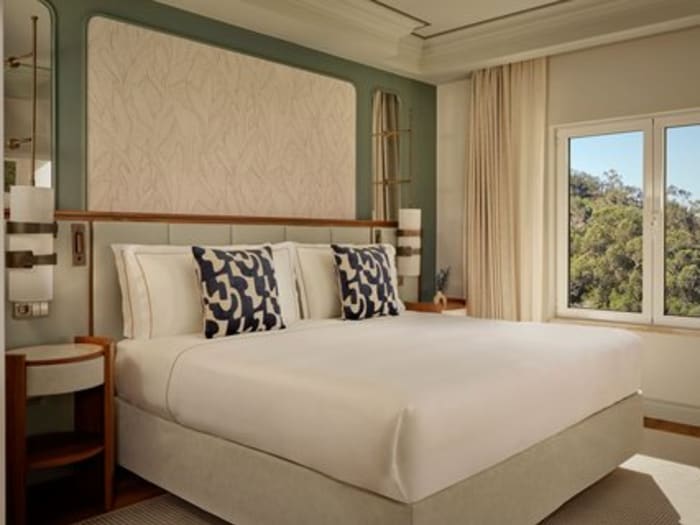
In a resort of this nature, the room is not merely a place to sleep. It acts as an interface between outdoors and privacy, between days of exploration and the quieter time of return. At Penha Longa Resort, that role is essential: after Sintra’s winding roads, palace visits, garden walks or excursions towards the coast, one expects a room to offer more than technical comfort. It should allow for genuine decompression, with a sense of space, light and continuity with the surroundings.
The overall spirit is that of a high-end international hotel, with all the clarity of planning and ease of use that implies. Travellers familiar with properties affiliated with The Ritz-Carlton will recognise the attention to balance: rooms designed to be immediately comfortable, suited equally to short stays and longer visits, and able to accommodate different guest profiles. That versatility matters in a resort welcoming both couples and families.
Quiet is particularly important here. The natural setting of the estate encourages a more composed experience, and the rooms extend that impression by offering a refuge after days spent exploring the region. In a destination as rich in visits as Sintra, the quality of a room is often measured by what it allows: slowing down, reading, sleeping deeply, planning the next day’s route or simply watching the light shift across the landscape. That ability to support the rhythm of travel is part of the property’s understated luxury.
For those seeking more space, the suites answer a different logic: that of a more residential stay. They are especially well suited to travellers who want to settle more fully into the resort, create longer periods of rest or enjoy additional room for life as a couple or with family. In a setting like Sintra, where one can easily be tempted to over-schedule every day, that extra space often changes the quality of the stay. It restores balance between exploration and retreat.
Part of the appeal of a five-star resort also lies in the service details surrounding the room. Here, daily housekeeping, turndown and the general organisation contribute to that sense of seamless continuity sought by demanding travellers. Nothing ostentatious: rather a series of attentions that make the stay smoother, more restful and more coherent. It is often in such discretion that the true quality of a hotel is measured.
For families, the presence of children’s areas and leisure activities gives accommodation another meaning. The room is no longer simply a stop between outings; it becomes the gathering point of a stay designed for several generations. For couples, by contrast, it can function as a cocoon from which to shape more contemplative days. This ability to respond to different uses without losing identity is one of Penha Longa’s strengths.
In short, the rooms and suites fully support the promise of the resort: to provide a comfortable, serene and well-orchestrated setting from which to discover Sintra in good conditions. They do not seek theatrical effect. Their role is more precise: to allow the traveller to feel immediately settled, protected from the pace outside and ready to enjoy a region that requires as much curiosity as availability.
Dining
In a destination resort, dining is a cornerstone of the stay. It punctuates departures, returns, and the overall perception of the place.
At Penha Longa Resort, this aspect is particularly significant as Sintra is best explored through excursions. One sets off early to visit a palace, returns after several hours of walking, and improvises a light lunch or a more leisurely dinner.
Thus, the establishment must offer a flexible dining experience that caters to these needs.
The natural setting plays a crucial role here. At the gates of the Serra de Sintra, meals fit seamlessly into the day. A breakfast before a visit, a lunch upon returning from a stroll, or a more tranquil dinner extends the experience of the stay.
In a five-star resort affiliated with The Ritz-Carlton, expectations span several dimensions: reliable execution, suitable timings, attentive service, and a menu capable of catering to varying desires throughout the day.
This is particularly important in an establishment that welcomes both couples and families. Some guests may seek a quieter dinner, while others appreciate a straightforward offering that can adapt to the pace of their journey.
The dining experience also serves as a transitional space. After visiting the palaces, gardens, and wooded vistas of Sintra, a meal provides a sense of stability. It is a time to gather, exchange thoughts on the day’s visits, and prepare for the adventures of the following day.
For travellers spending more time on-site, the culinary experience becomes even more pivotal. It should allow for a variety of atmospheres and accompany the different phases of the stay.
At Penha Longa Resort, dining embodies a comprehensive hospitality. It enhances the comfort of the venue, supports the discovery of Sintra, and contributes to a seamless experience. In a region where visitors come to see so much, it is invaluable to have the opportunity to unwind as well.
Concierge & Services
The quality of a grand resort is often measured by what is not immediately visible. Beyond the location, rooms, or atmosphere, the services determine the fluidity of the stay. At Penha Longa Resort, this aspect is particularly important as Sintra requires a certain orchestration. With the timing of visits, travel durations, fluctuations in crowds, and the need for rest periods, the experience benefits from methodical support. This is where an efficient concierge service truly shines.
The presence of a 24-hour concierge and a continuously open reception sets the tone from the outset. For international travellers, late arrivals, early departures, or last-minute adjustments, this availability provides genuine comfort. It is not merely a standard expectation in a five-star establishment; it becomes a tangible tool for making the stay more flexible. In a region like Sintra, where one may wish to leave early to avoid crowds, return at varying times, or organise a day based on the weather, this flexibility is invaluable.
The role of the concierge extends beyond simple logistics. In a resort designed as a base for exploration, it helps prioritise desires, construct realistic itineraries, and avoid missteps. Not all travellers approach Sintra in the same way; some prioritise monuments, while others prefer gardens, walks, or outdoor activities. Being able to rely on a team that can guide, confirm reservations, or suggest a coherent order of visits significantly enhances the quality of the stay. Here, advice often holds as much value as execution.
Daily services also contribute to this impression of a well-managed continuity. Daily housekeeping, evening turndown, luggage storage, laundry, or wake-up calls may seem secondary when considered in isolation. Together, however, they form a foundation of discreet comfort. They allow for lighter travel, adaptability to a packed schedule, a tidy room after a long day, and the freedom to focus energy away from logistics.
For families, this organisation holds particular value. Stays with children often require more anticipation, flexibility, and responsiveness. The fact that the resort offers dedicated spaces for children and leisure activities aligns with this same service ethos. Everyone can thus experience the place at their own pace. Parents can alternate between exploration and simpler moments on-site without losing coherence. For couples, the quality of service often translates into an almost invisible ease, allowing for complete relaxation.
Finally, the multilingual staff adds an essential dimension in an internationally oriented establishment. It simplifies communication, reassures, and makes personalised assistance feel more natural. In luxury hospitality, the precision of service does not solely rely on availability; it also depends on the quality of listening and the ability to immediately understand expectations.
At Penha Longa Resort, the services do not seek to be ostentatious. Their strength lies in their discretion, consistency, and ability to support a demanding stay without ever becoming burdensome. It is this silent mastery that allows the traveller to focus on what truly matters: enjoying Sintra, the estate, and the time regained.
The Sintra way of life
Staying at Penha Longa Resort also means adopting, for a few days, a certain way of living Sintra. The region is not discovered like a capital city or a seaside resort. It requires a more nuanced, almost literary approach: accepting detours, working with the terrain, leaving room for the unexpected and understanding that its beauty lies as much in the atmosphere linking its monuments as in the monuments themselves. In that respect, the resort plays a valuable role, because it allows guests to enter Sintra without being wholly subjected to its touristic intensity.
The local way of life begins with the landscape. The UNESCO-listed Sintra Mountains are not merely a backdrop; they shape movement, light, vegetation and even the rhythm of the day. One moves from a castle to a garden, from a shaded road to a viewpoint, from a historic house to a quieter village. Such variety calls for a certain openness. One must be willing to leave early, stop when a view demands it and return later to a site first seen too quickly. Here, luxury is not only material comfort; it also lies in the possibility of taking one’s time.
From Penha Longa Resort, that relationship with time becomes more natural. Guests can organise visits without haste, always with the prospect of returning to calm. This is a decisive advantage in a destination where crowd levels can sometimes blur the experience. Staying in peaceful surroundings, close to the major sites without being in the middle of their bustle, restores the quality of attention that Sintra fully deserves. One looks more carefully, walks more and feels less compelled to tick everything off than to see properly.
The Sintra way of life also rests on the alternation between culture and nature. Few destinations offer such a density of castles and gardens within such a distinctive environment. Visits are never purely monumental; they unfold within parks, slopes, avenues and openings onto the horizon. This continuity between built form and vegetation explains much of the local charm. It encourages less linear days, in which one moves naturally from interior to walk, from room to terrace, from a celebrated site to a quieter moment.
For families, Sintra can become a particularly vivid field of discovery, provided its rhythm is respected. Children find space, relief, gardens and perspectives that make visits less abstract. The resort, with its dedicated children’s areas and leisure activities, helps preserve that balance between curiosity and relaxation. For couples, by contrast, the region offers ideal material for a more contemplative stay, made up of early departures, unhurried returns and evenings extended in the quiet of the estate.
Ultimately, the Sintra way of life is not about accumulating iconic images, but about understanding the place’s sensory logic. Penha Longa Resort supports that approach particularly well. It allows the region to become something more than a day trip from Lisbon: a genuine stay, with pauses, temporary habits and its own tempo. That is perhaps the best way to approach Sintra today: not in the urgency of a checklist, but in the quality of presence.
Book via MyConciergeHotel
Booking the Penha Longa Resort through MyConciergeHotel means approaching your stay as a carefully curated experience. In Sintra, this methodology makes a significant difference. The region may seem close to Lisbon, yet it operates on its own terms: topography, traffic, seasonality, and popular sites all play a role. Days can fill up quickly without a modicum of foresight. Editorial and concierge support helps to ensure a smoother stay.
The first advantage lies in understanding the location. The Penha Longa Resort is not an interchangeable address. It caters to travellers who wish to blend cultural exploration, natural surroundings, and the comfort of a luxurious five-star resort. Booking with MyConciergeHotel allows you to position the establishment within your travel plans: whether it's a romantic getaway, a family break, a longer stay around Sintra, or a high-end stop on a Portuguese itinerary. This contextualisation aids in selecting a room as well as determining a suitable pace for your stay.
The second advantage pertains to organisation. It is advisable to book outdoor activities in advance, especially during peak season. This principle applies more broadly to the entire experience in Sintra. Some days benefit from being planned ahead of time. This helps to avoid downtime, unnecessary detours, and the busiest time slots. Reservation assistance helps to articulate priorities: which sites to visit first, how to incorporate rest periods, when to enjoy the resort more, and how to consider the weather or the composition of your party.
For families, this preparation is particularly beneficial. The Penha Longa Resort features dedicated spaces for children and leisure activities. These options should be integrated into the stay to alternate between visits and simpler moments on-site. For couples, the focus often shifts. The aim is to maintain a sense of lightness, avoid overly packed days, and leave room for spontaneity. In both cases, personalised advice allows for adjustments to the trip according to your actual expectations.
Booking via MyConciergeHotel also means benefiting from a rigorous editorial approach. We prioritise addresses that make sense within their destination. The Penha Longa Resort offers a genuine way to experience Sintra: in tranquillity, amidst nature, while remaining close to the region's castles and gardens. Our role is to help you make the most of this setting, depending on your travel season, length of stay, and style of exploration.
Finally, booking with MyConciergeHotel means choosing a form of peace of mind in advance. In luxury hospitality, comfort often begins before arrival. It arises when the broad outlines of your stay are clear, priorities are established, and the choice of address is coherent. In Sintra, this preparation is particularly valuable. It allows you to experience the Penha Longa Resort as the gravitational centre of a successful stay.