Palais Faraj Fez: a vantage point above the medina
In Fez, some hotels are understood through their inner courtyard, others through their address within the dense fabric of the medina. Palais Faraj is read differently. Its true landmark is height. What sets the property apart is not only its five-star status and Palace distinction, but the way it opens the city from a terrace that alters one’s sense of Fez. In a place so often experienced at street level, among lanes, gates and courtyards, elevation is not incidental: it offers another urban reading, almost a sensitive map of the medina.
The name many travellers search for, palais faraj suites & spa, suggests a stay where architecture, hospitality and outlook form a coherent whole. In Fez, a grand hotel is rarely defined by its façade alone. It is measured by how it settles into the old city, and by its ability to create calm without severing ties with the destination. Palais Faraj belongs to that category of addresses that provide retreat without erasing place. One does not come here to withdraw from Fez, but to observe it with greater depth.
The terrace, often central to searches for palais faraj fez or palais faraj restaurant, plays a defining role. From this elevated position, the city unfolds in layers: rooftops, minarets, walls, circulation lines and distant relief. As the light softens, Fez becomes not only a labyrinth but a landscape. That shift is one of the rare privileges of an address set above the medina. It lends the stay an almost contemplative quality while preserving the city’s cultural density.
The official hotel classification places the property at the highest end of the market, with five stars and Palace distinction. In the context of Fez, this establishes a precise level of expectation: continuous service, attention to detail, spaces designed for comfort, and a certain sense of arrival, rhythm and discretion. This framework does not say everything, but it clarifies the nature of the address. This is not merely a refined version of a traditional riad; it is a broader, more hotel-like interpretation of the city’s hospitality.
For first-time visitors, such positioning is especially valuable. The medina can impress through its density, soundscape and complex circulation. Returning to a place that offers air, space and an open view changes the way the destination is lived. For those who already know Fez, the pleasure is different: it lies in rereading a familiar territory from a wider, almost panoramic perspective. In both cases, Palais Faraj Fez stands out less through display than through the intelligence of its setting.
Palais Faraj restaurant: rooftop dining, garden atmosphere and the flavours of Fez
If the hotel’s public identity had to be distilled into one precise image, it would be its rooftop restaurant. The Michelin Guide documents it clearly: an elevated table, a garden-like atmosphere and wide views over Fez. In a city where dining is often associated with the intimacy of courtyards, this open horizon creates a very particular effect. One dines not enclosed within décor, but in conversation with the city itself. For travellers searching palais faraj restaurant, palais faraj fez restaurant menu or palais faraj menu, this is where the property’s singularity is most clearly expressed.
L’Amandier & Roof Top Garden is presented as refined Moroccan-Mediterranean cuisine, paired with notable Moroccan wines. That positioning is compelling because it avoids the easy opposition between local tradition and international register. It suggests dialogue instead: the flavours of Fez are framed within a broader Mediterranean sensibility, with attention to pairing and the rhythm of the meal. Michelin, moreover, refers to eclectic flavours of Fez, an apt phrase for a city whose cuisine has long drawn on multiple influences.
The rooftop is not merely an advantageous setting. It changes the very temporality of dinner. In late afternoon, the terrace acts as a belvedere from which to grasp the city’s relief. Then the light recedes, the volumes simplify, points of illumination emerge across the medina, and the meal shifts in tone. This movement from panorama to intimacy is one of the great strengths of elevated dining when well conceived. Here, the garden atmosphere noted by Michelin adds a vegetal softness to the mineral presence of the old city.
The food and drink offering extends beyond a single stage. The Golden Bar, described as a place for a drink with a view above the medina, continues this idea. The image of an illuminated classic liner hovering over the ancient city suggests the intended mood: not noise, but a hushed theatricality, almost cinematic. In Fez, where days quickly fill with visits, walking and sensory discovery, having a bar in which simply to slow down before the landscape is no minor detail.
Those comparing the city’s leading addresses often seek not an abstract ranking but a tone. Palais Faraj’s tone, in culinary terms, lies in this unusual combination: Moroccan-Mediterranean cuisine, Moroccan wines, and above all a direct relationship with the view. In Fez, that matters. The city is so dense and inward-looking that a terrace dinner acquires an almost geographical dimension.
Suites, rhythm and retreat: the spirit of Palais Faraj Suites & Spa
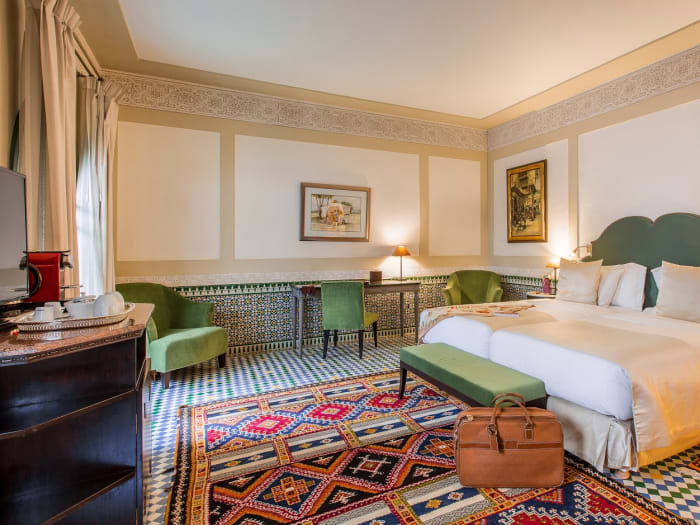
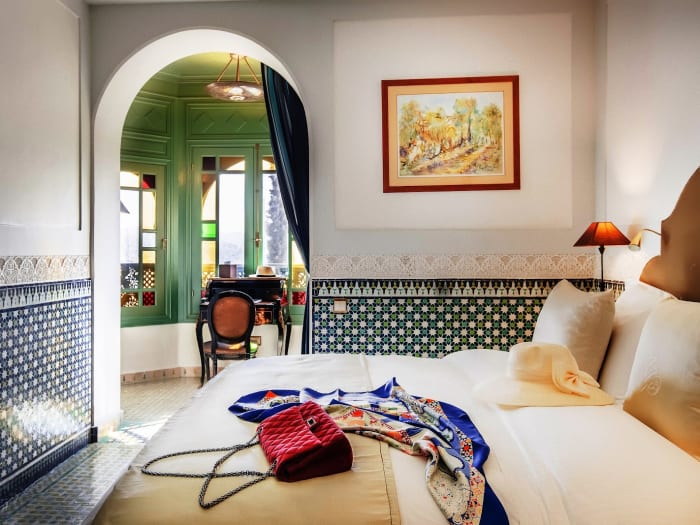
The name palais faraj suites & spa immediately suggests an experience centred on space and retreat. In Fez, that promise has particular meaning. The old city constantly solicits attention: lanes narrow, workshops open onto the street, sounds overlap, scents shift at every turn. In such a context, the room is not merely a place to sleep. It becomes an instrument of balance, a necessary counterpoint to the intensity outside. That is where the idea of a suite becomes especially relevant: not simply more square footage, but a more flexible way of inhabiting the stay.
In a grand hotel in Fez, one expects rooms to offer more than standardised comfort. They must create a transition between city and rest, between discovery and silence. The five-star classification and Palace distinction establish that level of expectation. This implies a certain relationship to bedding, daily housekeeping, turndown service, discreet interventions and the overall sense of continuity. Even when every decorative detail is not foregrounded, the essential quality often lies in rhythm: being able to leave early for the medina, return at midday, go out again, and find in the evening a space prepared for rest.
The term riad fès naturally evokes the charm of traditional houses, their inwardness, coolness and relationship to the courtyard. Palais Faraj belongs to that wider imagination of Moroccan hospitality, but in a broader and more hotel-like version. Travellers choosing an address at this level usually seek a synthesis: the feeling of being in Fez rather than in an interchangeable hotel, while enjoying fluid, legible comfort. Suites answer that expectation when they allow one to slow down, read, take tea, prepare for an evening on the terrace or simply let the city settle.
For travellers comparing the city’s emblematic addresses, the question is not really which is the most beautiful riad in Morocco. The real issue is the fit between an address and a way of travelling. Palais Faraj will suit those who want to combine Fez’s patrimonial intensity with a sense of distance, generous comfort and panorama.
24-hour concierge and service: the discreet mechanics of a Palace in Fez
In great hotels, service is never merely a list of facilities. It is an invisible infrastructure that makes a stay feel fluid. At Palais Faraj, several concrete elements define that discreet mechanism: 24-hour concierge, 24-hour front desk, daily housekeeping, turndown service, luggage storage, laundry, wake-up service and multilingual staff. Taken separately, these are familiar to high-end hospitality. Taken together, and placed in the context of Fez, they matter differently.
The medina of Fez is not a destination one moves through like an ordinary district. It requires organisation, flexible timing and sometimes last-minute adjustments. Leaving early to visit, returning later than expected, arranging an early departure, asking for logistical help, collecting luggage after a final lunch: all this belongs to the real quality of a hotel. In a city this dense, continuity of service matters more than elsewhere. A 24-hour front desk is not only a standard; it is a form of stability in an environment where days can be long and bearings shift.
The concierge, above all, plays a decisive role in a patrimonial destination. Travellers often have practical questions: whether the Royal Palace can be visited, what to prioritise in the city, how to organise a day without scattering it. A good concierge does not turn such requests into generic tourism. The role is to translate them into rhythm, sequence and advice suited to the traveller’s time and energy.
Fez as backdrop: safety, gates, palaces and the city’s art of living
Staying at Palais Faraj also means entering Fez from a particular angle. The city prompts recurring questions: is Fez safe, what should one prioritise, can the Royal Palace be visited, how should one read the city’s gates and thresholds? Such questions reveal the nature of the destination: a historic, dense and compelling city that can impress as much as it attracts. A grand hotel therefore does more than accommodate; it helps one read the city more accurately.
On safety, the most useful answer remains one of ordinary travel sense. Fez is a major cultural destination, lively and well visited, best navigated with clear bearings, attention to one’s belongings, sensible timing and recourse to the hotel’s assistance when needed. For many travellers, the feeling of being well supported changes everything. This is where a structured address, with continuous concierge and reception, provides practical reassurance.
The Royal Palace is often asked about because the word palace runs through the city’s imagination. Its monumental gates and institutional status make it a symbolic landmark, approached and admired from outside rather than experienced as a conventional interior visit. That distinction matters, because Fez is discovered less through a checklist of spectacular sites than through an understanding of thresholds, façades, perspectives and districts.
That is where Palais Faraj’s art of living becomes meaningful. The hotel is not simply an external observation post. It acts as a frame and an echo chamber, allowing one to enter Fez without being overwhelmed by it.
Palace, riad, hotel: a certain idea of heritage in Fez
In Fez, words matter. Riad, palace, medina, ramparts: each carries an urban history and a way of dwelling. When an address is called Palais Faraj, it immediately enters that imagination of the noble residence, representational architecture, and the relationship between inwardness and outlook. In this city more than in many others, hospitality cannot be separated from a culture of building. Even without unfolding a precise chronology, one understands that such a place dialogues with an older tradition: grand houses, hierarchical layouts, reception spaces and terraces as breathing points above dense urban fabric.
Fez has long been understood as a city of learning, trade, spirituality and craftsmanship. Its heritage does not lie only in isolated monuments but in an exceptional urban continuity. To stay in a hotel that assumes the vocabulary of a palace is therefore to enter that continuity, at least symbolically. The interest of a contemporary grand address lies in holding heritage and present-day use together: comfort, service, dining and the international rhythm of travel.
The distinction between a riad and a palace-hotel is revealing here. The former often suggests domestic scale and courtyard intimacy; the latter implies broader composition and a more theatrical relationship to space. Palais Faraj appears to belong to this second family while preserving what makes Fez so compelling: the sense that architecture protects, filters and orders the outside world.
Spa and wellbeing: a necessary counterpoint to the intensity of Fez
The name palais faraj suites & spa places wellbeing at the heart of the property’s identity, and in a city like Fez that is far from incidental. Here, the day engages the body as much as the mind. One walks extensively, often on irregular routes; one moves between cool interiors and more exposed spaces; one crosses dense, sonorous, highly animated sequences. In that context, the spa is not merely an amenity. It becomes a counterpoint, almost a necessity of rhythm.
The fact that an address couples suites and spa in its name suggests a promise of structured retreat. One does not come only to sleep and dine, but also to recover, slow down and regain a certain inward availability. In Fez, that matters. The city rewards attention, but it can also exhaust it if visits are chained together without pause. The spa then becomes a transition between exploration and assimilation.
In luxury hospitality, the best wellbeing spaces do not always seek to impress through scale. They seek accuracy: calming light, simple circulation, a sense of coolness, controlled gestures and preserved quiet. In a heritage destination, such restraint is often preferable to effect.
Booking Palais Faraj: choosing an address rather than simply a hotel in Fez
Booking Palais Faraj is not simply reserving a room in a five-star hotel in Fez. It is choosing a particular way of entering the city. For many travellers, the search begins with direct phrases — palais faraj contact, palais faraj suites & spa, palais faraj fez, palais faraj price — and then broadens into comparisons with other known addresses. That movement is natural. It reflects less hesitation than a wish to find the right tone of stay. In Fez, that nuance matters, because not every beautiful address tells the city in the same way.
Palais Faraj will suit those who value outlook, breathing space and the ability to connect the intensity of the medina with a structured place of retreat. The rooftop, documented by the Michelin Guide, is not a secondary advantage; it summarises a philosophy of stay. One discovers Fez at ground level, then rereads it from above.
Choosing such an address also makes sense for travellers who want a clear service framework. The Palace distinction and five-star classification establish a precise level of expectation. In Fez, where days can be as rich as they are demanding, that clarity has real value.