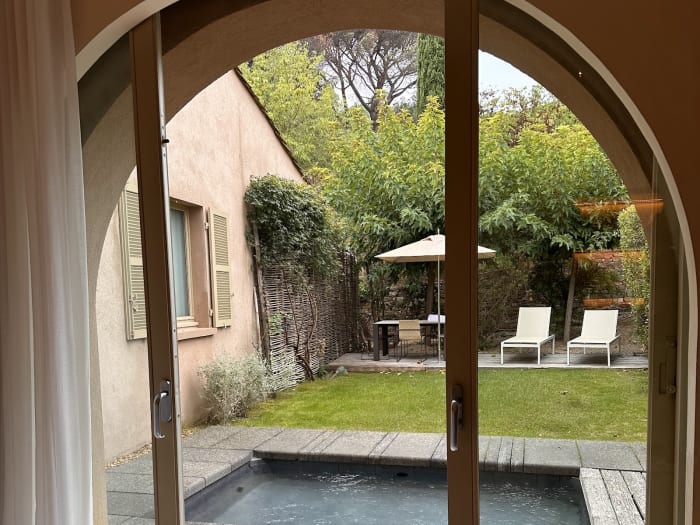
History & spirit of the house
In Saint-Tropez, hotel history is not written solely through grand façades facing the harbour or legendary addresses that accompanied the transformation of a fishing village into a summer capital. It is also shaped by more discreet houses, conceived for guests seeking not display but a precise art of hospitality. MUSE Saint-Tropez belongs to this contemporary reading of Tropezian luxury: a luxury of retreat, chosen rhythm, attentive service and comfort without stiffness. Its membership of Small Luxury Hotels of the World immediately places it within a family of intimate properties where character matters as much as standards.
This is not a historic palace in the heritage sense, but rather an address that reflects the evolution of Saint-Tropez itself. Since the second half of the 20th century, the peninsula has drawn artists, sailors, hedonists and international travellers in search of light, freedom and a Mediterranean sophistication difficult to reproduce elsewhere. Over time, that energy has become more nuanced. Alongside the bustle of the port, the beaches and summer nights, another demand emerged: for more private spaces able to offer proximity to Saint-Tropez without constant immersion in its intensity. It is in that balance that MUSE finds its place.
The hotel’s name suggests less a décor than a state of mind. It evokes inspiration, breathing space and a parenthesis in time. That tone is reflected throughout the property: contemporary lines, a carefully composed atmosphere, shared spaces designed with wellbeing in mind, and personalised service that favours relationship over protocol. In Saint-Tropez, where image can sometimes eclipse genuine experience, such an approach feels particularly relevant. It answers the expectations of guests who already know the destination, or who wish to discover it from a calmer base.
MUSE’s identity therefore rests on a form of quiet modernity. The contemporary here is not a fashionable gesture but a language: legible volumes, current design, fluid circulation and attention to everyday comfort. Luxury is measured by the quality of the welcome, the discretion of the staff and the ease with which a stay unfolds, from morning to a late return after dinner or an evening out. This philosophy suits a modern five-star hotel on the Côte d’Azur: less formal than a grand classic hotel, yet structured enough to meet the expectations of a demanding international clientele.
In that sense, MUSE Saint-Tropez says something accurate about contemporary Saint-Tropez. The destination remains tied to its myth, its glamour, its beaches and nightlife, yet it also knows how to welcome those who wish to experience the peninsula with greater measure. The hotel contributes to that evolution by offering a stay that gives up neither style nor service, while leaving room for relaxation, privacy and freedom of movement. That is perhaps its most meaningful legacy: not one of monumental history, but of a refined and distinctly current way of inhabiting Saint-Tropez.
The Establishment
Choosing MUSE Saint-Tropez means embracing a particular vision of the Tropezian experience: being close enough to the beach, restaurants, and nightlife while still retaining a sense of retreat. In a destination where distances can become complicated during peak season, this ease of access is invaluable. The hotel allows guests to enjoy Saint-Tropez without being overwhelmed by its relentless pace. It is a place to return to for tranquillity, a coherent aesthetic, and a more breathable rhythm.
The establishment stands out for its contemporary design. While some addresses on the Côte d’Azur lean heavily into a nostalgic Provençal style, MUSE adopts a more current and refined approach, without breaking away from the essence of Mediterranean leisure. This perspective shapes the overall experience, resulting in clear spaces, carefully chosen materials, tones that enhance light, and an impression of order and fluidity. The outcome evokes a controlled sophistication.
The communal areas, designed with well-being in mind, significantly contribute to this identity. They serve not just as transitions between the room and the outside world but become spaces where one can slow down, read, enjoy a drink, wait for a departure, or simply soak in the atmosphere. This focus on shared areas is particularly relevant in Saint-Tropez, where days often alternate between outings, beach time, shopping, meetings, and evenings out. Finding a calm and comfortable environment alters the perception of the stay.
MUSE's positioning also relies on personalised service. In a five-star establishment, this means less about the multiplication of spectacular effects and more about the ability to tailor the experience to concrete needs. Organising a late arrival, facilitating a reservation, recommending a beach based on the mood of the day, or ensuring a more leisurely pace. The hotel caters equally to couples and business travellers, implying a genuine flexibility in the use of spaces and in the support throughout the stay.
Finally, MUSE fully benefits from its Tropezian context. Saint-Tropez remains a place of contrasts: a village and an international stage, an ancient port and a global destination, bright days and lively nights. The hotel seems designed to navigate these contrasts with intelligence. It does not imitate local folklore nor does it seek to compete with the external hustle and bustle. Instead, it offers an elegant setting that allows guests to enter and leave the city at their leisure. It is this balanced relationship with the location that enhances its appeal.
Rooms and Suites
At MUSE Saint-Tropez, the room becomes the focal point of your stay. In Saint-Tropez, the rhythm alternates between beach, city, dinner, and nightlife. Rest and intimacy thus take on an essential role.
The contemporary design of the establishment suggests rooms and suites crafted for this purpose. They provide an elegant, calm, and comfortable base, suited to varied rhythms of life.
The contemporary decor, already evident in the communal spaces, finds its most tangible expression here. It is based on a balance of clean lines, soothing palettes, pleasant materials, and intuitive flow. A successful room on the Côte d’Azur welcomes light in a harmonious manner. It evokes a sense of holiday without clichés and maintains a genuine feeling of refuge.
Daily comfort often hinges on decisive details. Quality bedding, impeccable maintenance, a turn-down service, ample storage, and a relaxing atmosphere make all the difference. MUSE offers daily room service and a turn-down service, seamlessly accompanying the rhythm of your stay.
The suites cater to a desire for space and flexibility. They are suitable for couples, travellers who occasionally host guests, or those seeking a more residential setting. In Saint-Tropez, this aspect is particularly significant. A good accommodation should facilitate both the preparation for an active day and the pleasure of doing nothing.
Ultimately, the coherence between the room and the overall spirit of the hotel remains paramount. At MUSE, the ambience evokes contemporary serenity rather than ostentatious luxury. The rooms and suites extend this impression of refined seclusion, featuring a carefully curated aesthetic that is never intimidating. In Saint-Tropez, achieving the right interior reflects a discreet elegance. MUSE embodies this philosophy.
Dining
In Saint-Tropez, dining is an integral part of travel. It is experienced as much in the peninsula’s celebrated restaurants as in long terrace lunches, improvised post-beach meals, aperitifs that stretch into the evening and late dinners after the harbour. In that context, a hotel’s culinary offer is judged not only by technical ambition on the plate, but by its ability to accompany the real uses of the destination. For MUSE Saint-Tropez, whose brief emphasises elegance, wellbeing and personalised service, dining naturally forms part of a broader idea of comfort: offering moments that feel right for the Tropezian rhythm, in a setting coherent with the property’s contemporary identity.
Even without a detailed culinary signature, one can understand the role food and drink should play in a hotel of this level. In the morning, it begins with breakfast, which is never trivial on the Côte d’Azur. It is often the first true moment of the stay, the time when the day takes shape: beach, shopping, excursion, rest, lunch in town or a quieter afternoon. In an intimate hotel with attentive service, this moment gains in quality when it is delivered with flexibility, without stiffness, in an atmosphere that allows guests to settle in properly. Luxury here lies as much in pace as in content.
At lunchtime or for a light meal, the challenge is different. Saint-Tropez brings strong seasonality, summer heat and a way of life in which guests often look for fresh, legible dishes suited to days in motion. A good hotel table knows how to avoid excessive display in favour of precision: well-handled produce, an intelligently composed menu and attentive yet never intrusive service. In a house such as MUSE, one can easily imagine dining conceived as an extension of the wellbeing experience, with attention to lightness, freshness and ease of use.
In the evening, the hotel enters another temporality. Some guests will choose to go out and enjoy Saint-Tropez’s well-known restaurants; others will prefer to remain within the calmer setting of the property, especially after a full day or before a night out. This is where a five-star address must show flexibility: allowing for a more intimate dinner, a drink in an elegant setting, or simply efficient service for those wishing to preserve their energy. Personalised service becomes especially meaningful here, as expectations vary greatly from one traveller to another.
More broadly, dining in a hotel like MUSE should be understood as an art of accompaniment. It does not necessarily seek to outshine the Tropezian culinary scene, already rich and highly visible; rather, it should offer a credible, pleasant and well-executed culinary refuge. It is often this intelligence of positioning that distinguishes good hotels. In Saint-Tropez, where the external offer is abundant and sometimes theatrical, the ability to provide elegant, serene and stay-appropriate dining is a quality in itself. For travellers wishing to alternate between the outside world and inward comfort, that coherence between destination and house is invaluable. It allows them to enjoy the town fully while knowing that the hotel remains, at any moment, an address where one can also live very well.
Wellbeing & retreat
In Saint-Tropez, wellbeing is not limited to the spa in the strict sense. It lies in the way a stay is composed between energy and retreat, exposure and rest, sociability and privacy. This is why the wellbeing-focused shared spaces mentioned among MUSE Saint-Tropez’s highlights are especially meaningful. They suggest that the hotel does not merely provide elegant accommodation; it seeks to create an environment in which guests can genuinely recover, slow down and regain a sense of balance. In a destination as stimulating as the peninsula, that promise carries real weight.
Wellbeing in a contemporary hotel is often measured first by atmosphere rather than facilities. It begins with fluid circulation, controlled acoustics, spaces where one feels neither watched nor hurried, well-considered light, comfortable seating and that rare impression of being welcomed without being constantly solicited. MUSE appears to work precisely on that dimension. Luxury here is not conceived as an accumulation of signs, but as the ability to make a stay simpler, softer and more breathable. It is a demanding definition of comfort, particularly suited to guests who know the codes of high-end hospitality and expect more than a merely attractive décor.
Within that framework, moments of pause take on particular value. After a morning by the sea, a boat outing, a walk through the village lanes or a few hours spent in Tropezian bustle, returning to a place designed around wellbeing changes the quality of the trip. One is not seeking only physical rest; one is also looking to unload the visual and social intensity that often defines Saint-Tropez in season. Hotels that succeed in this transition are those that understand calm is not the absence of life, but an intelligent distance from commotion.
Personalised service plays a central role here. Wellbeing is never entirely standardisable, especially in a five-star property. Some travellers want a highly active stay punctuated by beaches, reservations and evenings out; others favour a more contemplative experience made of reading, long mornings and early returns. An attentive house knows how to adjust its recommendations, service rhythm and use of space to these differing expectations. The fact that MUSE suits both couples and business travellers reinforces the idea of adaptable wellbeing, one that does not rely on a single holiday script.
Finally, this dimension should be placed within the wider Côte d’Azur context. The region has long cultivated an image of sunny, festive and social resort life. Today, travellers often expect more: genuine rest, discretion and a calmer relationship with luxury. MUSE Saint-Tropez appears to answer that evolution through a wellbeing proposition integrated into the whole experience. Without resorting to inflated language, the hotel thus affirms an essential quality: that of being a place where one can not only stay, but also recalibrate. In a destination as coveted as Saint-Tropez, that ability to offer breathing space may be one of the most persuasive luxuries of all.
Concierge & Services
In a destination like Saint-Tropez, the quality of services significantly influences the fluidity of the stay. With late arrivals, early departures, and reservations to coordinate, a five-star hotel distinguishes itself by its ability to simplify organisation. MUSE Saint-Tropez offers a 24-hour concierge service and a reception that is continuously open. This aspect places the establishment within a framework of genuine availability, essential for an international clientele.
The concierge service goes beyond merely responding to occasional requests. It acts as a bridge between the client and the destination. In Saint-Tropez, this could mean recommending a restaurant, directing guests to a beach, organising a transfer, or facilitating a last-minute reservation. The personalised service at MUSE truly comes into its own here, requiring attentive listening, a good knowledge of the area, and the ability to suggest without imposing.
The house services further confirm this attention to detail. Daily housekeeping ensures consistent comfort, while the evening turndown service discreetly accompanies guests' return at night. The luggage storage is useful in a resort where transport schedules do not always align with check-in times. The laundry service caters to the needs of guests on extended stays or those mindful of their wardrobe during the busy summer season.
Other offerings, such as wake-up calls or the presence of multilingual staff, fall under the umbrella of functional luxury. They make the stay safer, clearer, and more comfortable. For a business traveller, this facilitates the organisation of a tight schedule. For a couple on a getaway, it allows them to delegate logistics and focus on the experience.
The services at MUSE Saint-Tropez embody a precise idea of contemporary luxury: being present without being intrusive, anticipating without rigidity, and accompanying without theatricality. In a city with a fast pace, this discreet assistance provides a welcome mental comfort, enabling guests to enjoy Saint-Tropez with greater freedom.
The Art of Living in Saint-Tropez
Staying at MUSE Saint-Tropez also means choosing a particular way to engage with the destination. Saint-Tropez is one of the most commented-on locations in the French Mediterranean. It is often reduced to its port, yachts, private beaches, summer nights, and boutiques. This image exists, but it does not tell the whole story. The Tropezian art of living also hinges on a unique light, the proximity of the sea, and the ability to swiftly transition from vibrancy to retreat. A hotel like MUSE, with its more serene positioning, allows for a more nuanced understanding of this experience.
The primary luxury of Saint-Tropez lies in making the most of time. Setting off early for the beach, returning for a quiet break, wandering through the streets at a gentler hour, or choosing dinner based on one’s mood. These simple decisions often define the quality of the stay. Easy access to the beach and proximity to nightlife make this flexibility possible. One can engage with the city's energy without being entirely at its mercy.
Saint-Tropez is also best explored on foot. By stepping away from the more obvious routes, one can rediscover its original scale. A quaint square, an ochre façade, a detail of shutters, a discreet café, a less prominent boutique. Even in high season, the village can sometimes feel legible, almost intimate. This pedestrian dimension greatly enhances the experience.
The local art of living also stems from the coexistence of multiple Saint-Tropez experiences. There is the version of the regulars, the newcomers, the sailors, the shopkeepers, and the long-time summer visitors. There are also the moments of returning from the market, the late afternoons, and the departures at sea. A good hotel does not impose a single narrative of the city; it helps navigate between these different registers. The personalised service at MUSE takes on a cultural as well as practical dimension here.
Thus, MUSE Saint-Tropez emerges as a relevant base for experiencing the peninsula without caricature. The establishment allows access to the beach, restaurants, and nightlife while providing a more serene counterpoint. It is often in this alternation that the best stays on the Côte d’Azur are born. In Saint-Tropez, where intensity is part of the scenery, this ability to create breathing space enhances the pleasure.
Book with MyConciergeHotel
Booking MUSE Saint-Tropez through MyConciergeHotel means approaching the stay with the right level of support from the outset. In a destination as sought-after as Saint-Tropez, where the summer season places heavy pressure on availability, transfers, beaches, restaurants and all related services, the quality of preparation matters almost as much as the quality of the hotel itself. A well-considered booking does not simply secure a room; it aligns the rhythm of the trip, the expectations of the stay and the very concrete realities of the destination.
MUSE appeals to guests seeking comfort, contemporary style, personalised service and smooth access to what Saint-Tropez offers at its most desirable: the beach, nightlife, notable addresses and the energy of the peninsula. This kind of hotel often calls for tailored preparation. A couple will not experience the stay in the same way as a business traveller, and a regular visitor to the Côte d’Azur will not have the same needs as a first-time guest. The value of an expert intermediary such as MyConciergeHotel lies precisely in the ability to qualify expectations in advance, so that the booking can be guided in a more relevant and efficient way.
In practical terms, that may mean choosing the right dates according to the atmosphere sought, anticipating peak periods, organising arrivals and departures more smoothly, or thinking about the stay as a whole rather than as a simple succession of nights. In Saint-Tropez, that broader view is invaluable. It helps avoid logistical friction that can quickly alter the experience, especially in high season. Booking early remains an essential recommendation if one wishes to enjoy the destination fully and preserve genuine freedom of choice.
Booking through MyConciergeHotel also means benefiting from an editorial reading of the property. MUSE is not simply another five-star address on the Côte d’Azur; it is a house that corresponds to a certain profile of traveller and a certain way of experiencing Saint-Tropez. Our role is to identify that fit. We favour hotels with a clear identity, real coherence between promise and experience, and the ability to offer more than a mere setting. MUSE answers that logic through its refined atmosphere, contemporary design, wellbeing-oriented spaces and sense of service.
Finally, booking with MyConciergeHotel means being able to rely on a more continuous relationship before, during and around the stay. In a destination where the right decisions are often made in the details — timings, reservations, pace, location, the balance between animation and calm — that support makes a tangible difference. It does not replace the hotel; it extends its intelligence. For a stay at MUSE Saint-Tropez, this approach is especially relevant. It helps transform a beautiful reservation into a well-constructed experience, faithful to what one comes to seek on the peninsula: style, fluidity and the rare feeling that everything is exactly in its place.