History & heritage
In Vichy, some addresses are best understood through their relationship with the town itself. Maison Decoret belongs to that rare category of hotels whose identity is shaped not only by décor or comfort, but by a way of inhabiting a place steeped in memory. In this spa town, with its Belle Époque façades, parks and grand urban perspectives, the property fits into a French tradition of refined, human-scale hospitality. Its Relais & Châteaux membership offers an immediate point of reference: a house where the experience rests as much on character and welcome as on the quality of the table.
The very name Maison Decoret suggests a residence rather than a standardised hotel. That distinction matters. The idea of a maison implies a more personal relationship to the stay, attention to the traveller’s rhythm, and a form of elegance that does not rely on display. One comes to Vichy for its thermal heritage, its walks and architecture, but also for the particular gentleness of towns long shaped by health cures and seasonal stays. Maison Decoret extends that spirit in a contemporary way: refinement here is not museum-like, but lived.
Vichy’s heritage is present in everything around the address. The town retains a distinctive silhouette of galleries, gardens, villas and buildings linked to spa culture. This context lends the stay unusual depth. It is not merely a gastronomic destination, nor simply a stop in Auvergne: it is a historic town shaped by care, promenade and seasonality. Maison Decoret finds its place within that continuity by offering an experience that combines calm, centrality and attention to detail.
The house is also best understood through the French tradition of properties where cuisine plays a structuring role. In many characterful addresses, the restaurant is not one amenity among others: it shapes the atmosphere, draws a loyal clientele and sets the rhythm of the day. Here, the commitment to local, seasonal produce places the hotel within a distinctly French lineage, where the art of hospitality is expressed through the plate as much as through the setting. That coherence between accommodation and gastronomy gives the whole a clear identity.
What stands out, finally, is the way Maison Decoret seems to favour lasting substance over effect. Nothing in the idea of the place calls for theatricality. Luxury appears here as a collection of right decisions: a peaceful address in the heart of town, an elegant yet welcoming mood, attentive service, and a table rooted in its region. At a time when so many hotels seek to impose an image, such restraint has real value. It allows the property to outlast fashion and remain legible for what it is: a characterful house in Vichy, designed for travellers who appreciate stays in which setting, cuisine and town form a single narrative.
The Establishment
Maison Decoret first captivates with a rare quality in the city centre: tranquility. This address enjoys a peaceful location in the heart of Vichy, allowing easy access to the main points of interest while maintaining a genuine sense of retreat.
The thermal baths, promenades, and architectural ensembles that contribute to the city's reputation are all within easy reach. At the end of the day, a more subdued atmosphere prevails, conducive to relaxation.
The establishment follows a principle of balance. Nothing appears ostentatious. Elegance is derived from a harmonious composition: welcoming volumes, well-maintained communal spaces, attentive decoration, and a muted tone.
This approach is particularly suited to Vichy, a city more about stays than mere transience. Maison Decoret is a place to inhabit for a long weekend or a gastronomic interlude.
The setting of Vichy plays an essential role here. Its thermal history and resort-style urban planning give it a distinctly identifiable character. The parks, avenues, Belle Époque buildings, and the general atmosphere invite exploration of the city on foot.
From the hotel, days naturally revolve around simple pleasures: a morning walk, visits to historic districts, a stop at the thermal baths, a pause in the gardens, and then returning home before dinner.
Inside, the spirit is that of a characterful address rather than a large, impersonal hotel. The warm welcome, discreet attention, and availability contribute to an overall elegant and calming tone.
This address is well-suited for couples on a getaway, gastronomy enthusiasts, and travellers seeking peace.
As a member of Relais & Châteaux, Maison Decoret embodies the character of the place, the care taken in hospitality, and the importance of the overall experience. Luxury here lies in the harmony between the address, the city, and how one engages with it.
One feels at just the right distance from the world—close enough to fully experience Vichy, yet protected enough to rest. Maison Decoret thus offers a central, peaceful, and embodied stay.
Rooms and Suites
At Maison Decoret, the room extends a certain idea of the stay. In this 5-star Relais & Châteaux address in the heart of Vichy, it is as significant as the rest of the experience.
The traveller seeks quality bedding and impeccable technical amenities. They also expect an atmosphere, intimacy, and continuity with the overall tone of the establishment.
The rooms are designed with a warm elegance in mind. They prioritise genuine rest over visual impact.
Comfort is found in discreet details: smooth circulation, well-balanced lighting, pleasant materials, careful soundproofing, and rigorous daily maintenance.
The turndown service and daily housekeeping confirm this attention to the rhythm of the stay. The hallmarks of great hotel comfort are present, but on a more personal scale.
The Vichy context adds a special dimension to the experience. After visiting the parks, Belle Époque architecture, or enjoying a thermal interlude, one appreciates an interior conducive to unwinding.
The room becomes a refuge between two highlights: discovering Vichy on one side and dinner on the other.
For couples, this quality is particularly important. The address is well-suited for romantic getaways, where the room serves as both a place for rest and a pause.
In French character hotels, the most appropriate rooms avoid standardisation without veering into eccentricity. Maison Decoret adheres to this principle, offering unique yet understated spaces.
The level of service reinforces this impression of controlled comfort. 24-hour reception, 24-hour concierge, luggage storage, laundry service, and wake-up calls facilitate the stay.
These services allow for a flexible arrival, a leisurely departure, and more freedom during the day. For a weekend in Vichy, the logistics remain unobtrusive.
The rooms and suites at Maison Decoret are envisioned as spaces for breathing. In a destination linked to care and slowing down, this function is particularly meaningful.
Here, the 5-star experience is also measured by the quality of rest. A well-maintained room, a fitting atmosphere, and discreet service give the stay its true character.
The Dining Experience
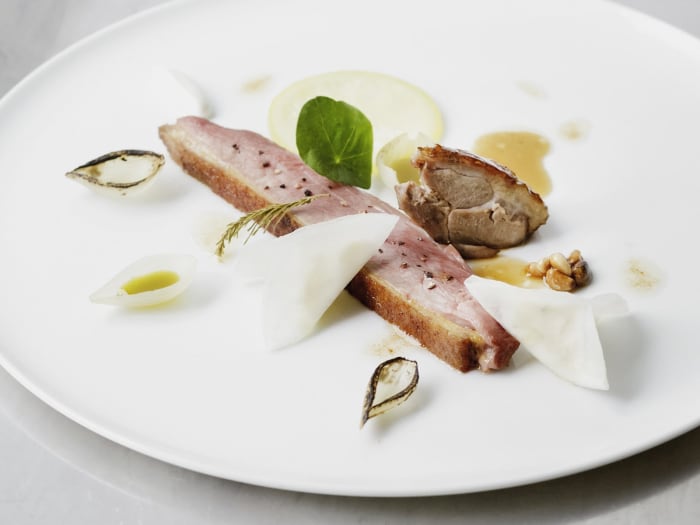
At Maison Decoret, gastronomy is one of the key reasons to choose this establishment. The cuisine is central to the experience, focusing on local and seasonal produce.
This approach places the hotel within a demanding culinary tradition. The dining experience reflects a specific territory, a seasonal calendar, and a mastery of techniques.
This philosophy entails a cuisine that is responsive to markets, producers, and the rhythm of harvests. It also requires adapting to what each season has to offer.
For the diner, this often translates into a sensation of precision. The dishes appear more coherent, the flavours more distinct, and the experience more rooted in a specific locale.
In Vichy, this approach takes on a particular significance. The city is synonymous with body care, health retreats, and a focus on well-being.
A restaurant that emphasises seasonality and quality ingredients naturally fits into this narrative. It maintains the sophistication expected of a five-star establishment.
The atmosphere of the house, elegant yet warm, also enhances the culinary experience. Service, setting, and dishes harmonise here without stiffness.
One can expect a dinner where attention to detail does not create distance. Refinement remains accessible.
Booking a table in advance is essential. The restaurant plays a central role in the overall experience of the stay.
Many travellers choose Maison Decoret for this culinary promise. The hotel seems to be organised around this commitment.
Beyond dinner, the gastronomic spirit influences the entirety of the experience. The discerning traveller will find a coherent destination here.
Maison Decoret offers more than just a stay in Vichy; it provides a way to experience the city through its cuisine.
Concierge & Services
In the realm of luxury hospitality, the most valuable services are not always the most visible. Maison Decoret exemplifies this perfectly. With 24-hour reception, 24-hour concierge, daily housekeeping, turndown service, luggage storage, laundry, wake-up calls, and multilingual staff, it offers a seamless hospitality experience.
The continuously open reception alters the relationship with time. In Vichy, it allows for late arrivals, early departures, or extending an evening without constraint. The stay adapts to the traveller, not the other way around.
The 24-hour concierge extends this logic. It facilitates reservations, taxis, visits, or strolls. It also helps guests make the most of Vichy with discretion.
Daily housekeeping and turndown service fall under a more intimate category. They ensure a well-kept room, ready to accompany the rhythm of the stay. These are discreet yet decisive attentions.
Luggage storage, laundry, and wake-up calls come into their own at the right moment. They allow guests to enjoy the city before arrival or after departure, providing practical comfort during a longer stay.
The multilingual staff deserves special mention. In a Relais & Châteaux establishment, this skill directly contributes to the quality of the welcome, enabling precise information, reassurance, and assistance.
Overall, Maison Decoret prioritises a hospitality of availability. Here, luxury is less about spectacle and more about the ease, calm, and freedom that the stay offers.
The Vichy way of life
Staying at Maison Decoret also means entering into a certain Vichy way of life. Few French towns possess an identity so immediately linked to the very notion of a stay. Vichy is not merely a destination; it is a way of occupying time. Its spa history, promenade-based urbanism, parks, Belle Époque façades and naturally gentler rhythm create a singular setting in which one rediscovers the pleasure of less saturated days. Thanks to its peaceful central location, the hotel allows guests to experience the town at its most fitting tempo.
Vichy’s first luxury is perhaps walking. The town lends itself admirably to moving about on foot, not out of necessity but for pleasure. One walks for the perspectives, the gardens, the architectural details and the gentle transitions between built spaces and green breathing room. From Maison Decoret, it is easy to imagine a day shaped not by touristic performance but by a sequence of chosen moments: stepping out in the morning, crossing a park, observing a façade, stopping for coffee, heading towards the baths or emblematic quarters, then slowly making one’s way back to the hotel.
Belle Époque architecture plays a major role. It gives Vichy an elegance of historic resort life that rests not only on a few monuments but on an overall urban atmosphere. Villas, public buildings, carefully composed alignments and spaces of sociability inherited from spa culture recall a France of seasonal stays in which care, display and leisure answered one another. For the contemporary traveller, this memory is not abstract. It can be felt in the way the town invites one to slow down, to look, and to take one’s place.
The thermal baths naturally form another centre of attraction. Even without detailing particular establishments or treatments, it is clear that Vichy remains associated with this culture of wellbeing and cure. In that respect, Maison Decoret appears to be a particularly convenient base. One can organise a stay around this dimension, whether in the form of a genuine restorative interlude or simply through the desire to reconnect with a town historically oriented towards care. This proximity between hotel, heritage and wellbeing gives the trip unusual coherence.
Yet the local art of living extends beyond baths and architecture. It also lies in a certain gentleness of habits. Vichy is a town where one can still attach importance to simple pleasures: reading in a park, extending an afternoon walk, dining without haste, watching the light change on façades. Maison Decoret, with its elegant and welcoming atmosphere, seems especially well attuned to that sensibility. It does not impose a programme; it offers a setting from which each guest may compose their own stay.
For couples, the town has a discreet yet genuine charm. It does not rely on spectacular exoticism; it offers something better, at times: a calm form of romance built on walks, gardens, dinners and the walk back to the hotel. For lovers of gastronomy, Vichy also becomes a contextual destination, where the table makes sense within a town historically devoted to the idea of staying. For travellers in search of rest, finally, it offers a valuable alternative to more agitated destinations.
That is perhaps what makes Maison Decoret particularly relevant here. The address does not seek to isolate the traveller from the place; it connects them to it. It allows Vichy to be experienced not as a fixed backdrop but as a complete experience made up of heritage, calm, taste and recovered time.
Book with MyConciergeHotel
Choosing Maison Decoret through MyConciergeHotel means giving an already distinctive address a booking framework equal to its singularity. Not all characterful houses are best reserved in the same way. Some require little more than a rate comparison; others, such as this one, benefit from a finer understanding of the stay one truly wishes to experience. In Vichy, between thermal heritage, Belle Époque promenades and a strong gastronomic promise, the success of a trip often lies in the harmony between the right moment, the right room and the right rhythm. That is precisely where editorial guidance and concierge support become meaningful.
Maison Decoret is not an interchangeable address. One does not choose it merely to sleep in the town centre, but for a precise combination: a five-star Relais & Châteaux house, an elegant and welcoming atmosphere, a peaceful location in the heart of Vichy, and a table that is one of the principal reasons for the stay. Booking with discernment therefore means thinking of the whole. Is the intention a primarily gastronomic weekend? A romantic escape with time for the baths and walks? A more contemplative pause centred on the town and its architecture? Depending on the answer, the way one organises the days changes, as does the value of arranging certain reservations in advance.
One of the most important points concerns the table itself. The Concierge’s advice is explicit: it is best to reserve the restaurant ahead of time. This recommendation is far from incidental. In a house where cuisine is a major distinguishing feature, failing to anticipate this moment would mean missing an essential part of the experience. MyConciergeHotel allows that logic to be integrated from the planning stage, so that arrival is devoted to pleasure rather than last-minute decisions.
Booking through MyConciergeHotel also means benefiting from a more qualitative reading of the address. Rather than reducing the hotel to a list of amenities, it is placed back in its real context: that of a spa town with remarkable heritage, a stay best experienced on foot, and a house where hospitality is expressed as much through calm and service as through gastronomy. This approach is particularly useful for travellers who do not yet know Vichy. It helps explain why the peaceful central location is so valuable, why the milder seasons are often the most pleasant, and why the address suits couples and lovers of fine dining especially well.
There is, finally, a dimension of trust in the act of booking. Travellers who choose houses such as Maison Decoret are rarely seeking a mere transaction. They expect selection, judgement and the ability to distinguish places with genuine personality from those that simply adopt an upscale positioning. MyConciergeHotel works within that logic of curation. The aim is not only to confirm a room, but to facilitate a stay that is more fitting, better prepared and more coherent with the traveller’s expectations.
In the case of Maison Decoret, that coherence is essential. The address reveals itself fully when one takes the time to articulate it with the town: a dinner reserved in advance, walks planned without excess, room left for spontaneity, and a peaceful return to the hotel. Booking through us means approaching Vichy not as a mere stopover, but as an interlude to be composed with care.
For travellers drawn to French character houses, seasonal gastronomy and towns best discovered slowly, Maison Decoret deserves that attentive preparation. MyConciergeHotel is here to make it simple, seamless and faithful to the spirit of the place.