History & Heritage
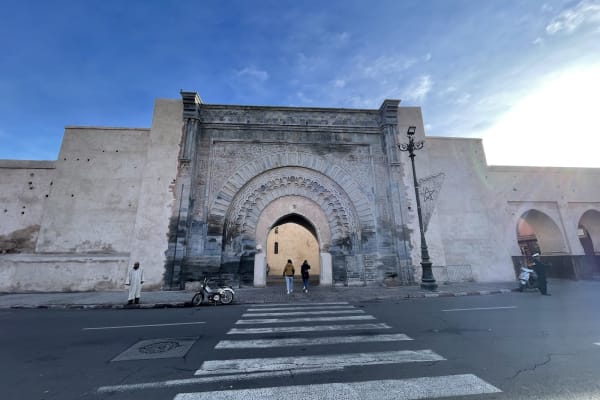
In Marrakech, history is intrinsically linked to that of the medina. The city was founded between 1070 and 1072 by the Almoravids and has since established itself as a significant political, economic, and cultural centre in the Muslim West.
This heritage is still evident in the urban fabric, the vistas, and the monumental landmarks. The Koutoubia Mosque is a testament to this foundational memory, reminding us of the power of a city envisioned early on as a capital and crossroads.
Today, the medina of Marrakech is a UNESCO World Heritage site. This recognition affirms a rare continuity between the historic city and contemporary life. Here, the past is not frozen; it remains visible, inhabited, and infused with ancient gestures and rhythms.
Among its most eloquent locations, the Jamaâ El Fna square holds a unique place. A true open-air theatre, it continues to captivate visitors. Its vibrant atmosphere extends a long-standing urban tradition where exchange, dialogue, and collective presence shape the identity of Marrakech.
Staying in the medina thus allows one to engage with a long history, still palpable at every turn—a narrative of a founding dynasty, of brilliance, and of permanence.
Architecture & Design
At Les Jardins de la Médina, architecture is first understood in the context of Marrakech itself. The city is part of an urban ensemble recognised as a UNESCO World Heritage site.
Founded between 1070 and 1072 by the Almoravids, Marrakech has emerged as a major political, economic, and cultural centre in the Muslim West. This historical depth gives context to the surroundings.
Within the medina, the built environment is never understood in isolation. It is part of a continuum of walls, courtyards, passages, and thresholds. The space prioritises intimacy, shade, and a sense of breathing.
This urban logic interacts with several monumental landmarks. The Koutoubia Mosque remains the most evident expression of this. Meanwhile, the Jamaâ El Fna square evokes the civic and vibrant dimension of the city.
To stay here is to inhabit an architecture that is primarily contextual—shaped by a long history, the density of the medina, and the Almoravid legacy.
Thus, the place occupies a rare heritage landscape, gaining presence through this historical proximity rather than mere effect. In Marrakech, architectural elegance often lies in this restraint.
The Experience of Staying
In Marrakech, architecture is first perceived as a living memory. The city, founded between 1070 and 1072 by the Almoravids, immediately imposes this depth.
Here, to stay means to immerse oneself in an ancient urban fabric, shaped by a long political, economic, and cultural continuity. This density lends a discreet gravity to the experience.
The eye adjusts to forms that belong to a significant history of the Muslim West. They are not merely decorative; they structure the experience.
The Koutoubia Mosque offers the clearest expression of this. Its presence calmly orders the horizon of Marrakech.
The Jamaâ El Fna square highlights another dimension of this architecture—one of a living space where the city composes its own theatre each day.
Classified as a UNESCO World Heritage site, Marrakech thus maintains a rare coherence. The built environment, the vistas, and the emblematic places all speak the same language.
In this context, the experience of staying takes on a particular tone. It resonates with a city where architecture is never isolated but is intertwined with the rhythm of daily life.
Wellness & Spa
Wellness here takes the form of a vast 3,000 m² garden, designed as a refreshing refuge in the heart of Marrakech. The experience begins outdoors, in a tranquil atmosphere enriched by vegetation and light.
The swimming pool naturally fits into this ensemble, providing a simple and soothing anchor for the day. It is a place to swim, slow down, or simply extend the silence of the garden.
The charm of the location lies in the direct relationship between water, shade, and space. The setting invites relaxation rather than demonstration. Everything seems arranged to allow the pace to slow down, without breaking the spirit of the house.
In an intense city, such an environment is invaluable. It allows for a form of immediate distance without leaving the hotel. Wellness is thus reflected in the volumes, in the presence of the garden, and in the pool that naturally accompanies the hottest hours.
Service & Team
The service here is organised with a simple and fluid logic, designed to enhance the stay without overwhelming it. Every request finds its place within a discreet rhythm, tailored to the life of the riad.
A paid airport transfer is available, providing a convenient solution for reaching the establishment or arranging a departure without detours, ensuring a seamless experience from the moment you arrive in Marrakech.
Room service is available 24 hours a day, offering genuine flexibility for late returns or leisurely awakenings, away from the city's tempo.
The property does not accommodate pets, making it an ideal setting for those seeking a preserved environment, consistently maintained without variations in usage.
Overall, the service is straightforward, without any unnecessary fanfare. While there are few options displayed, the essential services are clearly defined and easily integrated into your stay.
Practical Information
- Address: Marrakech, MA - Rating: 5 stars - Coordinates: 31.61276, -7.9873