History & sense of place
Huvafen Fushi belongs to the generation of Maldivian addresses that helped redefine the archipelago: no longer simply a spectacular beach retreat, but a fully formed way of staying, shaped around privacy, slow rhythms and a kind of luxury measured less by display than by space, silence and attentive service. In North Malé Atoll, with comparatively straightforward access from the international airport, the hotel occupies a particularly desirable geography: close enough to make arrival smooth, yet sufficiently secluded to create an immediate sense of withdrawal from the world.
The very name Huvafen Fushi evokes the island imagination of light, lagoon and low tropical vegetation shaped by sea winds. Here, the experience rests on a delicate balance between nature and design. Nothing in the concept seeks to compete with the setting; rather, the architecture and landscaping appear intended to let the sea, the sky and the reef remain the principal characters. That is what gives the property its enduringly contemporary feel: instead of a demonstrative style, it favours clean lines, open volumes and a constant relationship with the outdoors.
Its position as a member of Small Luxury Hotels of the World also says much about its personality. The affiliation suggests a certain scale, a search for individuality and a more personal style of service than a large-format resort can usually provide. At Huvafen Fushi, luxury is not defined by accumulation alone; it is expressed through the feeling of being expected, recognised and looked after without ever being overwhelmed. For couples, quiet-seeking travellers and seasoned island-resort guests who prefer to avoid overly animated atmospheres, that distinction matters.
The hotel’s legacy therefore lies less in a long historical timeline than in the way it has come to embody a precise vision of the Maldivian stay: villas poised over water or tucked into the sand, white beaches, crystalline seas and that rare sensation that time begins to expand. The setting is not merely photogenic; it creates a gradual decompression. Guests often arrive with an itinerary in mind and leave remembering instead a recovered sense of rhythm.
That, ultimately, is the spirit of Huvafen Fushi: an address that does not rely on excess, but on a carefully sustained continuity between landscape, hospitality and daily life on the island. Morning light glances off the lagoon, midday heat encourages stillness, and by evening sea and sky seem almost to merge. In that highly considered simplicity lies the hotel’s true signature. More than a beach resort, it is an elegant retreat for travellers who see a journey as an experience of breathing space as much as discovery.
The property, between lagoon and privacy
Staying at Huvafen Fushi means accepting a different scale of perception. The island is not conceived as a dramatic backdrop to be consumed quickly, but as an environment to inhabit slowly. From the moment of arrival, the reading of the place is clear: white-sand beaches, crystalline water, tropical greenery and low-slung architecture form a coherent whole with no visual rupture. The eye moves easily between villas, walkways, shared spaces and lagoon. Nothing feels closed, yet everything seems sheltered.
That sense of privacy is one of the property’s greatest strengths. Unlike certain island resorts that rely on animation or monumentality, Huvafen Fushi favours a hushed atmosphere. Circulation is discreet, spaces are sufficiently spread out to preserve a feeling of retreat, and throughout the island there is that quality of silence which so often makes the difference in the Maldives. The prevailing sound is not one of constant activity, but of wind, water and the light wash of the shore.
The natural setting is, of course, central. Malé Atoll is prized for its luminous lagoons and the ease with which one moves from contemplation to exploration. From the island, the relationship with the sea is constant: it is seen, heard and reached in a matter of steps. That immediate proximity changes the texture of daily life. Morning coffee takes on another dimension facing the water; a simple walk becomes a sensory experience; dusk almost naturally calls for a pause. The landscape is never just a background. It shapes time itself.
The architecture, for its part, seems designed to extend that feeling of fluidity. Materials and volumes admit light, views are left open and the shared spaces avoid any sense of crowding. The aesthetic is that of the better contemporary island addresses: understated elegance, clean lines, natural textures and a palette in dialogue with sand, timber and the changing tones of the lagoon. The result is neither rustic nor theatrical, but quietly composed.
What also distinguishes Huvafen Fushi is its ability to suit very different stays while retaining a strong identity. Couples find the expected romantic setting, but without overstatement. Travellers who simply want to rest appreciate how naturally the island encourages a slower pace. Those seeking a more active beach holiday can alternate between relaxation, swimming and water-based pursuits without the overall spirit of the place becoming diluted. That coherence is valuable: it allows each guest to inhabit the island at a personal rhythm.
In practical terms, the hotel functions as a complete retreat, where one may choose to do everything or almost nothing at all. That is often the mark of the best-conceived properties: they do not impose a script, but provide a setting so well judged that the stay finds its own form. At Huvafen Fushi, that freedom rests on a highly controlled sense of space. Between lagoon blue, white sand and softly considered design, the island offers an experience shaped as much by the beauty of the site as by the way that beauty has been made liveable.
Overwater Villas and Beach Retreats
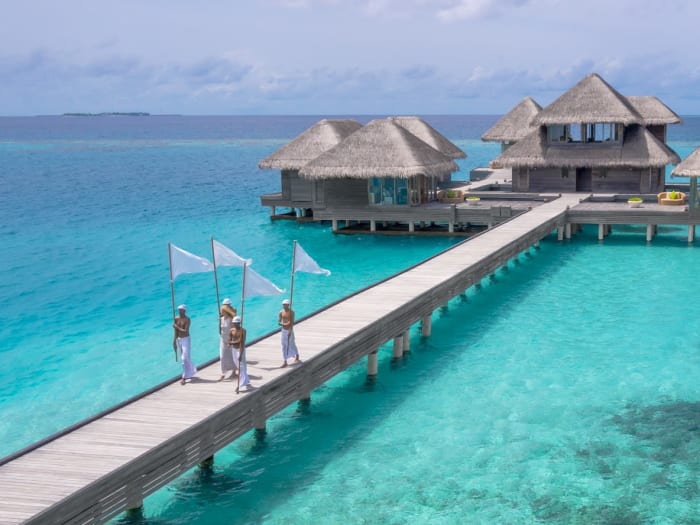
At Huvafen Fushi, accommodation is at the heart of the experience. The overwater villas firmly establish the destination within the Maldivian imagination. Sleeping above the water, witnessing the lagoon shift in colour, feeling the sea from your terrace or private deck: these gestures define the relationship with the place.
The overwater villas cater to a specific travel desire. They offer a sensation of suspension, almost isolation, while remaining connected to the island via discreet walkways. Guests are drawn in by the view, but also by the quality of silence. Above the lagoon, the horizon expands, allowing one to inhabit the landscape. In the morning, the light enters differently. In the evening, the terrace transforms into a vantage point over the sky and water.
On the beach or garden side, the accommodations provide an alternative relationship with the island. Some prefer direct access to the sand, walking barefoot to the shore, or the intimacy of tropical vegetation. In both cases, the logic remains the same: to preserve personal space, open up to the outside, and allow the architecture to complement the landscape.
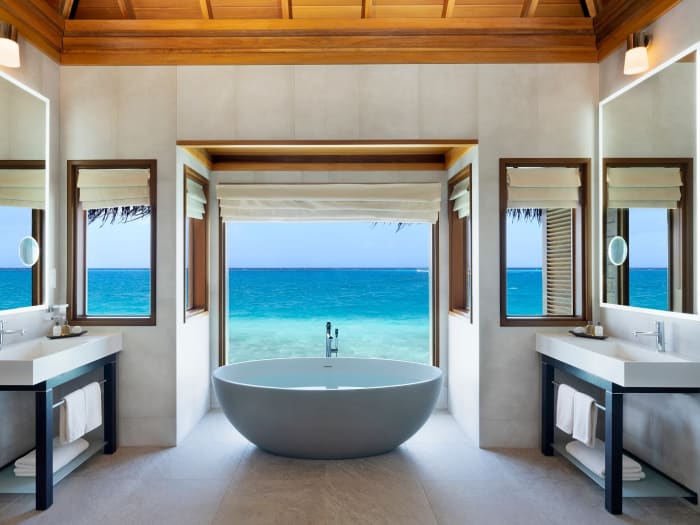
Comfort is expressed here in fluidity rather than effect. Generous volumes, bathrooms designed for relaxation, terraces that open to the outdoors, and carefully curated bedding contribute to this sense of refuge. The nightly turndown service and daily maintenance enhance this feeling of consistency. The room thus accompanies the various moments of the day.
What truly matters is the villa's ability to become a complete living space. It is not merely a place to sleep. One enjoys breakfast there, reads, observes the weather, takes a break between swims, and then finds precious intimacy after dinner. At Huvafen Fushi, accommodation remains inseparable from the landscape. The interior and exterior engage in a constant dialogue.
For a romantic getaway, the overwater villas retain their evocative power. For a more contemplative stay, the beach retreats offer another way to experience the island, more grounded in sand and foliage. In all cases, the experience rests on the same idea: to provide a calm and open personal space, where one sometimes wishes to linger.
Dining, between marine freshness and island rhythm
On an island resort such as Huvafen Fushi, dining plays a subtler role than it first appears. It does not merely feed or entertain; it structures the stay, marks the hours, follows the changing light and gives tangible texture to the experience of place. While no detailed list of restaurants or specific culinary signatures is provided here, one can still understand what guests seek in such an address: cuisine in tune with the climate, the maritime setting and the idea of luxury without heaviness.
In the Maldives, eating well often begins with understanding the context. Heat, humidity, constant proximity to the sea and the slower rhythm of the day all call for clear, balanced dishes rather than over-elaborate ones. At Huvafen Fushi, one would therefore expect a logic of freshness: fish and seafood inspired by the marine environment, tropical fruit, lighter lunches, and more settled dinners once the temperature drops and the island regains a particular softness.
The pleasure of the table also depends greatly on the setting. In this kind of resort, the memory of a meal is rarely separate from the way it was lived: breakfast facing the lagoon, lunch taken without ever really leaving the beach, dinner in a more intimate atmosphere with the sound of water in the background. The staging need not be dramatic to be memorable. Often, beautiful light, good spacing between tables, precise service and a sense of unhurried time are enough. Huvafen Fushi, with its intimate and peaceful positioning, seems especially suited to this form of dining that is experienced rather than simply consumed.
Service, indeed, is essential. In a hotel of this category, the quality of a meal depends as much on the plate as on the team’s ability to read the moment. Knowing when to speed up a simple lunch, when to preserve the pace of a romantic dinner, when to suggest an alternative discreetly, or how to account for dietary preferences and constraints: these are the details that turn resort dining into genuine hospitality. The property’s reputation for attentive service points in that direction.
For travellers, the table then becomes a natural extension of the villa and the island. What matters is less an accumulation of effects than a continuity of sensations: freshness, clarity, relaxation and, at sunset, perhaps a more festive note. The best meals in these latitudes are often those that leave room for the landscape and for conversation. They do not try to distract from the setting, but to accompany it.
Within a romantic stay or a restorative break, dining also takes on an almost choreographic role. Morning opens the day gently; lunch remains light to leave space for swimming or rest; evening gathers, slows and gives the stay its suspended moment. At Huvafen Fushi, one can easily imagine this succession of meals as another way of inhabiting the island, following the light, the temperature and the mood of the lagoon. That is often where the true success of island dining lies: in its ability to become one with the place.
Spa & wellbeing, in praise of slowing down
A place such as Huvafen Fushi almost naturally invites a wellbeing reading. Not in the sense of performance-led programmes or dramatic promises of transformation, but as an invitation to bring the body back into tune with the landscape. In the Maldives, simply being surrounded by water, light and space already alters one’s perception of time. A well-conceived spa does not artificially add another layer of relaxation; it gives more conscious form to that slowing down.
The hotel’s overall atmosphere—intimate, peaceful and oriented towards the sea—lends itself particularly well to this approach. One easily imagines a wellness space conceived as an extension of the island itself: somewhere that shares the same calm tonalities, natural materials and softened relationship with light. Luxury here lies not in profusion but in the quality of the sensory environment. Carefully controlled temperature, discreet welcome, precise gestures and unhurried intervals between treatments matter more than any overly emphatic wellness discourse.
For travellers, the spa often serves several functions during a stay. It can act as a decompression chamber on arrival, especially after a long journey. It then becomes a moment of recovery after water activities, sun exposure or the many hours spent walking, swimming, diving or simply living outdoors more than usual. Finally, it may form a central ritual within a romantic stay: a couples’ treatment, a silent interlude, a moment in which the movement of the day is fully suspended.
Wellbeing at Huvafen Fushi is not limited to the treatment room. It is legible across the entire experience: waking to a lagoon view, taking breakfast without urgency, alternating between swimming and rest, walking barefoot, dining without rigid time pressure and returning to a room prepared for the evening. Daily services, when they are smooth and dependable, contribute to that same feeling of lightness. True rest often begins when one no longer has to think about logistics.
In that context, a personalised wellness routine makes complete sense. It may be very simple: a massage at the start of the stay to release travel tension, a second more targeted treatment a few days later, deliberately protected periods of rest, careful hydration and gentler activities chosen according to one’s energy. The best resort spas understand this: they do not impose a universal protocol, but accompany a particular state.
What makes the experience especially convincing in the Maldives is that the landscape itself extends the effects of treatment. One leaves a massage and immediately returns to the horizon, the saline air and the shifting light on the water. The body does not re-enter an urban or enclosed environment; it remains within a continuity of calm. At Huvafen Fushi, that coherence between place, pace and the promise of wellbeing seems essential. More than a spa, it is a way of inhabiting the island with greater attention, slowness and presence.
Concierge & Services: Discreetly Orchestrated
Island luxury often relies on an apparent simplicity, supported by meticulous organisation. At Huvafen Fushi, this mechanism is facilitated by a concierge and reception open 24/7, daily housekeeping, turndown service, luggage storage, laundry, wake-up calls, and a multilingual staff.
The concierge plays a central role. In the Maldives, activities often depend on marine conditions, transfer schedules, and availability. Booking an excursion, adjusting an itinerary, organising a surprise, checking a schedule, or seeking advice becomes simpler.
The continuously open reception reinforces this sense of continuity. In an island context, this availability reassures and accompanies every moment of the stay.
Room services directly contribute to daily comfort. Daily housekeeping maintains a constant feeling of freshness in the tropical climate. The turndown service establishes a more relaxed rhythm at the end of the day.
Laundry, luggage storage, and wake-up calls fall under discreet yet useful logistics. Their efficiency lightens the stay.
The multilingual staff is also significant. In an international setting, understanding guests' expectations and habits is an integral part of the service.
At Huvafen Fushi, this well-orchestrated discretion naturally integrates into the experience. It allows the landscape and intimacy to take centre stage, while hospitality operates behind the scenes.
The Art of Living in the Malé Atoll
Discussing the art of living in the Malé Atoll is to acknowledge that in the Maldives, luxury is inseparable from geography. Here, everything begins with water. It dictates movement, colours, activities, and light. Staying at Huvafen Fushi means entering into a relationship with time and space that is markedly different from urban or continental destinations. The atoll is not approached as a series of addresses; it is discovered through immersion, shaped by the climate, the sea, and the slow pace they impose.
The Malé Atoll offers a precious advantage. It allows for quick access to a world of lagoons, white sands, and reefs, without the heavier logistics of distant domestic travel. This accessibility does not detract from the feeling of escape; rather, it makes it more fluid. One transitions more swiftly from travel to stay, from organisation to experience.
Once on the island, daily life reorganises around simple elements. Dawn becomes a moment to observe. Meals follow the light and warmth more than the demands of a schedule. Swimming naturally punctuates the day. One walks barefoot, reads longer, speaks more slowly, and observes more closely. This art of living is rooted in a deliberate reduction of the superfluous.
The relationship with nature here is more direct. The crystalline waters and marine life are integral to the experience. Even without a packed itinerary, a few moments by the lagoon are enough to grasp what makes the Maldives unique: the transparency of the water, the mobility of light, and the sensation of a living landscape. Water activities and excursions extend this relationship, allowing for further exploration, but the essence is already present in the proximity to the marine environment.
For couples, the Malé Atoll offers a particular kind of romance. It relies less on the city or heritage and more on seclusion and presence. Luxury here is not about a filled itinerary, but about shared time without interference. For travellers weary of urban rhythms, it is also a way to relearn the art of not filling every hour. Huvafen Fushi is conducive to this with its intimate and peaceful atmosphere.
Between November and April, the season is generally drier and more conducive to enjoying the surroundings. However, the art of living in the atoll is fundamentally based on a simple disposition: to accept slowing down, to let oneself be guided by the sea, and to consider that a successful day can hinge on just a few things—a swim, a good meal, a nap, a sunset. In a world saturated with demands, this simplicity constitutes a form of contemporary luxury.
Booking via MyConciergeHotel
Choosing Huvafen Fushi through MyConciergeHotel means approaching your stay with a level of preparation and personalisation suited to an island destination. In the Maldives, the quality of the journey depends as much on the chosen address as on the planning beforehand: schedules, transfers, type of villa, desired pace, prioritised activities, and moments of rest.
Huvafen Fushi caters to travellers seeking an intimate atmosphere, overwater villas or beach-facing accommodations, attentive service, and a setting conducive to relaxation. From the moment of booking, it is helpful to specify the nature of the desired stay—honeymoon, romantic getaway, wellness-focused retreat, beach escape with some water activities, or simply a need for disconnection. This response often influences the choice of villa, the length of stay, and the organisation of experiences on-site.
MyConciergeHotel's support allows for anticipation of essential points: choosing an overwater villa for immersion in the lagoon, or a villa close to the beach for a more direct connection to the sand and vegetation; planning the most sought-after activities, especially between November and April; and noting any particular expectations regarding pace, privacy, or services. In a resort where discretion and fluidity matter, this preparation is far from trivial.
Booking with an editorial and concierge intermediary also provides a more nuanced understanding of the hotel. Not all beautiful Maldivian addresses suit the same travellers. Some prioritise vibrancy, others family life, and still others a more demonstrative aesthetic. Huvafen Fushi is better suited to those who value tranquillity, quality service, the beauty of the lagoon, and a more introspective form of luxury. Knowing this before booking helps avoid mismatched expectations.
It is also wise to approach the reservation with the entire stay in mind, rather than just the room. In the Maldives, the experience is constructed as a whole: arrival, settling in, meals, rest periods, sea outings, treatments, moments of solitude, and dinners for two. A good reservation allows for this breathing space, without overloading the itinerary. The simplest advice often remains the best: book in advance what is essential, and then retain a degree of spontaneity on-site.
With MyConciergeHotel, the aim is to make the journey more just. For Huvafen Fushi, this means helping each traveller find the right version of the island: the most romantic, the most restful, the most contemplative, or the most balanced. In a destination where one seeks the obvious, this precision in advance allows for full enjoyment once on-site.