Hotel Claris Barcelona: an urban address shaped by art, pace and restraint
In Barcelona, some addresses opt for display, while others favour composition. Hotel Claris clearly belongs to the latter camp. Set in one of the city’s lively districts, it appeals to travellers looking less for spectacle than for a rare balance: the feeling of being fully in Barcelona without giving up a genuine sense of retreat. That tension between urban energy and interior calm defines much of its character.
From the moment of arrival, the hotel sets out an aesthetic that does not merely reproduce the expected codes of a contemporary five-star stay. Here, modern art and historic touches are brought together not as a decorative trick, but as a conversation between periods. The result is neither museum-like nor over-stated. Materials, proportions and objects create the impression of a private collection designed to be lived with. There is something distinctly Barcelonan in that cultivated approach to interiors, where elegance comes from the right juxtaposition rather than from excess.
The address therefore suits different kinds of guests without losing focus. Couples find a sophisticated refuge, equally appropriate for a short city break or a slower, more deliberate stay. Business travellers value the clarity of service, the ease of the shared spaces and the hotel’s ability to provide structure without coldness. That may be one of Hotel Claris’s most convincing qualities: it accommodates varied rhythms while maintaining a clear identity.
The communal areas play a significant role in this impression. Designed for relaxation, they avoid decorative noise and favour a quieter form of comfort. They are places to settle in for a meeting, a chapter of a book, a pause between engagements, or simply to reconnect with the city after a walk. In a destination as intensely visited as Barcelona, that capacity for breathing space matters almost as much as the location itself.
For anyone wondering where Hotel Claris is located, the answer matters less as a point on a map than as a promise of experience: a well-placed urban address connected to the city’s main currents, yet sufficiently sheltered to preserve the feeling of a chosen stay. That is what keeps it relevant. One does not come here merely to sleep in Barcelona, but to inhabit, for a few nights, a more measured version of its intensity.
Pau Claris, 150: a natural base for discovering Barcelona
For travellers familiar with the city, the street name alone is often enough: Pau Claris. In Barcelona’s urban imagination, the address immediately suggests an elegant central district shaped by shops, architecture, movement and everyday local life. To stay at Hotel Claris is therefore to settle into an active, legible Barcelona, one that lends itself equally well to walking and to wider movements across the city. For visitors wishing to combine efficiency with pleasure, that location matters greatly.
The surrounding area allows Barcelona to be approached in layers. One can set out in the morning towards major Modernist avenues, continue on to boutiques, cafés, cultural institutions or quieter residential squares, and return to the hotel without ever feeling detached from the city one came to experience. Everything seems connected by a coherent urban continuity. That is one of the privileges of a strong central address: it does not isolate guests from reality, it orders it.
This setting is especially well suited to two kinds of stay. On the one hand, business travel, for which transport links, ease of access and centrality remain decisive. On the other, leisure stays, when the aim is to discover Barcelona without turning every outing into logistics. Claris manages to answer both expectations because its immediate surroundings are lively without being chaotic, and well frequented without losing all nuance.
The neighbourhood also offers a subtler quality appreciated by seasoned visitors: it allows for shifts in tempo. One can devote an entire day to museums, architecture and walking, then choose in the evening between a restaurant, a drink or a quieter return to the hotel. That flexibility is valuable in a city where tourist intensity can sometimes impose its own rhythm. Here, the guest retains control of the itinerary.
Travellers looking at photos of Hotel Claris or trying to understand its atmosphere before booking often begin with the address, then realise that the location is more than a practical advantage. It directly shapes the way a stay unfolds. Barcelona is a city of façades, perspectives, details and thresholds between public and private space. To be based on Pau Claris is to enter that urban grammar naturally.
Hotel Claris is therefore not simply in Barcelona; it belongs to one of the city’s most fluid readings. For a first stay, it is a reassuring yet stimulating base. For a return visit, it is an anchor point that helps one reach the essentials quickly, then move beyond them with intention. In both cases, the address acts as a discreet accelerator of a well-made stay.
Rooms and suites: calm as an urban luxury
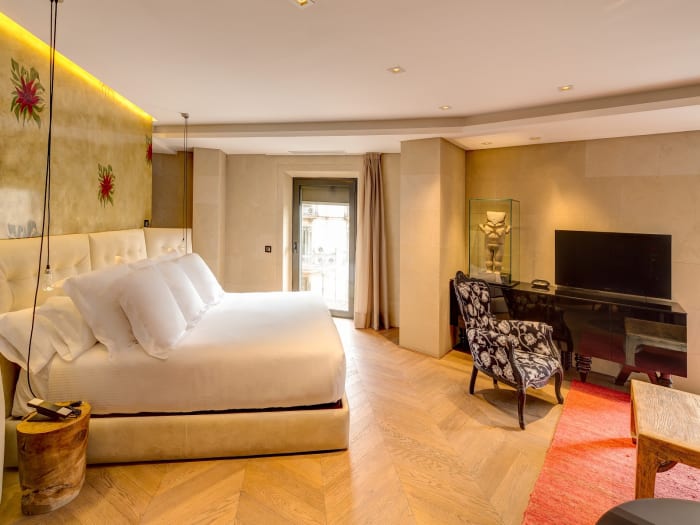
In a city as expressive as Barcelona, a hotel room can no longer be merely a place to pass through. It must offer a counterpoint. At Hotel Claris, that idea appears to shape the stay: after the energy of the neighbourhood, meetings, visits, dinners and long walks, returning to one’s room feels like a recentring. Luxury here lies not in effect, but in an interior’s ability to restore calm.
The hotel’s decorative identity naturally extends into its private spaces. The dialogue between modern art and historic touches creates an atmosphere that feels more cultivated than demonstrative. One imagines rooms in which contemporary lines are tempered by older references, where objects are not there to signal a trend but to build a mood. That visual restraint suits the spirit of the house: an elegance that values coherence over excess.
For couples, this translates into an immediate sense of intimacy. Nothing feels forced, and that is precisely what makes the stay pleasant. The room becomes a space to inhabit, not merely to occupy between outings. It is somewhere to prolong a late breakfast, return to in mid-afternoon, pause before dinner, or simply withdraw to recover a sense of silence. In the context of a city break, that ability to slow down changes everything.
Business travellers read something else into it, equally essential: reliability. A strong urban hotel should allow guests to work, prepare, recover and leave again without friction. Turndown service, daily housekeeping, a round-the-clock reception and concierge availability all contribute to that ease. These may seem discreet details, yet they define the real quality of a well-run professional stay.
Questions about the number of rooms often arise when considering an address such as Claris. More than the figure itself, what matters here is the overall impression: that of a property structured enough to provide the services of a major hotel, yet composed enough to preserve a clear relationship with its guests. One does not come here for anonymous monumentality; one finds a more measured scale, compatible with five-star comfort and the idea of personalised hospitality.
Ultimately, the rooms and suites at Claris belong to a very precise vision of urban hospitality. They do not try to compete with the city, nor to imitate it. Instead, they provide its necessary reverse: softer materiality, a slower rhythm and a more interior aesthetic. In a Barcelona so often lived outdoors, that quality of refuge makes all the difference.
Hotel Claris restaurante: two dining rooms, two registers, one shared standard
Dining plays a decisive role in the identity of a major urban hotel. It does not merely serve residents; it says something about how the address intends to converse with its city. At Hotel Claris, that conversation takes shape through two restaurants with distinct personalities, allowing guests to vary their mood without leaving the property. For travellers, this is an obvious convenience. For the hotel, it is a way of showing that food is not an ancillary service, but a full chapter of the stay.
Caelis holds a particular place within this landscape. Led by Romain Fornell, the restaurant offers a Mediterranean reading with French influence, precise without becoming rigid. Its Michelin star places it in a category where one expects both mastery and style. The interest here lies in that balance: a cuisine that embraces sophistication without losing sight of pleasure. Among the dishes that tend to linger in memory, the lobster, celeriac and foie gras stuffed macaroni neatly express the house style: generous, technical, yet never abstract.
For an in-house dinner, Caelis provides what one hopes for from a strong hotel restaurant: the possibility of a genuine gastronomic experience without breaking the rhythm of the day. One goes downstairs to dine and returns a little later with the feeling of having taken a complete culinary journey, without ever having had to wrench oneself away from one’s own pace. In Barcelona, where external dining options are abundant, the comfort of such internal ease can become a luxury in itself.
At the other end of the spectrum, Os-Kuro introduces a Japanese direction that broadens the hotel’s culinary horizon. Fish, meat, tempura, woks and a selection of sake form a proposition that is more direct and more flexible in use, yet equally relevant within an urban stay. It suits a more spontaneous dinner, a change after several Mediterranean meals, or simply the desire for the precision associated with Japanese cuisine when it is conceived for conviviality as much as for clarity of flavour.
This coexistence of two registers works especially well in a hotel frequented by both couples and business travellers. The former can build a stay around different experiences; the latter benefit from the flexibility needed to adapt meals to the day’s agenda. A representational dinner, a lighter evening, a meal that lingers or, on the contrary, a quicker moment: the hotel answers several scenarios without losing coherence.
Searching for “Hotel Claris restaurante” often means wanting to know whether the address is worth considering for its table as much as for its rooms. The answer is yes, precisely because the offer does not rely on a single gesture. Between the Mediterranean signature of Caelis and the Japanese orientation of Os-Kuro, Hotel Claris presents a complete vision of hospitality in which dining fully belongs to the Barcelona experience.
Concierge and services: the discreet mechanics of a seamless stay
In high-end hospitality, true comfort is not measured only by what one sees. It is read in the continuity of a stay, in the way each need finds its answer before it turns into inconvenience. At Hotel Claris, that quality rests on a range of services that define attentive hospitality without unnecessary emphasis. The twenty-four-hour concierge and front desk form the most visible foundation, yet their value goes beyond simple availability: they create a sense of permanence that is especially valuable in a city that lives late and is explored intensely.
For business travellers, this organisation is immediately legible. Late arrivals, early departures, last-minute requests and the need for a reliable rhythm all require a hotel capable of operating without interruption. A continuous reception, luggage storage, wake-up service and laundry answer that logic efficiently. The stay becomes more flexible, and that flexibility turns into a concrete luxury.
For leisure guests, the same services take on a different tone. Being able to leave luggage before heading out to explore the city, returning to a room refreshed each day, enjoying turndown in the evening, or relying on a team available at any hour changes the texture of a stay. One no longer thinks in terms of organisation, but of ease. That shift is precisely what distinguishes a well-run hotel from one that is merely well equipped.
Multilingual staff also contribute to this sense of flow. In an international destination such as Barcelona, the quality of exchange matters as much as the speed of response. Good service does not simply mean execution; it means understanding a guest’s tone, expectations and degree of independence, then adjusting the level of assistance accordingly. In a property welcoming couples, repeat visitors and business guests alike, that relational intelligence is essential.
The communal areas designed for relaxation extend the same impression of carefully calibrated service. They are not merely decorative; they act as buffer zones between city and room, meeting and rest, exterior and interior. They show how hospitality also depends on the staging of transitions. A strong hotel is not a sequence of services, but a chain of passages made easy.
This may be where Hotel Claris proves most convincing over time. It does not try to turn every gesture into an event. It prefers accuracy, continuity and discretion. In the realm of the urban five-star hotel, those are often the very qualities that inspire loyalty. A successful stay is not necessarily the one that multiplies effects; it is the one that makes everything feel natural. The concierge, reception, daily housekeeping and wider service culture at Claris work precisely towards that sense of ease.
Barcelona living, from the perspective of Claris
Barcelona is a city understood as much through its rhythms as through its monuments. One may come for the architecture, museums, grand avenues, Modernist façades or cultural institutions. Yet many return for something else: the way the day unfolds here, through light, walking, meals, conversations, detours and renewed momentum. A well-located, well-run hotel allows one to enter that cadence effortlessly. Claris offers precisely that kind of starting point.
From the hotel, the city can be approached as a sequence of scenes. In the morning, one sets out early to enjoy a Barcelona that is still somewhat restrained, when the streets are only gradually opening and architectural details reclaim their place before the crowds. By late morning, the district becomes livelier, terraces fill, shopfronts draw the eye and the city regains its full energy. Returning then to Claris for a pause, a meeting or lunch means not enduring that intensity, but orchestrating it.
The afternoon may continue towards the major classics or along more personal routes. This is where the hotel’s location comes fully into its own: it does not impose a single Barcelona, but offers several. The Barcelona of visitors who want to see everything, of regulars who prefer to choose carefully, of business travellers fitting in a museum or a walk between obligations. In every case, the hotel acts as a stable centre of gravity.
In the evening, Barcelona shifts register again. The city becomes both slower and more social. Dinners begin later, conversations lengthen and the streets remain animated. In that context, staying in a hotel where one can just as easily go out as dine in-house takes on particular value. One is never trapped by a programme. One can improvise, cancel, extend or return. That freedom is one of the real luxuries of urban travel.
Claris therefore suits those who wish to experience Barcelona without consuming it too quickly. Its refined atmosphere, communal spaces designed for relaxation and attentive service encourage a more nuanced kind of stay. One does not simply tick off places; one composes days. Highlights alternate with pauses. One accepts that the city is also made of intermediate moments: a coffee, a return to the hotel, a change of light, a dinner that gives shape to the evening.
That may explain the lasting appeal of certain urban addresses. They do not merely promise a level of comfort; they offer a way of inhabiting the destination. In Barcelona, Claris fulfils that role with precision. It accompanies the city without imitating it, makes it accessible without simplifying it, and allows each guest to build a personal reading of it, one that feels more elegant than hurried.
Booking Hotel Claris: what kind of stay does it suit?
Choosing Hotel Claris is less a response to a desire for display than to a particular idea of the well-conducted urban stay. The address suits travellers who value location, service quality, aesthetic coherence and the ability to shape their days without complication. In Barcelona, where the hotel landscape is broad and highly varied, that clarity matters. It means booking not merely a room, but a framework suited to a precise intention.
For a weekend away as a couple, Claris offers a particularly convincing formula. The lively neighbourhood provides immediate access to the city, while the hotel’s refined atmosphere creates the necessary counterpoint. One can alternate walks, visits, pauses at the hotel and dinner on site without having to choose between immersion and comfort. This flexibility appeals to couples who want to experience Barcelona at their own pace, without an overly rigid programme or constant dependence on transport.
For business travel, the address offers different strengths. Its central position, round-the-clock reception and concierge, daily service and general operational ease all answer the demands of a tight schedule. The hotel allows guests to work, host, go out or dine without wasting time. Above all, it avoids the functional coldness sometimes found in overly standardised business properties. Here, efficiency does not come at the expense of atmosphere.
Hotel Claris also suits those who already know Barcelona and wish to return with more comfort and less dispersion. On a first visit, one often tries to see everything. On later stays, one usually prefers to choose better. A hotel such as this supports that shift well. It allows guests to slow down, make more of in-between moments, reserve a strong table within the property itself, and use the city as the setting for a more personal itinerary.
Booking ahead can be wise during the busiest periods, especially when Barcelona is receiving a heavy flow of visitors. The advantage is not only securing the preferred room, but also organising the other parts of the stay more calmly, beginning with dining. In a house where the table genuinely matters, planning dinner in advance can shape the experience as a whole.
Ultimately, Claris speaks to travellers who expect something from a five-star hotel beyond status alone. They are looking for an address able to hold together several promises: a real urban presence, a considered interior, reliable services and a dining offer worthy of attention. In Barcelona, that is a particularly relevant equation. Booking here means choosing a way of staying that values precision over effect, and continuity over staging.