History & Positioning
The Grand Victoria Hotel stands out among urban addresses that prioritise overall coherence. In Taipei, this five-star establishment asserts a clear identity, embodying a refined city hotel designed for seamless, elegant stays without ostentation. Its membership in the Small Luxury Hotels of the World underscores its positioning, suggesting a more human scale, a focus on individual experience, and a genuine personality.
Rather than claiming a monumental heritage, the Grand Victoria Hotel distinguishes itself through contemporary classicism. Its name hints at European inspiration, which is particularly evident in the sophisticated, calm, and structured atmosphere. In a metropolis as dynamic as Taipei, this aesthetic stability is significant, catering to a diverse clientele. Business travellers, couples on urban getaways, and international visitors find a grounding point here.
The appeal of such an establishment often lies in what it does not impose. Here, sophistication stems from a certain way of doing things: attentive service, intuitive flow, communal spaces designed for moments of respite, and an overall sense of order. This type of hotel succeeds when it creates continuity between arrival, stay, and departure. Luxury here is less about accumulation and more about precision, perceived in the quality of the welcome, the discretion of the staff, the upkeep of the rooms, and the ability to respond promptly to requests.
In the landscape of Taipei, the Grand Victoria Hotel emerges as a trusted address. Its profile suits those seeking centrality, serenity, and international standards. It offers a pause within the city without isolating itself from it, which also explains its appeal to a mixed clientele of professionals and leisure travellers. The hotel provides a controlled environment, a composed ambiance, and an experience grounded in consistency.
The establishment and its address in Taipei
In Taipei, the Grand Victoria Hotel is conceived through an architectural lens that evokes the imagery of the Chinese palace. The design prioritises order, symmetry, and an immediately comprehensible presence.
The building, in its current form, belongs to the contemporary era, having been completed in 2007. This recent timeframe does not diminish the cultural reference it asserts; rather, it presents it with clarity.
Its architectural language engages in dialogue with an older memory of the city. In Taipei, the evocation of the Chinese palace also alludes to a deeply rooted political and heritage history. The Grand Hotel Taipei, originally constructed in 1952 under the direction of Chiang Kai-shek, remains one of the most eloquent landmarks.
This lineage gives the address a particular resonance. The architecture is not merely decorative; it is part of a continuum of forms and symbols that accompany the history of Taiwan.
As a whole, it creates a distinct presence within the urban landscape of Taipei. More than just an aesthetic vocabulary, the choice of the Chinese palace asserts a relationship with heritage, representation, and permanence.
Rooms and Suites
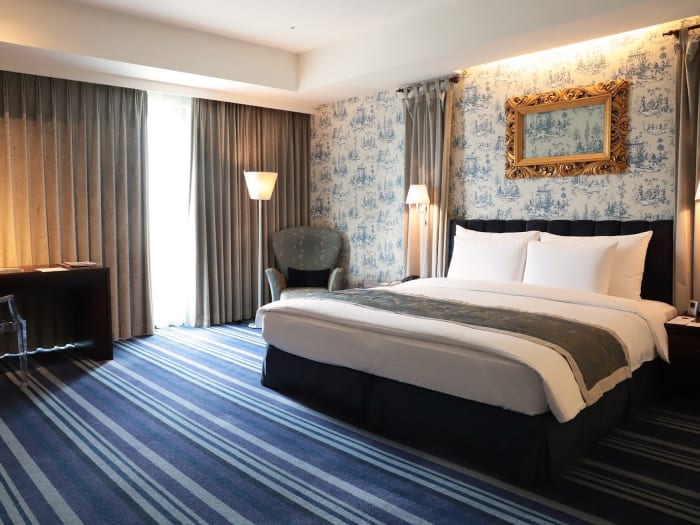
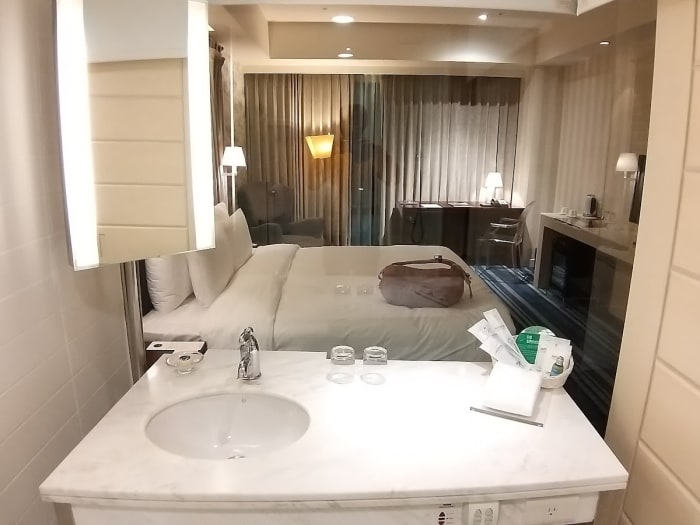
In a city hotel of this calibre, the room is never merely a functional space. It serves multiple roles simultaneously.
A refuge after a busy day, a temporary workspace, a true place of rest, it also accommodates slower stays. At the Grand Victoria Hotel, the rooms and suites extend the spirit of the establishment. Controlled elegance, discernible comfort, and attention to detail significantly enhance the experience.
A good luxury room in the city first establishes a clear separation from the external pace. In Taipei, where days can be quite full, this quality is particularly important. One expects serious bedding, careful soundproofing, well-proportioned volumes, and intuitive interior organisation.
Business travellers appreciate spaces that allow them to work without encroaching on their living area. Couples seek more intimacy, soft lighting, and the simplicity of a restful layout. In both cases, success hinges on the same factor: a room that requires no effort to adapt to.
The turndown service and daily maintenance contribute fully to this sense of continuity. A high-end stay often unfolds through regular, almost silent gestures. They keep the room in a state of constant readiness.
Returning at the end of the day to a tidied space, finding a calming atmosphere, noticing that everything is in its place—these details structure the feeling of comfort. They are particularly appreciated during multi-night stays when the room becomes a true temporary territory.
The suites follow a different logic. They cater to longer stays, informal receptions, or simply the need to breathe a little more. At an address like the Grand Victoria Hotel, they appeal to both frequent travellers and couples celebrating a special occasion.
Without spectacular effects, a successful suite offers a better balance between rest and activity. Between intimacy and representation. This is often where the maturity of a hotel is measured: in its ability to convey the generosity of space without losing overall coherence.
Ultimately, the rooms and suites of the Grand Victoria Hotel express its most intimate positioning. They do not necessarily seek to impress immediately. They persuade through use, night after night.
In the realm of luxury, this approach is often the most enduring. One remembers less a showy decor than a room where one has slept well, worked well, and recovered well. It is this quality of obviousness that one seeks in a great urban address.
Dining and culinary moments
Even when a brief does not detail the culinary offering, dining remains a central part of the experience in a five-star hotel. At Grand Victoria Hotel, it should be understood as a natural extension of the stay: a service that accompanies the different moments of the day, from breakfast to more formal meetings or quieter evening meals. In a sophisticated urban address, dining does not necessarily need to multiply concepts in order to feel right. It must above all respond precisely to the real uses of its clientele: efficiency in the morning, flexibility at lunch, comfort in the evening, and the ability to maintain consistent quality in both service and atmosphere.
Breakfast is often the first true indicator of a hotel’s level. For business travellers, it must allow a swift start without any sense of haste; for leisure guests, it can become a slower transitional moment before setting out to explore Taipei. In both cases, one expects restrained presentation, attentive service and an offering balanced enough to suit international habits. In a property that is part of Small Luxury Hotels of the World, this morning sequence often carries particular importance: it sets the tone for the rest of the stay, somewhere between precision and hospitality.
Lunch and dinner answer more varied expectations. Some guests seek the convenience of eating on site between commitments; others wish to use the hotel as a meeting point, or simply prefer not to go out again after a full day. In this context, the success of a hotel restaurant depends less on showmanship than on the clarity of the experience. A calm setting, well-paced service, a menu conceived for varied guests and a sense of rhythm are often enough to establish trust. Culinary luxury in a city hotel is frequently measured by this ability to make simple things especially pleasant.
Dining must also be considered a language of hospitality. A coffee taken in a shared space, a discreet snack, well-executed room service, a straightforward dinner after a late arrival: all these moments contribute to the overall perception of the property. They matter all the more in a city such as Taipei, where the external food scene is abundant and stimulating. For a guest to choose to remain in the hotel for a meal, the place must inspire confidence, the atmosphere must feel right and the service must adapt to the rhythm of the stay.
At Grand Victoria Hotel, dining should therefore be understood as a series of well-orchestrated moments rather than as a secondary function. It contributes to the property’s overall balance, everyday comfort and quiet elegance. Whether it is breakfast before a meeting, a meal taken in calm surroundings or a more settled evening, the role of dining is to accompany the city rather than compete with it. That is often the best position for a distinguished urban hotel: to offer a dependable, refined and pleasant setting that leaves the traveller free to compose their own pace.
Wellness, Recovery, and Time for Yourself
At the Grand Victoria Hotel, booking a spa treatment after a day of exploration makes perfect sense. Recovery is an integral part of the sought-after experience.
In Taipei, days are filled with travel, meetings, visits, and constant demands. The ability to slow down becomes an essential component of comfort.
Wellness in an urban hotel is not merely a checklist of amenities; it fundamentally relies on the quality of the atmosphere.
A well-designed treatment space allows for an immediate change of pace. The city’s rhythm no longer dictates the experience, shifting the focus from the itinerary to the sensation.
This is particularly valuable during short stays. An afternoon or evening treatment can rebalance a busy day, helping to ease the travel tensions and make the night more restorative.
For business travellers, it offers a way to regain mental availability. For couples, it can become a shared pause.
In contemporary luxury hospitality, the spa extends the service. It addresses the fatigue of jet lag, the need for recovery after travel, or the desire to centre oneself before dinner.
An establishment of this calibre knows how to guide its guests towards suitable treatments with simplicity and discretion. The quality of the experience relies as much on the gesture as on the appropriateness of the recommendation.
Wellness often begins before entering a treatment room, building in the guestroom, in the calm of communal spaces, and in the fluidity of service.
A sophisticated hotel succeeds when it creates a restorative environment. The spa is its most visible expression, yet not its only source.
At the Grand Victoria Hotel, a moment of wellness naturally integrates into the stay. Amidst the intensity of Taipei and the hotel’s restraint, the treatment becomes a point of balance.
Concierge and everyday services
Luxury hospitality is often measured less by what is visible than by what works without friction. From this perspective, the known services at Grand Victoria Hotel already outline the profile of a well-run house. A 24-hour concierge, 24-hour front desk, daily housekeeping, turndown service, luggage storage, laundry and wake-up service together form the discreet framework of a successful stay. Each of these services may seem expected in a five-star hotel; yet their mere presence is not enough. What matters is the way they are articulated to create an experience that feels continuous, clear and reassuring.
A permanently staffed front desk is first and foremost a guarantee of flexibility. In an international city such as Taipei, late arrivals, early departures and changes of plan are common. Being able to rely at any hour on an available point of contact materially changes the quality of a stay. The concierge plays an even subtler role. In a well-managed hotel, it does not merely execute requests; it helps simplify the city. Arranging transport, directing guests towards a district, recommending a better time to go somewhere, suggesting a smoother way to organise the day: these interventions may appear modest, yet they are decisive in the traveller’s actual experience.
Housekeeping and turndown belong to another, quieter temporality. They are reminders that a great hotel does not simply welcome guests; it constantly maintains the conditions of comfort. This regularity is particularly important for business stays, where the room must remain immediately usable, but it matters just as much for leisure travel. The feeling of returning to a prepared, orderly and calming space directly contributes to the quality of rest. Laundry, often underestimated, becomes essential as soon as a stay extends over several days or an agenda requires impeccable presentation.
Luggage storage and wake-up service belong to that category of amenities which seem simple until the moment they become indispensable. One allows guests to gain half a day in the city before check-in or after check-out; the other secures an important departure, an early flight or a meeting. In luxury hospitality, the value of a service often lies in its ability to absorb the potential points of tension within travel. The guest should not have to dwell on what might go wrong; the hotel exists to reduce that mental load.
At Grand Victoria Hotel, these services therefore express a clear promise: that of a stay supported with discretion. Nothing theatrical, but a series of concrete assurances that make the city simpler and time more fluid. This is precisely what many experienced travellers seek. They know that a great hotel is defined not only by its décor or address, but by the quality of assistance it provides at every stage. When that assistance is accurate, consistent and elegant, it becomes almost invisible. And that is often the surest sign of truly high-end service.
Taipei living, experienced from the hotel
Taipei does not reveal itself like a museum city. It is understood in layers, through rhythms and contrasts. One moves from a business district to a more intimate street, from contemporary architecture to a temple, from a department store to a local culinary scene, without any abrupt break. This is what makes the city so compelling for travellers who prefer lived-in capitals to static ones. From Grand Victoria Hotel, whose central address and proximity to points of interest are highlighted, this diversity becomes especially accessible. The hotel is not merely a place to stay; it can serve as a framework through which to read the city with greater nuance.
For a first stay, Taipei often impresses by its ease of use. Movement is relatively legible, the general atmosphere remains welcoming, and one can shape very different days according to one’s interests. Some will choose a cultural approach, alternating museums, temples and urban walks. Others will favour shopping districts, cafés, bookshops, department stores and design addresses. Others still will come above all to feel the city’s pulse, observe its habits, walk without too rigid a plan and let themselves be guided by the transitions between spaces. In every case, having a well-located hotel helps preserve that freedom.
Taipei is also a city lived through short moments: stopping for tea or coffee, pausing in the shade of a public space, making a detour into a shop, deciding on an impromptu dinner, taking an evening walk when the heat eases. The luxury of a good city hotel lies precisely in making these sequences possible. One can go out for a few hours, return to rest, and head out again later; improvise more; avoid having to choose between intensity and comfort. Grand Victoria Hotel appears to answer this logic of a flexible stay, in which the address acts as a stable base within a moving city.
For business travellers, this art of living takes another form. It is less about accumulating visits than about making intelligent use of the spaces between obligations. A central hotel can turn a free late afternoon into a genuine discovery, a business dinner into a pleasant extension of the day, or an open morning into a walk before an appointment. Here again, the quality of the address matters enormously. It conditions the way the city is perceived: as an additional constraint, or as a resource.
From Grand Victoria Hotel, Taipei can therefore be experienced with balance. The hotel provides the frame, the city supplies the substance. Between hotel sophistication and urban vitality, the stay finds its own tone. This is perhaps the best way to approach the Taiwanese capital: not by trying to see everything, but by agreeing to move through it with curiosity, method and openness. A good address never replaces the city; it simply helps one inhabit it more fully. That is exactly what one expects from a distinguished city-centre hotel.
Booking through MyConciergeHotel
Booking Grand Victoria Hotel through MyConciergeHotel means choosing an editorial and guided approach to high-end travel. In a market where hotel supply is abundant and often presented in a uniform way, real value lies not only in access to a room, but in the quality of the selection and in a nuanced understanding of each property’s profile. Grand Victoria Hotel does not speak to every traveller in the same way: it is particularly well suited to couples and business guests, and to those seeking a calm atmosphere, a central address and dependable services. To book with discernment is precisely to ensure that these qualities match the true nature of one’s stay.
The value of a platform such as MyConciergeHotel lies in placing the hotel back into its context of use. A five-star urban property is not merely a category; it is a set of balances between location, atmosphere, level of service, the rhythm of the house and its fit with the city. In the case of Grand Victoria Hotel, several points are already clear: membership of Small Luxury Hotels of the World, proximity to local attractions and business districts, a sophisticated atmosphere, and a service base that supports flexible, well-organised stays. This reading allows one to book not simply a level of comfort, but a coherent experience.
For a business trip, the key issue is often reliability. One looks for a hotel capable of supporting a schedule, absorbing the unexpected, simplifying arrivals and departures, and offering an environment conducive to concentration. For a stay for two, greater emphasis is placed on calm, quality of rest, ease of movement and the possibility of integrating moments of wellbeing. In both cases, a well-prepared booking can make a real difference: choice of room category, anticipation of a treatment, management of timings, and any special requests linked to the stay. This is where a concierge-led approach becomes especially meaningful.
Booking ahead, particularly during periods of high demand, remains a simple but important recommendation. Strong urban addresses that combine strategic location with a composed atmosphere are often among the first to fill. Anticipation not only secures the stay, but also helps define its contours: bedding preferences, transfer arrangements, needs linked to a business trip, or the wish to build additional comfort into the programme. The more carefully the stay is prepared, the more fluid the on-site experience becomes.
Choosing Grand Victoria Hotel through MyConciergeHotel is, finally, choosing luxury understood as suitability. Not the accumulation of generic promises, but the meeting point between an address, a city and a way of travelling. Taipei calls for a hotel capable of offering access, calm and quality of service at once. Grand Victoria Hotel appears to meet that expectation with measured elegance. Our role is to help you confirm that it is the right address for your stay, and to make the most of it from the moment of booking.