History & Heritage
Gōra Kadan Fuji belongs to a distinctly Japanese idea of hospitality: a retreat where the rhythm of a stay matters as much as the setting itself. The name Gōra Kadan immediately suggests, to travellers familiar with Japan, a refined house shaped by restraint, precision and a contemporary reading of the high-end ryokan tradition. In Shizuoka, the property extends that spirit within a landscape defined by Mount Fuji. Heritage here is not merely decorative; it is expressed through a way of welcoming guests that feels discreet, measured and almost choreographed.
What makes the hotel compelling is this balance between tradition and modern comfort. In many leading Japanese houses, luxury is not about display but about the obvious quality of materials, the depth of silence, the fluidity of service and the sense of being exactly where one ought to be. Gōra Kadan Fuji appears to belong to that family of addresses where architecture, landscape and hospitality form a coherent whole. Guests do not come simply to sleep with a view of one of the world’s most recognisable peaks, but to experience a carefully composed form of calm.
Its Relais & Châteaux affiliation offers another useful lens. It implies a certain level of expectation across the entire experience: character, a strong sense of place, personalised service and a meaningful relationship with the region. In Shizuoka, that takes on particular resonance, because nature is not a backdrop here. It shapes the light, the views, the seasons and the very mood of a stay. The heritage of the house is therefore inseparable from that of its surroundings: a Japan of legible landscapes, slow time and understated elegance.
To speak of heritage also means speaking of continuity in Japanese hospitality. The staff, the composition of the spaces, the attention to practical details and the feeling of intimacy all reflect a culture of service based on anticipation rather than display. This is not demonstrative luxury. Refinement lies in the accuracy of a room prepared for the evening, in the quiet handling of luggage, in the sense that every stage of the stay has been designed to reduce friction and leave room for contemplation.
That timeless quality helps explain the hotel’s appeal to travellers seeking serenity. Gōra Kadan Fuji does not aim to compete with theatrical city hotels or entertainment-led resorts. Its promise is different: to offer a refuge in a region where Mount Fuji acts as both visual landmark and cultural symbol. The result is access to a more essential idea of Japan, shaped by calm, aesthetic discipline and deeply human comfort.
The Establishment
The primary allure of Gōra Kadan Fuji lies in its location. Nestled in Shizuoka, amidst a tranquil environment, the hotel enjoys a privileged relationship with the landscape, particularly the silhouette of Mount Fuji.
This presence transforms the nature of the stay. It is not merely about a beautiful view; it introduces a scale, a breath, and a form of serene gravity. Depending on the weather, the season, and the time of day, the mountain can appear clear, veiled, or almost abstract. The spectacle is never ostentatious; it acts as a guiding thread, a silent presence that lends coherence to the place.
The establishment seems thoughtfully designed to take advantage of this relationship with its surroundings without overstating it. The architecture does not seek to dominate the landscape but to frame it. The openings, pathways, and resting areas invite light in, welcoming the variations of the sky and the sense of depth. At Gōra Kadan Fuji, this approach seems essential. Guests come seeking an experience of retreat, open to nature. Here, calm does not equate to austere isolation; rather, it represents a distancing from the tumult.
The setting of Shizuoka greatly contributes to this sensation. The region is among the most evocative in Japan for those interested in landscapes and seasons. Staying here means embracing a different tempo from that of the bustling metropolises. Days are structured around an alternation of moments: contemplating the view, taking time for a bath, lingering over meals, reading, walking, and then returning to the silence of the room. The hotel supports this way of inhabiting time.
The intimate and warm character is also understood through this location. A large hotel may impress, but a house like this seeks to envelop its guests. The common areas maintain a sense of tranquility and discretion. The traveller is not swept up in constant activity; rather, they may feel protected, almost sheltered from the outside agitation. For couples, this atmosphere is particularly precious, allowing for a stay focused on conversation, rest, and togetherness.
Seasonality plays a significant role here. In Shizuoka, the light, colours, and clarity of Mount Fuji vary greatly throughout the year. This dimension is an integral part of the experience. A stay will present a different face depending on whether one seeks clear skies, a more misty atmosphere, changing foliage, or a pronounced sense of freshness. Gōra Kadan Fuji lends itself to a journey prepared with intention. One does not come merely to tick off a destination but to experience a landscape at a specific moment.
Rooms and Suites
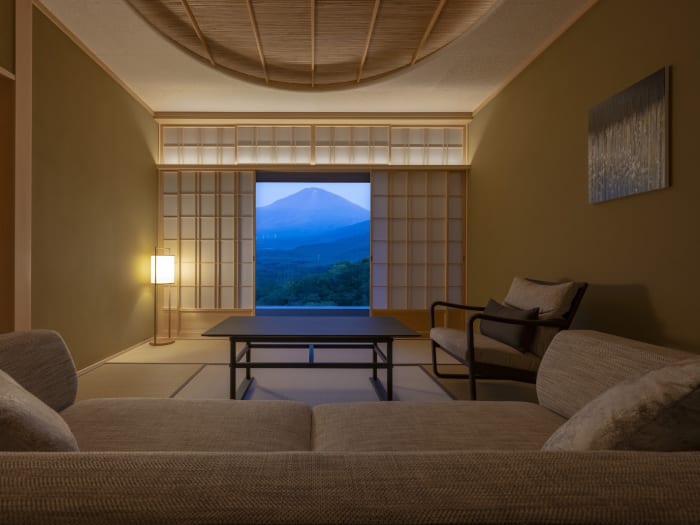
In a property of this nature, the room is at the heart of the experience. At Gōra Kadan Fuji, the spaces are designed as sanctuaries. Japanese aesthetics harmonise with contemporary comfort. Luxury is defined by balance: clear volumes, carefully selected materials, a calming palette, natural light, and an overall sense of order.
This hotel prioritises an atmosphere of immediate tranquility. From the moment you enter, everything contributes to a slower pace. The absence of visual clutter, the quality of textures, and the precision of the furnishings set the tone. In a Japanese context, this restraint is anything but cold; it creates a discreet warmth, founded on the harmony of elements. The traveller finds a fluid space, devoid of ostentation.
When present, the view of Mount Fuji plays a significant role, transforming the room into an intimate observation post. In the morning, the light lends the landscape an almost graphic clarity. As the day draws to a close, the contrasts soften. This connection to the outside world enhances the notion of a contemplative stay. One does not merely occupy a beautiful room; one inhabits a setting, with its variations and silences.
Modern comfort is another essential aspect. It is not about multiplying gadgets but ensuring a seamless experience. Quality bedding, controlled air conditioning, a bathroom designed for well-being, attentive daily maintenance, and evening turndown service structure the stay. The presence of daily housekeeping and a turndown service confirms this commitment to continuous care. Here, luxury is measured by the consistency of attention.
For couples, the room becomes a cocoon. The intimacy of home, its tranquillity, and the attention to detail foster relaxation. Opening the curtains to the mountain, taking time for tea, returning from a walk or a bath, only to find the room restored to order—this is often where the success of a place like Gōra Kadan Fuji is realised.
Travellers accustomed to large international hotels will find a different definition of refinement here. The private space is not designed to impress but to cultivate a quality of presence. The room becomes a true place of respite. One feels protected from the outside world while remaining connected to the landscape. In a region marked by nature and seasonality, this dialogue between interior and exterior lends the stay a particular depth.
Dining
Even when the exact culinary details are not specified, a Relais & Châteaux house naturally invites particular attention to dining. At Gōra Kadan Fuji, gastronomy should be understood as an extension of the place itself: an experience of seasonality, rhythm and detail rather than a simple food offering. In a setting so defined by nature and contemplation, meals take on a special role. They punctuate the day, give it structure and contribute fully to the refined sense of retreat guests seek.
In Japan, high-level dining often rests on accuracy rather than effect. Quality of produce, respect for the seasons, clarity of flavour, presentation and temperature matter as much as creativity. In a house such as this, one may expect a cuisine attentive to the region, the moment and the relationship between the plate, the setting and the service. The landscape is never far away: it shapes the light at table, the mood of the room and the willingness to savour slowly. Dining in such calm surroundings changes one’s perception of time.
Breakfast deserves special mention. In refined Japanese houses, it is often one of the most memorable moments of a stay. Not because it is theatrical, but because it begins the day with gentleness and precision. With Mount Fuji in view, or simply within the hotel’s peaceful atmosphere, this first meal can become a ritual: taking one’s time, observing the light, returning to simple gestures. For many travellers, it is here that the true quality of a house reveals itself.
Dinner generally carries a different tone, more enveloping in mood. After a day spent contemplating, walking or resting, the evening meal becomes a moment of recentring. Discreet service, the progression of dishes, attention to pace and to the privacy of guests all contribute to a sense of coherence. In a hotel with an intimate, welcoming atmosphere, dining should never break the spell through overstatement. It accompanies the stay and gives it sensory memory.
The Relais & Châteaux affiliation also suggests a certain standard in the relationship between hospitality and cuisine. Without claiming unverified details about a chef, concept or distinction, it is fair to say that dining is likely integral to the identity of the house. Guests choose this kind of address knowing that meals will not be incidental. They will be part of the journey itself, alongside the room, the view and the quality of service.
Spa & Well-being
At Gōra Kadan Fuji, well-being is woven into the very rhythm of the stay. It is as much about silence, the setting, and nature as it is about the dedicated facilities.
The identity of the establishment evokes an experience centred on tranquillity. A peaceful setting, an intimate atmosphere, attentive service, and a direct relationship with Mount Fuji form its fabric.
In Japan, well-being often pertains to a form of purification of rhythm. A stay here invites guests to slow down, speak more softly, observe more closely, and sleep better.
The quality of such an environment lies in its ability to produce this effect without ostentation. Calm settles naturally, from the view to the maintenance of the spaces.
In high-end Japanese hospitality, well-being prioritises the precision of gesture, the quality of welcome, and the sensation of intimacy. The traveller finds a genuine opportunity to centre themselves.
The presence of Mount Fuji adds a meditative depth. The light, air, variations of the sky, and the mountain's silhouette enhance this sense of alignment.
For couples, this dimension often holds significant value. Shared well-being comes through a slower pace, a cup of tea, the fading day, and a room prepared with care.
Gōra Kadan Fuji belongs to those addresses where well-being permeates the entire stay. The turn-down service, daily maintenance, concierge assistance, and the serenity of the setting all contribute fully to this experience.
Concierge & Services
In high-end hospitality, the quality of a stay is often measured by what is not immediately visible. Gōra Kadan Fuji falls into this category of establishments. The service does not seek to showcase itself; rather, it makes the experience smoother, calmer, and more authentic.
The hotel offers 24-hour concierge service, 24-hour reception, daily room service, turndown service, luggage storage, laundry service, wake-up calls, and multilingual staff. Taken together, these elements create a clear promise of continuity and attentiveness.
The round-the-clock concierge service is particularly important in a destination like this. In Shizuoka, where the stay may combine contemplation, regional excursions, and moments of rest, precise and discreet assistance makes a significant difference. A good concierge anticipates needs, tailors recommendations to the traveller's pace, and simplifies what could create friction.
The 24-hour reception also provides real comfort. Late arrivals, early departures, and last-minute adjustments are handled with flexibility. This constant availability is especially valuable for an international clientele. The multilingual staff enhances this quality of hospitality, facilitating communication and allowing the traveller to feel immediately understood.
Daily housekeeping and turndown service embody a certain philosophy of care. One leaves the room, returns, and finds the space restored to its cleanliness, freshness, and order. In the evening, the preparation for the night creates a different, more enveloping atmosphere. These silent gestures foster a sense of continuity that is highly precious.
Luggage storage and laundry services also play an important role. They lighten the stay, particularly for travellers combining multiple stops in Japan. The wake-up service follows the same logic, ensuring that every detail of the stay's rhythm can be accommodated.
The services at Gōra Kadan Fuji thus adhere to a simple philosophy: nothing should disrupt the quality of time spent on-site. Everything operates with discretion, precision, and kindness.
The Shizuoka Way of Life
Staying at Gōra Kadan Fuji also means encountering a particular idea of Shizuoka: a region where landscape, seasonality and one’s relationship with time deeply shape the travel experience. The local way of life is not ostentatious. It can be read in the way people look at Mount Fuji, in the attention paid to the weather, in the pleasure of moving between indoors and outdoors and in the importance given to quiet moments. For visitors arriving from major capitals, this quality of presence may be one of the most striking aspects of the stay.
Shizuoka occupies a singular place in the Japanese imagination. The region is associated with emblematic landscapes, legible nature and a balance between accessibility and retreat. It offers a less frenetic, more horizontal Japan, where one can still travel without feeling compelled to fill every moment. That openness is valuable. It restores weight to simple experiences: a walk, a change in light, an unhurried meal, a return to the hotel as the day begins to fade. Gōra Kadan Fuji fits fully within that logic.
Mount Fuji, naturally, structures this way of life. Its presence is not merely picturesque. It acts as both aesthetic and mental landmark. One looks at it in the morning to understand the day’s weather, notices it again as the hours pass and observes how it changes. In a world that prizes speed and accumulation, this repeated relationship with a single horizon can feel profoundly restorative.
For couples, Shizuoka offers a particularly favourable setting for reconnection. Away from major urban scenes, the region encourages a quiet form of complicity. One shares less a list of achievements than a state of mind: that of a journey with room to breathe. The hotel, with its intimate and welcoming atmosphere, extends that disposition.
Booking via MyConciergeHotel
Choosing Gōra Kadan Fuji through MyConciergeHotel means approaching your stay with the preparation that such an establishment demands. This type of house is not booked like a standard hotel. Because it relies on an atmosphere, a certain seasonality, and an experience linked to the rhythm of the place, it deserves to be chosen with care.
Booking several months in advance is advisable, especially during peak tourist seasons. The view of Mount Fuji, the tranquillity of the site, and the intimate nature of the experience can heighten demand. Anticipating helps to consider the journey as a whole: duration of stay, time of year, coordination with other stops in Japan, contemplative or more mobile tempo.
Booking with discernment also means understanding what one is seeking. Gōra Kadan Fuji will particularly suit couples, travellers in search of serenity, and those who appreciate discreet service. It is not a destination for animation or a packed schedule of activities; it is a refuge. The more the traveller approaches it with this mindset, the more likely the experience will resonate.
Support can also be invaluable in organising practical details: arrival and departure times, special requests, luggage management, rhythm preferences, and choosing the best period. In a place where fluidity matters as much as the services offered, this advance preparation holds real value. It allows for a more favourable arrival.
For international travellers, engaging with a contact familiar with the codes of luxury hospitality also provides comfort. It enhances clarity, coherence, and serenity. This is especially beneficial in a Japanese context, where the precision of customs and the importance of details enrich the journey.
Booking Gōra Kadan Fuji through MyConciergeHotel treats this stay for what it is: a pause founded on calm, views, quality service, and the elegance of contemporary Japanese hospitality. When a place relies so heavily on atmosphere, the reservation is already part of the journey.