History & heritage
In Vonnas, Hôtel Georges Blanc Parc & Spa belongs to a distinctly French story: that of a house which, over time, has become far more than a place to stay. Here, hospitality and gastronomy are not treated as separate worlds, but as two expressions of the same art of receiving guests. The Georges Blanc name immediately evokes a major culinary tradition, deeply rooted in Bresse and, more broadly, in this part of the Ain where the table remains a cultural marker. Without leaning on heritage for effect, the property reveals that continuity: a village house turned destination, a local anchor transformed into a reference address, a living legacy rather than a staged backdrop.
Vonnas itself plays an essential role in this identity. One does not arrive at an isolated hotel cut off from its surroundings, but at a place that remains in dialogue with the village, its pace, its softness and its human scale. That relationship gives the address a particular tone within French luxury hospitality. Where some properties rely on monumentality, Georges Blanc Parc & Spa cultivates a more rooted, more grounded form of prestige, one that is attentive to the quality of everyday life. Refinement here comes through precision, coherence and loyalty to a territory.
Its membership of Relais & Châteaux helps define this philosophy. It places the hotel within an international collection where the personality of the place matters as much as the level of comfort. In Vonnas, that personality rests on a rare balance between gastronomic reputation, elegant countryside atmosphere and the service standards of a great house. Guests quickly sense that the property is not trying to reproduce standardised luxury. Instead, it offers a distinctly French reading of hospitality: attentive, discreet, structured around the table, rest and the pleasure of taking one’s time.
The legacy can also be felt in the way the house seems to have grown in layers. One senses a history of additions, embellishments and successive refinements, all serving a fuller guest experience. The park, spa and various living and dining spaces now form a coherent whole, yet retain something organic, almost village-like in their layout. That impression matters: it avoids the feeling of an impersonal resort and reminds guests that luxury can emerge from a story patiently built over time.
To stay here is therefore to enter an address that carries memory without turning it into a museum. The past is never used as decorative rhetoric; it appears instead in the maturity of the service, in the quiet confidence of the place, in the way the house makes guests feel they have arrived somewhere that knows exactly what it is. For travellers interested in France’s great addresses, Hôtel Georges Blanc Parc & Spa represents a contemporary form of heritage: a village institution turned destination, where excellence is nourished above all by fidelity to place, cuisine and the art of hospitality.
The property
One of the singular qualities of Hôtel Georges Blanc Parc & Spa lies in its location at the heart of Vonnas. That central position does not translate into urban bustle, but into a rarer sensation: staying somewhere that genuinely belongs to its surroundings. The village is not merely a backdrop to the hotel; it contributes to its atmosphere. That relationship gives the stay a particular quality, shaped by calm, space and a sense of continuity between interiors, the park and the edges of the village.
The leafy park is one of the property’s defining assets. In a place of this kind, landscape is never incidental: it structures the experience. Here, greenery softens perspectives, filters views and establishes a slower rhythm. There is something deeply French in this pleasure of inhabited gardens, not monumental in the grand sense, but designed for walking, pausing, conversation and rest. Depending on the season, the light, foliage and flowering subtly alter the mood of the place. In the morning, the atmosphere may feel fresh and hushed; towards evening, more enveloping, almost contemplative.
The architecture and overall layout extend that idea of a village house enlarged to the scale of a grand hotel. This is not a uniform composition, but a setting that suggests several rhythms of stay: arrival, time at the restaurant, a spa interlude, returns to the room, passages through shared spaces. That variety creates a more nuanced experience than a single-block hotel. It also encourages a sense of intimacy, as each guest can find their own tempo between sociability and retreat.
The five-star standing is expressed less through ostentation than through the quality of upkeep, the ease of circulation and the feeling of serene order throughout. A great property is often recognised by precisely that: nothing feels forced, nothing disturbs the sense of effortlessness. Spaces are arranged so that the stay seems natural, almost self-evident. This impression is reinforced by a peaceful atmosphere, much sought after by travellers wishing to combine a notable table, high comfort and a restful setting.
Its position in Vonnas also allows the hotel to be approached as an elegant base for discovering a discreet, rural and food-minded France. This is far from mass tourism and overrun destinations; the appeal lies in the precision of the place, its rootedness, and the possibility of spending a few days at the pace of a village known for its culture of hospitality. For a long weekend or a refined stop on a broader route between Burgundy, Lyon and eastern France, the address offers a valuable pause.
What stands out, ultimately, is the coherence of the whole. The park, the calm, the village, the reputation of the house and the quality of service create a setting that does not seek to impress instantly, but to establish a lasting sense of rightness. That rightness is what makes the difference: a luxury of context as much as comfort, where one comes as much for the quality of the accommodation as for the experience of a complete place, deeply connected to its territory.
Rooms and suites
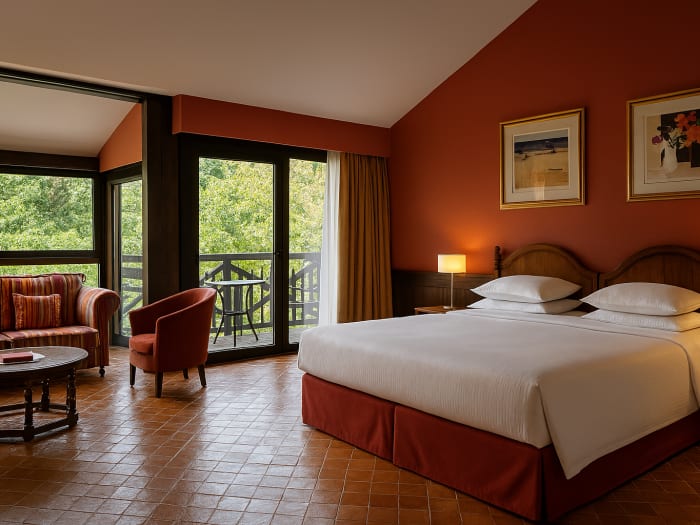
In a house such as Hôtel Georges Blanc Parc & Spa, the room is not merely a place to sleep between the highlights of a stay. It forms an essential part of the experience, offering a necessary counterpoint to the life of the restaurant, walks in the park and moments of wellbeing. Travellers who choose an address of this kind expect more than a high level of comfort: they seek atmosphere, intimacy, quiet and a sense of continuity with the spirit of the property.
Without detailing every room category here, it is fair to say that the rooms and suites in such an establishment are shaped by a logic of accomplished comfort, designed for restorative stays as much as for gastronomic escapes. Turndown service, daily housekeeping and attention to the guest’s rhythm all contribute to the impression of a perfectly run house. In luxury hospitality, true comfort often lies in discreet elements: welcoming bedding, fluid room layouts, carefully judged lighting, sufficient storage and bathrooms conceived as spaces of recovery rather than mere facilities.
The identity of the place suggests accommodation where French classicism meets a more contemporary elegance, without breaking with the spirit of Vonnas. In this type of address, one generally appreciates durable materials, soothing tones, measured decorative details and that ability to create refinement without visual excess. Luxury becomes more legible in such settings: it does not seek to prove itself, but to make the stay simpler, gentler and more harmonious.
The presence of the park and the peaceful atmosphere of the estate naturally influence how the rooms are experienced. A view onto greenery, the feeling of being sheltered from noise, the possibility of extending the calm of the gardens into one’s private space all matter greatly. For couples, this encourages stays centred on rest and the table. For families, it allows for a rhythm in which everyone finds their place, between shared time and moments of retreat. The address therefore suits several kinds of stay: a romantic weekend, a gastronomic break, a wellness pause or a longer stop to explore the region.
The five-star standard is also expressed in the hotel’s ability to adapt the stay to practical expectations. Reception and concierge services, luggage storage, laundry and attentive daily care create a reassuring framework, especially appreciated by those who wish to travel without friction. That ease matters as much as décor: it allows guests to focus on what matters most, namely the pleasure of being there.
Ultimately, the rooms and suites at Hôtel Georges Blanc Parc & Spa should be understood as spaces of respite. After dinner, a spa treatment or a day spent discovering the surroundings, they offer what great houses do best: the feeling of a refuge. An elegant, orderly and deeply calm refuge, where every detail seems designed to extend the experience of the place rather than compete with it. It is this coherence between accommodation, service and setting that gives the stay its real depth.
The Dining Experience
In Vonnas, gastronomy is at the heart of the experience. Hôtel Georges Blanc Parc & Spa attracts travellers for whom the culinary aspect motivates their stay.
Guests do not come merely for a comfortable night's sleep; they come for a relationship with taste, quality ingredients, the duration of the meal, and the essence of French hospitality.
The refined cuisine relies on local produce. In a region with strong terroir, this approach accurately reflects the locale.
Seasons, livestock, market gardening, regional traditions, and artisanal skills nourish the dining experience. Precision takes precedence over flamboyance.
Gastronomic luxury is defined by the quality of the ingredients, mastery of cooking techniques, and clarity of flavours. It also hinges on the ability to convey a sense of origin.
The meal unfolds within a carefully orchestrated timeframe. The arrival in the dining room, the rhythm of service, and the attention to pairings all contribute to the experience.
A great hotel restaurant is not judged solely by the plate but measured by the entirety of the sequence.
The staff strikes the right balance between presence and discretion, ensuring that diners feel attended to without being interrupted.
Breakfast extends this culture of the house. Well-chosen products, attentive service, and views of the park or village set the tone.
Lunch or dinner can become the highlight of the stay. It is advisable to reserve in advance, especially on weekends and during peak periods.
The establishment maintains a balance between haute cuisine and local roots. The connection to Bresse and Ain adds a unique depth to the experience.
Through the meal, the traveller gains insight into the region itself. The gastronomic experience structures the stay and often leaves the most lasting memories.
Spa & Well-being
The spa holds a vital place at Hôtel Georges Blanc Parc & Spa, contributing significantly to the balance of the stay. In a venue where the culinary experience plays a major role, the wellness space provides a valuable counterpoint. It invites guests to slow down, refocus, and recover. After the pleasure of the meal, the body finds its own rhythm here.
In luxury hospitality, the quality of a spa is not solely determined by the size of its facilities. It relies on the coherence of the overall experience, the expertise of the practitioners, and the atmosphere. A good hotel spa is primarily a transitional space. Guests enter still laden with the day's or journey's burdens and emerge more available, calmer, and more present to their stay.
In Vonnas, this dimension takes on a particular significance. The park, the tranquillity of the village, and the gastronomic identity of the establishment create an environment conducive to letting go. The spa deepens this sensation, allowing guests to organise their stay around complementary sequences: a walk, reading, lunch, treatment, rest, and dinner. This alternation between sensory pleasure and recovery gives time a different density.
Relaxing treatments cater to varied expectations. Some travellers seek a massage or a ritual to relieve the tensions of daily life, while others wish to incorporate their stay into a broader wellness philosophy. The advantage of a spa integrated within the hotel is the immediate accessibility of this retreat. Transitioning from one's room to the treatment area is effortless, encouraging a sense of surrender.
For couples, the spa enhances the retreat aspect of their time together. It offers a shared experience distinct from that of the restaurant—quieter and more introspective. For solo travellers, it often becomes one of the great pleasures of the stay. For families, it can complement a broader itinerary, supported by the hotel team.
The value of a spa like this also lies in its alignment with the overall spirit of the establishment. One does not expect a spectacular demonstration but rather a quality of welcome, care, and ambiance that is consistent with the rest of the experience. Well-being becomes a natural component of the stay in Vonnas, extending the philosophy of the place: to care, to slow down, to savour, and to rest.
Concierge & Services
Luxury in hospitality is often measured by what goes unnoticed. At the Hôtel Georges Blanc Parc & Spa, the 24-hour reception, 24-hour concierge, daily housekeeping, turn-down service, luggage storage, laundry service, wake-up calls, and multilingual staff create a seamless stay. They form a discreet framework designed to allow the essential to take centre stage.
The continuous reception provides genuine peace of mind. Whether it’s a late arrival, an early departure, an unexpected request, or simply a query, a team is available at any hour. In Vonnas, this presence accompanies the stay without adding any pressure.
The concierge plays a central role here. They reserve tables, adjust schedules, organise transfers, recommend walks, or help to balance a weekend between spa treatments and dining. This human mediation allows for the tailoring of each guest's experience.
The daily room service and turn-down service extend this attentiveness. Returning to a room tidied after an outing, then prepared for the night, provides a natural continuity to the stay. It is often in these details that the quality of a hotel is revealed.
Luggage storage and laundry services offer useful flexibility, especially during multi-stop trips. The multilingual staff facilitates the welcome of international guests without compromising the French essence of the establishment.
These services embody both hospitality and comfort. They anticipate, simplify, and enhance the stay. At Georges Blanc Parc & Spa, they support the dining experience, relaxation, well-being, and exploration of the village.
The art of living in Vonnas
A stay at Hôtel Georges Blanc Parc & Spa is also an encounter with a certain French provincial art of living, in its most subtle and convincing form. Vonnas is not a destination of display; it is a place of measure, rhythm and rootedness. One comes here less to tick off attractions than to inhabit a cultural landscape shaped by gastronomy, calm, nearby nature and gentle sociability. That quality of experience, difficult to reproduce artificially, is one of the address’s greatest charms.
The village first offers a human scale that has become precious. Everything seems to invite slowing down: short distances, leafy surroundings, the absence of saturation, the possibility of moving from a meal to a walk and then to a moment of rest without abrupt transitions. In a travel world often dominated by the accumulation of activities, Vonnas proposes something else: a form of quiet density. One can experience a great deal here while doing very little, provided one accepts being guided by the place rather than by an overfilled programme.
The surrounding nature fully contributes to that sensation. Without needing dramatic relief or spectacular scenery, the countryside of the Ain and the spirit of Bresse offer a setting conducive to gentle escapes. Walking, driving a few kilometres, observing the light over gardens and village edges, breathing air that feels more open than in the city: these simple gestures regain an almost luxurious value here. They perfectly complement the hotel experience, reminding guests that wellbeing is not confined to indoor spaces.
The local art of living obviously passes through cuisine, but not only through cuisine. It is also visible in the way guests are welcomed, in respect for the seasons, in attention to produce and in a certain idea of unhurried time. For travellers, this means that a stay in Vonnas can become a discreet initiation into a more intimate France, less spectacular than major tourist capitals, yet often more revealing of what the country offers at its best: coherence between landscape, table and hospitality.
The destination is particularly well suited to couples seeking a refined weekend, but it may also appeal to families or international travellers wishing to discover another face of French luxury. Not the luxury of shop windows, but that of houses built on a genuine culture of receiving guests. The seasons naturally alter the experience: warmer months highlight the park, terraces and walks; cooler periods reinforce the appeal of interiors, the spa and lingering meals. In all cases, the stay is best approached as a complete interlude rather than a simple overnight stop.
Vonnas ultimately reminds us that France still has destinations where reputation has not erased the truth of the place. That is perhaps what makes the experience so compelling. One finds here a form of elegant authenticity, without folklore or forced rusticity. For travellers drawn to addresses that express a territory with accuracy, Hôtel Georges Blanc Parc & Spa offers far more than high-level accommodation: it provides privileged access to a local art of living that is patient, gourmet and deeply restorative.
Book with MyConciergeHotel
Booking Hôtel Georges Blanc Parc & Spa through MyConciergeHotel means approaching the address with the care it deserves. A house of this kind is not chosen solely for last-minute availability or a simple price criterion. It is best prepared as a complete experience, where the rhythm of the stay, restaurant reservations, spa planning and understanding of the place matter as much as the room itself. That is precisely where editorial and concierge guidance becomes valuable: turning a reservation into a genuinely considered stay.
In the case of Vonnas, such preparation is particularly useful. The hotel attracts gastronomic travellers, couples seeking a peaceful weekend, guests loyal to France’s great houses and international visitors looking for an emblematic address without sacrificing intimacy. Depending on the season, the length of stay and individual expectations, the experience can be shaped in different ways. Some will prioritise the table and organise their visit around a dinner booked well in advance; others will seek more of a wellness interlude with spa time and rest; others still may wish to combine regional discovery with a gastronomic stop. Booking thoughtfully allows those priorities to be aligned.
MyConciergeHotel offers a useful reading of the place. The aim is not merely to confirm a room, but to help compose a coherent stay: choosing the right dates, anticipating key moments, checking restaurant availability, planning spa treatments and arranging arrivals and departures smoothly. In an address where certain highlights can fill quickly, that anticipation makes a real difference. It avoids experiencing the hotel only partially for lack of having reserved the elements that form its core.
This guidance is also valuable for travellers less familiar with the region. Vonnas is not consumed like a standardised destination; it is better discovered when one understands its rhythm, its interest and its place within a broader itinerary. A well-judged recommendation can be enough to transform a simple stop into a true destination stay. This is especially true for short breaks, where every sequence matters: arrival, settling in, spa, dinner, walk, breakfast, departure. Well arranged, these moments give the journey remarkable density.
Booking through MyConciergeHotel also means choosing a more qualitative approach to luxury hospitality. One that favours accuracy over accumulation, personalisation over automation, and knowledge of the place over mere transaction. For a house such as Hôtel Georges Blanc Parc & Spa, that approach is particularly relevant. It respects the spirit of the address, its rootedness, its standards and its deeply experiential nature.
If you are considering a stay in Vonnas, the best approach is therefore to plan ahead, especially for weekends and sought-after periods. The table deserves to be booked in advance, the spa can usefully be scheduled, and the length of stay often benefits from a little generosity so that you can fully enjoy the park, the village and the tempo of the house. In that attentive preparation, the experience has already begun.