History & heritage
Fogo Island Inn can only really be understood by first looking at the island that hosts it. Off the coast of Newfoundland, Fogo Island belongs to that Atlantic world where landscape, economy and ways of living have long been shaped by the sea, the wind and the seasons. This is not the story of a grand hotel planted in an already fashionable resort, but of a place rooted in an old island culture marked by fishing, mutual support and a practical relationship with the land and water. The property belongs to that continuity rather than staging it decoratively. Its identity rests on a contemporary reading of local traditions, visible in the architecture, in the attention paid to craftsmanship and in the way a stay seeks to connect guests with the island rather than shield them from it.
That sense of heritage is first apparent in the building’s formal language. The lines are contemporary, yet they speak to Fogo Island’s vernacular structures: timber houses, weather-wise construction and the constant presence of the ocean horizon. The inn feels both current and deeply anchored in its cultural setting. It is not a pastiche of the past; it is an interpretation. That distinction matters. Where some destination hotels merely borrow a few regional motifs, Fogo Island Inn appears to have been conceived as an extension of the island itself, with a clear desire to preserve coherence between landscape, memory and hospitality.
Its membership of Relais & Châteaux also helps define its place within the international hotel landscape. The affiliation places it among addresses where character, sense of place and the quality of the stay matter as much as comfort. Here, however, luxury takes on a particular form: it is not expressed through display, but measured in the quality of silence, the force of the views, the precision of service and the rare feeling of inhabiting a territory rather than merely passing through it.
Another essential aspect of its heritage lies in its commitment to sustainability and local culture, both central to the property’s identity. In an island setting, such a commitment is anything but abstract. It touches the way one builds, hosts, consumes and transmits knowledge. A stay therefore acquires an almost educational value in the noblest sense: it reveals a community, its customs and its relationship with time. For the traveller, this changes the very idea of luxury. One comes not only for a room with a view, but for a situated experience shaped by a collective story and a demanding geography.
In that respect, Fogo Island Inn belongs to a generation of hotels that understand that lasting prestige does not come from effect, but from rightness: the rightness of a building in its landscape, of service in its tone, of a table in its territory, of experiences in their relationship with the local community. Its heritage is not fixed; it continues to be written in that productive tension between local memory and contemporary hospitality.
The property
Arriving at Fogo Island Inn means accepting a certain displacement. The property is not discovered in the heart of a dense city fabric or in a codified seaside resort, but on an island where nature still sets the rhythm and remains palpably present. That geography immediately defines the stay. The inn is not merely a comfortable base; it acts as a privileged observatory over the North Atlantic, over shifting light, moving skies and that edge-of-the-world feeling which, here, is no cliché. The ocean views highlighted among the property’s defining features are more than a visual pleasure: they shape the entire experience.
The building itself plays a central role in that relationship with the landscape. Its architecture, inspired by local traditions, does not seek to disappear entirely, but to enter into dialogue with the site. It assumes a strong, almost sculptural presence while drawing on vernacular logics adapted to climate and island conditions. The result is a hotel that faces the sea directly and turns each space into a lookout point. One imagines lounges opening towards the horizon, circulation areas washed with changing light and places designed less for display than for looking outward. In such a setting, luxury also lies in the freedom to look.
The interior atmosphere, judging by the property’s positioning, appears to favour warmth over display. The key word is perhaps authenticity, provided it is understood in its demanding sense: not manufactured rusticity, but coherence between materials, volumes, service and environment. Fogo Island Inn seems to cultivate a restrained elegance in which modern comfort is folded into a broader local narrative. That restraint matters. It allows the landscape to remain the leading presence without asking guests to give up the standards expected of a five-star hotel.
The island character of the property also shapes one’s sense of time. One does not stay here in the same way one consumes a destination. Weather, season, light and the activity of the surrounding community all become part of the experience. Days may be paced by a coastal walk, a quiet hour reading towards the sea, a conversation with the team and a return to calm in spaces designed for contemplation. This slowness is not the absence of a programme; it is another way of inhabiting travel.
Finally, the property stands out for its ability to connect high-end hospitality with local immersion. This is one of the most compelling aspects of its positioning. Where some exceptional hotels create an almost self-contained world, Fogo Island Inn appears instead to preserve a degree of openness to the island, its culture and its people. That openness gives the place unusual depth. Guests come for comfort, certainly, but also for the feeling of touching something larger: a territory, a memory, a community. It is this combination of architecture, landscape and intelligence of place that makes the property distinctive.
Rooms and Suites
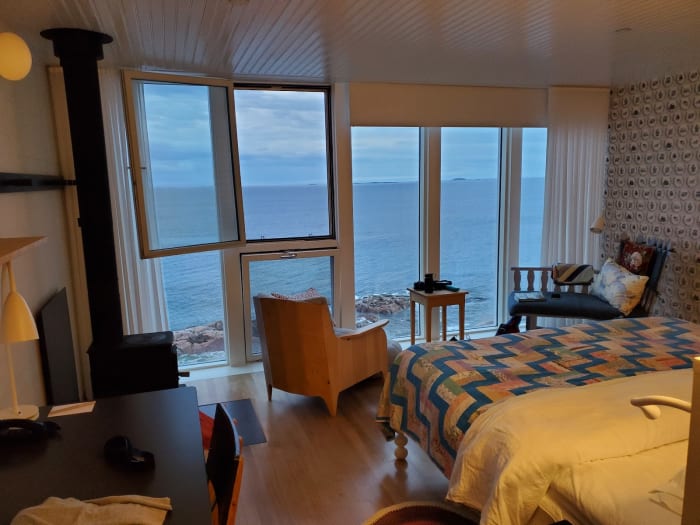
At Fogo Island Inn, the room serves as one of the primary points of contact with the landscape. The accommodation experience revolves around this relationship with the ocean and the island.
The view plays a central role. Waking up to the sight of the Atlantic, observing the shifting light, watching the weather change from a sheltered interior: this comfort transcends mere furnishings. The room becomes an intimate observation post, almost an extension of the shoreline.
The rooms and suites appear to be designed in a balance between modern comfort and local heritage. Contemporary design does not erase the location; rather, it interprets it with subtlety, through materials, lines, and warmth.
The island's inspiration is evident in tangible elements. Wood, textiles, and details evoke the local domestic history without any sense of reconstruction. This restraint offers the spaces a sensitive interpretation of the territory.
The service enhances this impression of controlled comfort. Daily housekeeping, evening turndown, 24-hour concierge and reception create a fluid and discreet environment. In such an isolated setting, this attentiveness reassures without imposing.
The rooms and suites also extend the silence. The absence of urban noise, the distance from ordinary rhythms, and the presence of nature create a rare privilege. These spaces invite one to read, write, gaze into the distance, or simply do nothing.
For couples as well as travellers seeking serenity, the accommodation plays a central role here. It is not merely about sleeping in a beautiful hotel; it is about inhabiting an Atlantic landscape for a few days with coherence and comfort.
Dining
At Fogo Island Inn, dining is best understood as a natural extension of the territory. Even without precise details about restaurants, chefs or menus, several aspects of the property’s positioning make the likely spirit of the culinary experience clear. In a place so strongly rooted in its island, its community and a commitment to sustainability, food can hardly be conceived as an exercise detached from context. It is meant to say something about climate, season, available resources and local habits. This is often where the credibility of a destination hotel is decided: in its ability to make the table a language of place.
The island setting suggests a cuisine attentive to freshness, provenance and seasonality. On a North Atlantic island, the seasons are not decorative but structuring realities. They influence supply, textures, appetites and methods of preparation. One therefore imagines a table that favours clarity over effect, with an approach in which apparent simplicity in fact requires great precision. In the best houses, this kind of culinary restraint is often the most convincing: it lets ingredients speak, respects traditions without freezing them and works with the environment rather than denying it.
The link with the local community, explicitly mentioned among the hotel’s distinctive experiences, may also find expression on the plate. That can mean attention to know-how, regional ingredients, stories of production or certain preparations inspired by the culinary heritage of the island and of Newfoundland. For the traveller, such an approach changes the nature of the meal. Dining is no longer simply about eating well in a beautiful setting; it is also about entering a cultural geography and understanding how a territory nourishes, preserves, shares and celebrates.
The setting, too, necessarily matters. In a property known for its ocean views, the dining room or food spaces must take part in that gentle drama of the landscape. Early light on the water, the slanting glow of late afternoon, changing skies, a sea at times calm and at times severe: all of these accompany the meal and give it unusual depth. Here, luxury lies not only in the sophistication of service, but in the way the environment becomes a silent guest.
One may finally assume that dining at Fogo Island Inn follows the same philosophy as the rest of the stay: precision, warmth and an absence of ostentation. The service expected of a five-star hotel is present, but gains meaning when it remains in tune with the place. Sincere attention, a measured rhythm, knowledge of the territory and a desire to reveal rather than impress: that is likely what best defines the spirit of gastronomy here. For guests, each meal can then become a sensitive reading of the island, its resources and its discreet way of life.
Wellness & Breathing
At Fogo Island Inn, wellness is approached in a different way. It emerges from the air, space, silence, light, and the opportunity to slow down.
In such a powerful environment, self-restoration relies less on facilities and more on the attention given to the body and time. This is an essential approach, deeply rooted in the location.
The ocean plays a central role in this experience. Staying in front of such a vast expanse of water alters breathing, internal rhythms, and the perception of the day.
Coastal walks, seasonal birdwatching, and the contemplation of the landscape from the hotel extend this sense of harmony with the environment. For travellers overwhelmed by stimuli, this simplicity is significant. It offers a genuine deceleration.
The comfort of the establishment naturally contributes to this. Attentive service, a room designed as a refuge, communal spaces open to the horizon, and an available concierge promote deep rest.
Wellness is not solely found in a treatment. It also arises from the fluidity of the stay and the discretion of the care provided. Here, luxury often lies in a perfectly orchestrated simplicity.
Seasonality also gives the stay different tones. Depending on the time of year, the island invites walking, observation, retreat, reading, and contemplation of the sky and sea.
This diversity prevents wellness from becoming a fixed programme. It situates it within a living relationship with the climate and landscape. The body adapts, the gaze sharpens, and the mind clears.
For travellers seeking serenity, Fogo Island Inn offers understated wellness, grounded in the place itself. The island provides the scale, the hotel offers the setting, comfort, and intelligent service. One leaves with the memory of a regained breath, a denser sleep, and a tranquil perspective.
Concierge & Services
In a destination hotel located on an island, the quality of services is measured by their ability to make the stay seamless while preserving the desired sense of remoteness. At Fogo Island Inn, everything is coherent: 24-hour concierge, 24-hour reception, daily housekeeping, turndown service, luggage storage, laundry, wake-up service, and multilingual staff. In such a unique context, these services allow guests to fully experience island life without worrying about logistics.
The concierge plays a key role here. In a destination where activities depend on the seasons, weather, and local rhythms, human guidance takes on particular significance. It is not just about securing a reservation or practical information, but about being directed towards experiences suited to the moment: a coastal walk, a period of observation, a meeting, or an itinerary based on daylight or wind conditions. In a place like this, such situational intelligence is invaluable.
Daily service must remain discreet. This is an essential aspect of contemporary luxury, especially in venues where guests seek calm and introspection. Daily housekeeping and turndown service maintain the room in constant comfort without imposing an excessive presence. This well-regulated hospitality allows the traveller to feel anticipated without being observed. In such a striking landscape, this discretion is the right tone.
The continuously open reception provides another form of serenity. In an island stay, where travel schedules may seem more complex, knowing that a contact is available at any hour transforms the experience. This also applies to simple yet crucial needs: luggage, laundry, wake-up calls, special requests. Luxury often lies in this continuity of attention, in the ability to respond promptly and flexibly.
Finally, the presence of multilingual staff underscores that the hotel welcomes an international clientele while remaining deeply local. This balance is among the markers of hotel maturity: knowing how to host the world without diluting one’s identity. At Fogo Island Inn, services are designed not to standardise the stay but to make it more comprehensible, comfortable, and personal. They form the invisible framework of an experience that appears simple, supported by very precise organisation.
The art of living on Fogo Island
A stay at Fogo Island Inn is also an opportunity to discover a way of inhabiting Fogo Island that extends well beyond the hotel itself. The property stands out for its immersive experiences with the local community, and that promise deserves to be taken seriously. At its best, such an approach does not turn a territory into folklore for visitors, but creates occasions for mutual understanding, for the circulation of stories and for attention to local ways of life. On an island marked by a strong cultural identity, this dimension is essential. It gives the journey a depth that few hotels can offer.
The local art of living seems first to be bound to a direct relationship with nature. The coastal trails mentioned in the concierge tip, seasonal birdwatching and the simple presence of ocean and sky shape a daily life in which the outdoors is never far away. Even on a short stay, visitors are invited to adjust their gaze: to observe light rather than chase a programme, to accept weather as part of the experience and to understand that the landscape is not a backdrop but a condition of life. This implicit pedagogy of place is part of the island’s appeal.
Yet the art of living on Fogo Island is not limited to nature. It also lies in community, in the memory of maritime livelihoods, in the forms of mutual support common to island territories and in a material culture shaped as much by necessity as by invention. Through architecture inspired by local traditions and through its commitment to the island’s culture, the inn appears intent on making that reality perceptible. For the traveller, this opens a more nuanced experience than that of a merely contemplative stay. One is not only looking at a landscape; one is coming into contact with a way of living within it.
That encounter has subtle effects. It first alters one’s idea of luxury by suggesting that rarity does not always lie in exclusivity, but sometimes in the authenticity of a connection. It also changes the rhythm of the stay. On Fogo Island, interest may arise from a conversation, a walk, an architectural detail, a shift in weather or a shared local story. It is a luxury of availability, almost of listening. It asks one to travel differently: less through accumulation, more through attention.
For couples and travellers seeking serenity, this way of life feels especially apt. It allows one to withdraw without cutting oneself off from the world, to find calm without entering the abstraction of a self-contained resort. Fogo Island Inn seems to offer precisely that: an elegant mediation between the intimacy of a fine hotel and the lived reality of an inhabited island. One leaves with more than images. One carries away a sense of climate, fragments of conversation, a sharper awareness of landscape and perhaps another idea of travel itself: slower, more situated and more attentive to the places that receive us.
Book with MyConciergeHotel
A property such as Fogo Island Inn is not booked in quite the same way as a conventional hotel. Its island character, the seasonality of activities, the importance of natural conditions and the specificity of the experience all call for more thoughtful preparation. This is precisely where MyConciergeHotel’s support becomes meaningful. Beyond simple booking assistance, the aim is to help travellers shape a stay that truly matches their expectations: a contemplative retreat, a couple’s escape, immersion in the landscape or a deeper discovery of local culture. In a place where every contextual detail matters, the quality of advice before arrival can transform the experience.
Booking with guidance first helps in choosing the right period. The existing description notes that activities vary with the seasons and that high season requires advance planning. This is essential. Depending on the time of year, the island reveals itself differently: light, wildlife observation, walking possibilities, general atmosphere and the rhythm of the stay all shift. A good travel concierge does not merely secure availability; they help interpret the calendar of the place. That seasonal intelligence is particularly valuable for a destination this singular.
Another advantage of accompanied booking lies in aligning services and expectations. Fogo Island Inn attracts travellers who are not simply seeking a high level of comfort, but a stay that feels right. It can therefore be useful to clarify in advance the kind of experience desired: a need for absolute quiet, an interest in coastal trails, a wish for immersive encounters with the local community, pacing preferences or service expectations. The more clearly these elements are defined, the more finely the stay can be adjusted. In character-led hospitality, personalisation is not a gimmick; it often determines the success of the trip.
MyConciergeHotel can also play an editorial role. Faced with a property this distinctive, travellers may sometimes project unsuitable expectations: imagining a spectacular resort where they will instead find an experience of place, or expecting constant entertainment when the destination invites contemplation. Thoughtful guidance helps establish the right frame and avoid misunderstandings. It is also a way of respecting the spirit of the hotel, which seems to rest precisely on coherence, discretion and depth of experience.
Finally, booking through MyConciergeHotel means choosing an approach to travel in which service begins before arrival. For a Relais & Châteaux property set in a remote environment and sought out for its singularity, that continuity of care is especially relevant. It allows guests to approach the stay with greater serenity, to anticipate key moments more intelligently and to make the most of what Fogo Island offers at its rarest: an encounter between grand landscape, local culture and contemporary hospitality. In a world where travel is too often booked too quickly and too alone, that quality of support becomes a genuine luxury.