History & Renewal
In Rethymno, the Creta Palace is situated on an island where history is layered like a palimpsest. Its opening in 1900 resonates, through a unique play of dates, with another chapter of Cretan memory.
Around 1900 BC, the Palace of Knossos was taking shape. The Minoans were cultivating a highly sophisticated culture, driven by advanced technical methods.
The palace combined multi-storey structures with complex drainage systems. This mastery still today reflects a civilisation attentive to both engineering and the quality of life.
In this Cretan imagination, Daedalus holds a special place. Tradition has hailed him as the greatest Greek inventor, a lasting symbol of constructive intelligence.
To discuss the Creta Palace from a historical perspective is to evoke this insular depth. Here, the present converses with an ancient memory, rich in invention, architecture, and craftsmanship.
Renewal does not stem from a rupture; rather, it is part of a Cretan continuity, where the idea of progress has long been rooted in material, forms, and practices.
The Establishment
The primary appeal of Creta Palace lies in its seaside location in Rethymno. The town offers a balance of beach, urban heritage, and a laid-back lifestyle.
The hotel unfolds within a spacious coastal setting, enhanced by the shoreline and an immediate sense of openness. Here, guests can immerse themselves in the rhythm of an ever-present marine landscape.
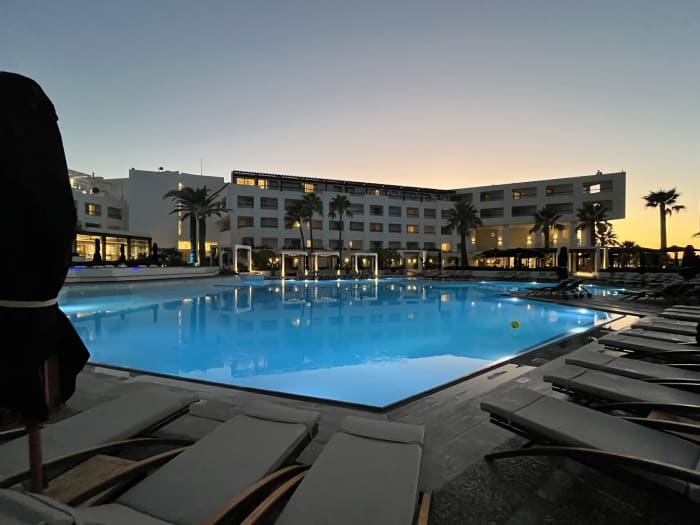
The resort's layout takes full advantage of its relationship with the shore. The gardens play a crucial role, with frangipani trees and palm trees creating a lush environment that softens the scale of the complex. They provide a natural transition between the buildings, relaxation areas, and the beach.
The pools contribute to this variety of experiences. The establishment offers several, including one heated seasonally. The beach, pools, gardens, and communal spaces complement each other, allowing families to enjoy long, fulfilling days. Couples can opt for quieter times or areas to enhance their experience.
The arrival of a new water park, set to open in July, will expand the leisure offerings. It will enrich the experience for families while maintaining the overall comfort of the resort.
Finally, the location benefits from its proximity to Rethymno. This setting allows for a delightful alternation between days by the water and outings in the city. Ancient alleys, Venetian facades, cafés, and evening strolls add another layer of depth to the stay. Creta Palace serves as both a beach hotel and a comfortable base for exploring the urban and maritime charms of Crete.
Rooms and Suites
In a resort of this scale, the room is not merely a place to rest. It must accommodate the various rhythms of the stay.
At Creta Palace, the complete transformation of the property suggests a thorough approach to the accommodations. The overall design prioritises contemporary comfort and a clear interpretation of the spaces.
The spirit is that of a well-conceived five-star seaside establishment. Simple circulation, a bright atmosphere, materials suited to the climate, and a constant connection with the outdoors.
In Crete, a successful room extends the feeling of being on holiday without freezing it in overly demonstrative decor.
A seaside stay calls for a particular aesthetic. The spaces allow light to flood in while maintaining a sense of freshness.
The colour palette remains soothing. The furniture is designed for practical use, from returning from the beach to enjoying a quiet evening.
In a fully reimagined resort, these details matter. Quality bedding, appropriate storage, functional bathrooms, and a clear separation between activity and relaxation.
Luxury here is measured by the absence of friction.
Creta Palace caters to a diverse clientele. This influences the design of the rooms and suites.
Couples seek tranquility, intimacy, and the daily presence of the sea or gardens. Families expect practical configurations and easy circulation.
Children up to 12 years can stay for free in certain rooms, subject to conditions. This family-friendly aspect is well integrated into the accommodations.
In such a venue, views and outdoor extensions are as important as the interior layout. A terrace, balcony, or easy access to gardens can transform the experience of the stay.
In this climate, one willingly spends a large part of the day outdoors. Even with minimal time spent in the room, one appreciates this continuity with the landscape.
Palm trees, the shade of the gardens, sea air, and the light of the late afternoon enhance the experience.
At Creta Palace, comfort takes precedence over decorative effect. The accommodations cater to the diversity of stays, whether for couples or families.
They maintain a cohesive overall feel with the property's renewal. A successful room allows one to reconnect with oneself without breaking away from the place.
Dining
At the Creta Palace, the dining experience is a thoughtfully crafted journey, balancing Cretan roots with more distant inspirations. Each venue presents a clear identity, without dilution.
Labyrinth occupies a central position. As the resort's signature restaurant, it takes its name from Crete's mythological heritage. Here, the dishes engage in a dialogue between Cretan repertoire and global influences, all within an open-minded spirit.
Asiana offers a different rhythm. This restaurant follows the thread of Eastern flavours, creating a spicier, more contrasting journey where the experience begins with aromas.
Trattoria brings forth a direct and warm Italian cuisine. The establishment favours straightforward techniques, featuring handmade pasta and wood-fired pizzas. It is a sincere approach, centred on taste and conviviality.
As daylight wanes, the Sky Bar shifts the perspective. This venue is cherished for its atmosphere oriented towards sunset, perfect for shared drinks and intimate dinners. It cultivates a relaxed elegance, ideal for leisurely evenings.
Together, these options create a coherent offering. Cretan, Eastern, Italian, followed by the sunset bar. A way to vary pleasures without losing the thread of the stay.
Wellness, Pools, and the Rhythm of Your Stay
At the Creta Palace, wellness is integrated into a simple and regular rhythm. It accompanies your stay without overwhelming it.
The Plaza Spa encompasses the essentials within a relaxing atmosphere. The hammam extends the sensation of relaxation, while the sauna provides a drier heat, ideal for a clear break during the day.
These spaces allow for easy alternation between quiet moments and time spent outdoors. The transition from one to the other gives the stay a smooth cadence, without disruption.
The shaded pool offers another way to slow down. Its shade invites for more tranquil swims, away from continuous sun exposure. Here, one finds a measured coolness, pleasant during the brightest hours.
Altogether, this creates a clear balance. A few laps, a moment in the hammam, then the silence of the sauna. The stay then adopts a more relaxed, almost instinctive tempo.
Here, wellness does not seek effect. It rests on simple gestures, clearly designed spaces, and a just alternation between water, heat, and rest.
Concierge & Services
In a five-star resort, the quality of services is assessed by their ability to enhance the stay without overwhelming it. Creta Palace boasts a robust service foundation: 24-hour concierge, 24-hour reception, daily housekeeping, turndown service, luggage storage, laundry, wake-up calls, and multilingual staff. Taken individually, these elements meet expected standards. When combined in a large resort, they ensure a seamless experience.
The concierge plays a central role here. In Rethymno, it does not merely organise transfers or respond to occasional requests. It can shape the stay, help plan daily activities, recommend the best times to explore the city, facilitate reservations, and cater to family needs. It also creates a connection between the comfort of the estate and the richness of its surroundings.
The continuously open reception provides essential flexibility for leisure stays. Late arrivals, early departures, unexpected requests, and last-minute adjustments are part and parcel of life in a large holiday hotel. When functioning well, this availability remains almost invisible, translating into a sense of simplicity.
The room and maintenance services adhere to this same philosophy. Daily cleaning and turndown service are primarily comfort tools. In a seaside hotel, where guests alternate between sand, pool, naps, and returns to their rooms, the quality of housekeeping becomes particularly significant. It ensures a welcoming, clean, and restful private space.
Laundry services and luggage storage meet very practical needs. For families, these services simplify organisation. For travellers extending their itinerary in Crete, they offer a valuable continuity. Multilingual staff are essential in an international resort, facilitating communication and reducing misunderstandings.
The services at Creta Palace are designed to cater to the diverse clientele without rigidity. This is an important quality in an establishment that welcomes couples, families, and guests with varying lengths of stay. The true luxury here lies in the assurance that ordinary needs will be met with consistency, discretion, and efficiency.
The Rethymno way of life
Staying at Creta Palace also means choosing Rethymno, and that choice is not incidental. Among Cretan towns, Rethymno has a particular quality: it combines the obvious appeal of a seaside destination with the depth of an old town. That duality considerably enriches a stay. One may spend the morning between beach and pool, then within a short time reach an urban fabric where Venetian and Ottoman influences remain visible, in weathered façades, narrow lanes, discreet squares and cafés where the day stretches on. For a seafront hotel, such proximity to a town of character changes everything. It avoids the isolation of the pure resort and gives the trip a more nuanced texture.
Rethymno is best discovered on foot, especially in late afternoon and evening, when the light softens. One finds there that Greek way of living outdoors, of making the promenade a daily ritual, of allowing meals to unfold over time. Travellers staying several nights at Creta Palace would do well to alternate resort time with outings into town. This alternation helps reveal contemporary Crete more clearly: a tourist island, certainly, but also an inhabited territory shaped by local habits, markets, cafés, independent shops and a highly visible sociability.
Rethymno’s coastline is also part of this way of life. The sea is not merely a backdrop; it structures the day, movement and moments of pause. Early in the morning it gives the landscape an almost mineral clarity. At midday it becomes an invitation either to swim or to retreat into shade. In the evening it accompanies walks and late dinners. A hotel such as Creta Palace benefits fully from this Mediterranean temporality. It allows guests to enter into it without effort by offering a stable and comfortable point of departure.
Crete more broadly has a strong identity that exceeds postcard imagery. Its relationship to food, hospitality, unhurried time and outdoor living nourishes the travel experience. Even when choosing a large resort, it is worth remaining attentive to these signs: a local pastry tasted in town, a lively terrace at the start of the evening, a simple conversation with a shopkeeper, the way residents occupy public space. It is often these details that give a stay its memory.
Creta Palace has the advantage of offering a setting complete enough for those who wish to rest without a programme, while remaining well placed for a freer discovery of Rethymno. This is a valuable combination. It suits families, who can plan short and easy outings, as well as couples, who may appreciate walks in town after the beach or after dinner.
Ultimately, the Rethymno way of life rests on a form of balance: between sea and town, between heritage and daily life, between organised stay and light improvisation. Creta Palace fits naturally within that balance. It gives access to the Crete of holidays, but also, through its setting, to a more inhabited, more sensitive and more lasting Crete.
Booking via MyConciergeHotel
Booking the Creta Palace through MyConciergeHotel means approaching this resort methodically. A stay prepared with precision, yet without rigidity.
In an establishment of this size, multiple pools, various dining options, a children's programme, and from July, a new water park structure the experience. Anticipation makes a real difference.
It serves not only to secure a room but also to construct a coherent stay that aligns with your travel rhythm. Family holidays during peak season, a romantic getaway, or a longer stay in Crete.
The first challenge is to choose the right time. The summer season is particularly favourable for outdoor activities and is also when demand is highest.
In a resort designed to accommodate families and couples, availability, room configurations, and access to sought-after slots change rapidly. Booking early ensures accommodation security and facilitates stay organisation.
The second point concerns meals and activities. Booking certain experiences in advance avoids last-minute decisions, especially during busy periods.
In a large resort, perceived fluidity often hinges on these details. Knowing where to dine on certain evenings. Identifying the best times to enjoy the pools or the children's programme. Planning an outing to Rethymno without encroaching on downtime.
MyConciergeHotel provides this editorial and practical support. The interest extends beyond mere booking; it lies in the ability to contextualise the venue and assist the traveller in formulating the right requests.
In the case of the Creta Palace, this could mean particular attention to the needs of families with young children, or the desire for a quieter stay as a couple, or the wish to combine resort life with explorations of Rethymno.
Booking with discernment also involves considering the nature of the place. The Creta Palace is a large beach resort. Space, diversity, services, leisure, and on-site life define the experience.
To fully enjoy it, it is wise to think of your stay as a whole. The room, meals, relaxation times, children's activities, and city outings benefit from being articulated in advance.
Thus, booking the Creta Palace through MyConciergeHotel results in a more coherent stay. In a venue where the experience depends on the careful orchestration of time and activities, this support takes on its full meaning.