History & heritage
In Arequipa, history is never mere backdrop: it shapes the city, its light, its materials and even its way of welcoming visitors. CIRQA belongs to that continuity. The property sits within one of the city’s historic quarters, in an urban fabric where mineral façades, patios and restrained lines speak of a culture built over time rather than for effect. The experience begins with the rare feeling of staying somewhere that does not attempt to look old, but naturally belongs to a city whose heritage remains among the most legible in Peru.
Arequipa is often associated with its pale volcanic stone, sillar, which gives local architecture its almost chalky glow and sculptural presence. In that context, CIRQA feels particularly well judged: not as a hotel imposed upon a heritage narrative, but as an address in conversation with the city’s codes. Volumes, textures and the play of shade and light recall the Andean and colonial architectural traditions that shaped the historic centre. The result is neither museum-like nor folkloric. It is a contemporary interpretation, attentive to the spirit of place and to the way hospitality can extend an urban memory.
What makes CIRQA compelling is precisely this balance. The hotel embraces a Peruvian identity, visible in both architecture and interiors, yet without decorative excess. Cultural references are present, legible and at times tactile, but always integrated into a stay designed for the modern traveller. That restraint matters: it allows guests to feel Arequipa without reducing it to a sequence of visual clichés. One senses a local elegance made of honest materials, mineral coolness, quiet and spaces that invite contemplation rather than display.
Its Relais & Châteaux affiliation also helps define its position. That membership suggests a certain idea of travel, grounded in character, cuisine, service and a strong sense of place. In a city where history is everywhere, that philosophy takes on particular resonance. CIRQA does not simply offer five-star comfort; it proposes a way into Arequipa through form, rhythm and material culture. For the traveller, that changes the nature of the stay: it becomes less functional and more of a sensitive reading of the destination.
This relationship with heritage is also felt in the overall atmosphere. CIRQA has the quality of a retreat without being cut off from the city, cultivated without being intimidating. It offers what the best heritage hotels understand well: not the reconstruction of an idealised past, but the chance to inhabit the present in a setting with depth. In Arequipa, where the city is discovered as much through its stone as through its daily life, that depth is part of the truest luxury.
The property
Staying at CIRQA means choosing an address that privileges atmosphere over display. From the moment of arrival, the hotel stands out for a calm, almost monastic relationship to space, material and light. That impression is not austere; it comes instead from a controlled sobriety, very much in tune with Arequipa and with a contemporary idea of luxury that is less demonstrative and more sensory. Walls, circulation areas and shared spaces seem designed to slow the eye. One enters as if into an urban refuge, with the immediate sense that the city remains close, yet its bustle can be held at a distance.
The historic setting is essential here. In an old quarter, the relationship between the hotel and its surroundings is not merely geographical; it is almost organic. CIRQA draws on the principles that make the region’s houses so appealing: thick walls, cool interiors, the importance of patios or breathing spaces, and a constant dialogue between indoors and out. This local architecture rooted in Peru is not a marketing line but a tangible reality. It translates into a very particular kind of comfort, made of quiet, filtered light and proportions that soothe.
The interior design extends that logic. References to Peruvian culture are not treated as decorative quotations; they shape the hotel’s identity. Natural materials, a restrained palette, craftsmanship and locally inspired details form a coherent whole in which nothing seeks to distract from the place itself. CIRQA’s elegance lies in this ability to create a complete world without excess. There is an intelligence to the use of emptiness, texture and rhythm that gives the public spaces a rare quality: they invite conversation as readily as retreat.
This blend of tradition and modern comfort is perhaps one of the property’s most persuasive qualities. Travellers will find the expected codes of a five-star hotel, but in a discreet version, at times almost domestic in feel. Refinement is not staged as performance. It appears in the ease of use, the quality of service and the way spaces support the different moments of a stay: arrival, a pause during the day, returning after sightseeing, dinner, the end of the evening. Each moment seems to have been anticipated without rigidity.
CIRQA therefore suits a variety of travellers. Couples will appreciate its intimate mood, solo guests its sense of life and character, and culture-minded visitors its coherence as a base for discovering Arequipa. Even if one spends little time there during the day, the hotel sets a rhythm. It offers a form of re-centring, particularly valuable in a city whose heritage encourages constant exploration. Returning to CIRQA means returning to an aesthetic and emotional continuity, a place that does not compete with the destination but helps reveal it.
Rooms and Suites
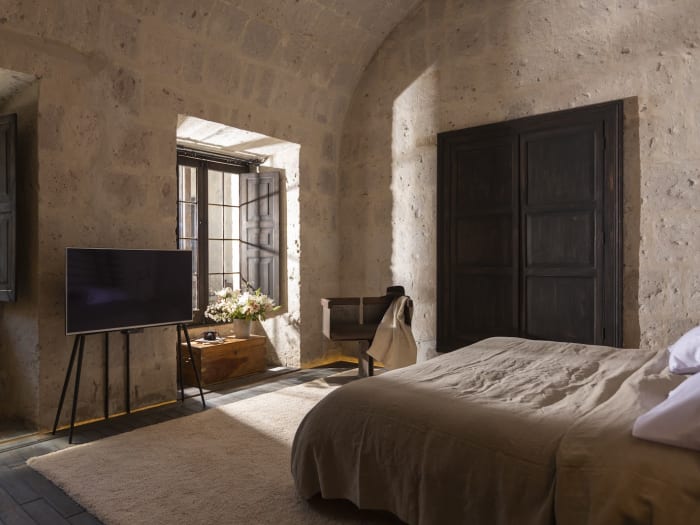
In a hotel like CIRQA, the room extends the architectural narrative of the house. It offers a contemporary interpretation of local heritage, featuring authentic materials and preserved volumes. The rooms and suites provide the traveller with a serene relationship to time. After the vibrancy, light, and contrasts of Arequipa, here one finds a mineral calm.
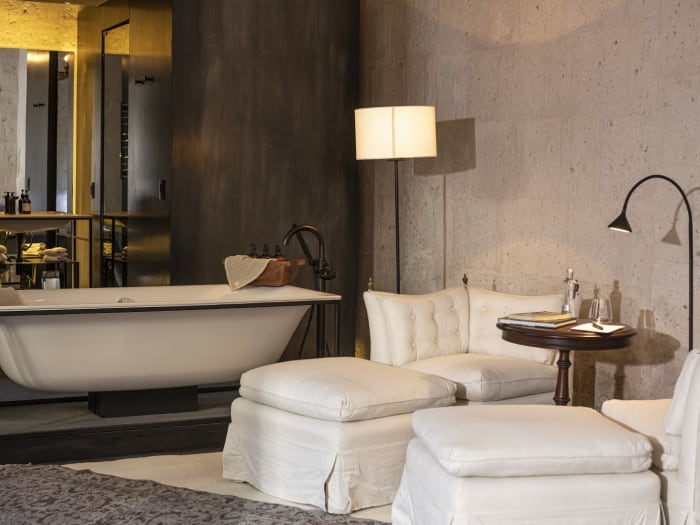
The first comfort often lies in space. In historic buildings, the quality of a room is determined by its proportions, the thickness of the walls, and the light. The interiors, rooted in Peruvian culture, favour coherence over accumulation. Clean lines, a muted palette, natural textures, and measured details compose the whole. This restraint allows for a deeper appreciation of the materials, the coolness of the surfaces, the softness of the linens, and the harmony of the space.
This aesthetic is based on balance. For the traveller, it translates into rooms that do not tire the eye and remain welcoming at all times. One can begin the morning slowly, take a break after visiting the historic centre, or return in the evening to a sense of order and rest. Here, luxury lies in this continuity.
Modern comfort plays an essential role in this experience. It is not just about amenities, but about how they recede to enhance well-being. A good room quietly meets the needs of the stay. Pleasant temperature, quality bedding, attentive maintenance, and evening turndown service. CIRQA embodies this philosophy of discreet service, appreciated by guests seeking serenity and style.
The suites, in this context, offer a more residential experience. In Arequipa, having a larger space changes the way one inhabits the journey. There is more time to read, to contemplate, to let the city in gradually. One of the charms of CIRQA lies here. The stay is not merely about ticking off visits; it is also about inhabiting a place that is just, calm, and rooted in its context.
For couples, these rooms and suites provide an intimate setting without ostentation. For solo travellers, they offer a structured and elegant refuge. For all, they remind us that a great hotel knows how to create a room that lingers in the mind even before leaving the city.
The Dining Experience
In the Relais & Châteaux universe, dining is never a mere ancillary service. It contributes to the identity of the house, just as much as the architecture or the hospitality. At CIRQA, this dimension takes on a particular significance. Arequipa boasts a rich culinary culture, renowned in Peru for the depth of its traditions and the distinctiveness of its regional cuisine.
The hotel’s setting lends itself naturally to this. In a house where local architecture and interior design are intertwined with Peruvian identity, dining becomes another way to engage with the place. Guests do not come merely for a well-executed dinner, but for a continuity of experience. The materials, the light, the rhythm of service, and the attention to ingredients all contribute to this. The dining experience then extends the language of the house, with the same restraint and precision.
Arequipa invites this exploration. The city is known for its strong regional identity. Curious travellers often wish to go beyond the most famous dishes to grasp a culinary culture in its nuances. A hotel of this calibre can play a valuable role. It offers a well-curated and contextualised entry point. Service is of utmost importance here. It accompanies discovery, suggests a rhythm, and guides towards local pairings or specialities.
In the morning, this philosophy can be found in breakfast. In a city where light is so abundant, starting the day in a calm setting is already a luxury. Later, after a day of sightseeing, the dining area can become a place of re-centering. Guests return not only for the cuisine but also for the atmosphere. That of a house that knows how to host without fuss. Exploring the surroundings also allows for the discovery of local cuisine. CIRQA thus engages in a dialogue with the city.
This is where the gastronomic interest of the establishment lies. The hotel provides a coherent setting to savour a certain idea of contemporary Peru while allowing Arequipa to take its rightful place. This approach avoids the pitfall of a gastronomy disconnected from its environment. At CIRQA, dining can become a way to read the place. Understanding the seasons, the products, the habits, the conviviality, and this Peruvian way of making the table a space for sharing.
Concierge & Services
The luxury of a hotel like CIRQA is measured as much by what it showcases as by what it enables. In Arequipa, the services shape the stay. A 24-hour concierge, continuous reception, daily room service, evening turndown, luggage storage, laundry, wake-up calls, and a multilingual team create a seamless experience.
The concierge plays a central role here, guiding guests through the discovery of the city, suggesting an itinerary, reserving a table, or organising transfers. It is often in these interactions that the true quality of a hotel is revealed. An effective concierge understands the traveller and tailors their recommendations accordingly.
The 24-hour reception offers invaluable flexibility, facilitating late arrivals, early departures, and changes to plans. This continuous availability reassures guests and maintains a high standard of hospitality at all times.
Daily room service and evening turndown contribute to a discreet comfort, simplifying the stay without being intrusive. Returning to a tidied room after a day in the city enhances this sense of hospitality. The luggage storage and laundry services extend this logic, proving useful for travellers on the move.
The presence of a multilingual team is also noteworthy, allowing for precise communication and clear recommendations. CIRQA thus brings together the essential services of a grand establishment, delivered in a discreet, attentive, and human manner.
The Art of Living in Arequipa
Choosing CIRQA also means embracing a particular way of experiencing Arequipa. The city is not merely defined by its monuments. It has a unique rhythm, light, and urban texture. From a hotel in the historic district, the experience takes on a special density. One steps out in the morning into a city shaped by the sun, the light stone, and the calm perspectives of the ancient streets. Walking here is less about accumulating stops and more about understanding how architecture, daily practices, and the Andean landscape respond to one another. CIRQA thus becomes an anchoring point. An address that prepares the gaze.
Arequipa captivates with its coherence. Here, many elements converge. Colonial history, regional identity, religious culture, the importance of materials, and the presence of volcanoes compose a unified whole. This coherence is felt in daily life. It is perceived in the squares, cloisters, and façades. The city also offers spaces of retreat amidst its vibrancy. With its local architecture and design rooted in Peruvian culture, CIRQA does not erase this reality. It accompanies it and makes it more legible.
For the traveller, the art of living in Arequipa often involves alternating intensity with retreat. The city beckons exploration. Heritage, markets, street scenes, culinary culture, craftsmanship, and the atmosphere of the old neighbourhoods. Yet it also rewards those who know how to slow down. Sitting in a patio, observing the light on the stone, taking the time for a coffee, returning to the hotel in the mid-afternoon, then heading out for dinner. This economy of the stay is particularly apt here. CIRQA seems designed for this. Its blend of tradition and modern comfort allows for experiencing the destination without excessive fatigue. These moments of pause enrich the experience.
From May to September, the drier season is often appreciated for the clarity of the days and the ease of movement. However, Arequipa is best discovered through availability. One must be willing to notice the details. To be guided by a street, a courtyard, a material, a meal. In this perspective, the role of the hotel is crucial. A good address does not dictate a programme. It creates the conditions for a finer attention. CIRQA seems to fit this definition. It offers a setting that is both protective and open to the city.
This makes it a relevant destination for travellers with varying expectations. Couples will find a city conducive to wandering and extended pauses. Solo travellers will appreciate the clarity of the historic centre. They can enjoy rich days without losing the thread of their stay. Culture enthusiasts will see a dense field for exploration. The hotel is not a refuge cut off from reality, but a sensitive extension of the city. In Arequipa, the art of living is not a formula. It is a way of inhabiting time. CIRQA offers a coherent translation of this.
Booking via MyConciergeHotel
Booking CIRQA through MyConciergeHotel means approaching this address with the right level of support. A character hotel in the historic district of Arequipa is not chosen solely for its five-star status or its affiliation with Relais & Châteaux. It is chosen for the quality of experience it promises and for the coherence between the place, the destination, and the style of travel sought.
CIRQA caters to travellers seeking more than just comfortable accommodation. Some will come for a cultural interlude in one of Peru's most unique cities. Others for a refined stop within a broader itinerary. Still others for the pleasure of staying in a house where architecture and design tell a story about the country.
Booking with discernment involves asking the right questions in advance. Which room category should be prioritised based on the length of stay? Should restaurant reservations be made prior to arrival, especially during high season? How can one best organise arrival and departure times to enjoy the city without constraints? Which services will be most useful depending on whether one is travelling as a couple, alone, or as part of a longer journey through Peru?
In a destination like Arequipa, it is easy to underestimate the richness of the historic centre and the necessity of allowing for rest periods. A few prior decisions can make a significant difference. A good reservation is not merely a price confirmation. It is a matter of coherence. It allows for anticipating expectations, signalling preferences, and thinking about the experience as a whole.
The best time to visit Arequipa generally falls between May and September, when the weather is drier. It is advisable to book in advance during the tourist high season. Hotels with a strong identity, especially those belonging to discerning collections, attract a clientele that often books early. Anticipating allows for securing one's stay and choosing the type of room and pace of travel more comfortably.
Booking CIRQA through MyConciergeHotel also means benefiting from a perspective that places the hotel in its real context. The address is discovered as a situated experience. A contemporary Peruvian house, rooted in the history of Arequipa, designed for travellers sensitive to the character of places. This precision avoids misunderstandings and allows for making the reservation the first act of the journey.