History & sense of place
Castle Hot Springs belongs to that rare category of addresses whose identity does not rely on manufactured spectacle, but on landscape and on a simple promise: to come here in order to slow down. In Morristown, within Arizona’s desert and mountain surroundings, the hotel follows a long tradition of nature-led hospitality in which the setting itself takes precedence. The property’s very name points to the hot springs, a defining element of its character. In the American imagination, this kind of retreat recalls an older culture of restorative travel: one leaves the city behind in search of air, silence, naturally heated water and a deliberate withdrawal from ordinary pace.
What makes Castle Hot Springs compelling is precisely this balance between seclusion and refinement. The hotel does not overplay drama; instead, it allows the contours of the land, the light and the vegetation to do most of the work. That restraint gives the stay a particular tone, more intimate than performative. Luxury here takes the form of reclaimed time: an early walk, shifting colours across the hills, the mineral warmth of the springs, and then a return to attentive hospitality. In that sense, the address fits a very contemporary idea of the destination hotel, one where guests come not merely to sleep, but to inhabit a place.
Its status as a Relais & Châteaux property also says much about its philosophy. The affiliation suggests a certain standard in welcome, detail, environmental awareness and the overall coherence of the guest experience. Here, that translates less into display than into consistency: a preserved natural setting, a peaceful atmosphere, outdoor experiences conceived as a natural extension of the property, and service that accompanies without intruding. For travellers more familiar with grand urban hotels, Castle Hot Springs offers an appealing counterpoint: a form of sophistication expressed through space, discretion and a close relationship with the landscape.
The spirit of the place particularly suits those seeking a retreat for two, or a stay centred on wellbeing in the broadest sense. This is not only about physical relaxation, but about changing one’s rhythm. Silence has a real presence here, as does the sensation of being removed from the usual flow. Far from austere, that feeling creates a gentle conviviality: guests share a common desire for calm, open air and simplicity delivered with care. That is perhaps the hotel’s lasting distinction. More than a hotel, Castle Hot Springs feels like a contemporary refuge in which nature is not a secondary backdrop, but the very heart of the experience.
The property within its landscape
A stay at Castle Hot Springs begins with accepting a geography. Morristown is not the sort of destination one happens upon for a simple overnight stop; one comes because one is looking for somewhere apart, an environment that immediately imposes a different scale of time. The site, described as scenic and peaceful, creates a valuable sense of remove for travellers seeking disconnection. The contours of the land, the open horizon, the dry light and the desert palette form a setting that changes throughout the day without ever needing embellishment.
The property draws much of its character from this immersion. Nature here is not confined to a few views from a terrace: it shapes the day itself. In the morning, cooler air encourages an early start; by daylight, outdoor spaces become privileged vantage points; at sunset, the landscape takes on an almost cinematic depth. This direct relationship with the outdoors explains why the address appeals so strongly to couples and to travellers who want the stay itself to become an experience of restoration. The calm is not an abstract marketing claim: it is perceptible, tangible, almost physical.
Within that context, architecture and layout are expected above all to support the site. At this level, one looks for a hotel that preserves privacy, opens onto the landscape and allows a fluid transition between restful spaces, convivial areas and wellbeing facilities. Castle Hot Springs appears to follow that overall logic: offering a comfortable refuge without breaking its dialogue with the natural surroundings. The result will particularly appeal to guests who prefer destinations with a strong geographical identity over more urban or social addresses.
The presence of hot springs in a natural setting gives the place its most distinctive dimension. They anchor the experience in something elemental and ancient: water, warmth, mineral texture, the body releasing tension. In a resort hotel, many amenities can be reproduced elsewhere; a natural hot spring creates an immediate relationship with the land. That is what makes the address memorable. Guests do not come only for five-star service, but for this precise combination of seclusion, landscape and wellbeing.
For French and European travellers, the experience also carries a particular cultural appeal. It offers access to a very American idea of the high-end retreat, yet without excess. Luxury is legible here in the amount of space, in the quality of attention, in the possibility of living outdoors and in the rare sensation of being genuinely elsewhere. Castle Hot Springs therefore speaks to those who choose a hotel for its rootedness even more than for its image: a place where one comes less to tick off amenities than to inhabit, for a few days, a landscape.
Rooms, suites and the art of retreat
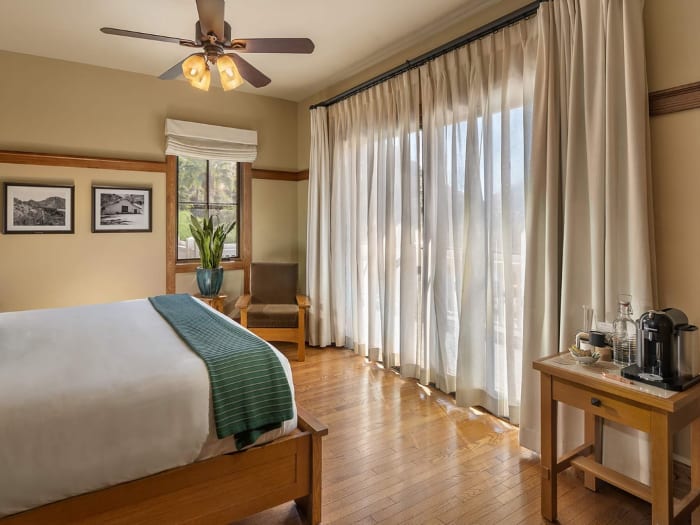
At an address such as Castle Hot Springs, the room is not merely somewhere to sleep: it extends the very idea of retreat. Travellers who choose this property are not necessarily looking for the animation of a grand urban palace, but rather for a carefully considered intimacy able to echo the silence of the site. One therefore expects the accommodation to offer comfort, calm and continuity with the natural surroundings. Even without detailing every category, the overall logic of the experience is clear: returning from an outdoor activity, a session in the hot springs or a walk at sunset, and then finding a private space that genuinely encourages decompression.
Luxury here lies less in accumulation than in rightness. A strong resort room in such a setting should provide breathable proportions, excellent bedding, pleasing materials, a bathroom designed for winding down and a calm relationship with the outdoors. Natural light plays an essential role. In nature destinations, it is not merely an aesthetic advantage: it structures the stay, accompanies early mornings and reinforces the sense of being far removed from ordinary life. Travellers attuned to these details know that successful accommodation does not try to compete with the landscape, but allows it room.
For couples, who appear to be among the hotel’s most natural guests, that dimension matters particularly. A romantic address is not defined by a few predictable codes; it is recognised by its ability to create mental space. Being able to read, rest, share a coffee or simply watch the late-day light without interruption is part of the experience. In this kind of stay, the room becomes a rhythm: one returns to it between moments outdoors, lingers there more than one would in a city, and rediscovers a sense of withdrawal that gives the journey coherence.
The turndown service and daily housekeeping listed among the known amenities reinforce this impression of discreet comfort. Such attentions matter all the more in a destination hotel where guests genuinely spend time in their room or suite. Returning at the end of the day should feel simple, fluid and restful. Nothing should distract from the essential point: the quality of rest. That is often where the success of a wellbeing stay is decided. Activities, landscapes and baths may shape the memory, but it is the room that allows the body to keep pace.
Castle Hot Springs will therefore appeal to travellers who value accommodation conceived as a personal retreat rather than a mere logistical base. In a hotel world often dominated by immediate visual effect, this quieter approach has real value. It is a reminder that a great stay sometimes depends on very simple things: a perfectly calm night, an unhurried awakening, the sense of being sheltered without being cut off from the landscape, and the pleasure of returning to a space of one’s own after a day spent outdoors.
Dining, between nature and the rhythm of the stay
At Castle Hot Springs, dining is best understood as part of the stay rather than as a separate stage. In a nature retreat of this level, guests are not merely looking for a good meal, but for a way of eating that feels in tune with the place, the rhythm of the day and the spirit of the journey. After a morning outdoors, time in the hot springs or an open-air activity, a meal takes on a particular function: it recentres, extends the sense of wellbeing and gives the stay its sensory structure. It is within that continuity that the hotel’s table is best appreciated.
Its Relais & Châteaux affiliation suggests genuine care for the culinary experience, the quality of service in the dining room and the coherence between plate and destination. Without claiming unconfirmed specifics, one may say that such an address appeals to travellers who appreciate restaurants where the context can be felt: cuisine that is clear, suited to the climate, the pace of the stay and the idea of restoration. In a desert environment, freshness, precision, balance and controlled simplicity often make more sense than any overly heavy display. Pleasure then comes from rightness rather than effect.
Breakfast deserves particular attention in a property of this kind. It is not simply the day’s first meal; it shapes the way one enters the landscape. Taking one’s time in the morning, with the light gradually settling across the surroundings, is fully part of the experience. For many travellers, these quiet, almost suspended moments are what remain most vividly in memory. Lunch and dinner accompany different tempos: one lighter and more sunlit, the other more enveloping, suited to conversation and the return to calm.
For couples, dining also plays an obvious relational role. In an address designed for slowing down, the meal becomes a space of shared presence. One reconnects after activities, extends the day and allows conversation to unfold without haste. The attentive service mentioned in the short description finds its full meaning here: the aim is not to theatricalise the moment, but to make it feel fluid. A good hotel table knows how to become memorable without ever distracting from what guests came to seek in the first place: a pause, a breath, a sense of alignment between place and stay.
Ultimately, dining at Castle Hot Springs belongs to an aesthetic of coherence. It will appeal less to those chasing showy addresses than to travellers sensitive to the idea of a meal as a natural extension of landscape and wellbeing. In a hotel where the outdoor experience matters so much, the ideal table is one that accompanies, restores and structures the day intelligently. It is often this discreet exactness that defines the very best stays.
Hot Springs, Well-being, and Reconnection
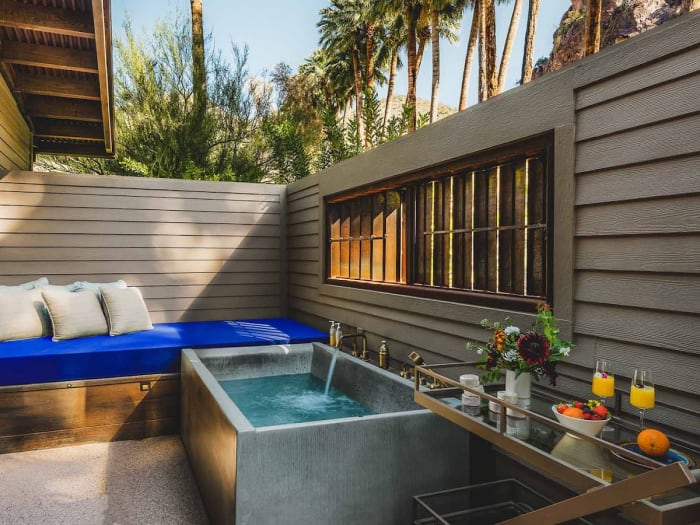
At Castle Hot Springs, the focal point of your stay revolves around the hot springs. Few hotels integrate naturally warm water into a pristine natural environment. Here, relaxation emanates from the very location. It is not merely about indulging in a spa; it is about entering a slower rhythm, guided by water, warmth, and silence.
The hot springs simplify luxury. They evoke primal sensations, experienced here with authenticity. The warmth soothes. The mineral quality of the water asserts itself. Breathing becomes steadier. The landscape sharpens as the body ceases to resist. In Morristown, the experience takes on an almost meditative quality. The contrast between the arid desert and the enveloping presence of hot water creates a strong sensory memory.
Well-being is interpreted here in a broad sense. It does not solely rely on treatments or facilities. The stay is organised around recovery, serenity, and self-care. Outdoor experiences contribute to this philosophy. Walking, breathing, observing, alternating movement with rest. Rejuvenation feels less compartmentalised and more holistic. This approach will appeal to travellers who prefer a more organic sense of well-being.
For couples, the hot springs represent a highlight of their stay. They offer a shared moment of calm, devoid of the need for conversation. This experience is also suitable for solo travellers or those seeking to break free from accumulated fatigue. Castle Hot Springs does not impose a performance of well-being. Each guest can find their own pace. Extended immersion, alternating with outdoor activities, retreating to their room, or simply contemplating the surroundings.
In a world saturated with distractions, this form of slow luxury holds particular value. The hot springs remind us that a successful stay does not hinge on the multitude of options available. It rests on the quality of a central experience, fully embraced. At Castle Hot Springs, well-being arises from this simple truth: being in warm water, surrounded by nature, with enough time for the body and mind to reconnect at the same pace.
Concierge & services, discretion as a signature
In a secluded destination hotel, the quality of service is measured not only by abundance, but by the ability to make a stay feel simple, fluid and frictionless. According to the known information, Castle Hot Springs offers a 24-hour front desk, 24-hour concierge, daily housekeeping, turndown service, luggage storage, laundry service, wake-up service and multilingual staff. Taken individually, these may seem standard for a five-star address; taken together, however, they define an important promise: constant yet discreet support in a place where guests come precisely to shed logistics.
The concierge plays a central role here. In an environment where outdoor experiences are a key part of the stay, the concierge becomes the interface between a guest’s wishes and the realities of the site: the rhythm of the day, the organisation of activities, practical advice and adaptation to changing conditions. A good concierge does not merely respond; it anticipates with tact. It knows when to suggest, when to simplify and when to leave space. In a property oriented towards wellbeing and serenity, that relational intelligence matters as much as efficiency itself.
Daily housekeeping and turndown belong to the same idea of comfort without display. They allow guests to return to a room in a state of order and calm that extends the relaxation they came to find. Laundry and luggage storage, though apparently more practical, also take on particular value during a nature-led stay: they ease transitions, reduce material constraints and make the experience more flexible, especially for travellers combining several stops or wishing to enjoy outdoor activities fully without concern for secondary details.
The presence of multilingual staff also deserves notice. In a property likely to welcome an international clientele, this is not merely a matter of linguistic convenience; it contributes directly to the quality of the welcome. To be understood precisely, and to express a preference, request or specific need without approximation, immediately changes one’s relationship to the stay. Luxury, in its most accurate definition, often consists in removing the small resistances that create unnecessary fatigue.
Finally, the availability of both reception and concierge around the clock is particularly reassuring in a remote setting. It guarantees continuity of presence, essential if seclusion is to remain chosen rather than imposed. That is the difference between simple accommodation in nature and a true five-star hotel: the feeling of being far from everything, without ever being left to oneself. Castle Hot Springs appears to understand that nuance. Its service, as reflected in the available information, speaks to travellers who expect less display than reliability, less theatre than well-judged attention. In contemporary luxury, this form of discretion is often the most persuasive.
The Art of Living in Morristown: Slow Down, Step Outside, Breathe
Morristown is not a city for urban wandering in the European sense. Its art of living is primarily defined by space, climate, and nature.
Choosing Castle Hot Springs means embracing a destination that tells its story less through monuments and more through a connection to the landscape. This distinction is valuable. It encourages deeper observation, less planning, and allows the day to unfold with the light.
In this environment, immersive outdoor experiences take on their full significance. They are not merely entertainment; they represent a way of inhabiting the place. Depending on one’s desires, this may mean walking, contemplating, exploring the surroundings, or simply settling down to face the landscape.
The luxury of this destination often lies in this regained freedom. Not being compelled to hyperactivity. Having the option to choose an active day or one that is almost still. Castle Hot Springs is particularly conducive to a more introspective and sensory interpretation of travel.
For couples, Morristown and its surroundings provide a setting conducive to a retreat. Away from urban centres, attention shifts to simple, memorable experiences. A sunrise. An evening spent in the hot springs. A dinner without excessive background noise. A stroll in the dry desert air.
Travellers seeking rejuvenation will also find here a form of mental hygiene. The desert landscape, in its starkness, clarifies sensations and reduces unnecessary noise. In a world overwhelmed with programmes, this simplicity possesses a deeply luxurious quality. It restores value to elemental experiences: sleeping well, breathing well, eating well, walking, being silent, and observing.
This is perhaps the best way to understand the local art of living at Castle Hot Springs. Not as a list of activities, but as a way to enter a territory. Morristown thus becomes less a point on a map and more a pretext for deceleration. For French travellers accustomed to associating luxury with cultural density or urban sophistication, the experience may come as a surprise. It offers an alternative definition of refinement: space, calm, nature, and a service sufficiently attentive to allow the place to speak for itself.
Book through MyConciergeHotel
Booking Castle Hot Springs through MyConciergeHotel makes particular sense once one understands the nature of the stay being sought. This is not an address chosen merely to compare room categories or optimise a simple stopover; it is a destination in its own right, with a strong experiential dimension. In that context, support at the booking stage becomes especially valuable. It allows the stay to be considered as a whole: ideal length, desired rhythm, the place of outdoor experiences, wellbeing moments, and the specific expectations attached to a journey for two or a true digital and mental retreat.
One essential point with this type of hotel is anticipation. The short description rightly notes that booking ahead is advisable, especially during busier periods. This recommendation is far from incidental. In a high-end retreat where the natural setting, hot springs and peaceful atmosphere are the main draw, availability can become a decisive factor. To plan ahead is not only to secure the stay, but also to give oneself the opportunity to organise its defining moments more intelligently.
Booking through MyConciergeHotel also means approaching the reservation with an editorial perspective rather than a purely transactional one. For a property such as Castle Hot Springs, that nuance matters. Travellers often need help in clarifying their expectations: are they seeking above all absolute calm, a romantic escape, a wellbeing-led stay, or a balance between relaxation and outdoor activity? This work of precision improves the relevance of the choice and, consequently, the quality of the stay. A great destination hotel reveals its full value when it corresponds exactly to the intention behind the trip.
The value of concierge support before arrival also lies in the ability to flag the practical points that genuinely shape the experience. In a remote setting, logistics, arrival timing, preferred pace and particular requests may have more impact than they would in a standardised urban hotel. Being accompanied allows these parameters to become fluid elements rather than sources of friction. It is a simple but decisive way of beginning the stay before departure itself.
Finally, booking through a specialist in luxury hospitality responds to a very contemporary expectation: saving time while making a more accurate choice. Castle Hot Springs appeals to travellers who value serenity, coherence and quality of attention. It is only logical that the booking process should reflect those same principles. MyConciergeHotel fits that approach: helping guests choose not the most visible hotel, but the one best suited to a precise travel desire. For an address as distinctive as this, that mediation makes all the difference. It allows the stay to begin not as a mere reservation, but as the preparation of a genuine retreat.