History & Heritage
Staying at Hotel Castello Banfi - Il Borgo is to step into a Tuscany shaped by time. The experience unfolds within a renowned vineyard, nestled in the heart of Montalcino. This address draws its uniqueness from the connection between built heritage, agricultural land, and the art of hospitality.
The term 'borgo' evokes a historical ensemble, suggesting a continuity between architecture, countryside, and daily rituals. This impression is what prevails upon arrival.
Medieval architecture sets the tone. It is not a reconstructed decor but a legible Tuscan vocabulary. Simple volumes, stone, ancient lines, and a close relationship between interior and landscape. The hotel fits seamlessly into this overarching logic, interpreting it with the comfort and service of a five-star establishment affiliated with Relais & Châteaux.
This affiliation signifies a particular vision of hospitality: attention to place, enhancement of craftsmanship, and a keen sense of detail. It fosters a dialogue between accommodation, gastronomy, and local culture. At Castello Banfi - Il Borgo, this promise takes a coherent form. The vineyard constitutes an essential part of the identity of the estate, structuring the rhythm of the seasons, the interpretation of the landscape, and a portion of the experiences offered.
Montalcino adds an extra layer of depth. This small Tuscan town is associated with a premier winemaking tradition and is steeped in the history of the Sienese hinterland, characterised by fortified villages, agricultural lands, and scenic routes. Choosing Il Borgo means opting for immersion rather than a mere stopover; it invites one to feel the enduring essence of the territory.
The heritage of the place is also reflected in its atmosphere. Here, luxury is primarily expressed through coherence: that of a medieval site carefully reinterpreted, and that of a renowned vineyard that gives a tangible meaning to the stay. For travellers attuned to the notion of a destination in itself, the hotel emerges as a gateway to a cultivated, serene, and inhabited Tuscany.
The property
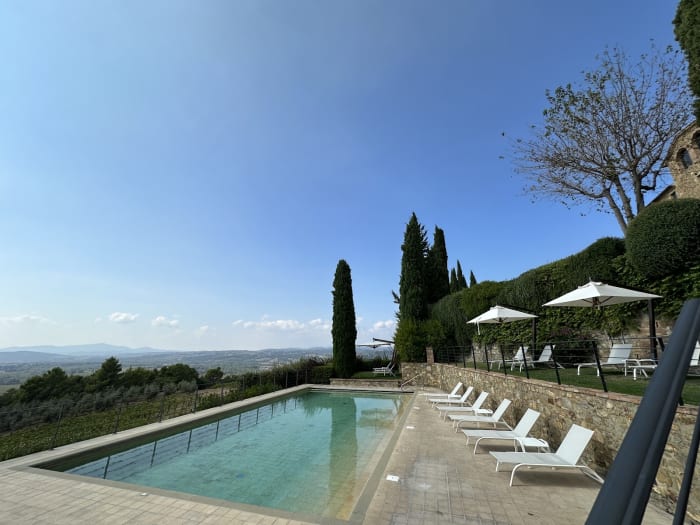
Hotel Castello Banfi - Il Borgo is defined first and foremost by its setting. Being in the heart of the Tuscan hills is not a vague phrase here: it means direct contact with rolling relief, secondary roads threading through vineyards, and a shifting light that transforms the landscape from morning to evening. The estate offers that rare sense of seclusion without complete remoteness. Guests feel removed from noise and urban pace, yet still connected to one of Italy’s most desirable regions for lovers of culture, wine and inhabited countryside.
Arrival is part of the experience. As one approaches Montalcino, Tuscany becomes more mineral, more expansive, almost choreographed by the lines of the hills and the rows of vines. Then the estate comes into view, with its historic architecture and preserved hamlet character. This natural staging never feels contrived; it belongs to the geography itself. The hotel benefits from a privilege much sought after in high-end country hospitality: it is both a destination and a base. One may choose hardly to leave the property, or use it as a starting point for exploring Montalcino and the wider Sienese countryside.
The surrounding wine landscape gives the place a precise identity. The views are not merely scenic backdrops; they speak of cultivated land and seasonal work. The palette changes through the year: fresh greens in spring, luminous density in summer, warmer tones in autumn, when the countryside seems to gather around harvest time and morning mist. For travellers, this seasonal variation matters. It alters the mood of the stay and helps explain why spring and autumn are often considered especially rewarding times to discover the region.
The property itself appears designed to extend that relationship with the landscape. In a house of this kind, circulation, openings, possible terraces and shared spaces all matter when they guide the eye outward. Guests come here to inhabit a site as much as a room. Relative silence, clean air, old stone and vineyard horizons create an immediate sense of release, especially valued by travellers wishing to slow down without sacrificing comfort.
The Relais & Châteaux positioning reinforces this reading. It suggests a characterful address, human in scale, where the experience of place matters more than standardisation. At Il Borgo, that translates into intimacy and continuity: between medieval fabric and contemporary use, between Tuscan countryside and international hospitality, between retreat and discovery.
Rooms and Suites
At Castello Banfi - Il Borgo, the room extends the essence of the place. Here, one inhabits Tuscany for a few days, in a harmonious blend of character, tranquillity, and comfort.
In this former borgo, the rooms and suites maintain a sense of authenticity. They also meet contemporary expectations regarding bedding, privacy, and service.
One anticipates spaces where materials converse with the original architecture. Stone, wood, natural tones, and understated lines evoke the Tuscan countryside without resorting to folklore.
The decor complements the reading of the building. The charm lies in the proportions, the light, the thickness of the walls, and the views of the hills or vineyards.
Luxury here is rooted in the essentials. Silence, carefully chosen bedding, comfortable bathrooms, evening turndown service, and daily maintenance ensure a seamless stay.
In a rural destination, these details matter even more. They facilitate a smooth transition from outdoor days to restful interiors.
The wine-growing setting also influences how one experiences their room. It becomes a sanctuary to return to after a day exploring the Val d’Orcia, visiting a winery, or strolling through the hills.
The room thus transforms into a place of calm. One finds a comfortable temperature and the leisurely pace of successful stays in Tuscany.
For couples, this atmosphere fosters a natural intimacy. For families, a peaceful environment provides a welcome stability between excursions.
In the suites, the experience gains in spaciousness. A sitting area and more generous circulation allow for reading, working, or contemplating the landscape.
At Il Borgo, the expectation is not for ostentatious design. It is rooted in an elegance that is intrinsic to the site.
When choosing a category, it is wise to consider the rhythm of the stay. A romantic getaway calls for a characterful room. A longer stay benefits from prioritising more space.
The allure of Il Borgo lies in this promise. To sleep in a vibrant cultural landscape, in a home where hospitality enhances the place without overshadowing it.
Dining
At Castello Banfi - Il Borgo, dining cannot be separated from wine, nor wine from the territory. That is one of the great strengths of staying on a renowned wine estate: the table takes on a wider meaning than that of a hotel restaurant alone. It becomes a meeting point between landscape, produce, know-how and hospitality. In the Montalcino region, eating and drinking belong to a deeply rooted culture in which quality is measured not only by sophistication but by accuracy of pairing, seasonality and fidelity to an exacting Tuscan tradition.
The property’s medieval setting gives this experience additional depth. A meal served in a place marked by history carries a different resonance from dinner in an interchangeable space. Here, architecture, materials and the rhythm of the surrounding countryside all help establish a different tempo. One takes time. Breakfast may become a moment of contemplation; lunch, a bright pause between visits; dinner, a way of extending the day through local flavours and estate wines. This continuity between outdoors and table is central to the identity of the property.
Local wine tasting is one of the known highlights, and naturally one of the main threads of the stay. For many travellers, coming here means engaging more closely with Tuscan wine culture in an actual production setting. That involves not only tasting but understanding: grape varieties, soils, exposures, seasonal work, and the way an estate expresses its style. When properly led, a tasting is not merely a sequence of glasses; it becomes a reading of the landscape. At Il Borgo, the proximity between accommodation and vineyard gives the experience unusual coherence.
As for cuisine, the natural expectation is a table attentive to Tuscan terroir and ingredient quality. Without claiming unconfirmed details about a chef or accolades, it is fair to say that a Relais & Châteaux house in such a context is generally judged by its ability to translate place onto the plate.
Concierge & Services
At Castello Banfi - Il Borgo, comfort is underpinned by well-orchestrated discretion. A constant presence, precise gestures, and seamless organisation accompany your stay.
The property offers a 24-hour concierge service, a 24-hour reception, daily room service, evening turndown service, luggage storage, laundry service, wake-up calls, and multilingual staff.
In a region like Montalcino, the concierge plays a central role. It assists in booking winery tours, suggesting scenic routes, choosing the right time to explore a nearby village, or adjusting plans according to the weather. It is advisable to book winery visits in advance, as they are often in high demand.
The continuously open reception provides appreciated flexibility. Late arrivals, early departures, and last-minute requests can be managed more serenely. In the Tuscan hills, this availability naturally aligns with the rhythm of travel.
The daily room service and evening turndown service extend this continuity. After a day outdoors, returning to a meticulously tidied room contributes to the balance of the stay.
Laundry and luggage storage services meet very practical needs. They are useful for longer stays, road trips across Italy, or intermediate stops. The wake-up call service remains relevant before a morning excursion, transfer, or scheduled activity.
Multilingual staff also matters. They facilitate communication, whether explaining a tasting, detailing an itinerary, or responding to specific requests.
The services at Il Borgo follow a simple logic: to support the stay without disturbing its serenity. A reliable, continuous assistance tailored to the location.
The art of living in Montalcino
Montalcino is not only a destination for lovers of great wine; it is also a way into Tuscany through its most contemplative side. The local art of living rests on a particular combination of relief, silence, agricultural culture and built beauty. The Tuscan hills, so often invoked, take on a distinctive density around Montalcino: they are not merely beautiful, but worked, inhabited and read through the seasons. Staying at Castello Banfi - Il Borgo allows guests to attune themselves to that rhythm, far from a hurried, checklist version of Tuscany.
The first local luxury is time. It is measured in roads that undulate without straight lines, in villages discovered slowly, in lunches that stretch on, and in late afternoons when the light seems to suspend distance. Travellers who choose Montalcino accept to replace accumulation with attention. Sometimes a simple walk sets the tone for an entire day: observing the vines, sensing changes in altitude, understanding how the landscape opens and closes. This quality of experience, both simple and profound, helps explain the region’s enduring appeal.
Wine, of course, structures much of this way of life. Yet it would be reductive to limit Montalcino to wine alone. Here, wine is a gateway to something broader: a refined rural civilisation in which the table, hospitality, conversation and respect for the seasons form a whole. One learns to taste more slowly, to compare different expressions of the same territory, and to perceive what the landscape says before the first glass is even poured.
Booking via MyConciergeHotel
Booking Castello Banfi - Il Borgo through MyConciergeHotel means approaching this destination methodically. A stay here requires more attention than a standard urban hotel. The choice of season, pace, room, and reserved experiences profoundly influences the journey.
The first point to consider is the season. In spring, the countryside regains its freshness, and the days invite walks. In autumn, the region gains visual depth, particularly for travellers attuned to the world of wine. Summer enchants with its light and outdoor life but often requires more foresight. During peak season, demand can be high. It is advisable to book early, especially if the stay includes winery visits.
The second consideration pertains to the construction of the itinerary. At Il Borgo, it is wise not to overload the days. The charm of the place lies in the balance between discovery and retreat. MyConciergeHotel can assist in defining this tempo. Plan for an early arrival, book a tasting, and allow time for dining and enjoying the landscape. In Montalcino, the quality of the stay depends less on the number of activities than on their coherence.
Winery visits should be booked in advance. They are highly sought after and often feature among the highlights of the stay. Engaging with MyConciergeHotel allows for securing these in advance and crafting a coherent itinerary. Depending on your profile, it may also be wise to keep some free time to explore the surroundings, enjoy lunch in the region, or relish the tranquillity of the estate.
Booking with assistance also presents logistical advantages. In a rural setting, details matter more. Arrival times, specific needs, coordination of a couple's or family stay, and particular requests related to the pace of travel are all significant. The presence of a 24-hour reception and concierge on-site ensures continuity. Preparation in advance allows for arriving in the best conditions. This is especially true for international travellers or those incorporating Montalcino into a broader itinerary in Italy.
Booking via MyConciergeHotel also means choosing a more accurate understanding of the stay. It is not merely about reserving a room. It is about grasping what makes this address unique: its medieval architecture, its affiliation with a wine estate, its atmosphere of Tuscan retreat, and its suitability for both romantic getaways and family stays.