History & heritage
Perched above Merano, Hotel Castel Fragsburg belongs to an Alpine tradition in which hospitality begins with a relationship to the landscape. The very name suggests an old stronghold overlooking gardens, orchards and the mountain scenery of South Tyrol. Rather than turning history into theatre, the hotel cultivates continuity: that of a characterful residence transformed into a refined retreat, where guests come less to be seen than to inhabit a place. This distinction matters. In a destination long associated with spa culture, promenades and a gentle climate, Castel Fragsburg offers a more secluded, contemplative interpretation of the grand hotel.
Its membership of Relais & Châteaux helps define that identity. It signals not only a level of service, but also a house philosophy rooted in human scale, a strong sense of place and attention to meaningful detail rather than display. Luxury here is expressed through balance: architecture in dialogue with its surroundings, interiors that privilege light and quiet, and service that is attentive without becoming formal. The appeal of the address lies precisely in this equilibrium between heritage and contemporary comfort. One senses the depth of the place, yet never as a constraint. The past provides a frame, not a frozen set.
Merano offers a particular context. Historically sought after for its climate and leisurely way of life, the town has long attracted travellers in search of fresh air, gardens and calm. Castel Fragsburg extends that legacy while giving it a more intimate dimension. Where some historic hotels in the region embrace thermal grandeur or urban elegance, this house favours distance, elevation and the feeling of being slightly apart. That position creates a different rhythm: guests slow down, watch the changing light over the mountains around Merano, and rediscover the value of a stay shaped by walking, meals and rest.
The heritage of Castel Fragsburg is therefore not only architectural. It is also cultural, rooted in a distinctly local way of bringing together Italian influences and Alpine tradition, refined hospitality and a simple relationship with nature, regional cooking and polished service. The result is never ostentatious. It speaks to travellers who value hotels with a legible personality, where a true sense of place has been preserved. In the landscape of high-end hospitality, that is a rare quality: an establishment that does not seek to reinvent itself every season, but to deepen what it already is. Castel Fragsburg emerges as an address of continuity, calm and fidelity to its setting — a house that turns its history into a discreet art of welcoming.
The Establishment
What strikes you first at Castel Fragsburg is the sense of space. Not the monumental expanse of a large resort, but rather the feeling of being perched above, open to the surrounding mountains of Merano. The view stretches far, the air flows freely, and the light shifts throughout the hours. This direct relationship with the landscape is one of the privileges of this location. You are not merely in Merano; you observe it from a secluded vantage point. Mornings begin with sharp ridge lines in the fresh air, extending into late afternoons where the colours warm on the slopes.
The natural environment plays an essential role here. The hotel caters to travellers seeking tranquillity without the sensation of sterile isolation. The site acts as a threshold between various uses of the land: walking, exploring the surroundings, embarking on excursions into the alpine landscapes, and then returning to a human-scale home. Access to hiking trails is one of the most tangible advantages of the stay. Simply stepping out of the hotel allows you to enter a different rhythm, that of paths, woodlands, panoramas, and altitude variations. This proximity to nature shapes the experience.
The architecture and communal spaces further enhance this immersion. The terraces, openings, lounges, and relaxation areas become transitional spaces between the intimacy of the room and the grandeur of the landscape. Enjoying a coffee facing the mountains, reading in the silence of the garden, or dining as dusk falls over the ridges: here, these moments hold a special significance.
The intimate atmosphere is reflected in a homely scale, fluid circulation, and spaces designed for habitation. Here, luxury is not measured by abundance but by the quality of presence that the place allows. Couples find a conducive setting for retreat. The hotel also appeals to those who associate travel with a form of re-centering. One comes to breathe, to shed the noise, and to regain a finer attention to the surroundings.
This location above Merano allows for the rare combination of two pleasures: immediate nature and the proximity of an elegant resort town. You can dedicate a day to strolls, gardens, or local discoveries, then return to the calm of the castle. This alternation is at the heart of the Castel Fragsburg experience. It provides the stay with a precious flexibility, balancing contemplation, movement, and a return to silence.
Rooms and suites
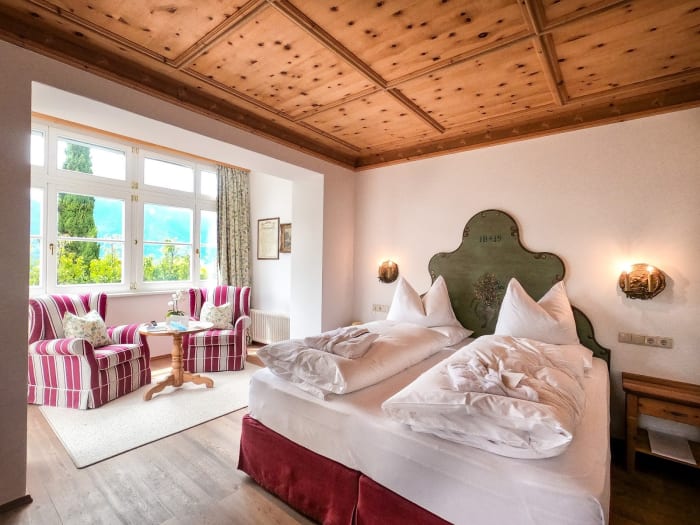
At Castel Fragsburg, the room is not merely a stop between activities; it is integral to the sense of retreat that defines the house. In a hotel of this kind, one expects less decorative display than a feeling of rightness: comfortable proportions, well-handled light, reassuring materials and, above all, the impression that the landscape continues to exist from within. The advice to book a room with mountain views is especially relevant here. In Merano, the view is not an incidental extra; it becomes part of the stay, almost a quiet presence accompanying slow mornings and the return from walks.
The spirit of the rooms and suites is likely in keeping with the rest of the property: discreet refinement, genuine comfort and attention to detail rather than accumulation of effects. In an intimate address, successful accommodation often depends on balancing privacy with openness. Guests appreciate being able to withdraw, read, rest and prolong the calm of the outdoors while still enjoying the level of service expected of a five-star house. Turndown service, daily housekeeping and the availability of an attentive team all contribute to this ease of use, often more decisively than any overt sign of luxury.
For couples, one of the hotel’s most natural audiences, the room becomes the setting for a stay designed for two without ostentation. The aim is not necessarily to multiply amenities, but to create the right atmosphere: gentle rhythms, a sense of shelter and continuity between interior comfort and the serenity of the site. Suites, for those wishing to extend the experience, generally answer a desire for more space, a broader pace and moments lived without haste. In a place like Castel Fragsburg, extra square metres mainly mean more time for oneself and greater freedom in how the day is inhabited.
Attention to detail is also visible in what one does not immediately notice: the smoothness of service, the preparation of the room in the evening, the discretion of the staff and the ability to anticipate needs without intruding on private space. This is one of the most reliable hallmarks of fine hospitality. Comfort is not limited to furnishings; it lies in the absence of friction, in the sense that everything is in place to allow rest. After a hike or a day spent exploring Merano and its surroundings, returning to a quiet, orderly room open to the landscape can feel deeply restorative.
Ultimately, the rooms and suites at Castel Fragsburg derive much of their value from the relationship they create with time. Guests often linger longer than expected because the spaces invite them to slow down. Opening the curtains onto the mountains, letting in the morning air, taking an afternoon pause, watching the evening light: these simple gestures become perceptible again in a place designed for repose. The accommodation is not only comfortable; it offers a setting for a renewed quality of presence, which may well be one of the most convincing definitions of contemporary luxury.
The Dining Experience
Gastronomy holds a natural place in the Castel Fragsburg experience, extending the identity of the venue. In a Relais & Châteaux establishment, the dining experience contributes to the interpretation of the region. In Merano, located in South Tyrol, it embodies the convergence of multiple heritages. Alpine culture, mountain seasons, Italian influences, and regional produce intertwine here, giving rise to a cuisine that is rooted, accessible, and capable of translating a landscape into flavours.
Here, meals also set the rhythm of your stay. After a walk along the surrounding trails or a restful afternoon, the dining area becomes a serene gathering place. It radiates the warmth of home and the precision of service. While the decor matters, the atmosphere takes precedence. Serenity, attentiveness to the meal's tempo, and the freedom to take your time are paramount. This chosen slowness aligns perfectly with the spirit of an intimate hotel.
The emphasis on local produce calls for a cuisine that is attentive to the seasons and freshness. In this region, it showcases vegetables, herbs, fruits, and traditional Alpine preparations alongside Italian cuisine. More than just a catalogue of ingredients, it represents a way of cooking. Respecting origins, avoiding artifice, and allowing flavours to express themselves clearly. For the traveller, this approach offers a taste of the locale without any folklore.
Breakfast also deserves special attention. In a hotel open to the mountains, it takes on an almost ceremonial value, especially against the backdrop of the landscape. The morning light on the peaks sets the tone for the stay. Quality is less about abundance and more about selection, freshness, and coherence with the spirit of the house. Here, a good breakfast is meant to be just, generous, and calming.
Finally, the dining experience at Castel Fragsburg is part of a broader concept of hospitality. Personalised service finds a natural outlet here. Recommending a wine, adjusting the pace, considering preferences, or recognising the habits of long-staying guests. These gestures lend the meal its authenticity. In a setting where nature, tranquillity, and intimacy are central, gastronomy remains true to the hotel. A characterful establishment, rooted in its landscape, attentive to the quality of every moment.
Spa & Well-being
At Castel Fragsburg, well-being is approached as a continuum rather than a departure. This is not a place to escape the world, but rather to extend the effects of a soothing environment. Set against a picturesque landscape, the spa complements what the mountains, silence, and light have already initiated: a slowing down of the body, heightened awareness, and a rediscovered breath.
This philosophy finds a natural home in Merano, a destination synonymous with leisure, self-care, and a lifestyle rooted in balance. Castel Fragsburg offers a more intimate interpretation of this concept. Here, well-being transcends a mere checklist of facilities; it is woven into an experience characterised by tranquility, unobstructed views, fresh air, and reclaimed time. After a hike, a gentle stroll, or a day spent exploring the surroundings, returning to the spa feels like a natural progression.
In such an establishment, the wellness experience resonates with the scale of the hotel. One expects not so much a spectacular effect but a quality of atmosphere: peaceful spaces, a controlled pace, attentive hospitality, and the genuine opportunity to truly retreat. For couples, this dimension is particularly significant. The spa becomes a shared sanctuary, embodying a form of quiet luxury that is true to the identity of Castel Fragsburg. For solo travellers, it provides a space for re-centering after the demands of travel and daily life.
Personalised service takes on special importance here. In the realm of well-being, the distinction often lies in the ability to tailor the experience: advising on the right moment, guiding towards an appropriate treatment, and understanding whether the guest seeks recovery, deep relaxation, or simply a moment of pause. Care is not solely technical; it is also relational.
Finally, well-being at Castel Fragsburg extends beyond the spa. It permeates the entire stay: in the quality of sleep, in the silence of the rooms, in the possibility of walking directly from the hotel, and in the emphasis placed on nature and contemplation. Thus, the spa becomes the visible heart of a broader equilibrium, that of a house designed to help its guests rediscover a more harmonious rhythm.
Concierge & Services
At Castel Fragsburg, the service does not aim to be spectacular. Instead, it seeks to provide a seamless, comprehensible, and profoundly comfortable stay.
The offerings include 24-hour concierge service, 24-hour reception, daily housekeeping, turn-down service, luggage storage, laundry, wake-up calls, and multilingual staff. Together, they create an experience where the traveller need not worry about the practical aspects of their stay.
The concierge plays a significant role here. The hotel lends itself to walks, hikes, local discoveries, moments of relaxation, as well as organising transfers or outings depending on the season.
In a natural environment like Merano, a good concierge tailors their recommendations to the actual pace of the guests. Some may set off early on the trails, while others might prefer a more leisurely day, balancing city exploration, a relaxed lunch, and a return to the spa.
The reception and concierge, available 24/7, provide discreet security. Late arrivals, early departures, requests for assistance, or adjustments to an itinerary are handled with ease.
Room services also contribute to this overall impression. Daily housekeeping ensures a continuity of comfort, while the turn-down service prepares the room for the night.
Laundry, luggage storage, and wake-up calls practically simplify the stay. They are particularly useful for travellers on the move, those arriving after a long journey, or those departing early to explore the region.
Multilingual staff is essential in an international destination like Merano. They contribute to a welcoming quality where guests feel understood, guided, and supported.
In a characterful establishment, the most appropriate service maintains a respectful distance. Attentive without being intrusive, precise without rigidity, warm without forced familiarity. Castel Fragsburg embodies this tradition.
The Art of Living in Merano
Staying at Castel Fragsburg means discovering a particular vision of Merano, at the crossroads of several influences. Here, Italy converses with the alpine world. The gentleness of walks complements the verticality of the terrain. The resort remains close to the mountains.
Merano is not merely a starting point for excursions; it is a place where one can modulate their time. Visitors seek out gardens, promenades, terraces, markets, and landscapes, before returning, at the end of the day, to the more secluded calm of Castel Fragsburg.
The hotel's location encourages this interpretation of the destination. With easy access to trails, walking enthusiasts place nature at the heart of their stay. One can transition from a refined hotel to a mountain path in no time. The surroundings of Merano lend themselves to this alternation between gentle effort and contemplation.
However, Merano is not limited to hiking. Its art of living is characterised by a quiet elegance. The city is best discovered on foot, in successive touches. There is space for the serendipity of views, façades, gardens, and pauses. For the travellers of Castel Fragsburg, this urban dimension offers a counterpoint to the hotel’s retreat.
The seasons naturally alter the experience. Summer lends itself to exploring the surroundings, walking, and outdoor living. Winter opens the perspective of mountain-related activities, particularly skiing nearby. This seasonal variation broadens Merano's appeal.
From Castel Fragsburg, the art of living in Merano rests on a simple idea. Comfort is intertwined with its environment. One eats locally, walks easily, contemplates extensively, and rests better. The stay is structured around enduring and measured pleasures. Merano, as seen from the heights of Castel Fragsburg, becomes a way of inhabiting travel with greater calm and presence.
Book with MyConciergeHotel
Booking Castel Fragsburg through MyConciergeHotel means approaching the property in the right spirit: that of a stay planned with precision, without losing the simplicity that gives the place its charm. A hotel like this is not chosen only for its five-star status or its membership of Relais & Châteaux. It is chosen for a subtler combination: an intimate atmosphere, a calming natural setting, remarkable views over the mountains around Merano, and direct access to a destination where walking, wellbeing and local gastronomy form a coherent way of life. Booking therefore benefits from guidance, so that the stay can be matched to the traveller’s real profile.
One of the first decisions naturally concerns the room. In this house, orientation and view matter greatly; the advice to favour a mountain-view room should be taken seriously. That choice can transform the quality of the stay, especially for a couple’s trip or a visit centred on rest. Booking with support also helps determine the right time to travel. Summer is ideal for hiking and exploring the surroundings in particularly pleasant conditions, while winter will suit those wishing to combine hotel calm with nearby mountain pursuits. Between these two poles, the shoulder seasons may appeal to travellers sensitive to light, tranquillity and a gentler pace.
Using MyConciergeHotel also makes it possible to think about the stay as a whole. At Castel Fragsburg, the experience goes beyond the overnight stay. It may be useful to organise relaxation time, meals, special requests, arrival and departure schedules, and even suggested itineraries around Merano in advance. This preparation is not rigid; on the contrary, it is intended to preserve fluidity once on site. The more a hotel is oriented towards calm and personalisation, the more valuable it is to arrive with certain choices already clarified, while still keeping the freedom to improvise according to the weather, one’s energy or the simple wish to do nothing at all.
For couples, Castel Fragsburg is especially relevant when seeking a characterful address that is secluded without being remote, refined without feeling cold. For travellers drawn to nature, easy access to hiking trails is a concrete advantage. For those prioritising wellbeing, dedicated relaxation facilities complete the experience in a natural way. And for guests attentive to the quality of the table, the emphasis on local produce gives a clear direction to the hotel’s culinary identity.
Finally, booking through MyConciergeHotel means benefiting from both an editorial and a practical perspective. The aim is not merely to secure a room, but to ensure that the property corresponds exactly to what is being sought: silence, views, intimacy, personalised service, access to nature and a soothing rhythm. In the case of Castel Fragsburg, that fit is essential. It is a house that reveals itself fully to those who come in search of the right thing: not the bustle of visible luxury, but the rare quality of a stay in the heights, oriented towards landscape, rest and a form of beauty lived with discretion.