History & heritage
Casa de São Lourenço belongs first to a landscape before it belongs to hotel history. Here, the story begins with the Serra da Estrela, the great mountain range of central Portugal, a territory of granite, deep valleys, high pastures and villages long shaped by the seasons. Manteigas, set against the slopes, still preserves that direct relationship with the land. One comes here not to withdraw from the world entirely, but to recover a slower, more attentive scale of living. The hotel makes sense within that continuity. It is not merely a place to stay; it participates in a way of inhabiting the mountains, of watching the light move across the ridges, of listening to silence and understanding the force of the region.
Its place within Relais & Châteaux helps define that identity. Membership in the collection does not suggest display for its own sake, but rather a certain idea of hospitality: a house of character, rooted in its setting, attentive to the table, to service and to the overall experience of place. That implies a sensitive reading of local heritage, not as decoration but as living material. In a region where craftsmanship, mountain produce and rural traditions still matter, the hotel naturally aligns itself with a culture of welcome that values sincerity over show.
The property’s heritage is also felt in its relationship with architecture and interiors. In the Portuguese mountains, buildings have long been conceived in dialogue with the climate: protective walls, openings that frame the landscape, spaces designed for warmth in winter and ease in summer. Without venturing into specifics that would require firmer sourcing, it is fair to say that the spirit of the house extends that intelligence of place. Luxury here takes a measured, tactile form, one that privileges materials, natural light, views and quiet comfort.
What ultimately sets the address apart is the way it turns a stay into an experience of territory. In many mountain hotels, nature remains a backdrop. Here, it genuinely shapes the rhythm of travel. In the morning, the Serra da Estrela asserts itself through crisp air and clear lines; by day, it invites walking, observing and venturing out; by evening, it restores the idea of refuge. That alternation between openness and retreat gives Casa de São Lourenço unusual depth. The hotel does not attempt to compete with the landscape; it accompanies it, reveals it and, in a sense, interprets it.
For the traveller, this heritage translates into a rare feeling: that of being welcomed into a house that could not exist elsewhere. The name, the site, the atmosphere, the cuisine and the promise of wellbeing form a coherent whole. In a hotel world often shaped by standardisation, that coherence matters. It gives the stay a density one remembers long after departure, not as a dramatic spectacle, but as a lasting impression of rightness.
The Establishment
Staying at Casa de São Lourenço means choosing a hotel where the primary quality is its relationship with the landscape. Nestled in the heart of the Serra da Estrela, the establishment benefits from an environment that immediately imprints its character on the stay. The contours, the vegetation, the crisp air, and the changing light create a sense of retreat without complete isolation. One feels distanced from urban rhythms yet connected to a vibrant territory, traversed by paths, mountain roads, and a still-present local culture.
This address first captivates with its sense of obviousness. In such a setting, a large hotel might fall into ostentation or excessive rusticity. Casa de São Lourenço opts for a more balanced approach. It offers high-end comfort that allows the site to speak for itself. The gaze is naturally drawn to the outside, towards the mountain lines and the open perspectives. The communal spaces also play an essential role, providing areas for pause, reading, conversation, or contemplation.
The warm and friendly atmosphere aligns with what one expects from a successful mountain retreat. Here, luxury is not solely measured by equipment or service. It lies in the ability of the place to make its guests feel at ease. This is achieved through welcoming volumes, tasteful decor without ostentation, and an overall impression of calm. After a day spent outdoors, this quality of hospitality becomes even more pronounced. One returns to a home designed as a contemporary refuge.
The setting naturally lends itself to outdoor activities. The Serra da Estrela is associated with hiking, nature observation, scenic routes, and various uses depending on the seasons. The hotel serves as a relevant base for travellers wishing to alternate exploration and relaxation. Couples seeking a contemplative stay, families drawn to wide-open spaces, walking enthusiasts, or travellers eager to breathe can find their rhythm here.
It is also important to highlight the sensory dimension of the place. In mountain destinations, the experience is not solely about the view. It encompasses the temperature of the air in the early morning, the denser silence in the evening, the scent of woods and herbs, and the contrast between the mineral exterior and the interior comfort. Casa de São Lourenço is designed to amplify this sensitive reading of the site. The stay thus becomes an immersion in a Portuguese landscape still preserved from the most uniform tourist codes.
The establishment caters to travellers who seek less a scene than a presence. The presence of the territory, the presence of long time, the presence of hospitality expressed with simplicity. It is this restraint, combined with a level of comfort that is five-star, that makes the house unique.
Rooms and Suites
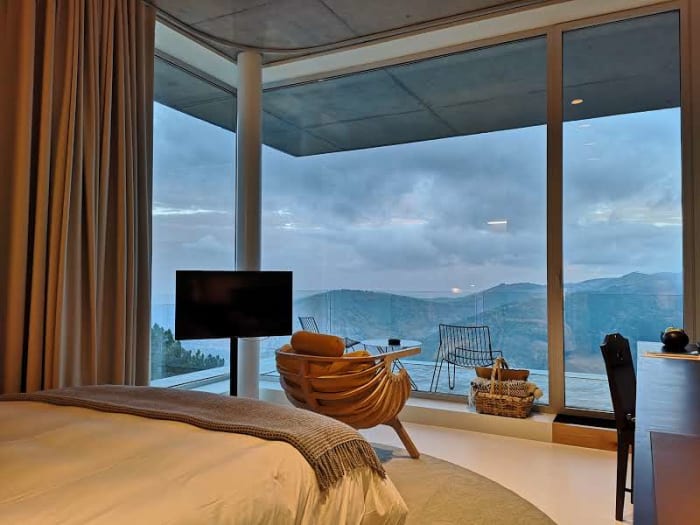
At Casa de São Lourenço, the room extends the landscape and the rhythm of the stay. It invites rest, reading, and observation.
The spirit of the rooms and suites aligns with the identity of the house. One finds a sober elegance, attentive to materials, light, and the clarity of spaces.
In the mountains, the essential lies in immediate tranquillity. The bedding, acoustics, temperature, and lighting all contribute to this. Nothing distracts, nothing fatigues; everything invites one to settle down.
In the Serra da Estrela, the landscape changes with the hours, the mists, and the seasons. A well-designed room thus becomes an intimate observatory. In the morning, the light is bright. In the evening, the contours soften. At night, the calm of the site prevails.
The rooms and suites cater to different uses. A couple will find a discreet retreat. A family will appreciate a comfortable anchor between outings. In both cases, the decor narrates the place without compromising daily comfort.
The nightly turndown service and daily maintenance reinforce this impression of constant care. Returning to a perfectly tidied room extends the continuity of comfort.
Ultimately, the rooms and suites at Casa de São Lourenço prioritise a form of luxury focused on rest. In a destination where the outdoors plays a major role, the quality of the interior remains essential.
The Table
Gastronomy plays a decisive role in the experience at Casa de São Lourenço. The local cuisine, centred on regional products, connects the traveller to the territory.
The Serra da Estrela boasts a strong culinary identity. It is shaped by altitude, livestock, seasons, gardens, herbs, and conservation traditions. A successful cuisine does not seek to erase this origin; rather, it highlights it with precision.
The interest of a Relais & Châteaux address often lies in its ability to harmonise hotel standards with local culture. One expects a refined interpretation of the regional repertoire here, based on products that tell the story of the Portuguese mountains.
This may involve iconic ingredients from the interior of the country, preparations inspired by local practices, or a more contemporary approach that remains true to authentic flavours, seasonality, and the clarity of the plate.
Dining takes on a special dimension in an environment like Manteigas. After a day of walking, exploring, or contemplation, the table extends the sense of place.
A well-thought-out dining room, measured service, a concise menu, and a breakfast that encourages one to take their time—these are often the elements that leave a lasting impression on a stay.
In mountain destinations, the gustatory memory is linked to the sensation of comfort. A hot dish, a robust texture, a well-prepared local product, an inspired dessert—these details compose a coherent experience.
Local cuisine is also a way to open up the journey. For international guests, it offers a gateway to the interior of Portugal. For travellers familiar with the country, it reveals a more discreet and mountainous facet.
In both cases, the table becomes a language. It tells the stories of landscapes, practices, seasons, as well as a relationship with work, proximity, and transmission.
The warm atmosphere naturally extends to the restaurant. A large hotel table does not need to be solemn to be memorable; it often benefits from maintaining a sense of conviviality.
The ideal service is present without being intrusive. It advises without imposing. It accompanies the meal with ease.
At Casa de São Lourenço, the table is an integral part of the house's identity. It is neither accessory nor decorative; it is one of the most direct means of understanding where one is. In a hotel where the landscape matters just as much, eating local is a way of staying more authentically.
Wellness & Breathing
At Casa de São Lourenço, wellness is seamlessly woven into the experience of the place. In the mountains, it transcends mere facilities.
It emerges from the surroundings, the silence, the air, and a rediscovered rhythm. The Serra da Estrela offers that sought-after quality of decompression for many travellers.
To slow down, to walk, to sleep better, to let one’s gaze wander into the distance. To rediscover the simple effects of a preserved environment.
Here, wellness begins upon arrival, in the quality of the welcome and the support provided. It continues in the communal spaces and in the room, designed as a refuge.
The stay allows for a balance between physical activity and recovery. This holistic approach to comfort fosters a deeper rejuvenation.
The mountain setting enhances this sensation. After a hike or a day spent outdoors, the body craves calm, warmth, and relaxation.
The spaces dedicated to wellness then take on their full significance, whether for rest, treatment, contemplation, or a more personal routine.
In the finest nature hotels, wellness is not separate from the rest of the experience; it is its logical extension.
Wellness here also has a mental dimension. Travellers who choose Manteigas and the Serra da Estrela often seek a form of re-centering.
The landscape contributes significantly to this. The open lines, changing light, and the presence of the elements restore inner space.
In this perspective, the experience relies less on performance and more on coherence. To sleep well, to eat well, to walk, to breathe, to take one’s time.
To benefit from discreet service and to rediscover the taste of silence. It is often the simplest gestures that leave the most lasting effects.
Wellness also takes on a seasonal tone here. In spring and summer, the mountains invite movement and openness.
In the cooler seasons, they call for retreat, comfort, and warmth. Casa de São Lourenço adeptly accompanies these variations.
This address thus appeals to travellers in search of tranquility. Here, one experiences the mountains not as a performance, but as a breath.
Concierge & Services
In a five-star mountain hotel, the quality of service is measured by its ability to anticipate needs. Casa de São Lourenço offers a 24-hour concierge, a continuously open reception, daily room service, turndown service, luggage storage, laundry service, wake-up calls, and a multilingual team. Together, these services create a genuine fluidity, invaluable in a destination where the stay combines relaxation, excursions, and practical organisation.
The 24-hour reception and concierge are particularly useful in this context. In the mountains, days do not always follow an urban rhythm. One might leave early, return late, request last-minute advice, or simple logistical assistance. The continuous presence of a team reassures and simplifies the experience. Here, luxury takes the form of discreet availability.
The concierge also plays a role as an interface with the territory. In the Serra da Estrela, the quality of the stay often depends on well-adjusted recommendations. Which trail to choose depending on the season, when to go to enjoy certain views, how to balance walking and resting, which villages or routes are worth a detour. A good concierge service does not merely respond; it guides with precision.
The daily room service and turndown service enhance the comfort of the stay. They maintain a constant quality, useful when alternating between outdoor activities and relaxation. Returning to a perfectly maintained room after a walk contributes to the experience. The laundry service, luggage storage, and wake-up calls also meet very concrete needs, especially during multi-night stays.
The multilingual team deserves special mention. In a Relais & Châteaux house, it makes the welcome smoother for an international clientele. It also helps to preserve a personal relationship with each guest. Good service is not only efficient; it remains clear, natural, and tailored to the person in front of them.
Ultimately, the services at Casa de São Lourenço reflect a clear philosophy: to facilitate without overwhelming. In the best nature hotels, the staff removes friction and makes the days simpler. This discreet quality often matters just as much as the decor or location in the memory of the stay.
The Art of Living in Manteigas
Manteigas is not a place to be discovered in haste. It is a small mountain town where one enters through its atmosphere.
Its charm lies in its location within the Serra da Estrela. This is complemented by the beauty of the valleys, the culture of the highlands, and a distinctly Portuguese sense of sobriety.
Staying at Casa de São Lourenço means embracing this art of living. Here, nature is not a mere backdrop; it forms the very essence of local life.
The first luxury of Manteigas is time. Days here are simple yet fulfilling. Waking up to mountain views, enjoying a leisurely breakfast, taking a walk, and pausing in a village.
Then, returning to the hotel to read or relax. Finally, indulging in a dinner rooted in regional flavours. This simplicity defines the destination.
The region naturally lends itself to outdoor activities, with hiking being a prominent feature, though it does not encompass the entire experience.
There is also the joy of observing the landscape, following a back road, or watching the light dance on the granite. The Serra da Estrela caters to both active travellers and those seeking the embrace of grand scenery.
Manteigas serves as one of the most sensitive anchors in this landscape. The local art of living is also expressed through its cuisine and products.
In the heart of Portugal, cooking remains a vessel of memory and identity. A successful stay is thus also about how one savours the region.
Taking the time for a meal, discovering mountain specialities, understanding the seasons and local produce—all of this is part of the experience.
Through its focus on regional cuisine, the hotel acts as a mediator between the traveller and the territory.
Manteigas captivates with its quality of presence. The landscape does not overwhelm; it accompanies.
The town does not strive to entertain at all costs. It allows space for observation, conversation, and rest.
This restraint enables a different experience of Portugal, far from the most expected tourist routes, fostering a more intimate relationship with the country.
Choosing Casa de São Lourenço is to embrace a particular vision of travel—less spectacular, more profound, and more attuned to the quality of each moment.
Manteigas offers this setting with precision, which is what gives a stay here its lasting value.
Book with MyConciergeHotel
Booking Casa de São Lourenço through MyConciergeHotel means approaching the stay with a logic of guidance rather than simple transaction. A mountain address such as this one often deserves a degree of preparation, not because it is complicated, but because much of its appeal depends on how one chooses to experience it. Length of stay, season, desired pace, the balance between rest and outdoor activity, preferred room type, expectations around dining or wellbeing: all these elements benefit from being considered in advance, turning a good reservation into a truly well-judged stay.
That is precisely where a travel concierge service becomes valuable. In a destination such as Manteigas, the point is not merely to confirm a room in a five-star Relais & Châteaux hotel. It is to understand the intention behind the trip. Some travellers will want a highly contemplative pause, almost still, with a few gentle walks and plenty of time at the hotel. Others will wish to explore the Serra da Estrela more actively, using the property as a comfortable refuge between days outdoors. Others again may be travelling as a couple, as a family, or as part of a wider itinerary through Portugal. Each case calls for slightly different advice.
Booking with MyConciergeHotel also brings an editorial perspective to the address. Casa de São Lourenço is not an interchangeable hotel. Its appeal lies in a precise alchemy of landscape, hospitality, regional cuisine and warm atmosphere. Guiding a client well therefore means helping them understand whether the house truly matches their expectations. It also means highlighting the essentials: the destination is particularly well suited to outdoor pursuits, the milder seasons are especially appreciated, and booking ahead may be wise during busier periods.
This tailored approach is all the more useful because contemporary luxury is often defined by relevance rather than abundance. The right hotel is not simply the one that ticks boxes; it is the one that resonates with a particular travel desire. Casa de São Lourenço will especially suit those seeking a refined nature-led experience, genuine warmth of welcome, a table rooted in its territory and a lasting sense of calm. MyConciergeHotel’s role is to identify that fit and then simplify the entire booking journey.
Finally, booking through MyConciergeHotel also means benefiting from a more continuous relationship before departure. A mountain stay often raises very practical questions: how many nights to allow, when to travel depending on the type of experience sought, how to organise the days, what rhythm to adopt in order to enjoy the place fully. Editorial and concierge support helps answer such questions with nuance, without reducing the hotel to a technical factsheet.
For a house like Casa de São Lourenço, this way of booking makes sense. It respects the singularity of the place and the singularity of the traveller. And it is often from that well-prepared meeting between the two that the most memorable stays are born.