History & spirit of the place
Bettei Senjuan embodies a distinctly Japanese idea of hospitality: a retreat designed for slowing down, contemplating, and yielding to the rhythm of the landscape. In Minakami, a region of mountains, forests and thermal waters, the hotel experience is not merely about an elegant address; it extends an older culture of restorative travel, where one comes first for the air, the water, the seasons and the quality of silence. In that sense, the property expresses an identity shaped less by display than by balance. Luxury here takes the form of reclaimed time, careful materials, architecture that frames the view, and a calm relationship with nature.
The very name suggests this spirit of chosen retreat. In Japanese imagination, bettei evokes a separate residence, a place set apart for rest, contemplation and distance from ordinary obligations. Senjuan, meanwhile, calls to mind the atmosphere of a refined pavilion, almost a tea-house sensibility translated into the scale of a stay. Without turning tradition into theatre, Bettei Senjuan adopts several of its essential codes: restraint of line, the importance of emptiness, the dialogue between indoors and outdoors, and that particularly Japanese way of making the season perceptible in every part of the stay.
Its membership of Relais & Châteaux also helps define its philosophy. The collection brings together houses where the experience rests on character, service and cultural rootedness. Here, that means a measured approach to refinement: nothing feels forced, and nothing disrupts the sense of harmony. The hotel speaks to travellers seeking not a performance of prestige, but an address able to convey local sensibility through architecture, welcome, cuisine and, naturally, the onsen.
Its most tangible inheritance may therefore be that of the Japanese thermal tradition itself. To stay in a contemporary ryokan-inspired property is to accept a different order of pleasures: first the bath, then the meal, then rest. The body unwinds, the mind clears, and one rediscovers what it means to inhabit a place, even for a single night. In an age defined by speed, that kind of stay retains an almost radical quality.
Bettei Senjuan succeeds in bringing together several registers without setting them against one another: the elegance of a five-star hotel, the restraint of Japanese-inspired design, the promise of attentive service, and the depth of a long-established thermal landscape. Its history is not that of a monument or a staged institution; it is the subtler story of a house that fits into a broader cultural and natural continuity. That coherence between place, purpose and emotion is precisely what gives it presence.
The property, between mountains and stillness
In Minakami, Bettei Senjuan finds its full meaning in the dialogue it maintains with its surroundings. This part of Japan is known for its mountains, rivers, forests and hot springs, and has long attracted travellers in search of clear air, marked landscapes and a more immediate relationship with the seasons. The hotel fits into that geography with notable restraint. It does not attempt to dominate the site, but to attune itself to it, as though the architecture were there above all to create pauses and let the mountain speak.
From the moment of arrival, the prevailing impression is one of withdrawal. One gradually leaves behind the ordinary markers of travel and enters a quieter world, where sounds diminish and each transition seems designed to lower the pace. That sense of threshold is essential to the Japanese experience of a stay: it is not only about changing places, but changing states. Bettei Senjuan cultivates precisely that shift. The lines are pared back, circulation is fluid, and views are carefully framed. The result is an atmosphere of calm that does not feel decorative, but genuinely preparatory.
The mountain setting plays a central role. Depending on the season, it transforms the stay entirely. In the warmer months, light reveals the texture of the trees, the air feels sharper, and there is a strong sense of openness to the surrounding nature. In autumn, colours deepen and intensify the contemplative character of the place. In winter, snow brings an almost tactile quality of silence, felt especially from the bathing areas. This seasonal variability is part of the property’s identity: one comes not simply for a room or a service, but to experience a particular moment in the Japanese landscape.
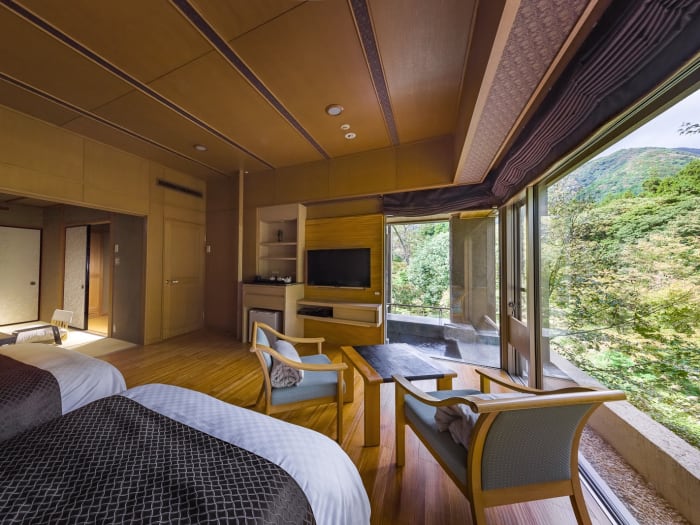
The interior design extends that relationship to the site. Inspired by Japanese traditions while incorporating contemporary touches, it favours natural materials, legible volumes and an aesthetic of discretion. The eye is never overloaded. Instead, everything seems arranged to make attention possible: a framed view, soft light, the presence of wood, the sensation of space. That restraint gives the hotel a lasting elegance, removed from passing trends.
What most distinguishes Bettei Senjuan is its ability to offer a form of quiet luxury. In many hotels, the setting is merely a backdrop; here, it structures the experience. The landscape is not an addition, but an active component of the stay. It appears in the onsen baths, in the zen-like atmosphere of the shared spaces, and in the way time seems to stretch between tea, bathing and dinner. For travellers seeking an address where environment matters as much as comfort, Minakami offers a valuable counterpoint to Japan’s major urban destinations, and Bettei Senjuan presents a particularly calm and coherent interpretation of it.
Rooms and suites, the art of retreat
At Bettei Senjuan, the room is conceived not simply as a place to sleep, but as an extension of the thermal and contemplative experience. It reflects a Japanese idea of retreat in which privacy is measured not only by size or equipment, but by the quality of silence, the ease of movement, and the feeling of being sheltered from the outside world without being cut off from the landscape. The overall spirit favours serenity: clean lines, natural materials, a calming palette, and an ongoing dialogue between indoors and outdoors.
The design, described as Japanese with contemporary touches, appears to follow a logic of balance. Traditional references are not used as emphatic decorative signs, but as a spatial grammar. This may be expressed through restrained volumes, attention to texture, soft light and an arrangement that encourages immediate relaxation. In this kind of address, comfort often lies in precision: a well-ordered space, carefully prepared bedding, discreet turndown service, and an atmosphere that naturally invites rest. Luxury is therefore read in the coherence of the whole rather than in accumulation.
In a property of this nature, the room also becomes a vantage point on the season. In Minakami, the landscape changes markedly over the year, and that variability lends particular depth to the stay. The same room is experienced differently depending on whether the mountain appears in the green light of summer, the copper tones of autumn or the whiteness of winter. That relationship with the outdoors is essential: it reminds guests that they are not in an interchangeable hotel, but in a house designed for a specific territory.
Travellers drawn to Japanese aesthetics generally appreciate this controlled spareness, where nothing is left to chance and space is allowed to breathe. Those discovering this style of hospitality often find in it another definition of comfort. The point is not to multiply effects, but to create the conditions for deep rest. Reading a few pages after bathing, taking time over tea, watching the light shift, allowing calm to settle in: the room supports these simple gestures and gives them a particular quality.
Service naturally completes this impression. Daily housekeeping, turndown service and attentive organisation of the stay help maintain a sense of continuity without intrusion. That is the balance at stake: to offer hospitality that is precise and available, yet never heavy-handed. For couples, restorative breaks or a pause within a broader journey through Japan, the rooms and suites at Bettei Senjuan answer a very specific desire: that of a place where one can truly inhabit time. In a hotel world often dominated by image, that quality of retreat remains one of its most persuasive strengths.
Dining, shaped by season and precision
In a Japanese house of this calibre, dining occupies a central place in the overall experience. At Bettei Senjuan, it naturally follows the logic of the property: respect for rhythm, attention to season, a search for balance and a sense of detail. Without precise information here about a culinary signature or a particular chef, one can say that the legitimate expectation of such a hotel rests on cuisine in affinity with its territory and with the aesthetics of Japanese hospitality. The meal is not an additional service; it is one of the defining moments of the stay, alongside bathing and rest.
In Japanese tradition, especially in thermal retreat houses, dinner is often conceived as a sequence, almost as a narrative. Flavours unfold with restraint, textures answer one another, temperatures are handled with precision, and presentation fully contributes to the experience. This approach does not seek spectacle, but clarity. Each element has its place, and each plate aims for a form of rightness. In a setting such as Minakami, that philosophy takes on particular resonance, because it allows the landscape to enter the meal, not literally, but through seasonality, produce and atmosphere.
In the morning, breakfast generally extends the same idea of quiet luxury. Here too, quality is measured less by abundance than by the care given to the first moment of the day. In a mountain environment, after a silent night and perhaps an early bath, breakfast takes on an almost ritual dimension. It accompanies the body’s awakening, prepares one for a walk or a day of rest, and contributes to that rare feeling of time not pressing.
What makes dining especially important in this kind of address is that it acts as a revealer of place. It connects the guest to a culture of hospitality founded on seasonality, restraint and precision. Travellers accustomed to major Western gastronomic scenes often discover here another language of refinement: less demonstrative, more attentive to nuance, balance and continuity between setting, service and plate. In a Relais & Châteaux member property, that coherence is all the more expected because it forms part of the stay’s implicit promise.
For couples, the table at Bettei Senjuan may become one of the most enduring memories of the journey precisely because it belongs to a wider sequence: returning from the bath, dining in a hushed atmosphere, sleeping deeply, waking to the mountain. The meal is never isolated; it belongs to a temporary way of life, intensely felt. That continuity is what makes the difference. More than culinary performance, guests come here for a complete experience in which gastronomy contributes to the overall harmony of the stay and to that rare impression of being exactly in the right place at the right time.
Onsen & Well-being: The Heart of the Experience
At Bettei Senjuan, the onsen baths naturally shape the stay within a mountainous setting. In Minakami, the thermal bath is nestled in an environment of retreat, silence, and fresh air.
The onsen experience invites a change of pace. The body relaxes, the mind follows, and the presence of the landscape enhances this sensation. Light, air, and the seasons impart a unique quality to the bath.
Well-being here stems from a cohesive approach. The tranquillity of the spaces, the discretion of the service, the connection to nature, restful moments in the room, and the rhythm of meals all contribute to this atmosphere. While treatments or massages are available, they merely extend this state of relaxation.
This approach is suited to travellers seeking a luxury of rejuvenation. The thermal bath, repeated throughout the stay, becomes a landmark. In the late afternoon, before dinner, or at dawn, it reveals a different nuance of the place each time.
For guests unfamiliar with Japanese customs, the onsen also offers a sensitive learning experience. It invites respect for a ritual, encourages slowing down, and embraces shared silence. At Bettei Senjuan, well-being is not solely about comfort; it provides structure to the establishment.
Concierge & Services: A Discreet Presence
At Bettei Senjuan, the quality of service is measured by the fluidity it provides. The traveller perceives a seamless arrival, a room ready at the right moment, and a respected rhythm. This silent efficiency aligns with the spirit of the place. In a mountain retreat inspired by Japanese traditions, the service supports the experience without overwhelming it.
The 24-hour reception and concierge service offer considerable comfort. They facilitate late arrivals and multi-stage stays. A multilingual staff also simplifies the experience. Additional services include daily housekeeping, turn-down service, luggage storage, laundry, and wake-up calls. Together, these attentions create a coherent and tension-free experience.
In Minakami, the concierge also helps adjust the stay to the rhythm of the locale. They can advise on the best times to enjoy the baths, suggest walks, facilitate transportation, and organise the details of arrivals or departures. When executed well, these interventions significantly enhance the experience. The service does not aim to impress; it seeks to make things just right.
This discretion is particularly important in an establishment focused on rest. Guests come here to find calm, sometimes after a busy itinerary in Japan. They expect a service that can anticipate without intruding, respond quietly, and remain available without imposing.
For couples, this precision contributes to a sense of respite. Arriving serenely, entrusting practical matters to a competent team, and returning each evening to a thoughtfully prepared room frees up mental space. At Bettei Senjuan, the familiar services are not about spectacle; they form a foundation of attentive comfort, suited to a place where peace, continuity, and controlled simplicity prevail.
The Minakami way of life
Staying at Bettei Senjuan also means discovering another side of Japan, far from the intensity of the major cities. Minakami belongs to those destinations where travel takes on a more grounded, more sensory pace, one more attentive to the elements. The appeal here lies not in accumulating monuments or ticking off addresses, but in the quality of a territory experienced through its relief, its water, its climate and its seasons. For many travellers, this dimension provides an essential counterpoint to Tokyo, Kyoto or Osaka: a breathing space in the fullest sense.
The region is first and foremost a destination of nature. Mountains shape the horizon, forests alter the light, and waterways contribute to a feeling of freshness and constant movement. Even without a packed programme, simply staying in such an environment changes one’s perception of time. One walks more, observes more, and more readily accepts the slower transitions between moments of the day. Morning does not have the same density as in the city, nor does evening. That quality of presence to place is perhaps one of Minakami’s greatest attractions.
The other essential dimension is, of course, that of the onsen. In many parts of Japan, thermal towns have shaped a specific way of life, built around short restorative stays, repeated bathing, meals taken at regular times and particular attention to rest. Minakami belongs to that culture. People come here to recover, to enjoy a preserved natural environment and to reconnect with a form of sophisticated simplicity. Bettei Senjuan translates that tradition very well into a contemporary language without diluting it.
Depending on the time of year, the region offers very different impressions. Summer draws visitors for its greenery, lighter air and the possibility of fully enjoying the natural setting. Winter, by contrast, gives the stay a more introspective, enveloping dimension, especially appealing around hot baths and snowy landscapes. Between the two, the transitional seasons remind one how much Japan is a country of nuance, where the beauty of a place often lies in shifts of light, temperature and colour.
For travellers who value experience over tourist performance, Minakami is a destination of real rightness. One comes here less to do than to feel: to feel the effect of the bath, the quality of the air, the silence of evening, the presence of the mountain. This economy of gestures is not meagre; on the contrary, it becomes richly rewarding once one accepts slowing down. That is why a stay at Bettei Senjuan is particularly well suited to couples, lovers of discreet retreats, and anyone seeking in travel a form of rebalancing. Minakami does not reveal itself through spectacle; it reveals itself to those willing to pay attention, and that is precisely what makes it memorable.
Book with MyConciergeHotel
Booking Bettei Senjuan with MyConciergeHotel means approaching the stay with the same sense of rightness one expects on site. An address such as this is not chosen solely for its five-star status or its membership of Relais & Châteaux; it is chosen for a very specific kind of experience, one that often needs to be properly understood in advance. MyConciergeHotel’s role is precisely to help align the hotel, the season, the pace of the journey and the guests’ real expectations, so that a stay in Minakami fulfils its promise.
In the case of Bettei Senjuan, several points deserve consideration before booking. First, the timing of the stay: is this a restorative stop within a denser Japanese itinerary, or is Minakami itself the destination for several days? Then there is the season: summer and winter do not offer the same experience, nor the same relationship to landscape and bathing. Finally, the nature of the trip matters: a couple’s escape, a discreet celebration, a restorative break, or the discovery of a more contemplative Japan. These nuances matter because they shape the way the property will be lived.
MyConciergeHotel can assist with that finer reading of the stay. The value lies not only in confirming a room, but in preparing a coherent framework: optimised arrival and departure times, luggage handling, advice on the best rhythm for enjoying the onsen, anticipation of high-demand periods, and, where relevant, integration with the other stages of a wider journey. In a destination where guests come precisely in search of ease and calm, that advance preparation has real value.
Booking early is generally wise, particularly during the most sought-after periods. Retreat-style properties in Japan, especially those with a strong sense of place, tend to attract guests who plan ahead. This is all the more true for international travellers wishing to include Minakami in a broader itinerary. A well-considered booking helps preserve what makes the stay so valuable: the impression of simplicity, continuity and natural ease.
Choosing MyConciergeHotel also means benefiting from an editorial perspective and support focused on quality of experience rather than mere transaction. For Bettei Senjuan, that means understanding that the essential thing cannot be reduced to a list of amenities. What matters here is the harmony between a place, a season, a state of mind and a certain idea of travel. If you are seeking in Minakami a peaceful retreat shaped by onsen bathing, contemporary Japanese design and discreet service, this is an address worth considering carefully. And if you wish to book it under the best possible conditions, MyConciergeHotel can help turn a good travel intention into a genuinely accomplished stay.