History & island identity
Belmond Cap Juluca belongs to that rare category of hotels whose image has travelled far beyond their island. On Anguilla, along the bright curve of Maundays Bay, the property has built an instantly recognisable identity: low-rise whitewashed buildings, domes and lines that converse with the sea horizon rather than with display. Here, luxury is not defined by spectacle but by clarity: a place designed to let the beach, the sky and the water take centre stage.
This Caribbean-inspired architectural character has long shaped the hotel’s reputation. It gives the address a distinct place within the region’s hospitality landscape, where many properties lean either towards the standardised large resort or the fully private villa. Cap Juluca occupies a more nuanced territory: that of a high-end seaside retreat where guests come in search of a sense of ease. The white façades answer the pale sand, the vistas open onto turquoise water, and the whole remains human in scale, encouraging calm.
Its belonging to Belmond also places the hotel within a tradition of hospitality grounded in a strong sense of place. The brand is known for celebrating destinations with character, and this is reflected in the way Cap Juluca is experienced: not simply as somewhere to stay in the sun, but as a destination hotel in its own right, tied to a certain art of slowing down. Service, never stiff in appearance, follows the same logic. It adapts to the guest’s rhythm rather than dictating it, which suits Anguilla particularly well.
The history of the property is therefore read less as a sequence of events than as the continuity of an atmosphere. Generations of travellers have come here in search of the same essentials: one of the Caribbean’s most coveted beaches, a feeling of openness, and the impression of living outdoors from morning to evening. The setting does not need embellishment to remain memorable; a few precise elements are enough — late light on the domes, wind in the palms, the barefoot walk between room and sea.
In a luxury world often tempted by excess, Cap Juluca has preserved a certain restraint. That is precisely what makes it distinctive. The hotel speaks to travellers who prefer coherence to effect, natural beauty to staging, and gracious service to theatre. Its legacy is that of a great beach hotel in the noblest sense: a place that understood early on that true sophistication sometimes lies in placing nothing between the guest and the landscape.
The property, between white sand and open-air architecture
Staying at Belmond Cap Juluca means, first and foremost, inhabiting a shoreline. The hotel unfolds along Maundays Bay, one of Anguilla’s most sought-after stretches of coast, with the kind of beach that immediately defines a stay: pale sand, shallow turquoise water, a generous sweep of bay wide enough for long views yet sheltered enough to retain a sense of privacy. The relationship with the landscape is not incidental; it shapes the entire experience.
The property’s layout has been conceived to maintain a constant dialogue with the outdoors. Guests move between buildings as though through an ordered seaside village, where the sea is always near, visible or at least perceptible. The Caribbean-inspired architecture reinforces this sense of flow. The volumes remain low, the white façades catch the light without heaviness, and outdoor spaces play a central role in the way the hotel is lived in. This is far from a self-contained resort: here, air, light and views are part of the comfort.
That direct relationship with the beach is one of the hotel’s defining privileges. Access to the white sand is immediate, with no road to cross and no distance to negotiate, which changes the quality of a stay entirely. One can move from room to sea with almost domestic ease, return for shade, go back for a swim, then let the day continue as the light softens over the bay. This continuity between indoors and outdoors creates a valuable freedom, especially for travellers who seek not activity for its own sake but the ability to shape their days at their own pace.
The overall atmosphere remains relaxed, though never careless. It is one of Cap Juluca’s most successful balances. The setting is refined enough to satisfy guests accustomed to leading hotels, while preserving an island softness that avoids formality. Families find a calm and legible environment, couples a peaceful mood, and seasoned Caribbean travellers an address that does not overplay its exoticism.
A sense of space matters here as well. Even when the hotel is lively, the bay absorbs the eye and gives the stay room to breathe. Days organise themselves around simple but decisive elements: the changing colour of the water, the breeze from offshore, the pleasure of an early swim, the ease of settling outdoors. In this context, luxury takes on a very concrete meaning: that of a place designed to make one’s presence within the landscape feel more immediate.
Cap Juluca is not merely set by the water; it is entirely structured by that proximity. That is what explains its lasting appeal. For many travellers, the hotel captures a certain idea of the Caribbean: high comfort, certainly, but above all a recovered sense of simplicity within a natural setting that requires no embellishment.
Rooms and suites, the privilege of living outdoors
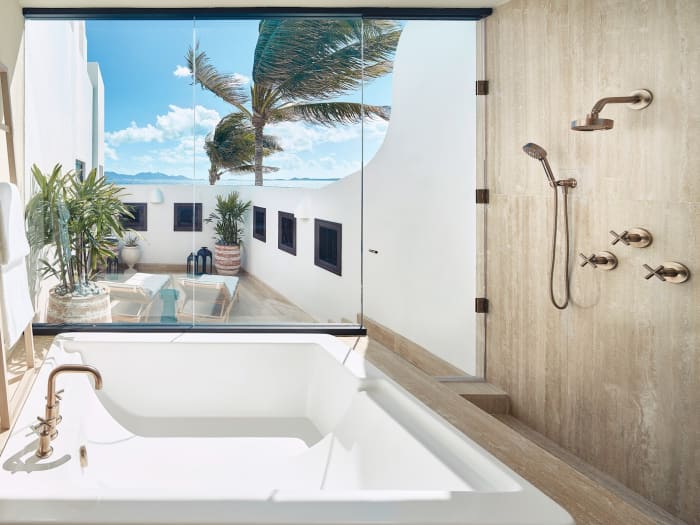
In a beach hotel of this calibre, the success of rooms and suites is measured less by decorative effect than by the accuracy of their relationship with the setting. At Belmond Cap Juluca, that principle is clearly at work. Accommodation is conceived as an extension of the shoreline: spaces shaped by light, airflow, ease of access to the outdoors, and that particular feeling of a stay lived as much outside as within.
The overall aesthetic remains consistent with the property’s identity. One finds a calm reading of seaside luxury, built on pale tones, open volumes and a restrained framing of views. The décor is not intended to compete with the landscape; it supports it. That restraint is valuable. It allows the rooms to retain a timeless quality, far removed from heavily trend-led resort design that dates quickly.
Daily comfort also rests on the services expected at this level: regular housekeeping, turndown, and attention to the rhythm of a stay. These details, though discreet, are central to the perception of a well-run hotel. They allow guests to return from a swim or a walk with the sense that everything has quietly been restored, efficiently and without intrusion.
What leaves the strongest impression here is the way the accommodation sits within the topography of the bay. Depending on location, rooms and suites may enjoy a more or less direct relationship with the beach, yet all benefit from the proximity that defines the Cap Juluca experience. One does not come here to shut oneself away; one comes to open the doors, let in the morning light, listen to the wind, and watch the sea change through the day. Terraces, balconies or outdoor areas, where present, become genuinely important to the rhythm of a stay: early coffee, reading in the shade, returning from the beach, a quiet pause before dinner.
For couples, the hotel offers a setting particularly well suited to a peaceful seaside retreat. For families, the legibility of the site and the immediate nearness of the sand make the day-to-day notably easy. In both cases, the room is not merely somewhere to sleep; it becomes a flexible anchor point from which to shape one’s own rhythm between sea, rest and meals.
Many tropical hotels promise immersion in nature without fully delivering it. At Belmond Cap Juluca, the promise feels more convincing because it rests on concrete choices: low-rise architecture, a direct relationship with outdoor space, and fluid movement between private quarters and the beachfront. The result is a form of comfort that is especially sought after today: not simply being well accommodated, but feeling that one truly inhabits the place where one is staying.
Dining, between marine freshness and island rhythm
In Anguilla, food is part of the journey. The island is known across the Caribbean for the quality and variety of its dining scene, and a stay at Belmond Cap Juluca naturally belongs within that culture of meals well enjoyed. Without relying on grand claims, the hotel offers a setting especially suited to dining that favours freshness, clarity and the pleasure of attentive service by the sea.
In a beachfront property of this level, the first luxury often lies in the setting itself: breakfast in soft morning light, lunch without losing contact with the beach, dinner as the heat recedes and the bay changes colour. Cap Juluca feels made for this rhythm. The day unfolds easily, with its alternation of activity and long pauses of rest that defines the best tropical stays. Dining accompanies that movement rather than interrupting it.
One may reasonably expect a hotel of this kind to offer cuisine in tune with its surroundings: seafood, lighter preparations suited to the climate, fruit, fresh textures, and an emphasis on clean flavours. In the Caribbean, the success of a meal depends not only on technical sophistication but on the balance between generosity, precision and context. A well-grilled fish, a plate designed to be enjoyed on a terrace, a lunch that still leaves room for an afternoon swim — these are often the true markers of the most desirable seaside tables.
Service is essential here. In leading island hotels, dining succeeds when it combines professionalism with ease. Travellers expect fluidity, availability and the ability to adapt to relaxed schedules without ever feeling mechanical. That quality of presence aligns particularly well with the spirit of Belmond and the atmosphere of Cap Juluca, where guests seek lived hospitality rather than overt ceremony.
The hotel also makes an excellent base from which to explore Anguilla’s wider culinary culture. The island’s manageable scale lends itself to gastronomic discovery, and the concierge can naturally guide guests according to mood, whether towards a barefoot beach table, a more contemporary address or a quieter dinner. Returning afterwards to the calm of Maundays Bay is part of the pleasure.
Ultimately, dining at Belmond Cap Juluca is not reducible to a list of venues or signatures. It belongs to a way of inhabiting the day. To eat here is to extend the landscape, respect the climate and accept a slower pace. It is also to understand that by the sea, the most convincing refinement is not always the most showy, but the one that feels entirely natural: a good ingredient, precise cooking, a well-placed table, and the sense that nothing need be hurried.
Wellbeing, chosen slowness and a marine horizon
Even when a beach hotel is not defined first and foremost as a wellness destination, certain properties possess a quality of calm that naturally turns a stay into something restorative. Belmond Cap Juluca is one of them. Simply being set on Maundays Bay, with direct access to white sand and turquoise water, alters one’s relationship with time. Guests rise earlier to enjoy the softer light, walk more, swim more, linger outdoors, and rediscover a healthy tiredness born of air, sun and movement.
In this context, wellbeing is not limited to a treatment menu. It lies in the full set of conditions created by the hotel: a peaceful atmosphere, open architecture, fluid movement between private space and the outdoors, and service discreet enough never to disturb the sense of retreat. For many travellers, that is the true essential. Contemporary luxury is no longer only about the accumulation of facilities, but about offering an environment in which body and mind can return to a more natural rhythm.
The beach plays a central role. Walking by the water early in the morning, settling before the bay with a book, alternating swims and rest, watching the light change through the day: these simple gestures often form the best possible routine. Their advantage is spontaneity, with no imposed programme. Cap Juluca is particularly well suited to those seeking gentle restoration rather than a heavily structured retreat.
Travellers who wish to shape a more deliberate wellbeing interlude can naturally draw on the resources of a leading hotel: concierge guidance, the organisation of restorative moments, and recommendations adapted to individual pace. In a property of this calibre, the intelligence of service lies precisely in understanding that rest does not look the same for everyone. Some will want long hours on the beach; others an early start, a shaded nap, a light dinner and an early night. Cap Juluca’s setting makes all of these rhythms easy to adopt.
It is also worth noting the specific effect of marine landscapes on the way a stay is experienced. The eye travels far, the horizon clears the mind, and the soothing repetition of sounds — wind, waves, the discreet life of the hotel — creates a soundtrack conducive to release. These are difficult things to quantify, yet they are decisive in the memory of a place.
At Belmond Cap Juluca, wellbeing is therefore not a separate discourse from the rest of the experience. It is a direct consequence of it. Guests come for the beach, for the beauty of Anguilla, for the hotel’s relaxed elegance; they often leave with the feeling of having genuinely recovered. That may be the most convincing form of resort luxury: a stay that does not add tension to daily life, but gently loosens it.
Concierge & services, efficiency without theatre
In high-end hospitality, the quality of service is often measured by what remains almost invisible. At Belmond Cap Juluca, that idea feels particularly apt. The hotel offers the essentials expected of an international five-star property — 24-hour concierge, 24-hour front desk, daily housekeeping, turndown service, luggage storage, laundry, wake-up service and multilingual staff — yet the real point is not the list itself. It lies in the way these services support a stay that feels fluid, never over-managed or stiff.
The concierge naturally plays a central role. On an island such as Anguilla, where guests may wish to alternate beach days, dining discoveries, simple transfers and more structured arrangements, having a point of contact available at all hours changes the quality of travel. A good concierge does more than execute requests; they help calibrate the stay. They know when to suggest booking ahead, how to adapt plans to weather or light, and how to preserve the sense of spontaneity that matters so much by the sea.
The round-the-clock front desk contributes to the same calm. Arriving late, leaving early, adjusting plans or handling practical matters never becomes a source of friction. In island destinations, where transport timings can require a degree of flexibility, this constant availability is especially valuable. It keeps the stay simple, even in its logistical aspects.
Daily housekeeping and turndown belong to that same well-judged hospitality that makes a difference over several nights. In a beach climate, where life unfolds between shore, terrace and room, the regular resetting of private spaces is not a minor detail. It contributes to the sensory comfort of the stay: returning from a swim to find a room fresh, orderly and ready for the next part of the day or for the evening.
Laundry and luggage storage, though less visible, answer very practical needs. They ease longer stays, early arrivals and late departures, allowing guests to enjoy the beach until the last possible moment without unnecessary inconvenience. The wake-up service may seem classic, yet it remains useful in the context of flights and early departures.
What truly distinguishes a great hotel, however, is the overall tone of service. At Cap Juluca, one expects less a display of protocol than a quality of presence: availability, courtesy, discretion and the ability to anticipate without intruding. That manner suits the spirit of the place perfectly. The staff support the stay; they do not dramatise it.
For MyConciergeHotel travellers, this is exactly the kind of address that matters: a hotel where services are fully in place, yet remain in the service of a larger feeling — that of a life made easier by the water. The real luxury here may well lie in that impression that everything works naturally, and that nothing interrupts the softness of the stay.
The Anguilla art of living, Cap Juluca style
Anguilla is not an island that reveals itself through display. Its charm lies in discretion, in an elegance without emphasis, and in a very direct relationship between natural beauty, daily life and the pleasure of travel. Belmond Cap Juluca captures that art of living particularly well. It allows guests to experience Anguilla not as an abstract postcard setting but as a destination where one quickly learns to value simple things: a beautiful beach, a good meal, easy movement, time outdoors, and a sense of calm that becomes quietly addictive.
From Maundays Bay, the island can be approached in gentle stages. One may choose hardly to leave the hotel and still fully inhabit a seaside interlude, or use the property as a base for other beaches, other tables and other viewpoints. Anguilla lends itself well to that alternation. Its relatively manageable scale allows days to be composed without logistical heaviness, reinforcing the sense of holidays lived intelligently.
The local art of living also rests on a particular relationship with the coast. Here, the sea is never far away, and it shapes habits as much as imagination. Lunch is easily taken by the beach, the day is organised around light and wind, and quality of moment often matters more than quantity of activity. Cap Juluca, with its relaxed seaside atmosphere, fits exactly within that way of being. The hotel does not seek to isolate the traveller from Anguilla; it introduces them to its rhythm.
That alignment matters. Many luxury hotels could be moved from one island to another without losing their identity. Cap Juluca, by contrast, feels deeply tied to its site. The whiteness of its architecture, the immediate nearness of the water, the softness of its circulation and the restraint of its atmosphere all resonate with the idea of Anguilla itself: a destination valued by travellers who recognise the worth of unforced luxury.
For couples, the island offers a setting well suited to a sunny retreat without excessive bustle. For families, it offers clarity and gentleness that make a stay easier. For seasoned Caribbean travellers, it often represents a calmer alternative to more exposed destinations. In every case, returning to Cap Juluca at the end of the day is deeply satisfying: the bay, the pale sand, the lowering light, and the sense of having chosen the right tempo.
That may be the essence of the Cap Juluca way of living: not trying to do everything, but doing what matters well. Swimming for a long time. Taking lunch slowly. Reading in the shade. Letting evening arrive. In a travel world often saturated with demands for experience, the hotel recalls an older and more durable truth: some destinations are best understood when one simply agrees to be there.
Book with MyConciergeHotel
Booking Belmond Cap Juluca through MyConciergeHotel means approaching the property in the right way: as a stay considered in advance, refined to suit your travel rhythm, and never reduced to a simple hotel transaction. A hotel of this kind deserves careful preparation, not because it is complicated, but because its value lies precisely in the quality of details. The right accommodation category, the right moment in the season, the organisation of arrivals and departures, the balance between complete rest and discovery of Anguilla — all of this materially shapes the experience.
High season, generally running from December to April, is the most sought-after period for enjoying the Caribbean climate at its best. It is also when availability can tighten. Booking ahead therefore helps not only to secure preferred dates, but also to choose more carefully the location or style of stay that suits your expectations, whether for a retreat as a couple, a family holiday, or a winter escape centred on beach time and recovery.
The value of MyConciergeHotel also lies in its editorial reading of the property. Cap Juluca is not an interchangeable resort. Its appeal rests on subtle balances: a peaceful atmosphere, highly recognisable architecture, a direct relationship with one of Anguilla’s finest bays, and service that favours fluency over display. To guide a traveller well is therefore to help them understand whether this style of luxury suits them — and, when it does, how to make the most of it.
In practical terms, this means preparing certain elements before arrival: stay preferences, requests linked to daily rhythm, arrangements for time on the beach, recommendations for dining on property or elsewhere on the island, and the practical handling of timings. The Concierge’s advice is especially relevant here: reserving your beach lounger in advance to make the most of sunny days may sound simple, but it is exactly the sort of attention that turns a good stay into a seamless one.
MyConciergeHotel can also place the hotel within a wider journey. Anguilla may be the centre of a purely seaside escape, but it can equally form part of a more considered Caribbean itinerary. In both cases, the aim is to preserve what makes Cap Juluca so compelling: its sense of natural ease. Everything should contribute to making arrival simple, settling in immediate, and those first moments on Maundays Bay feel as though they had always been meant to happen that way.
For a property of this nature, booking well does not simply mean obtaining a room. It means preparing the conditions for an experience that is coherent and faithful to the spirit of the place. With MyConciergeHotel, Belmond Cap Juluca is approached as it should be: not merely as a beach hotel, but as a distinguished island address best experienced with precision, softness and time.