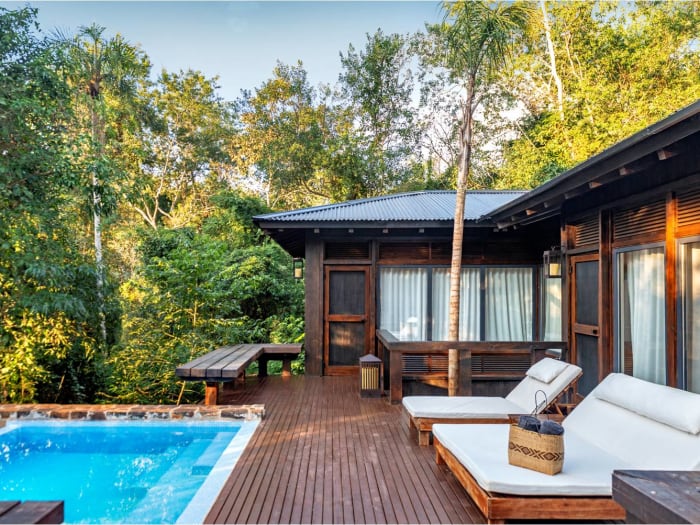
History & spirit of the place
Awasi Iguazu reflects a contemporary vision of nature-led hospitality: few accommodations, generous space, and a relationship with the landscape that matters more than spectacle. Rather than competing with the force of the nearby Iguazu Falls, the hotel offers a counterpoint. Where the falls impress through scale, the property favours intimacy. Where the site itself is about grand panoramas, the stay here is shaped by slower rhythms, observation, quiet, and a genuine sense of immersion in the subtropical forest of northern Argentina.
As a member of Relais & Châteaux, the hotel aligns with a certain idea of high-end travel built on a strong sense of place, thoughtful hospitality, and an experience defined by coherence rather than display. Awasi Iguazu is grounded in discreet luxury: architecture integrated into the vegetation, décor inspired by local culture, tailored service, and a clear intention to let nature remain the principal setting. This is not an urban luxury hotel transplanted into the forest; it is a retreat conceived in dialogue with its environment.
Puerto Iguazu, the Argentine gateway to the falls, has long been seen as a point of transit. The merit of an address like this is that it turns a stopover into a stay. Guests come not only to see one of South America’s great natural landmarks, but to inhabit a region of red earth, humidity, filtered light and layered cultural influences. In that context, the hotel acts as an interpreter, opening access to the essentials of the destination without compromising the comfort expected of a five-star property.
The spirit of the place is also tied to its deliberately intimate scale. That dimension changes the way the hotel is experienced from the outset. Arrivals feel less anonymous, conversations more direct, recommendations more nuanced. It is far removed from large destination resorts where logistics dominate the mood. Here, the stay can feel almost residential at times, with the welcome impression that each day may be adjusted to the weather, one’s energy levels, or simply the desire to do less.
Ultimately, Awasi Iguazu’s sense of heritage lies not in grand age or palace-style history, but in a very current redefinition of luxury in a natural setting. Refinement is measured by accuracy: in materials, in service, in light, in silence, and in proximity to one of the continent’s most memorable landscapes. For seasoned travellers, it is precisely this restraint that gives the place its depth. The hotel does not attempt to distract from the falls; it prepares guests to discover them, then allows the experience to continue in a calmer, more grounded way.
The hotel, between subtropical forest and calm
One of Awasi Iguazu’s most immediate strengths lies in its setting. Close to Iguazu Falls, the hotel offers access to one of the continent’s great natural landmarks while remaining sufficiently removed to recover a sense of quiet. That measured distance matters. It avoids the bustle of transit areas and restores the stay to a slower, more sensory rhythm. From the moment of arrival, the landscape takes over: dense vegetation, light humidity in the air, birdsong, and the region’s distinctive red earth. The setting is not merely a backdrop; it shapes the entire experience.
The property has been conceived as an immersion rather than a separation from nature. Its architectural and decorative language appears designed less to impose a demonstrative signature than to accompany the site. Lines remain restrained, materials converse with the surroundings, and references to local culture prevent the feeling of interchangeable luxury. There is a clear intention to root the hotel here, and nowhere else. In a destination as powerful as Puerto Iguazu, that coherence matters.
The overall atmosphere is peaceful, almost hushed. That does not mean austere; on the contrary, the hotel cultivates a discreet warmth made up of comfort, attention and space to breathe. The shared areas invite guests to slow down between the stronger moments of the journey. After an excursion to the falls, that sense of returning to calm is especially welcome, as though the stay were built around an alternation between outward intensity and inward retreat. It is a rare balance, particularly in destinations dominated by a single iconic site.
The intimate scale of the address plays a central role in this impression. A smaller hotel changes the perception of everything: circulation feels easier, encounters are fewer but often more meaningful, and one more readily recovers the feeling of a refuge. For couples, this configuration encourages a cocooning experience. For families, it allows discovery and rest to coexist without the dispersal often found in larger resorts. In both cases, nature remains the constant thread.
The property will especially appeal to travellers seeking more than a logistical base for visiting the falls. It suits those who want to understand the region through atmosphere as much as through landmarks. Here, luxury does not mean sealing oneself off behind thick walls, but feeling protected while remaining open to the landscape. Light, sound, air and vegetation all remind guests that they are staying in a living environment.
This sense of immersion also explains why the drier period, often considered to run from May to September, can shape the experience without altering its essence. Whatever the season, Awasi Iguazu retains its identity as a refined subtropical retreat. Guests may come for the falls, certainly, but they stay for the rarer sensation of inhabiting the threshold between carefully calibrated comfort and omnipresent nature.
Rooms, privacy and immersion
At Awasi Iguazu, accommodation fully supports the promise of the place: to experience the destination without giving up comfort. More than a place to sleep, the room becomes a calm observation point over the surrounding forest. The relationship with the outdoors is essential. The aim is not to create a sealed bubble cut off from the landscape, but a protective interior that still allows nature to enter through light, views, sounds and a sense of space. That way of inhabiting the territory is central to the experience.
The decorative style, described as inspired by local culture, brings warmth and avoids impersonal minimalism. In a property of this kind, details matter more than ostentation: natural textures, a palette in dialogue with the vegetation and earth of the region, and furniture designed for genuine comfort rather than effect. The overall impression is one of discreet elegance, entirely in keeping with Awasi’s spirit. One can easily imagine spaces to which guests return in the afternoon not out of necessity, but because they extend the feeling of retreat.
Privacy is another major strength. In a destination where days may be shaped by excursions, transfers and the visual force of the falls, returning to calm accommodation changes the quality of the stay considerably. The room becomes a place of decompression. It allows the day to settle, the intensity to recede, the forest to be heard again. For travellers who value the sensation of being alone in the world without being cut off from service, it is a particularly successful balance.
Daily comfort is supported by services which, while not spectacular, make a real difference at this level: daily housekeeping, turndown service, and attention to the guest’s rhythm. These create a welcome continuity of care. Luxury is then expressed through ease: a room always ready after an excursion, a bed prepared in the evening, an atmosphere that feels orderly and restorative. Such gestures may appear simple, yet they shape the sense of an effortless stay.
For couples, the accommodation naturally lends itself to a romantic experience in the truest sense: not decorative, but grounded in calm, the beauty of the setting, and the freedom to live at one’s own pace. For families, the primary value lies elsewhere: having a serene base between discoveries in an environment that remains deeply transporting. In both cases, the hotel appears to favour quality of presence over an excess of features.
What stands out in the end is the coherence between the rooms and the rest of the property. Nothing feels imposed. Immersion in nature, personalised service and a peaceful atmosphere are all reflected at the scale of the accommodation. That is often where a destination hotel succeeds or fails. When a room is not only comfortable but also right for the place, it transforms the stay. At Awasi Iguazu, it seems conceived as an extension of the landscape, with all the softness, quiet and presence that implies.
The Dining Experience: A Harmony of Product, Territory, and Rhythm of Stay
At Awasi Iguazu, gastronomy plays a vital role in interpreting the territory. Within a Relais & Châteaux property, the dining experience seamlessly extends the essence of the location.
In Puerto Iguazu, this philosophy calls for a cuisine that engages in dialogue with the subtropical environment, regional produce, and the rhythm of excursions.
The primary challenge lies in the tempo. Days spent around the Iguazu Falls begin early, are lived intensely, and then require moments of pause.
The dining experience must adapt accordingly. A breakfast prepares guests for exploration. A light lunch accompanies the day’s adventures. Dinner re-establishes a sense of leisure for the traveller.
Culinary luxury here is defined by the appropriateness of the moments as much as by the contents of the plate. One expects a cuisine that is clear, refined, and rooted in its context.
Local inspiration can also extend to the dining table. The flavours of northern Argentina and regional influences provide context without resorting to folklore.
The quality of ingredients, herbs, fruits, and the freshness of preparations are as significant as the way they harmonise with the climate. Each meal becomes another means of engaging with the landscape.
The atmosphere is just as important as the menu. In an intimate and tranquil hotel, the focus is less on the social scene and more on an immediately fitting setting.
Bespoke service takes on its full meaning here. Adjusting timings, considering excursion departures, and offering tailored recommendations enhance the overall experience.
These thoughtful touches are invaluable in a destination where programmes vary according to the weather, the energy of the moment, or the desire to remain on the estate.
For couples, the dining experience can become one of the pleasures of their stay. For families, it provides comfortable anchors after active days.
The key is that the meal does not disrupt the overall tone of the hotel. At Awasi Iguazu, gastronomy serves as a discreet yet structuring thread.
The finest dining experiences in nature hotels do not overshadow the landscape; rather, they deepen it, creating a coherent sequence of sensations without any pretentiousness.
Concierge & Services, the Art of Tailored Stays
The luxury of Awasi Iguazu is reflected in the quality of its support. In Puerto Iguazu, stays are often organised around excursions, varying schedules, and unpredictable weather conditions. The ability of a hotel to adapt the experience is what truly sets it apart.
The presence of a 24-hour concierge and a continuously open reception underscores this commitment. A point of contact is available at all times, ready to facilitate an early departure, respond to last-minute requests, or organise the logistics of a visit.
In a smaller hotel, this availability takes on a more personal dimension. Guests are not dealing with a system, but with a team that is attentive to the nuances of their journey.
The familiar daily services — daily housekeeping, turndown service, luggage storage, laundry, and wake-up calls — may seem standard. However, in a setting focused on nature and excursions, they acquire a special significance. Returning from an active day to find a tidy space enhances the overall experience.
Tailored service is also evident in the guidance provided for exploring the Iguazu Falls and the surrounding region. The hotel can direct guests according to their preferences, assist in organising activities, and take into account each individual's pace. Advice thus becomes an integral part of the stay.
The multilingual staff adds a welcome comfort for an international clientele. The clarity of communication and the precision of recommendations are crucial, especially during a short visit.
A good concierge also knows how to strike a balance. Some travellers wish to see the highlights of the falls, while others seek time to read, observe the forest, or enjoy the tranquility of their accommodation. The service then adapts to genuine desires, with presence, precision, and discretion.
The art of living in Puerto Iguazu
Staying in Puerto Iguazu is not simply about ticking off a visit to the falls. The town and its region invite another way of travelling, one more attentive to transitions, climate and the textures of the landscape. That is perhaps what Awasi Iguazu helps guests understand best: the idea that one comes not only for a natural landmark, but for a complete subtropical atmosphere. Here, air, vegetation, light and sound combine into a distinctive way of living, far removed from purely urban or seaside destinations.
The first step is to accept a different rhythm. Days may begin early in order to enjoy the best visiting conditions, but they benefit from moments of return and quiet. Puerto Iguazu does not lend itself well to frantic consumption of travel. Heat, seasonal humidity, dense vegetation and the emotional force of the falls all call for a certain openness. One quickly understands that the most successful experience is not necessarily the one that accumulates activities, but the one that alternates intensity and retreat. Through its peaceful atmosphere, the hotel supports precisely that reading of the place.
The local art of living is also rooted in the relationship with nature. In this borderland region of forest, the landscape is never merely decorative. It imposes itself physically through density and vitality. That changes the way one eats, moves, rests, and even watches the time. Guests become more attentive to the conditions of the day, the quality of the light, the right moment to go out or to return. This sensitivity to context is part of the pleasure of the stay. It restores a tangible dimension to travel that over-smoothed destinations sometimes lose.
Puerto Iguazu is also a meeting point of different cultural influences, at the crossroads of Argentina, Brazil and Paraguay. Without reducing the region to geography alone, that proximity undeniably nourishes a particular imaginary: one of passage, mixture and circulation. In a hotel whose décor is inspired by local culture, this regional depth may be perceived subtly through materials, flavours, forms of welcome, and the way the place is narrated to visitors.
For couples, the art of living in Puerto Iguazu often lies in seeking a shared experience that is not over-programmed: waking in greenery, a memorable excursion, a slow return to the hotel, a quiet dinner, and the feeling of being far from everything without sacrificing comfort. For families, it is more about finding balance between discovery and recovery in a destination that impresses adults and children alike. In both cases, the success of the stay depends on the ability to inhabit the region rather than merely pass through it.
That is why a property such as Awasi Iguazu makes such sense. It allows Puerto Iguazu to be experienced as a destination in its own right. The falls remain the great draw, certainly, but they do not tell the whole story. There is also the forest, the recovered silence after visiting, the quality of the welcome, the attention to detail, and that rarer feeling of having approached a famous destination without reducing it to its best-known image. That, perhaps, is the true luxury of travel here: leaving with the memory of a territory, not only of a site.
Book via MyConciergeHotel
Booking Awasi Iguazu through MyConciergeHotel means opting for a well-prepared stay that deserves careful consideration. An establishment of this calibre cannot be reduced to a mere hotel category or a list of amenities. Its true essence emerges when the journey is conceived as a whole: the ideal duration of stay, the timing of visits to the falls, a balance between excursions and relaxation, and the alignment between the travellers' profiles and the spirit of the hotel.
Awasi Iguazu is suited for couples seeking intimacy, nature-loving travellers, as well as families wishing to explore Iguazu in a serene and personalised setting. Before making a reservation, it is wise to clarify one’s expectations. Are you looking for a refined base close to the falls? Do you desire an immersive experience where the hotel is as significant as the destination? Would you prefer a short and intense stay, or a few nights that allow for a slower pace? These answers will guide the choice of dates, rhythm, and on-site organisation.
The travel period also deserves special attention. The months from May to September are often favoured for their drier climate, serving as a useful reference for optimising visiting conditions. Beyond the season, one must consider the nature of the stay. Some seek favourable weather for excursions, while others are more accepting of climatic variations to enjoy a more tropical atmosphere. A well-supported reservation allows for adjustments to these parameters.
Another essential point is to anticipate activities. Excursions to the falls often form the heart of the journey and benefit from prior organisation. Booking through MyConciergeHotel enables a discerning approach to this preparation. The goal is not to fill the agenda but to construct a coherent itinerary. It is also important to account for the time needed to enjoy the hotel, its tranquillity, immersive qualities, and bespoke service.
This method of booking is ideal for travellers who understand that true luxury begins before arrival. It lies in the quality of advice, the anticipation of useful details, and the ability to ask the right questions. A hotel like Awasi Iguazu reveals its true value when one comprehends its promise: proximity to a major site, yet an intimate experience; five-star comfort, yet rooted in nature; attentive service, without ostentation. Booking well ensures that the stay will resonate with this tone.
By choosing MyConciergeHotel, one ultimately favours a more nuanced understanding of the establishment. It is not merely a transaction but a contextualisation. For a trip to Puerto Iguazu, this makes a significant difference. One does not simply choose a room near the falls; one chooses a way to experience the destination. In the case of Awasi Iguazu, this distinction is essential.