History & Heritage
In Izu, hospitality is not merely a matter of service; it belongs to a long-standing culture shaped by hot springs, mountain scenery and a distinctly Japanese sense of retreat. Hotel Asaba belongs to the ryokan tradition, a form of lodging that goes far beyond an overnight stay to offer a complete experience built around rhythm, silence, measured gestures and close attention to the immediate surroundings. Here, heritage is not expressed through emphatic storytelling, but through a way of inhabiting space, welcoming guests, serving tea, preparing a bath and allowing nature to enter the experience without ever forcing it.
Its membership of Relais & Châteaux offers a useful frame of reference: a house where local identity comes first, and where architecture, cuisine and the art of hosting are conceived as a coherent whole. In Asaba’s case, that coherence begins with a fidelity to traditional Japanese aesthetics. The volumes, lines, materials and the relationship between indoors and outdoors all belong to an enduring visual language that favours balance over effect. Wood, openings onto the garden, framed views and restrained decoration create an atmosphere in which nothing feels demonstrative, yet every detail seems exactly where it should be.
On the Izu Peninsula, a region known for its onsen and shifting landscapes, this form of hospitality has found a natural setting. Travellers do not come here simply in search of a highly comfortable hotel; they also come to experience a different pace. A stay is organised around elements that appear simple: bathing, dining, resting, contemplating a garden or the late-afternoon light. It is precisely these elements, when handled with precision, that give a property its enduring character.
The heritage of a ryokan such as Asaba also lies in its ability to remain contemporary without severing itself from its foundations. Today’s expectations in terms of comfort, discreet service and seamless stays are very much present, yet they never override the spirit of the place. Luxury here is less about display than about the quality of attention: a room prepared with care, turndown carried out quietly, a front desk available at all hours, cuisine rooted in local produce and a constant sense of ordered calm.
For European travellers, part of Asaba’s appeal lies in this meeting point between two ideas of the grand hotel. On one side are the international codes of five-star hospitality; on the other, the world of the ryokan, with its own cultural depth. The result is neither pastiche nor superficial adaptation, but a property that fully inhabits its context. It is this fidelity to a Japanese tradition of welcome, enriched by contemporary standards, that gives the hotel its singularity. More than a backdrop, Asaba offers a lived heritage: a stay through which one understands, by experience, what hospitality truly means in a place such as Izu.
The Setting
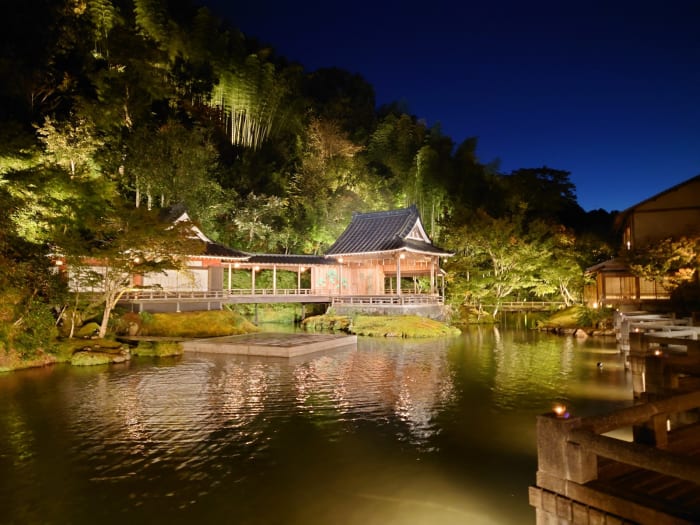
Asaba’s first luxury is its place within the landscape of Izu. The region, known for its gentle relief, abundant vegetation and the constant presence of thermal water, offers a setting that naturally invites one to slow down. The hotel makes full use of this context without overstating it. Rather than imposing itself upon nature, it seems to settle into it, creating a continuity between traditional architecture, gardens and views opening onto a soothing environment. This rootedness is essential to the experience: one is not staying in an interchangeable property, but in an address deeply connected to its territory.
The traditional Japanese architecture, one of the hotel’s defining features, shapes this impression from the moment of arrival. The lines are sober, circulation is designed to create transitions, and the shared spaces invite presence rather than display. There is a clear intelligence in the use of emptiness, light and materials, all of which form part of the comfort. Where some hotels multiply visual effects, Asaba favours an aesthetic of restraint. The eye settles on a detail in wood, the line of a roof, the frame of an opening onto the garden or the water. This apparent simplicity in fact requires considerable mastery.
Its natural setting in the heart of Izu makes the property both a place to stay and a destination in itself. One may of course use the hotel as a base from which to explore the region, its landscapes and its hot-spring culture, but many travellers will find themselves wanting simply to remain. Time takes on a different texture here. In the morning, the light transforms the volumes and reveals the delicacy of the materials. During the day, the public spaces and guest rooms become quiet refuges. In the evening, the atmosphere narrows gently around bathing, dinner and an almost ceremonial sense of retreat.
This relationship to place is reinforced by the quality of the hotel’s core services, which ensure discreet ease. A 24-hour front desk and concierge, daily housekeeping, turndown, luggage storage and attentive assistance allow a stay to unfold without friction. In a property of this nature, comfort is not only about what is visible; it also lies in everything that is resolved without apparent effort. Multilingual staff, where available, further enhance this sense of ease for international travellers.
Asaba is especially suited to those seeking a carefully constructed calm, far from urban rhythms and standardised hotels. The setting is not spectacular in the Western sense; it is subtler than that. Its power lies in the harmony between site, architecture and the promise of rest. In a destination such as Izu, famed for its picturesque scenery and hot springs, this address offers a refined interpretation of restorative travel. One comes here to sleep, certainly, but also to recover a quality of attention to the outside world: the season, the moisture in the air, the silence of a corridor, the rustle of the garden, the warmth of the water. It is this accumulation of perceptions, more than a simple inventory of facilities, that truly defines the property.
Rooms & Suites
In a ryokan of this calibre, the room is not merely a private space; it is the heart of the stay. At Hotel Asaba, one can reasonably expect the accommodation to extend the spirit of the house as a whole, shaped by traditional Japanese architecture, visual calm and discreet comfort. Rather than an accumulation of objects or overt technology, luxury is expressed through the quality of materials, the clarity of the volumes and a sense of order. The traveller finds a refuge designed to soothe rather than impress.
The Japanese ryokan tradition places particular importance on the relationship between the room and its immediate surroundings. This often translates into careful attention to openings, natural light, views of the garden or landscape elements, and a degree of spatial flexibility. Even where contemporary standards are fully present, the spirit remains that of a living space in which one rests, takes time to observe and allows silence to become part of comfort. At Asaba, this logic appears entirely consistent with what is known of the property: a place where the stay forms part of a broader experience of relaxation.
Daily service plays a central role here. Housekeeping, turndown and sensitivity to the guest’s rhythm all contribute to the seamlessness that distinguishes the best addresses. Nothing needs to be spectacular in order to be memorable: it is enough that a room is always immaculate, that returning after dinner reveals an atmosphere already prepared for the night, or that a practical need is anticipated with tact. In a property devoted to rest, this operational discretion matters as much as the décor itself.
Travellers drawn to Japanese aesthetics will particularly appreciate the restraint of the spaces. In this kind of house, the room often leaves space for visual breathing. The lines are clean, the materials natural, the furnishings measured. The absence of excess allows one to refocus on simple sensations: the texture of a floor, the warmth of wood, the light shifting through the day, the nearness of the garden or the presence of water in the imagination of the place. When well handled, this sobriety is never cold; on the contrary, it creates a deep, almost mental form of comfort.
For a stay as a couple, Asaba appears especially well suited. The promise is not that of a lively urban hotel, but of a retreat for two, where the room becomes a space of reconnection. The seasons play an important role. Depending on the time of year, the light, the colours of the landscape and the overall atmosphere subtly transform the experience. This is one of the privileges of staying in a region such as Izu: feeling that the accommodation is not cut off from the outside world, but in dialogue with it.
Ultimately, Asaba’s rooms and suites should be understood as places to inhabit in their own right, not simply as bases between activities. They reflect the hotel’s philosophy: to welcome with precision, to offer comfort without noise and to favour harmony over effect. For travellers seeking a more inward form of luxury, one that pays more attention to rhythm than to staging, this is precisely the kind of accommodation that makes the difference.
The Dining Experience
At Hôtel Asaba, gastronomy is more about the essence of place than a display of prestige. The cuisine showcases local ingredients, reflecting the seasons and the proximity to both the sea and fertile lands. This culinary approach extends the sense of rootedness already evident in the architecture and the relationship with nature.
In a ryokan, meals structure the day. It is not merely about nourishment but about experiencing a moment of rhythm and attentiveness. The textures, temperatures, the succession of dishes, and the presentation create a silent narrative. At Asaba, dinner and breakfast are highlights of the stay, offering a sensitive interpretation of the region through fresh, seasonal produce.
The value of local cuisine in such an establishment lies in preserving a certain truth of travel. Instead of a standardised international repertoire, diners discover a table that speaks the language of Izu and Japan. This is reflected in the attention given to broths, seasonal vegetables, fish, and delicate preparations. Refinement is found in the precision of cooking, the balance of seasonings, and the way each ingredient is allowed to express its character.
The setting plays an obvious role. In a hotel where traditional architecture is central, the dining spaces contribute to the overall experience. Here, the focus is less on animation and more on serenity. The service follows the same philosophy: present, attentive, yet never intrusive. This restraint allows the meal to become a pleasantly concentrated, almost meditative moment.
For international guests, the table at Asaba can serve as a gateway to the subtleties of Japanese culinary art. Far from clichés or more demonstrative urban formats, it reminds us that high Japanese hospitality often rests on nuances. A leaf, a piece of ceramics, an order of service, a combination of flavours can be enough to create a lasting impression. In this context, dining at Asaba is one of the most direct ways to understand the place.
In summary, the dining experience extends the hotel's overall promise: that of a restorative stay, precise and rooted in its environment. Travellers who choose Asaba for its tranquillity, architecture, and affiliation with Relais & Châteaux will find a natural complement here. To dine is also to inhabit Izu, for the duration of a meal conceived as an art of attentiveness.
Spa & Well-being
At Asaba, well-being is not presented as an isolated department, but rather as the very fabric of the stay. In Izu, the thermal waters are integral to the identity of the place. Staying here means entering a culture of bathing, relaxation, and recovery. Rest is not passive; it is supported by the environment, customs, and the rhythm of the day.
Within the realm of the ryokan, bathing takes on an almost ritualistic dimension. It prepares one for dinner, extends the stroll, and soothes after travel. The experience at Asaba is rooted in this Japanese tradition of care through water and tranquility. The warmth, silence, the slow pace of movement, and the quality of the surroundings create a form of gentle therapy. It is particularly suited to travellers seeking to shed urban fatigue or the disorientation from long journeys.
Well-being is also influenced by what surrounds the bath. Traditional architecture, proximity to nature, the simplicity of the rooms, and the quality of service foster genuine relaxation. One sleeps better when stimuli are reduced. Breathing changes when spaces are ordered and quiet. Recovery is deeper when meals and rest align within a coherent logic of balance. This coherence distinguishes truly calming destinations.
For couples, Asaba can represent a retreat. The stay takes the form of a chosen withdrawal, encompassing baths, time in the room, meals, and contemplation of the landscape. The seasons enhance this aspect. Depending on the time of year, the air, light, and external colours alter the sensation of the bath and the quality of rest. Well-being is therefore not standardised; it depends on the dialogue between the body, the place, and the season.
In this context, the idea of wellness refers less to performance than to harmonisation. Luxury lies in having time, space, and attention to rediscover a sense of inner availability. This is also what makes such a destination a welcome interlude in a denser itinerary across Japan.
At Asaba, well-being is not limited to a treatment or a bath at the end of the day. It engages the landscape, water, architecture, cuisine, and service. In Izu, this approach is strikingly evident. A grand stay of rest relies less on sophisticated amenities than on an overarching intelligence that is attentive to essential sensations.
Concierge & Services
At Asaba, the quality of service is defined by the consistency of discreet attention. The concierge and reception are available 24/7, complemented by daily housekeeping, turndown service, luggage storage, laundry, wake-up calls, and a multilingual staff.
In a traditional ryokan, this ensemble brings a genuine fluidity to the stay. It supports the international traveller without altering the spirit of the place.
The round-the-clock reception provides a sense of serenity. In Izu, it allows for managing late arrivals, logistical needs, or practical questions at any hour.
The concierge plays a more subtle role. It assists in organising the stay, adjusting schedules, and recommending a pace of visits suited to the desired relaxation.
Daily maintenance and turndown service extend this impression of continuous care. The room remains a refuge ready to welcome a moment of rest.
Laundry services and luggage storage address very practical needs, facilitating transitions before or after check-in and lightening the stay.
The multilingual staff is a real asset. They help explain certain customs, respond to practical questions, and assist foreign travellers with tact.
Overall, the approach follows a logic of silent support. Assistance is present without being intrusive, serving the purpose of rest and simplicity.
The Art of Living in Izu
Staying at Asaba is to discover a particular vision of Izu. A peninsula characterised by its varied landscapes, coastlines, lush vegetation, and hot springs, the region holds a unique place in the Japanese imagination. For the traveller, this art of living is not merely a checklist of sites but relates to a more sensitive connection to the landscape, the seasons, and the time available.
Izu lends itself particularly well to this approach. The light, foliage, humidity of the air, and temperature of the water alter the perception of the place. Spring, summer, autumn, and winter each tell a different story. In a home oriented towards rest, this seasonal variation becomes a luxury in itself.
The art of living in Izu is also rooted in the culture of onsen, deeply embedded in the region. Staying in an environment where hot water is part of daily life changes one's relationship with the body and time. One walks differently, eats differently, and organises the day around moments of relaxation. This prioritisation of tangible well-being partly explains the region's enduring appeal.
In Izu, the landscape is as much felt as it is seen. There is the scent of the air, the presence of vegetation, the gentle sound of water, and the warmth or coolness of an evening's end. In a hotel like Asaba, where traditional architecture fosters a close relationship with the outdoors, this sensory dimension comes to life.
For couples, the destination encourages reconnection and silent interludes. For solitary travellers, it can offer a space for introspection, almost contemplative. In both cases, Izu acts as a destination for deceleration.
A stay at Asaba allows for experiencing this in excellent conditions: coherent architecture, local cuisine, a culture of bathing, attentive service, and a soothing natural environment. Together, these elements shape a way of travelling that is slower, more precise, and more sustainable.
Book with MyConciergeHotel
Booking Hotel Asaba through MyConciergeHotel means choosing editorial and human guidance suited to a property whose subtlety deserves to be properly understood before departure. A five-star ryokan that is a member of Relais & Châteaux is not booked in quite the same way as a conventional hotel. Travellers generally seek more than a room: an atmosphere, a rhythm, a wellness experience, an immersion in a region known for its hot springs and natural scenery. Our role is precisely to help you assess whether that promise matches your way of travelling, the season you have in mind and the place you wish Izu to occupy within your wider journey through Japan.
Asaba is particularly well suited to couples in search of tranquillity, travellers sensitive to traditional Japanese architecture and those wishing to build a restorative pause into a denser itinerary. It is an address that lends itself well to decompression stays, discreet anniversaries, understated honeymoons or restorative interludes between major cities. Booking with MyConciergeHotel allows you to ask the right questions in advance: ideal length of stay, the value of arriving early enough to enjoy the property, transfer arrangements, luggage handling, expectations regarding dining and wellness, and the degree to which the ryokan experience aligns with your travel habits.
Our approach favours clarity. We place the hotel’s confirmed features in context — its five-star positioning, Relais & Châteaux membership, natural setting in the heart of Izu, traditional architecture, wellness focus and local cuisine — so that you can book with full understanding. Where some platforms simply list facilities, we seek to convey the logic of the place. This matters especially for a hotel such as Asaba, whose value lies as much in atmosphere and rhythm as in services themselves.
Booking through MyConciergeHotel also means benefiting from a curatorial point of view. In a Japanese destination rich in options, not every luxury address answers the same travel desire. Some favour visibility, others intimacy; some are designed for active exploration, others for retreat. Asaba clearly belongs to the latter category. We therefore help position it at the right moment in your itinerary, so that the experience can unfold with full meaning. One night may be enough to glimpse the spirit of the place, but a slightly longer stay often allows its depth to be better appreciated.
Finally, our support is designed to make the experience smoother even before arrival. Need to anticipate a particular request, understand the general workings of a ryokan, assess the best time to travel or shape a coherent stay around wellness and nature? That is exactly where we come in. In Asaba’s case, such preparation is far from incidental: it allows you to enter the stay in the right frame of mind.
Choosing Asaba means opting for a form of quiet luxury, rooted in Izu and in the Japanese tradition of hospitality. Booking it through MyConciergeHotel means ensuring that this promise is read with precision, respected in its nuances and intelligently integrated into your journey. For travellers who value accuracy over effect, it is often the best way to begin the experience.