History & positioning
Amilla Maldives belongs to a generation of Maldivian resorts that combine island seclusion, contemporary architecture and a more relaxed interpretation of luxury. The appeal here is not that of a historic grand hotel in the European sense, but of a place conceived for a very modern desire: to experience the Maldives in a preserved setting, with space, privacy and a genuine emphasis on wellbeing. Its location in Baa Atoll, one of the archipelago’s most sought-after regions, gives it an immediate sense of identity. Guests come as much for the feeling of remoteness as for the quality of the marine environment, in an area known for rich underwater life and luminous lagoons.
The resort’s positioning is also reflected in its membership of Small Luxury Hotels of the World, a collection associated with independent properties of strong character. This suggests less a rigid protocol than a particular idea of hospitality: intimate in scale, distinctive in spirit, and designed to feel more individual than a standardised stay. At Amilla Maldives, this translates into a deliberately serene atmosphere, villas conceived as private sanctuaries, and a style of service that favours ease over display.
The address speaks to different kinds of travellers. Couples will find the Maldives they came for — pale beaches, open horizons, villas oriented towards the water — but also a real sense of calm that allows them to slow down. Families, meanwhile, benefit from an environment that does not sacrifice elegance for practicality. That balance matters: some resorts excel at romance but struggle with multi-generational stays, while others prioritise activity at the expense of tranquillity. Amilla Maldives seeks a middle ground between the two.
Its identity ultimately rests on a form of luxury that is less demonstrative than sensory. Wellbeing is not treated as an optional extra but as a guiding thread: silence, light, direct contact with nature, time for rest, for water-based pursuits or for more personal rituals. In the Maldivian context, where many properties promise something exceptional, that nuance is meaningful. The resort is defined not only by the objective beauty of its private island, but by the way it frames that beauty: with restraint, with space, and with a contemporary aesthetic that leaves the landscape in the leading role.
The Establishment
Staying at Amilla Maldives means choosing a private island in the Baa Atoll. The setting invites disconnection and fosters an immediate connection to the sea. Light sands, tropical vegetation, and a lagoon with ever-changing hues create a landscape that is quintessentially Maldivian. The island offers an environment that is both spectacular and soothing, with nature fully structuring the experience.
The Baa Atoll is among the most sought-after areas in the Maldives, renowned for its pristine environment. It attracts travellers who are passionate about marine life, snorkelling, and ocean excursions. Visitors come here not only for the island's idyllic setting but also for the villas that sit by the water's edge. The ocean sets the rhythm for each day, with light, tides, wind, and the colours of the sky serving as tangible markers.
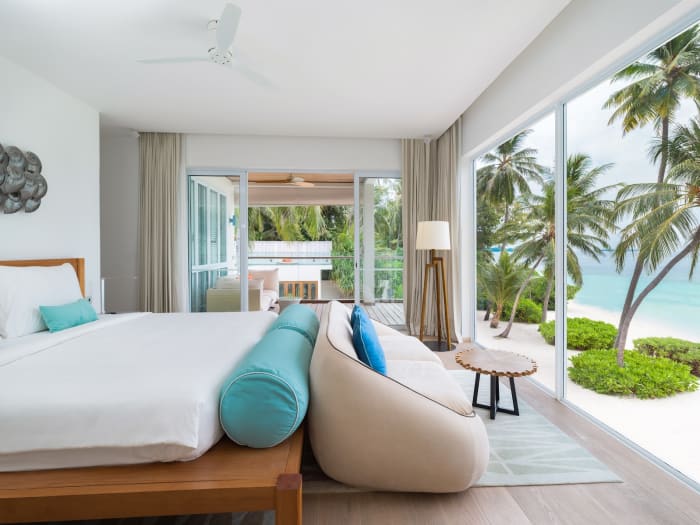
The architecture and layout of the hotel extend this interpretation of the location. The contemporary design does not compete with the landscape; it complements it. Clean lines open up perspectives, allow light to flood in, and enhance the feeling of space. Amilla Maldives adheres to this philosophy, with fluid circulation, airy volumes, and a seamless transition between indoor and outdoor spaces.
The address is also distinguished by its serene atmosphere. This tranquility stems from the space, intimacy, and natural rhythm of the island. Days can be organised around water activities, wellness moments, a lunch on the sand, or a stroll along the shore. There is no imposed cadence; this freedom is significant to the overall experience.
The establishment caters to both couples and families. Travelling duos find retreat, contemplation, and the simple pleasures of a well-curated tropical stay, while families enjoy an environment where everyone can experience the Maldives at their own pace. The private island forms a world unto itself, complete yet not detached from nature.
Rooms, Villas & the Art of Intimacy
At Amilla Maldives, accommodation is at the heart of the experience. Elegant villas with contemporary design define the stay, balancing modern aesthetics, comfort, and intimacy.
In the Maldives, a successful villa allows for living both indoors and outdoors. Here, the volumes, light, and direct connection to the landscape shape the experience.
Contemporary vocabulary finds its natural place in an island setting. Crisp lines, light materials, a soothing palette, and wide openings harmonise with the lagoon, sky, and vegetation.
Luxury here takes the form of private space. One can read, relax, enjoy discreet meals, or take a dip just steps from their room.
The elegance of the villas also lies in their versatility. For couples, they provide a cocoon where silence, bedding, the bathroom, terrace, and connection to the outside matter.
For families, accommodation must remain both beautiful and practical. Space, clear organisation, and the ability to share without overcrowding become essential.
Amilla Maldives caters to both couples and families, meeting these dual expectations without compromising the identity of the place.
In an island resort, intimacy also depends on the layout, vegetation, perspectives, and the rhythm of service. A well-designed villa allows for the choice of openness.
One can isolate themselves, receive a meal in private, engage in water activities, or join communal spaces at their own pace. This freedom contributes to the relaxation of the stay.
The modern and refined design ultimately conveys a sense of timelessness. The villa naturally extends the private island, open to water and light, protective when needed.
Dining
In an island resort, gastronomy plays a structuring role. It sets the rhythm of the days, provides reference points for the stay, and contributes to the memory of the place.
At Amilla Maldives, the dining experience is imbued with the spirit of a contemporary luxury hotel. Flexibility, quality of execution, attention to the setting, and variety of offerings accompany the different moments of the day.
In the Maldives, the greatest luxury often lies in the context of the meal. A breakfast facing the morning light. A light lunch between swims. A dinner by the water as the heat subsides.
In a wellness-oriented establishment, one expects a cuisine that is fresh and clear. It aligns with the climate and the island's rhythm, suitable for both relaxation and family holidays.
Amilla Maldives can offer several dining options without overwhelming the experience. Very simple moments coexist with more elaborate dinners. This versatility contributes to the comfort of the stay.
In-villa dining is also part of the Maldivian art of living. A private breakfast, a lunch on the terrace, or a dinner in one’s retreat extends the intimacy of the accommodation. This service allows guests to enjoy the villa at their own pace.
Dining also contributes to the emotional identity of the journey. One remembers a coffee early in the morning, a fresh juice after a swim, or a quiet dinner following a snorkelling outing. At Amilla Maldives, the dining experience naturally accompanies both contemplation and active days spent between beach, lagoon, and marine discoveries.
Spa & Wellness
At Amilla Maldives, wellness transcends the mere concept of a spa. It permeates the entire stay, with the tranquility of the private island playing a significant role.
The lagoon, the space between the villas, and the alternation between rest, movement, and water activities establish a gentler rhythm. The body slows down, and the mind clears.
In this context, the spa naturally extends the experience. The essence lies in treatments tailored to the climate, the journey, and the need for re-centering.
After a long journey, a day in the sun, or several hours in the water, a wellness ritual takes on profound significance. It helps to release tensions.
The serene atmosphere is essential. In the Maldives, a successful wellness space preserves a sense of lightness, with discreet service and calming environments.
Transitioning from a private villa to a treatment and then returning to the beach or one’s terrace creates a rare continuity. This is often where the difference is made.
The hotel accommodates both couples and families, allowing each to find their own rhythm, whether through couples’ treatments, individual time, or shared moments.
Wellness also unfolds outdoors. Snorkelling, swimming, walking on the sand, natural light, and sea air contribute to this sense of rejuvenation.
Amilla Maldives articulates this natural dimension with a structured hospitality promise. Treatments do not appear as mere interludes but as a way of inhabiting the island.
Concierge & Services
In a private island resort, the quality of service is measured by the fluidity of the stay. At Amilla Maldives, the concierge discreetly plays this role. Practical details fade away to make room for the experience. This begins before arrival, with the organisation of transfers, the preparation of activities, and a keen understanding of each stay, whether romantic, family-oriented, or wellness-focused.
The hotel caters to both couples and families. This versatility calls for a service capable of adjusting its tone and offerings. A honeymooning couple has different expectations compared to a family looking to share an active holiday. In the former case, the concierge prioritises intimacy, well-chosen reservations, and respect for private rhythms. In the latter, it coordinates shared moments, water activities, meals, and relaxation times, without rigidity. Luxury often lies in this ability to adapt.
Water activities are naturally part of the stay. In the Maldives, snorkelling, diving, and boat outings are often the highlights. Booking in advance secures the desired slots and allows for a more harmonious organisation of the days. A good concierge helps to create a coherent rhythm between exploration, relaxation, and free time.
Villa service is another important marker. In a setting where intimacy and private space matter greatly, bringing comfort to one's doorstep transforms the experience. Meals, special attentions, or tailored moments all depend on precision. A well-timed service intervenes discreetly at the right moment.
Belonging to Small Luxury Hotels of the World reflects a certain level of expectation in hospitality. At Amilla Maldives, this takes on full meaning in an island environment where each day can follow a different rhythm. A morning by the lagoon, an afternoon of relaxation, a private dinner, an activity booked at the last moment. The service makes these transitions feel natural. What remains is the impression of a seamless stay, free from friction.
Book through MyConciergeHotel
Booking Amilla Maldives through MyConciergeHotel means preparing for an island getaway with method, attention, and a keen eye for detail. In the Maldives, the success of your journey relies as much on the choice of destination as on the organisation of transfers, the rhythm of your days, activities, and accommodation. A private island in the Baa Atoll is not reserved like a simple beach holiday.
The benefit of concierge assistance is primarily to clarify the purpose of your stay. Whether it’s relaxation, snorkelling, a romantic interlude, a family trip, or a wellness retreat, this intention helps define the appropriate duration, the type of villa, and the experiences to consider. Some water activities are best planned in advance. Between November and April, this foresight allows for greater freedom on-site.
MyConciergeHotel also provides a qualitative insight into the destination. Amilla Maldives is a five-star hotel and a member of Small Luxury Hotels of the World, located in the Baa Atoll. Its identity combines serenity, contemporary design, and a focus on wellness. These nuances are significant when making your choice. Two resorts may offer comparable comfort while providing very different atmospheres.
The support offered helps to organise the stay without making it rigid. For a couple, this might mean prioritising intimacy, time in the villa, and a few selected experiences. For a family, it often involves alternating activities, relaxation, and shared moments without overwhelming anyone. In both cases, the goal remains the same: to arrive on the island with the feeling that everything has been thoughtfully planned.
Booking through MyConciergeHotel is about seeking a form of tranquil precision. In this destination, the difference often lies in the details: the right accommodation, the right timing, the right reservations, and the right balance between exploration and retreat. Amilla Maldives lends itself well to this approach, with a luxury that is rooted in the quality of the experience. Concierge assistance helps to maintain a coherent, fluid stay that remains true to the spirit of the Maldives.