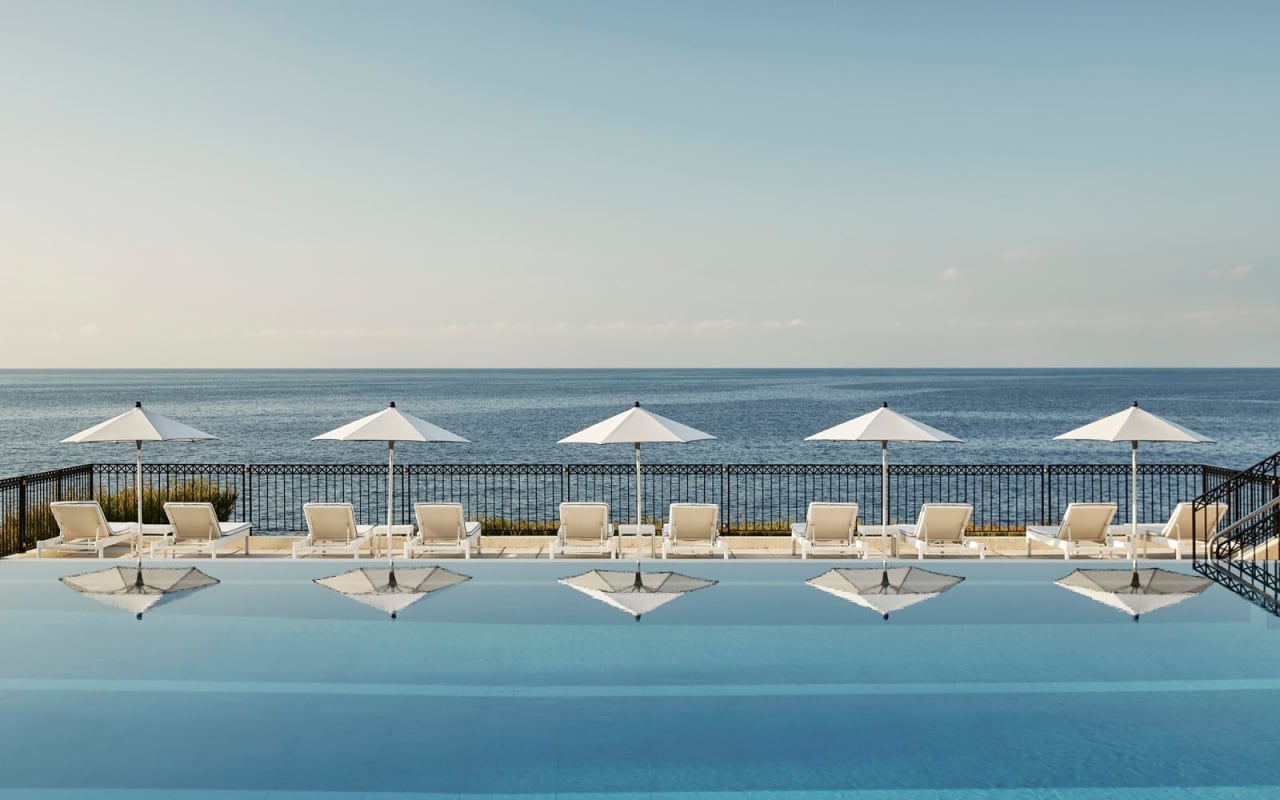
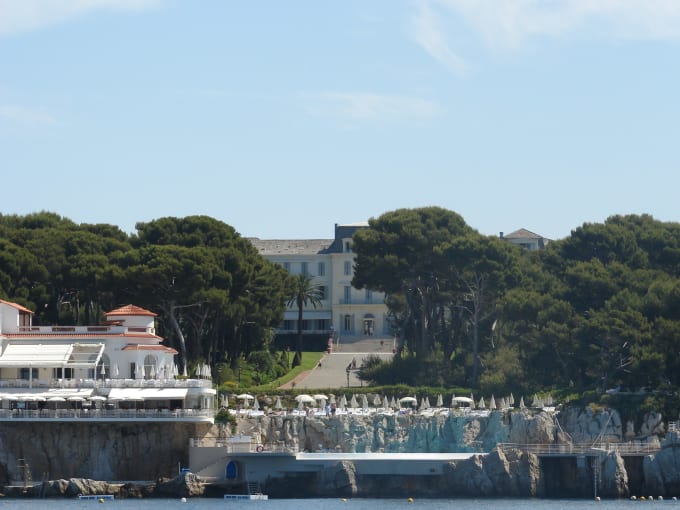
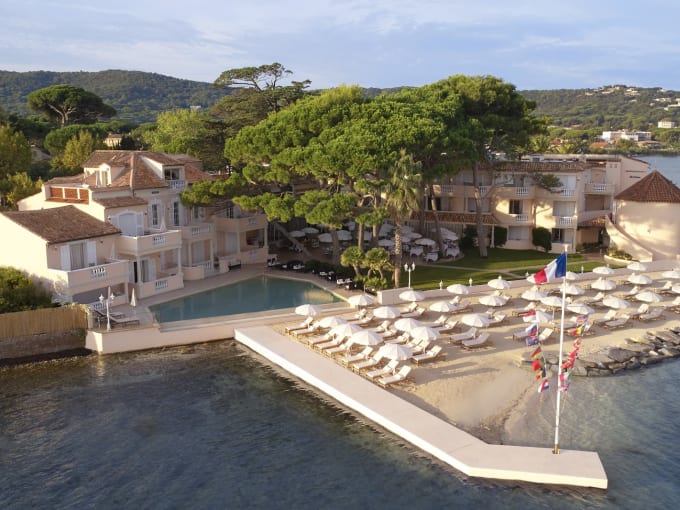
In France, seaside palaces hold a unique position. They are not merely defined by a private beach or a terrace overlooking the water. They narrate a specific geography, contrasting seasons, and a particular vision of the summer getaway. Between the Mediterranean, the Atlantic, the English Channel, and Corsica, the relationship with the sea varies profoundly. In Saint-Tropez, the experience is shaped by light, gardens, and the proximity of coves. In Dinard or La Baule, it takes the form of a grand resort, more structured and horizontal. In Saint-Jean-Cap-Ferrat, it becomes a dialogue between rocky capes, pine forests, and the horizon. This ranking focuses on the rare encounter between palace addresses and maritime locations. Here, the setting ceases to be a mere backdrop; it becomes the very reason for the journey.
To establish this ranking, we adopted a strict editorial approach. Firstly, the palace status serves as the foundation. Next, we examine the tangible relationship to the sea. Dominant views, access to the coastline, locations on a peninsula, in a bay, on a beach, or in immediate proximity. We also consider the coherence of the venue. Architecture, gardens, outdoor spaces, pools, terraces, and the rhythm of summer life. A convincing seaside palace is not judged solely by its address; it is assessed by its ability to bring the shoreline to life. Our advisors also take into account the reputation of the establishment, the consistency of the experience, and the clarity of its positioning. Finally, we favour hotels that embody a destination, not just those that occupy it.
The French panorama is more varied than one might imagine. The Côte d'Azur boasts several major signatures. Airelles Saint-Tropez Château de la Messardière, Cheval Blanc St-Tropez, the Grand-Hôtel du Cap-Ferrat, A Four Seasons Hotel, and the Hôtel Barrière Le Majestic in Cannes each present very distinct styles. One works with the hill and gardens; another is nestled in the intimacy of a Tropezian address. A third cultivates the majesty of a cape, while the fourth embraces a grand urban façade facing the Croisette. Further north, the Grand Hôtel Barrière de Dinard, Hôtel Barrière Le Royal La Baule, and Hôtel Barrière Le Westminster Le Touquet remind us that French maritime palaces are not limited to the south. Corsica offers yet another grammar, more mineral and discreet, with the Grand Hôtel de Cala Rossa, the Hostellerie du Moulin des Oliviers, and Hôtel A Speranza.
For 2025 and 2026, several trends are emerging in this segment. The first concerns space. Travellers are seeking less visible ostentation and more thoughtfully designed volumes, usable outdoor areas, and a genuine sense of openness. The second relates to the connection to the site. The most convincing hotels no longer aim to dominate the landscape; instead, they integrate with it more subtly. This enhances Mediterranean gardens, wind-sheltered terraces, pools open to the horizon, and easy access to the sea. We also observe a strong expectation for long stays. In summer, a coastal palace should facilitate multiple uses of the stay: morning swims, shaded lunches, beach returns, and evenings facing the open sea. Finally, the international clientele remains attentive to major brands but increasingly values local anchoring and the personality of the place.
This is perhaps where French luxury retains its strength. It does not rely solely on material rarity; it hinges on a way of orchestrating the experience. A smooth arrival, service that anticipates without imposing, a room designed for light, a restaurant that extends the landscape, a pool that does not compete with the sea. In the best seaside palaces, all this seems simple. In reality, this simplicity demands a great deal of mastery. My advice is to look beyond the images. An iconic façade does not guarantee the best stay for everyone. Some travellers want to experience the beach on foot, while others prefer height, tranquillity, or a more secluded peninsula. The right seaside palace is not just beautiful; it corresponds to a very personal way of experiencing summer.
Thus, this ranking should be read as a curated selection, not as a universal verdict. The first is not the only valid choice, and the twelfth is never a secondary option. Each establishment meets a different expectation. Some excel due to their immediate location by the shore, while others shine with a defining view, a rich hotel history, or a rare ability to evoke the sea even from a distance. What our advisors often observe is the gap between projected desire and actual use. A couple does not choose like a family, and a long weekend is not considered the same as a fortnight in summer. An address in Cannes does not play the same tune as a house in Bonifacio or Dinard. Our hierarchy highlights the beauty of the maritime setting without overshadowing the diversity of styles.
In the following Top, you will find twelve French palaces where the sea truly matters, whether through views, access, atmosphere, or the memory of the place. Notably, each offers a different interpretation of the coastline.