Le Marais embodies a quintessentially Parisian concept of the urban hotel. It is a place to sleep in the heart of a vibrant neighbourhood, and to stay for its rich cultural density. Between private mansions, galleries, museums, terraces, and ancient streets, the experience takes on a rare texture. Here, luxury is not merely measured in square metres; it is reflected in the address, the tranquillity achieved despite the bustling city, and the precision of the service. For the discerning traveller, Le Marais caters to various needs: a weekend on foot, a design interlude, a heritage stay, or a wellness retreat. This area has also refined its high-end offerings, now prioritising identity, exact location, and local experience. This selection aligns with that logic, highlighting urban hotels that can embody Paris without resorting to caricature.
At MyConciergeHotel, we do not rank a neighbourhood as if compiling a simple list of addresses. We first observe the coherence between the location and the hotel. In Le Marais, this alignment is crucial. A beautiful façade is not enough; a relevant setting, seamless access to cultural institutions, and a genuine understanding of the neighbourhood are essential. We then assess the quality of accommodation: room size, tranquillity, service level, operational consistency, communal spaces, and the ability to provide a frictionless urban experience. We also consider objective signals such as a 5-star rating, brand reputation, architectural uniqueness, the presence of a spa, views, or a location on an iconic square. Finally, our advisors examine the actual usage: who feels comfortable there, for what type of stay, and at what pace of travel.
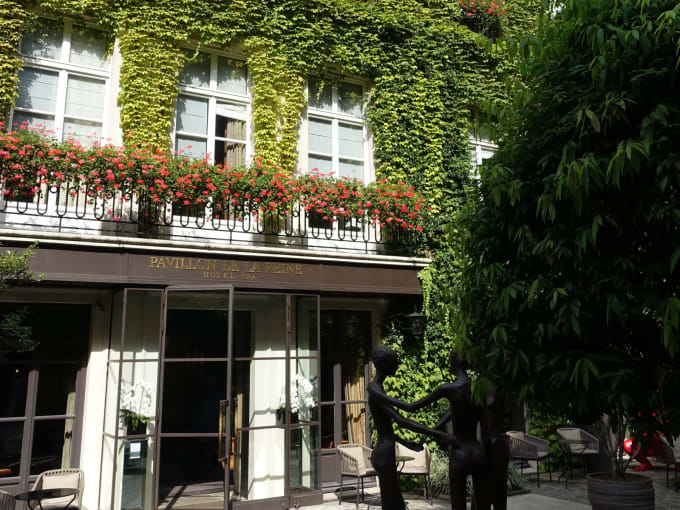
The panorama of this selection clearly illustrates the diversity of the broader Marais. Cour des Vosges epitomises the quintessential heritage address, with its location at Place des Vosges speaking for itself. Le Pavillon de la Reine, also situated on this square, offers a more discreet and subdued interpretation of the grand Parisian hotel. Grand Mazarin introduces a more contemporary energy, firmly rooted on the right bank, vibrant and central, with a more social approach to the stay. Maison Proust presents a more intimate experience, appealing to travellers sensitive to atmosphere, decor, and inner narratives. Finally, SO/ Paris opens up new perspectives, with its riverside position on the edge of Le Marais providing expansive views and a more vertical relationship with the city. Thus, five hotels, each offering distinct ways to inhabit Paris.
For 2025 and 2026, several trends are solidifying in this segment. Firstly, the high-end traveller seeks a hotel that simplifies the city, favouring clarity over ostentation. A good lobby, a precise concierge, a functional restaurant, and rooms designed for quick recovery are key. Secondly, urban spas are gaining importance, not as mere decorative features, but as tools for pacing. In a dense neighbourhood, the ability to swim, receive a massage, or simply slow down can transform the stay. Another evolution is the sustained demand for addresses with a strong identity. Travellers increasingly negotiate between two desires: on one hand, the heritage hotel, quintessentially Parisian; on the other, the design hotel, more open to the contemporary scene. This ranking reflects this movement, not choosing sides but highlighting addresses that deliver on their promises with clarity.
Le Marais also serves as a reminder of what French luxury truly means in an urban context. It is not merely about ostentation; it is about composition. A beautiful address, a clear story, service that anticipates without intruding, and enduring details. In this neighbourhood, the ideal hotel knows how to engage with the city, not isolating the traveller from the outside but rather providing a better way to enter it. This is why we place such value on the relationship with the urban fabric: stepping out on foot to Place des Vosges, visiting an exhibition, crossing the Seine, or returning late without losing the sense of shelter. These are very concrete criteria. It is also worth noting that the best hotel is not always the most ostentatious; often, it is the one that facilitates the stay with the most natural ease.
Thus, this ranking should be read without seeking a vain absolute. These five hotels do not offer the same experience, and that is precisely their appeal. Some will be better suited for a first stay in Paris, while others will resonate more with regular visitors seeking a characterful address. Some prioritise the monumentality of the location, while others focus on intimacy, decor, or views. What our advisors observe is the fidelity between promise and reality. A hotel may be highly successful for a couple on a getaway, but less so for a business traveller or a family. Conversely, a more contemporary address may work better for a short stay. Our hierarchy distinguishes profiles of excellence; it does not distribute abstract accolades but assists in making the right choice.
Before delving into the Top 5, keep this simple idea in mind: in Le Marais, the address already does much of the work. But only execution can transform a beautiful location into a great stay. Here are the hotels that, according to our criteria, achieve this best.