The Marais is not a hotel district in the traditional sense. This is precisely what makes it essential for the discerning traveller. One comes here less to tick off an address than to truly inhabit Paris for a few days, immersing oneself in the scale of a street, a square, or a passage. Among private mansions, galleries, museums, sought-after restaurants, and characterful shops, the area creates a dense, cultured, and highly mobile Paris. It connects the historic right bank with a more contemporary scene. Within this perimeter, luxury hotels do not seek ostentation. Instead, they focus on location, the quality of silence, the architectural reading of the surroundings, and the sensation of being exactly in the right place. It is this balance that we aimed to illuminate with this ranking.
To establish this selection, we never rely on a single promise of image. Our advisors first cross-reference tangible elements. The category, the exact address, the establishment's roots in the neighbourhood, and the coherence of the experience are as important as the level of service. We also observe how a hotel interacts with Le Marais. Some prioritise intimacy behind a discreet façade, while others embrace a more visible presence, offering views, dining, or wellness spaces designed as destinations. We take into account the actual rhythm of a stay. The arrival, circulation, quality of the rooms, relationship to light, and ease of access to Place des Vosges, the Seine, or museums all significantly impact the experience. A good hotel in Le Marais should serve the neighbourhood, not erase it.
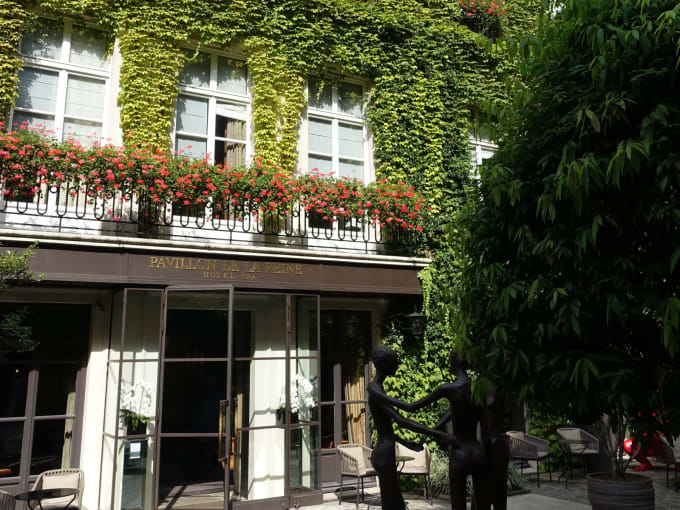
The selected panorama clearly showcases the diversity of this Parisian micro-market. Cour des Vosges and Le Pavillon de la Reine embody a strong heritage reading of the district, in direct contact with Place des Vosges or its immediate surroundings. Grand Mazarin offers a more theatrical interpretation, situated in a lively area close to shopping streets and the energy of central Le Marais. Maison Proust follows a more subdued, literary logic, where atmosphere becomes a major component of the stay. SO/ Paris provides another perspective. Its relationship with Le Marais is more peripheral, with an address that also overlooks the Seine and contemporary Paris. This contrast is valuable. It reminds us that Le Marais is not a frozen postcard. It is a territory with porous boundaries, where multiple ways of staying coexist.
For 2025 and 2026, several trends are confirmed in this segment. The first concerns critical size. The most discerning travellers often seek smaller establishments, where arrival remains smooth and service is clear. The second relates to wellness. The spa is no longer just a selling point but a recovery tool after a busy day in Paris. The third trend concerns the room itself. There is now an expectation for genuine sound insulation from urban noise, without breaking with the neighbourhood. Finally, dining is evolving. A hotel in Le Marais does not need to be self-sufficient. Instead, it should offer a credible anchor point and then allow the neighbourhood to do the rest. What our advisors observe is a more mature demand. The traveller seeks a just address, not a decor that monopolises attention.
French luxury in Le Marais is often expressed through subtler signs than elsewhere. It lies in the proportion of a lounge, the quality of a courtyard, and the way a reception supports without overplaying. It also relates to the perception of time. Leaving early to cross a square still calm. Returning late afternoon after an exhibition. Dining late, then finding a room where the neighbourhood seems to fade away. In this regard, the best addresses do not mimic the grand palaces of the boulevards. They embrace a different grammar. More residential, more cultured, sometimes more introspective. My advice: in Le Marais, choose a hotel according to how you wish to experience Paris. A leisurely stay, a gastronomic weekend, a design escape, or a discreet interlude each require a different address.
Thus, this ranking should be read without a reflex for superlatives. The number one is not the only good choice. It corresponds to an editorial hierarchy, based on the overall balance between location, identity, consistency, and desirability. But each establishment has its audience. One address may be ideal for a first discovery of the neighbourhood. Another may suit a Paris regular seeking a specific refuge. A third may be more appealing for its views or its more contemporary relationship with the capital. This is one of the attractions of Le Marais. The district allows for very different experiences within a limited radius. It is important to note: this top 5 does not distribute absolutes. It helps to distinguish nuances, which is often more useful when booking a grand hotel in Paris.
Our top 5 best hotels in Le Marais thus brings together five solid interpretations of the district. Five addresses, five ways to enter Paris, with distinct priorities yet a shared commitment to excellence.