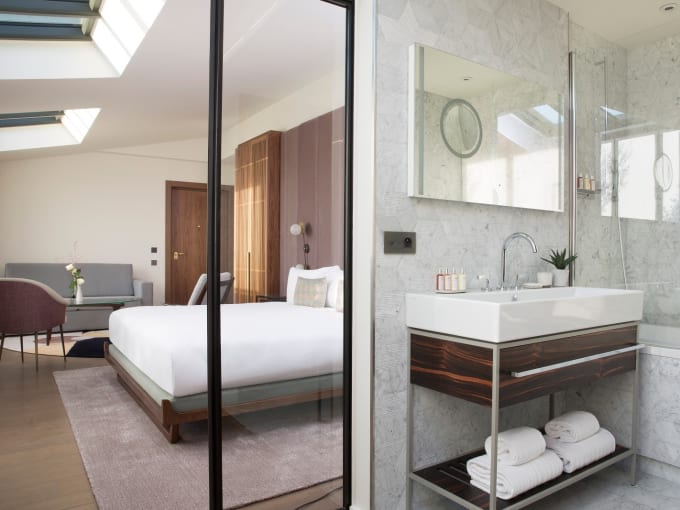
Bastille is not a museum district. It is a vibrant part of Paris that stays alive late into the night, evolves rapidly, yet maintains a genuine urban continuity. Between the 11th and 12th arrondissements, the address is as significant as the style. Visitors come here for a rare density where galleries sit alongside workshops, serious dining establishments neighbour local bars, and grand perspectives suddenly open onto more intimate streets. For the discerning traveller, Bastille meets a specific expectation. One seeks an urban hotel, a hotel that engages with the city. It must allow for easy walking in and out, enabling one to experience Paris without filters. Within this area, Cour des Vosges, Grand Mazarin, Maison Bréguet, and SO/ Paris each offer very different interpretations of this dynamic Paris.
At MyConciergeHotel, our rankings are never based on a single impression. We first consider objective elements. The ranking level, the five-star category, the actual location, the coherence of positioning, the perceived quality of common spaces, and the hotel's ability to deliver on its promises are all crucial. We also observe finer criteria. Is the arrival seamless? Are the rooms designed for an urban stay? Can the service adapt to very different rhythms? Does the address facilitate both a cultural weekend and an extended business trip? In Bastille, these questions are decisive. The neighbourhood imposes a certain intensity. A good urban hotel must absorb this energy without being overwhelmed by it. This is often where the difference lies between a lovely address and one that is truly relevant.
The panorama of this selection illustrates that there is not just one way to stay around Bastille. Cour des Vosges views Paris through the lens of heritage and historical significance. The relationship with time here is unique. One seeks a characterful address in a setting that immediately speaks to lovers of old Paris. Grand Mazarin offers a different perspective. More on the right bank, with a more cosmopolitan spirit, it connects Bastille to the Marais with great fluidity. Maison Bréguet, on the other hand, plays a more understated role. Its grounding in the 11th corresponds to a neighbourhood Paris that is creative and mobile. Finally, SO/ Paris adopts a more panoramic scale. The view, the height, and the relationship with the Seine alter the experience. Four hotels, therefore, and four ways to inhabit the same area.
For 2025 and 2026, our advisors observe a clear evolution in demand within central Paris. The high-end traveller is no longer just seeking a beautiful room. They want an address that simplifies the city. This means short journeys, mixed uses, and a genuine clarity of the neighbourhood. Bastille meets this expectation well. The area allows for smooth transitions from a meeting to an exhibition, and then to dinner, without constantly relying on a car. Another strong trend is the value placed on views, light, and spaces where one can slow down. This explains the interest in hotels offering a spa, a pool, a rooftop, or simply well-designed lounges. Lastly, local identity is regaining importance. Travellers want to feel Paris, not interchangeable hospitality. Here, each address in our selection offers a distinct interpretation.
Discussing French luxury in this sector requires avoiding clichés. In Bastille, luxury is not a display. It is more about precision. A good address knows how to create a transition between the external hustle and the internal calm. It also understands that a Parisian stay hinges on concrete details. Bedding that truly aids recovery. A well-thought-out bathroom. A service capable of securing a relevant table rather than just a visible one. A location that saves time, and thus enhances comfort. It is this discreet intelligence that we seek. In such a vibrant neighbourhood, it becomes essential. My advice is simple. In Bastille, choose less a decor than a rhythm. Some travellers desire historical depth. Others prefer the contemporary scene, a view, or a more residential atmosphere. The right hotel is one that aligns with your way of experiencing Paris.
Thus, this ranking should be read as a guiding tool, not as an absolute verdict. The first does not negate the fourth. It simply responds, in our view, with greater precision to the concept of an urban hotel in Bastille. This nuance matters. A hotel steeped in heritage may appeal more to a lover of historical places. Another, more vertical and panoramic, will better suit a short stay with a busy agenda. A third will be ideal for those wishing to remain in a more local Paris. What our advisors observe is the coherence between the address, the neighbourhood, and the actual use. We do not rank hotels in the abstract. We rank them within a specific context. Bastille demands a grounded perspective. It is a neighbourhood of movement, contrasts, and energy. The best addresses are those that transform this intensity into readable comfort.
Before entering the Top 4, keep this idea in mind. In Bastille, a successful urban hotel does not isolate you from the city. It offers the best version of it, with the right degree of distance.