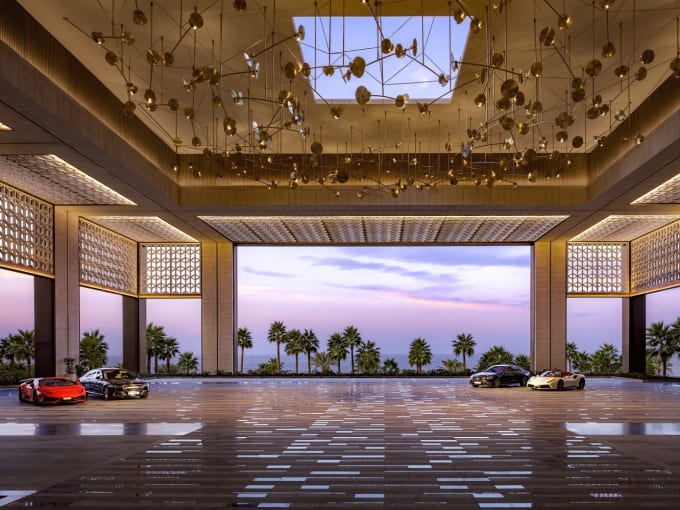
Dubai is often described through its verticality. However, the hotel design here warrants a more nuanced exploration. The city is not merely defined by its skyline effect; it brings together a variety of aesthetic languages. Couture minimalism at the Armani Hotel Dubai. The theatrical exuberance of Atlantis The Royal. Maritime and Italian lines at the Bulgari Hotel. A creative and urban spirit at Hotel Indigo Dubai Downtown. Even the 25Hours Hotel Dubai One Central introduces a more narrative energy. In Dubai, design is not an added decoration; it structures the experience, the flow, the light, and the relationship with the city. This is precisely why this selection matters. It helps distinguish hotels where form truly interacts with function.
To establish this ranking, we do not adhere to a single aesthetic. We first observe the overall coherence of the project. Architecture, interiors, materials, views, arrival sequence, and brand identity must speak with one voice. We also consider a hotel's ability to embed its design within Dubai. A grand design hotel here does not copy London, Milan, or Miami; it interprets its context. Our advisors also assess the clarity of the spaces. A spectacular lobby is not enough; well-thought-out rooms, fluid circulation, and an atmosphere that lasts from morning to night are essential. Finally, we value recognised signatures, influential addresses, and hotels whose design remains relevant beyond the initial opening effect.
The panorama of this selection clearly illustrates Dubai's plurality. Some hotels embrace monumentality. Burj Al Arab Jumeirah remains a visual manifesto, instantly recognisable. Address Sky View leans more towards contemporary lines and its relationship with the skyline. Four Seasons Hotel DIFC adopts a more urban, intimate scale, suited to the business district. Other addresses shift the gaze. Arabian Boutique Hotel reminds us that design in Dubai can also draw from heritage and local roots. Al Maha, a Luxury Collection Desert Resort & Spa, Dubai, steps away from the metropolitan register. Its aesthetic engages with the desert and the nature reserve. This ranking does not seek a single definition of beauty; it maps out various ways to inhabit Dubai with style.
The trends for 2025 and 2026 confirm this evolution. Hotel design in Dubai is becoming less demonstrative and more editorial. Guests are seeking places with a clear intention. They want to understand why a room is designed in a certain way. They wish to feel a neighbourhood, a brand, a visual culture. The most interesting hotels are now focusing on texture, art, natural light, and human scale. Hybrid spaces are also gaining importance. Libraries, lounges, rooftops, and dining concepts must extend the identity of the place. What our advisors are also observing is a return to more narrative design. 25Hours Hotel One Central is a good example of this. Conversely, establishments like Bvlgari Hotel & Resort are betting on restraint, precision, and permanence.
At MyConciergeHotel, we interpret luxury with a French sensibility. This does not mean imposing a French style on Dubai; it means prioritising accuracy, proportion, and service in harmony with the location. A successful design hotel is not just photogenic; it must offer comfort, visual calm when needed, and genuine usability. My advice is simple: always observe how a hotel manages transitions. The arrival from the street, the passage to the lobby, the opening of the room, the relationship between the bathroom, light, and view. This is often where the difference lies between a thoughtfully designed address and one created to impress for just a few moments.
It is also important to read this ranking without a reflex for superlatives. The number one hotel is not necessarily the ideal choice for everyone. Some travellers seek a bold, almost theatrical design, while others prefer a quiet elegance. A business stay in DIFC does not call for the same decor as a weekend on Palm Jumeirah. A desert getaway does not meet the same expectations as a Downtown address. We therefore rank hotels that each excel in a specific register. Being lower in the ranking does not mean being less desirable; it simply indicates that the interpretation of design is different or more specialised. It is essential to remember that this ranking serves as a selection tool and never replaces the suitability of an address for your way of travelling.
In the following top, you will find eight hotels, each telling a facet of design in Dubai. Some have become landmarks, while others charm with a more contemporary interpretation. All deserve attention for concrete reasons.