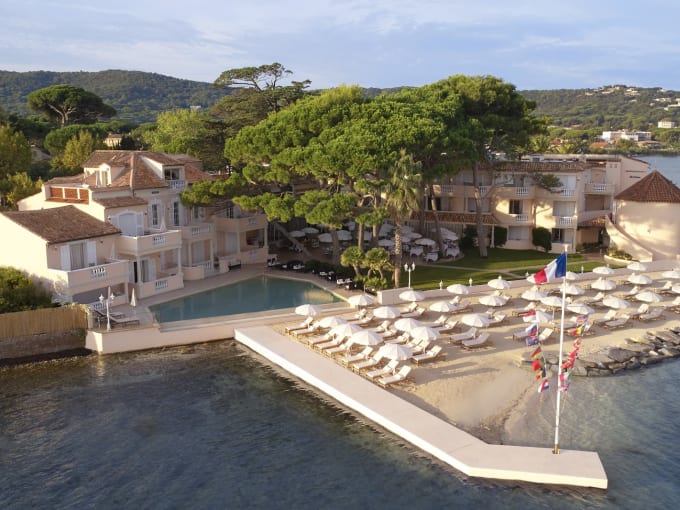
In Saint-Tropez, a charming hotel is not merely a photogenic address. It embodies a relationship with the place, the light, and the Provençal rhythm. In this town, heritage is as significant as the view. Travellers seek a home with a memory, rather than just a seasonal backdrop. This is precisely what makes this segment so intriguing today. Among bastides, historic estates, and palaces set in an already legendary landscape, Saint-Tropez boasts a rare density of addresses with strong identities. Airelles Saint-Tropez Château de la Messardière, Cheval Blanc St-Tropez, Château de la Messardière, Villa Marie, and La Réserve Ramatuelle - Hôtel, SPA and Villas create a very clear panorama. Some embody the Tropezian heritage, while others interpret the Riviera with a more contemporary flair. All contribute to a shared idea. Here, charm arises from a genuine connection to the locale.
To establish this ranking, we do not seek mere publicity. We first observe the coherence between the address and its surroundings. In Saint-Tropez, this means the relationship to the village, the bay, the umbrella pines, and the hills of Ramatuelle. We then consider the heritage dimension, which can be architectural, landscape-related, or cultural. A charming hotel does not need to be old; however, it must possess a presence, continuity, and a recognisable signature. Our advisors also take into account the quality of experience, including arrival, circulation, the sense of intimacy, the reading of outdoor spaces, and the ability to embody the South without resorting to folklore. Finally, we incorporate objective benchmarks: official category, Palace status where applicable, brand reputation, precise location, and consistency of positioning. This ranking remains editorial, yet it is based on verifiable facts.
The Tropezian panorama presented here is intentionally concise. Five hotels suffice to showcase the diversity of local charm. On one hand, there are institutions of almost palatial scale, such as Airelles Saint-Tropez Château de la Messardière or Cheval Blanc St-Tropez. Their strength lies in an immediately recognisable identity. On the other hand, there are establishments that focus more on the sensation of retreat, like Villa Marie or La Réserve Ramatuelle - Hôtel, SPA and Villas, located in Ramatuelle. The case of Château de la Messardière also merits attention for what it represents in the destination's imagination. What connects these addresses is not a singular style, but a particular way of inhabiting the Mediterranean landscape. Some favour discreet monumentality, while others embrace botanical intimacy. It is important to note that charm in Saint-Tropez is never monolithic; it takes various forms, depending on the distance to the village and the relationship to the sea.
For 2025 and 2026, we observe a clear evolution in expectations. The luxury traveller no longer seeks merely a beautiful room and a nearby beach; they wish to understand where they are staying. In Saint-Tropez, this favours hotels capable of offering a precise interpretation of the territory. The major trends are well-known: more space, greater privacy, more gardens, and a marked return to architectures that engage with Provence. Landscape heritage becomes central. A path lined with pines, a terrace overlooking the bay, a building perched on the heights are as important as a well-honed service. We also note a more mature expectation regarding wellness. The spa remains significant, but it must be integrated into a holistic experience. Finally, the season is extending. Establishments that maintain relevance outside the peak summer period are becoming increasingly pertinent. Sustainable charm is also measured by the ability to endure over time.
There exists a very French notion of hotel luxury in Saint-Tropez. It does not rely solely on ostentation; rather, it is based on the mastery of proportions, the sense of hospitality, and the appropriateness of the setting. In the finest establishments, nothing feels forced. Heritage is not a superficial argument; it structures the experience. A façade, a garden, a view of the sea, or a historical location become elements of language. What our advisors often observe is that the most discerning travellers do not merely seek prestige; they look for a place that can slow down the Tropezian narrative. They wish to rediscover the residential aspect of the destination, characterised by hills, estates, quieter paths, and elevated views. In this spirit, charm is not the opposite of grand luxury; it can sometimes be its most convincing form when the hotel remains grounded and legible.
This ranking should therefore be read methodically. It does not designate a perfect hotel for everyone; rather, it ranks different propositions based on their ability to coherently express Tropezian heritage. A Palace may appeal due to its historical depth or location, while a more discreet establishment may convince through its atmosphere and relationship to the landscape. We do not compare interchangeable products; we compare visions of stay. This is an important nuance. A couple seeking isolation will not perceive Saint-Tropez in the same way as a family staying for several nights. A regular visitor to the Riviera does not expect the same experience as a first-time traveller. My advice is simple: focus less on mere notoriety and more on the harmony between the address and your way of experiencing the destination. A good charming hotel is one that enhances the place, not one that obscures it behind its image.
In the following top list, we have selected five addresses that each tell a facet of Saint-Tropez and its immediate surroundings. Some overlook the bay, while others prefer a botanical retreat. All have a clear reason for being included.