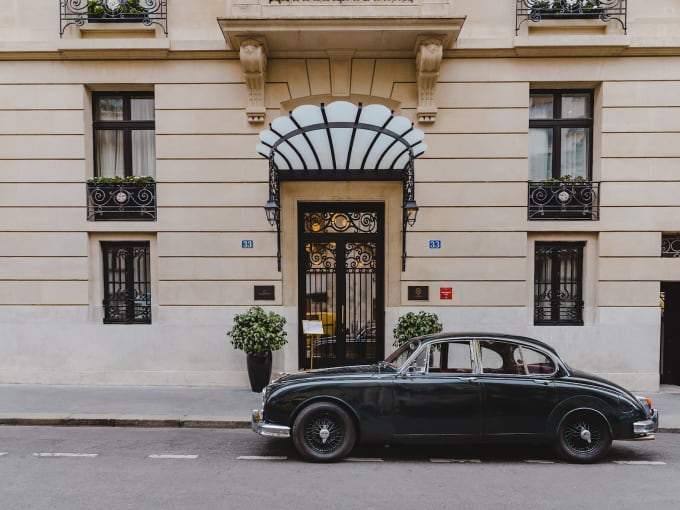
In the 8th arrondissement of Paris, charming hotels are not merely discreet little addresses. Here, charm intertwines with diplomatic history, Haussmannian avenues, and renowned fashion houses. Between Place de la Concorde, Avenue Montaigne, Faubourg Saint-Honoré, and the edges of Parc Monceau, the area showcases a distinctly Parisian version of hotel heritage. While there are certainly palaces, there are also more intimate hotels. Their commonality lies less in the number of stars than in a certain density of place. 19th-century façades, reinterpreted private mansions, Art Deco decor, plush lounges, and urban views create a rare landscape. It is precisely this blend that our travellers seek. They want Paris, but a Paris that is lived in, comprehensible, with an address that tells a story about the neighbourhood.
To establish this ranking, we do not rely on a vague notion of refinement. We examine concrete, observable, and comparable elements. First, the heritage anchoring of the address. A historic building, an iconic location, a strong relationship with the urban fabric of the 8th are all significant. Next, the coherence between architecture, decor, and the overall experience. A charming hotel succeeds when its identity extends beyond the lobby. We also consider the quality of the location, the sense of intimacy, the clarity of service, and the ability to provide a credible Parisian experience. Official distinctions can illuminate our assessment. Palace Atout France, major international brands, or more discreet establishments do not imply the same register. However, each can produce a characterful address.
The panorama of the 8th arrondissement is particularly intriguing, as it juxtaposes several types of hotels. On one side, institutions like Hôtel de Crillon, Four Seasons Georges V, Hôtel Le Bristol Paris, Plaza Athénée Paris, or La Réserve Paris – Hotel and Spa. They embody a prestigious memory of the capital. On the other, establishments that engage with heritage on a more intimate scale, such as Hôtel de Sers or Prince de Galles. Contemporary signatures, like Bulgari Hotel Paris or Royal Monceau Raffles Paris, reinterpret the area with modern codes. Finally, addresses like Fouquet’s Paris, Hôtel Barrière Le Fouquet's Paris, or Château des Fleurs demonstrate that a charming hotel can also arise from an atmosphere, a street anchoring, or a specific decorative vocabulary. Thus, the 8th is not uniform. It offers multiple interpretations of Paris.
What we observe for 2025 and 2026 is clear. High-end travellers are seeking less visible ostentation and more depth of place. They want to understand where they are sleeping. In the 8th, this translates into an increased interest in addresses that can connect heritage with contemporary use. A large spa is important, but it is no longer sufficient. A beautiful suite matters, but it must fit within a broader narrative. Guests are paying more attention to acoustic quality, the fluidity of movement, the presence of terraces or urban views, and how the hotel opens up to the neighbourhood. They also appreciate establishments that manage to provide genuine intimacy in a highly exposed arrondissement. It is worth noting that charm in 2025 is not a fixed decor. It is a sensation of balance between heritage, service, and the Parisian rhythm.
French luxury in the 8th relies on a subtle grammar. It is not only expressed through noble materials or a brand's signature. It pertains to the manner of entering a place, being welcomed, traversing a lounge, and finding calm after the avenue. In this district, the best charming hotels know how to orchestrate this transition. They offer a form of retreat without cutting off from the world. Heritage plays a central role here, as it gives immediate depth to the stay. A classically Parisian façade, a staircase, a courtyard, a view of the rooftops, or an address linked to the social history of the area alters the perception of travel. My advice is simple. In the 8th, choose less a style than a relationship with the neighbourhood. It is this relationship that will shape the quality of the memory.
This ranking should therefore be read without automatic reflexes. It does not claim to designate a perfect hotel for everyone. A historic palace may suit a first-time visit to Paris, as it concentrates strong reference points. A more intimate address may appeal more to a regular visitor seeking calm and personality. A very contemporary hotel may seem more appropriate for an extended business trip. A more classic establishment may be better suited for a heritage weekend. What our advisors often observe is that the notion of charm varies according to the purpose of the stay. It also depends on sensitivity to decor, immediate surroundings, the level of activity, and the type of service expected. We have therefore favoured hotels that possess a genuine point of view. Each expresses a distinct way of inhabiting Paris 8th.
In the following Top 6, you will find addresses where heritage is not merely a selling point. It genuinely structures the experience. Some belong to the Parisian institution. Others play a more intimate tune. All share a clear identity, a strong anchoring in the 8th, and that rare quality: to give the feeling of a Paris that is both historical, vibrant, and personal.