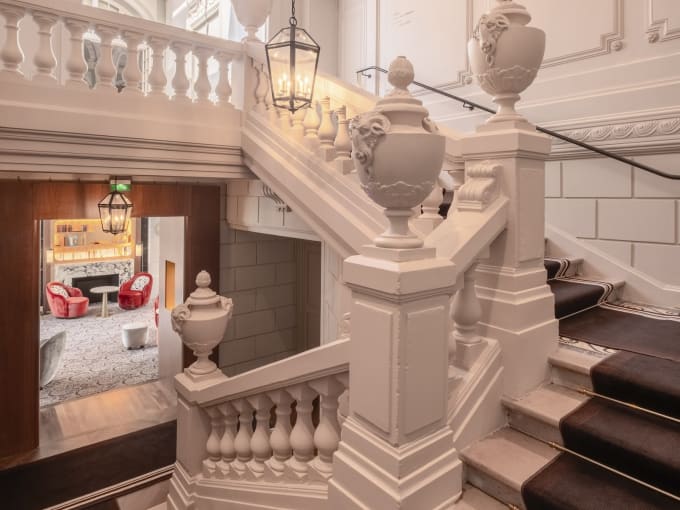
In Île-de-France, the charming hotel takes on a unique significance. It is not merely defined by its small size or antique decor. It is part of a territory where heritage shapes the journey. Between royal forests, courtly towns, historic residences, and more discreet addresses, the region creates a distinctly French geography of stay. People often come for Paris. Sometimes, they stay for what surrounds it. Versailles and Chantilly encapsulate this logic well. On one side, the monarchical heritage, classical perspectives, and the ritual of gardens. On the other, equestrian elegance, forest edges, and a culture of refined weekends. In this landscape, establishments like Auberge du Jeu de Paume, Hôtel Les Lumières, or Trianon Palace Versailles offer different interpretations of heritage charm.
To establish this ranking, we do not seek mere publicity. We first observe the coherence between the location and its environment. A charming hotel in Île-de-France must engage in dialogue with its address. It should tell something about its territory. We then examine the architectural quality, the clarity of the decorative project, and the relationship to history. Service is equally important, not in a demonstrative manner, but in its ability to make the stay seamless. We also consider the relevance of common spaces, local anchoring, the sense of intimacy, and the consistency of the experience. What our advisors primarily observe is balance. Charm begins there. When nothing seems forced, and everything appears in its rightful place.
The Île-de-France panorama is more varied than one might think. It is not limited to the grand names near the monuments. It also includes hotels that cultivate a more understated idea of luxury. Some draw on a clearly identified aristocratic past. Others favour a contemporary interpretation of heritage. In Versailles, the experience can be lived in immediate proximity to the castle's imagery. In Chantilly, it takes on a more pastoral, almost sylvan tone, with a strong connection to the paths, stables, and grand vistas. This diversity is essential. It allows for a distinction between ostentatious stays, weekend getaways, and more discreet retreats. My advice is simple. In Île-de-France, one should choose a charming hotel as one would choose a country house. For its rhythm, as much as for its decor.
The trends for 2025-2026 confirm this evolution towards a more contextual luxury. Travellers are asking for less spectacle and more meaning. They want to understand where they are sleeping. They seek hotels capable of offering a heritage immersion without museum-like rigidity. This involves buildings restored with precision, sustainable materials, thoughtfully designed rooms, and seamlessly integrated wellness spaces. The demand for local stays continues to support Île-de-France. A French, European, and international clientele sees it as a credible alternative to a simple Parisian city break. Heritage then becomes a framework for breathing. The grand establishments near Versailles or Chantilly benefit from this expectation. They provide immediate access to major sites while offering a calmer tempo than that of the capital.
It is also important to recall what charm signifies in a demanding French tradition. It is not about accumulation. It is not ornamentation for ornamentation's sake. It is a way of inhabiting history with restraint. In the best addresses, heritage is never a costume. It remains a structure, a language, and sometimes a discipline. A beautiful ceiling height, a framed view of a garden, a well-proportioned lounge, or a quiet corridor can matter more than a spectacular device. This is especially true in Île-de-France. The most convincing hotel luxury is often that which allows space for the place. It accompanies the visitor rather than dazzling them constantly. This restraint, when mastered, gives stays a rare depth. It distinguishes the hotels we readily recommend from those we quickly forget.
Thus, this ranking should be seen as an editorial selection, not as a universal verdict. Each hotel has its audience, its moment, and its function. Some will be better suited for a romantic getaway. Others for a cultural stay, an extended weekend, or a celebratory stopover. We do not seek to oppose styles. We aim to prioritise experiences based on the accuracy of their offerings. A grand name is not enough. A prestigious location is not sufficient either. What matters is how the address transforms these assets into a memorable stay. This is why our perspective remains nuanced. It values the personality, consistency, and intelligence of the place. In a region as exposed as Île-de-France, this requirement is essential. It allows for the distinction between a well-born address and one that is truly accomplished.
The following top 5 thus brings together charming hotels where heritage is not merely a backdrop. It structures the experience, the rhythm of the stay, and the final memory.