History & heritage
Duba Plains Camp belongs less to the history of grand buildings than to the tradition of the contemporary safari camp, conceived in close dialogue with one of Africa’s defining landscapes. Its heritage is not that of an urban palace or an aristocratic residence, but of a certain idea of bush travel: discreet hospitality, careful service, and a deep connection to place. Set in Botswana’s Okavango Delta, the camp is shaped by an environment whose value lies as much in its beauty as in its ecological balance. The property follows the rhythm of the land—its seasons, light, and natural rules—and it is precisely this relationship with the living world that defines its identity.
Its membership of Relais & Châteaux helps to clarify this singular position. In that context, luxury is not conceived as display, but as quality of experience: the feeling of being exactly where one ought to be, in spaces designed with intelligence, cared for by teams able to anticipate needs without ever intruding. At Duba Plains Camp, that philosophy takes on a particular form because it must engage with remoteness, wilderness, and the demands of conservation. The camp does not attempt to tame the delta; instead, it proposes a way of staying within it that is respectful, comfortable, and thoughtful.
Its strong commitment to eco-tourism is another pillar of its contemporary heritage. In a region where human presence must remain measured, every decision matters: the siting of the camp, the management of resources, the way safaris are conducted, and the manner in which guests are introduced to the fragility of the ecosystem. This lends the stay an added depth. One does not come merely to tick off a safari experience, but to gain some understanding of a floodplain landscape, the movement of species, the importance of the dry season, and the way wildlife shapes the daily rhythm of life here.
The camp’s image is also closely linked to the delta’s lions, which guests may encounter on safari. This wildlife dimension has helped build its reputation among travellers seeking serious immersion in nature. Yet to see Duba Plains Camp only as a vantage point for sightings would miss what makes it distinctive. Its heritage lies in the balance between the intensity of the outdoors and the gentleness of the indoors: setting out at dawn, returning for a quiet lunch, listening to the stillness of the plains, then heading out again as the light softens. The camp becomes a threshold between two worlds—observation and repose.
In that sense, Duba Plains Camp belongs to the broader history of the safari reimagined for the twenty-first century: one in which elegance does not erase the landscape, service supports the experience without overplaying it, and privilege is measured by the rarity of a genuine encounter with the natural world. Its heritage is living rather than monumental, built on attentiveness, transmission, and restraint. It rests on a simple conviction: in a place such as the Okavango, true luxury lies in enabling an honest meeting with nature, without disturbing its order.
The property
A stay at Duba Plains Camp means entering a geography unlike any other. The Okavango Delta is neither a fixed backdrop nor merely a game reserve: it is a shifting world shaped by water, grasses, floodplains, and animal movement. The camp occupies a privileged position within this natural system, with the rare sensation of being far from everything without ever feeling cut off. Arrival itself prepares guests for a change of scale. Familiar reference points fall away, replaced by a place where light, silence, and the presence of wildlife immediately alter one’s sense of time.
The camp’s architecture and layout respond to that reality. In an environment of such power, it would be futile to compete with the landscape. The challenge is instead to settle into it with restraint, creating views, shade, places to pause, and a fluid relationship between indoors and out. The camp is conceived as an inhabited lookout: somewhere one may withdraw, read, dine, or talk, before returning quickly to what matters most—the spectacle of the delta. That continuity between comfort and immersion is central to its character.
The day is organised around safaris and intervals of rest. In the morning, the air is still cool and wildlife movement gives the landscape a particular tension. By midday, the camp returns to a slower rhythm, suited to repose and contemplation. Then comes the afternoon, with denser light, longer shadows, and the anticipation of evening sightings. This alternation is not incidental; it structures the entire experience of the place. Duba Plains Camp is not a hotel where one sleeps between excursions, but a camp where each space, meal, and silence extends the connection with the surrounding environment.
One of the property’s most striking qualities is the sense of complete immersion in nature. This is not a marketing phrase but a sensory reality. Sounds, scents, shifts in the wind, the proximity of plains and channels—all remind guests that they are staying within a living territory. For many travellers, it is precisely this density of the real that distinguishes the Okavango from other safari destinations. The experience is not limited to sightings of emblematic animals; it includes reading the landscape, noticing tracks, following the movement of water, observing changes in light, and gradually understanding a complex ecosystem.
The camp therefore appeals to those seeking a form of luxury that is less demonstrative than deeply contextual. Comfort is certainly present, but it is never detached from place. It exists to make a more attentive presence in the outside world possible. Guests come for the delta’s lions, for the beauty of the safaris, for the serenity of a preserved environment; they often remember most vividly the camp’s singular way of conveying the grandeur of the landscape without turning it into a performance. Duba Plains Camp offers a temporary way of inhabiting the wild, with all the delicacy, wonder, and respect that implies.
Rooms and suites
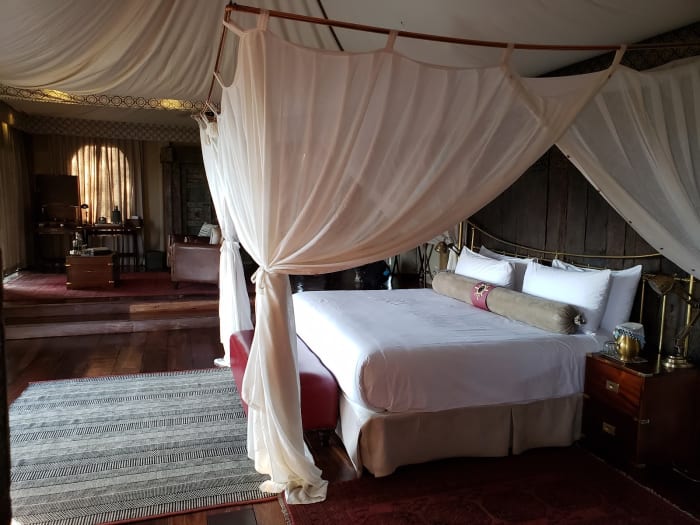
In a camp of this nature, accommodation is not merely a place to sleep: it forms the other side of the safari experience, one of retreat, restored coolness, and attention to detail. At Duba Plains Camp, rooms must answer a particular equation. They need to protect from the sun, provide privacy, allow for proper rest after early departures, and yet maintain a constant relationship with the outdoors. Comfort therefore takes on a specific form here—less urban than landscape-led. One expects a room to hold silence, frame the light, and let in the feeling of the delta without exposing guests to its harsher elements.
This changes the nature of the stay. After hours spent observing wildlife movement, returning to one’s private space does not mean breaking with nature, but altering one’s distance from it. The gaze shifts. One notices the quality of a terrace, the orientation of an opening, the way materials correspond to the tones of the plains. Luxury lies not in accumulation but in coherence. A successful room in the Okavango is one that soothes without distracting, envelops without isolating, and extends the outdoor experience rather than contradicting it.
Travellers drawn to the spirit of great African lodges generally appreciate this combination of refinement and practicality. Everything should feel effortless, even though much has been carefully considered to make the stay smooth: daily housekeeping, the preparation of the room at the right moment, attention to the rhythm of safaris, and the pleasure of returning to an orderly, welcoming space after an outing. The camp’s known services, including daily housekeeping and turndown service, contribute directly to that sense of continuous care. They create a form of quiet comfort that is especially valuable in such an intense environment.
The room also becomes a private observation post. Between activities, guests read, sort through photographs, or allow the emotion of a wildlife encounter to settle. Couples find a setting conducive to switching off; families, when choosing this type of stay, enjoy a calm interval between outings. In every case, the aim is the same: to provide a refuge that never distracts from the primary reason for travelling here. The camp does not promise an inward life cut off from the world, but a gentler way of inhabiting it.
It is this restraint that gives Duba Plains Camp’s accommodation its value. One does not come here for decorative display or theatrical effect. One comes for rooms capable of accompanying the experience of the delta with precision. In the morning, they prepare guests for departure; on return, they receive the happy fatigue of the day; in the evening, they become a transitional space between the intensity of safari and the calm of night. In a place where the outdoors naturally commands attention, successful accommodation means creating an interior that is protective, elegant, and deeply attuned to the landscape.
The Dining Experience
At Duba Plains Camp, dining is intrinsically linked to the surrounding landscape. In this remote and vibrant environment, each meal holds a unique significance. It marks a pause in the day, brings together travellers, and extends the experience of the outdoors.
A breakfast following an early morning outing. A lunch bathed in the delta's light. A dinner as the temperature cools. These moments weave together the memories of the stay.
Being part of Relais & Châteaux signifies a genuine commitment to the art of hospitality and the coherence of the culinary experience. In a high-end safari camp, this is reflected in precision, freshness, a sense of rhythm, and adaptability to the constraints of the location.
Gastronomy here is primarily about delivering a service of accuracy. It aligns with the variable schedules of safaris, the simple cravings that arise after hours in the bush, and the more leisurely dinners in the evening.
The communal aspect of dining is highly valued here. Meals foster a sociability characterised by spontaneous exchanges, shared stories of the trails, comparisons of observations, and moments of silence in the face of the landscape.
Duba Plains Camp nurtures this warm atmosphere without any forced effort. The conviviality is an integral part of the journey.
Dining also contributes to the overall comfort. In a stay focused on nature, good food is as much about pleasure as it is about balance. A well-thought-out meal helps guests catch their breath and savour the privilege of being present.
Here, luxury is expressed through the fluidity of service, the controlled simplicity of presentation, and the ability to adapt the pace of the meal to the rhythm of the day.
The dining experience at Duba Plains Camp remains true to the spirit of the place. The cuisine intelligently and discreetly complements the delta experience. Meals become a moment of respite, a setting for conversation, a way to bring the outside world into the intimacy of the camp.
Wellbeing & the rhythm of the stay
At Duba Plains Camp, wellbeing is not limited to the existence of a spa in the conventional sense. In a place such as the Okavango Delta, it begins with a renewed relationship to time, space, and silence. The stay imposes a different, more organic rhythm, alternating early departures, attentive observation, calm returns, and slow evenings. When properly supported, this structure is not exhausting but deeply centring. One sleeps more deeply, looks more carefully, speaks less hurriedly, and allows the day to unfold according to light and the movements of nature.
The camp offers precisely this framework for decompression. Simply being surrounded by a preserved landscape, far from urban demands, creates a beneficial rupture. The eye rests on the lines of the plains, the ear adjusts to different sounds, and the body recovers a simpler awareness of heat, air, and the healthy tiredness that follows time outdoors. In this sense, wellbeing is not an added programme but part of the experience of immersion itself. Luxury lies in the ability to slow down without feeling deprived of anything.
Periods of rest at camp are essential here. Between safaris, guests return to their room, a lounge, a terrace, or a patch of shade. They read a few pages, drink something cool, and let the morning’s images return. This quality of pause is fundamental. It prevents the saturation that emotionally rich journeys can sometimes bring. At Duba Plains Camp, the intensity of the outdoors is balanced by moments of withdrawal that give the stay its depth. The experience becomes sustainable not because it multiplies activities, but because it creates breathing spaces.
For travellers seeking a retreat for two, the camp also has a deeply soothing dimension. The natural setting, the remoteness, and the feeling of standing outside ordinary life create ideal conditions for genuine disconnection. Families, for their part, often find here another way of being together—more attentive and less fragmented by screens or daily routines. In both cases, wellbeing arises from the quality of presence made possible by the place.
Lastly, the camp’s eco-tourism commitment also contributes to this sense of rightness. Staying in a property that seeks to preserve its environment changes one’s relationship to comfort. Essential things are valued more highly, the worth of resources is more clearly understood, and the stay is perceived as a form of coexistence rather than possession. This awareness strengthens the inner calm that many associate with great nature-based journeys. At Duba Plains Camp, wellbeing is not staged; it is built through rhythm, restraint, and a deep accord between hospitality and landscape.
Concierge & Services
In a remote camp in the Okavango, the quality of service is measured by the seamlessness with which everything is arranged. Duba Plains Camp offers a 24-hour concierge service and reception, along with daily housekeeping, turn-down service, luggage storage, laundry, wake-up calls, and multilingual staff. In the context of a wilderness camp, these services take on particular significance. They ensure that the stay remains simple and serene, despite the remoteness and logistical challenges.
The concierge plays a central role here. It supports the rhythm of the journey: departure times, practical organisation of the stay, individual preferences, specific needs, and coordination with the camp team. In an environment where days begin early, this continuous presence provides reassurance and ease. It allows travellers to focus on what truly matters: observing, resting, and enjoying the surroundings.
The wake-up service becomes invaluable when early morning safaris demand precise timing. The turn-down service and daily housekeeping extend the feeling of comfort after hours spent outdoors. Returning to a prepared room, finding personal belongings organised, and relying on laundry services are all details that concretely enhance the safari experience.
The presence of multilingual staff adds an important dimension to the welcome. In an international destination, the quality of human interaction is as crucial as operational efficiency. Being able to ask questions, understand directions, and share expectations in a conducive environment contributes to the quality of the stay. The friendly atmosphere also relies on this: warm, attentive, and discreet hospitality.
Finally, the services at a camp like Duba Plains Camp create a framework of trust. In nature, travellers accept a degree of unpredictability, but they need to feel that the organisation remains solid. This is the essence of well-managed service: enabling a surrender to the landscape because the logistics remain steady. At Duba Plains Camp, the services make immersion smoother, more comfortable, and more fully experienced.
The Art of Living in the Okavango Delta
Discussing the art of living in the Okavango Delta may seem paradoxical, given that the area is primarily defined by its raw nature. Yet, a way of inhabiting the world is revealed here, and Duba Plains Camp provides a clear interpretation of it. This art of living is neither urban nor worldly. It is based on attentiveness, patience, an understanding of the landscape, and an acceptance of a rhythm dictated by light and wildlife. It also requires a certain humility: in the delta, man is not at the centre. He is merely a transient guest in a living system that is far larger than himself.
This inner disposition profoundly alters the quality of the journey. One learns to see differently. A movement in the grasses, a change in the wind, a track in the soil, a sudden silence all take on meaning. Safaris to observe the delta's lions are part of this pedagogy of observation. Of course, the thrill of encountering large wildlife remains a highlight. However, the experience becomes richer when accompanied by a more nuanced understanding of the environment. The delta invites less to consume images and more to develop a sense of presence.
The local art of living is also tied to seasonality. The dry season, from May to October, is particularly conducive to safaris. This practical consideration reveals something deeper: here, the time of travel is not abstract. It depends on the waters, the movements of animals, the readability of the terrain, the density of vegetation, and the temperatures. Choosing to come to the delta means accepting that nature partially dictates the conditions of the experience. Far from being a constraint, this dependence restores the truth of the stay.
In this context, the camp becomes a mediator between comfort and the wild world. It allows access to a form of elegance that does not oppose nature but draws inspiration from it. Here, one finds a taste for well-crafted things, the pleasure of attentive service, and the warmth of exchanges. Yet all of this is reordered by the landscape. Luxury is no longer an accumulation of signs; it becomes a quality of relationships. A relationship with time, first, as one ceases to seek to accelerate everything. A relationship with others, next, as conversations often gain in depth. A relationship with oneself, finally, as distance and silence allow for a rare release.
This is undoubtedly what makes Duba Plains Camp so memorable for travellers seeking true escape. The camp does not merely offer accommodation in a spectacular destination; it opens the door to another way of living, even if briefly. A way that is slower, more sensitive, and more aware of the fragility of natural balances. In a world saturated with distractions, this art of living in the delta appears as a luxury in the truest sense: not excess, but the opportunity to finally align one’s gaze, time, and attention with what truly matters.
Booking via MyConciergeHotel
Booking Duba Plains Camp through MyConciergeHotel means preparing for this journey with the care that such a unique destination demands. A stay in the Okavango Delta is not something to be improvised. It requires consideration of the right season, the desired pace, the profile of the travellers, expectations regarding immersion and comfort, as well as the practical details that transform the experience. Our role is to make this preparation clearer, more serene, and more personalised.
The first challenge is to ensure the compatibility between the camp and your travel style. Duba Plains Camp is particularly suited to nature lovers, travellers drawn to wildlife observation, and those seeking contextualised luxury, where the landscape takes precedence. Couples will find a strong setting for a romantic interlude. Families seeking escape can also have a memorable experience here, provided they enjoy the rhythms of safari and the remoteness. Our support allows for a precise evaluation of these elements, ensuring that the stay meets your expectations.
The timing of the trip is a second crucial point. The dry seasons, from May to October, are especially favourable for safaris. Depending on your priorities—wildlife observation, weather conditions, or the pace of your stay—we assist you in identifying the most suitable window. The goal is not merely to book a room but to orchestrate a moment that is just right, under the best possible conditions.
Booking with MyConciergeHotel also means benefiting from an editorial and practical insight into the location. A camp like Duba Plains should not be chosen solely based on photographs or a list of amenities. What truly matters is the quality of immersion, the spirit of service, the balance between adventure and comfort, and the relevance of the camp for first-time safari-goers or those already familiar with Southern Africa. We help you ask the right questions, anticipate essential needs, and prepare a coherent stay.
Finally, our support extends the spirit of the camp: discretion, precision, and attentiveness. From the initial advice to the booking, the aim is to simplify without standardising. For such a unique place as Duba Plains Camp, this approach makes a difference. It allows for confident travel, informed departure, and entry into the experience with a free spirit. In a destination where the essence lies in the quality of presence to the landscape, anything that lightens the organisation beforehand becomes a luxury.