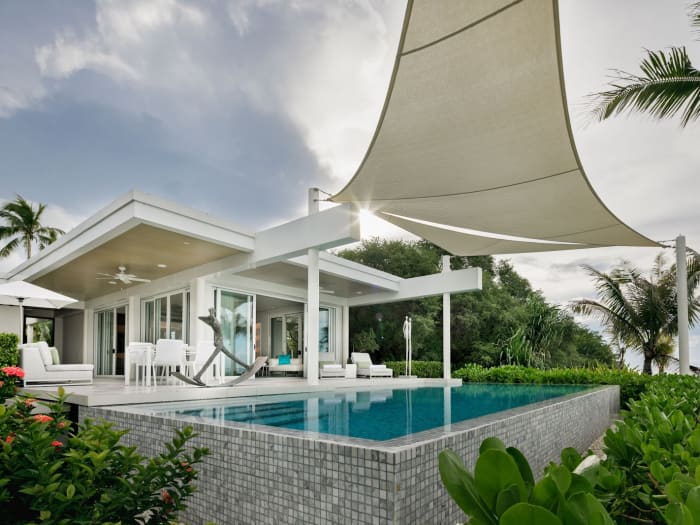
A private island in Palawan, far from the noise of the world
Banwa Private Island belongs to that rare category of addresses one does not reach by chance. In Palawan, within an archipelago often counted among South-East Asia’s most striking, the hotel unfolds across a private island surrounded by clear waters and a seascape that immediately imposes a different rhythm. Here, luxury is not measured in display but in distance from the everyday: the open horizon, the absence of traffic, the physical sense of being welcomed into a world apart. For travellers seeking a luxury hotel in Palawan without compromise on privacy, this geography already carries much of the promise.
Arrival is part of that separation. The island is reached by boat or helicopter, two modes of access that say much about the place: Banwa is not an improvised stop, but a destination conceived as a stay in itself. Travellers often ask how to get to Banwa Private Island; the answer lies in this logic of organised remoteness, where each transfer becomes the first stage of the experience. The journey is not merely practical; it prepares the eye, slows the tempo and establishes the feeling of crossing into a quieter world.
The unspoilt natural setting is not a brochure phrase. It shapes the way one inhabits the island, moves through it and watches the light shift across the water through the day. At Banwa, the sea is never a distant backdrop: it accompanies movement, meals, reading and early mornings. Ocean views, ever-present, create a rare continuity between indoors and out. That direct relationship with the landscape helps explain why the address appeals both to couples in search of retreat and to travellers familiar with major island resorts yet looking here for something more exclusive.
Among the most beautiful hotels in the Philippines, Banwa Private Island occupies a singular place. Its inclusion in The World’s 50 Best Hotels 2025 does not add artificial prestige; it confirms what is already evident on site: the coherence of a project in which seclusion, service and environment all work in the same direction. Those wondering what truly distinguishes a top-tier private island from a conventional beach resort will find a clear answer here. It is not only the beauty of the setting, but the way everything is designed to preserve a sense of space, calm and sovereignty.
Banwa therefore speaks to a particular idea of travel: one that values discretion, unhurried time and the feeling of being almost alone in the world. In Palawan, where luxury hospitality has broadened in recent years, this address stands apart through the clarity of its proposition. One comes here for the island itself, for the quality of its remove, for the precision of its hospitality, and for that form of serenity that only certain places can make tangible within minutes of arrival.
A contemporary aesthetic rooted in local materials
One of Banwa Private Island’s most persuasive achievements lies in its architectural language. The property adopts a contemporary vocabulary—clear, legible, composed—without ever breaking with the softness of the tropical landscape around it. In many island hotels, design swings between heavy-handed folklore and interchangeable international minimalism. Here, the balance is subtler. Modern lines bring clarity to the spaces, while the use of local materials anchors the whole in a specific geography: that of Palawan and, more broadly, the maritime Philippines.
This alliance between modernity and local grounding creates an atmosphere of unusual rightness. Nothing feels applied for effect. Textures, volumes, airflow and light all seem conceived to support life in a tropical climate rather than to impose an abstract style. The result is neither rustic nor showy. It is a composed form of luxury in which contemporary comfort remains permeable to its natural context. Travellers attentive to architecture will notice the way the landscape is allowed to breathe through the buildings, and how transitions between shade and sun, indoors and out, shelter and openness are handled with ease.
The hotel’s modern design is therefore not merely a matter of appearance. It organises a way of inhabiting the island. In a place where the ocean is ever-present and the light can be brilliant from early morning, spaces benefit from being calm, readable and visually quiet. Banwa seems to understand that elegance in such a setting lies less in adding than in calibrating. Local materials bring warmth and depth; contemporary lines prevent excess. Together they create an environment in which nature retains the leading role.
That restraint also contributes to the sense of privacy. On a private island, architecture must offer protection without confinement, presence without domination. The buildings and villas appear to answer that requirement with measured intelligence. One finds here a distinctly contemporary idea of luxury: generous spaces, a constant relationship with the outdoors, and a palette that soothes rather than strives to impress. It is an aesthetic likely to age better than trend-driven gestures, because it rests on principles of balance rather than noise.
Within the landscape of luxury hotels in Palawan, such visual coherence matters. It sets Banwa apart from more demonstrative addresses by asserting a calm, almost confidential identity. The stay gains a particular quality from this: the absence of theatricality. Everything seems designed to accompany light, wind and the rhythm of island days. For the traveller, that translates into a rare sensation: the impression that the place has found its natural form, and that refinement here emerges from the accord between architecture, material and landscape.
Private villas with ocean views: privacy as the true luxury
At Banwa Private Island, accommodation is not conceived as a mere room with a fine view, but as an extension of the island itself. The private villas, opening towards the ocean, sit at the heart of the experience. In a luxury market where privacy is often promised more than truly delivered, Banwa adopts a clear proposition: to give each stay the feeling of a personal retreat, almost domestic in its ease, while maintaining the level of service expected of a five-star hotel.
The sea view is essential here, yet it is not treated as a cliché. It structures one’s relationship with time. In the morning, it accompanies a slow waking, with light gradually settling across the water. By day, it constantly recalls the island and its chosen remoteness. In the evening, it becomes a more contemplative horizon, suited to quiet dinners and unhurried conversation. In many beach addresses, the view is a selling point; at Banwa, it becomes a daily material, almost a form of breath.
The private character of the villas responds to a strong expectation among travellers comparing the most beautiful hotels in the Philippines or hesitating between different island retreats. The question is not only how much one night at a place such as Banwa Private Island may cost, but what that price truly covers. Here, it first covers space, calm and a clear sense of separation from the rest of the world. That is also what feeds the property’s reputation for exclusivity and explains why it frequently appears in conversations about the most luxurious private islands in the region.
Modern design softened by local materials finds its most convincing expression in the villas. One imagines interiors planned to let light move freely and to create continuity with terraces, gardens and marine outlooks. Nothing calls for display. Luxury is read in the balance of proportions, in the quality of silence, in the ability to move from shared moments to genuine chosen solitude. For couples, this naturally supports a romantic experience without overstatement. For families or travellers accustomed to large resort villas, it offers a rarer kind of freedom: the freedom to live entirely at one’s own pace.
What ultimately distinguishes these villas is less an accumulation of features than a particular idea of privilege. Being on a private island is already a powerful promise; having a space that allows one to inhabit that promise fully is its fulfilment. At Banwa, the villa is not simply a base between activities. It becomes an observatory, a refuge and at times the day’s main destination. Reading by the water, lingering over lunch, waiting for the heat to soften before stepping out again: such simple gestures acquire unusual density here. It is in this quality of use, more than in spectacle, that the stay’s real singularity resides.
Latitude: a flexible table, international and Filipino
Dining at Banwa Private Island centres on Latitude, a restaurant that neatly reflects the spirit of the property: precise, attentive hospitality able to adapt to the traveller rather than impose a fixed ritual. In a place this remote, meals naturally take on particular importance. They punctuate the day, accompany one’s return from the water, extend the late afternoon and become one of the most immediate languages of care within the stay. Latitude answers that expectation with a flexible proposition in which international cuisine and Filipino inspirations coexist without rigidity.
What distinguishes the table is less the idea of a spectacular menu than that of a listening culinary service. The team shapes meals according to the guest’s wishes, preferred style and chosen timing. That freedom is especially valuable on a private island. It allows for a light lunch after a morning in the sun, a more elaborate dinner by the sea, or an even more intimate sequence designed around a personal rhythm. In a hotel world where fine dining can sometimes become performative, this approach feels particularly apt: it places pleasure, availability and context back at the centre of the experience.
The presence of Filipino flavours alongside international cooking also gives the stay greater depth. For many travellers, discovering Palawan is not only about admiring a landscape, but about entering, however briefly, a culture of tastes, products and gestures. A table able to move between local repertoire and more global references answers that double expectation: the desire for exploration and the comfort of a grand house. At Banwa, such flexibility makes sense. It corresponds to a place that privileges individualisation over standardised format.
Questions of price often arise when Banwa Private Island is discussed. Why is an island such as Banwa so expensive? Part of the answer lies here, in a degree of personalised attention that goes beyond simple dining. On a private island, feeding guests is not merely about serving dishes; it is about orchestrating moments, anticipating wishes and ensuring that each meal accords with the climate, the day’s programme and the mood of the stay. That discreet yet constant quality of service contributes fully to the property’s perceived value.
Latitude therefore belongs to a broader vision of the art of receiving. The restaurant is not a theatre separate from the rest of the hotel; it extends the island experience with the same fluidity. One finds here what one comes to Banwa for: space, suppleness and the impression of time returned to the traveller. Within the landscape of luxury hotels in Palawan, this way of thinking about dining as a bespoke service rather than a showcase is especially appealing. It gives meals a rare quality: they become memorable not because they strive for effect, but because they feel exactly right.
Concierge, butler service and the discreet logistics of an island hotel
At a property such as Banwa Private Island, the quality of a stay depends as much on what remains unseen as on what is immediately visible. The island, the ocean, the villas and the light compose the sensory part of the experience; the concierge, round-the-clock reception, butler service and daily housekeeping ensure its smoothness. This is often where the difference lies between a very beautiful hotel and a truly resolved address. At Banwa, that service machinery appears designed never to interrupt the sense of retreat that defines the place.
The presence of a 24-hour concierge and continuously available front desk responds first to a simple reality: on a private island, everything must be anticipated with precision. Transfers, timings, last-minute wishes, programme adjustments and dining arrangements require finer organisation than in a city hotel. The traveller does not necessarily perceive this architecture of service, and that is precisely the sign that it works. Everything feels simple because discreet work makes that simplicity possible.
Butler service adds to the impression of personalised accompaniment. In luxury hospitality, such service can sometimes become performative. Here, it makes sense when it remains measured, attentive and contextual. On an island sought out for calm, excellence lies less in multiplying interventions than in being present at the right moment. Arranging a meal around a particular wish, adjusting the rhythm of the day, easing practical details of the stay: these are the gestures—modest in appearance—that transform the experience.
Daily housekeeping, turndown service, laundry and luggage storage all belong to the same logic. They free the traveller from material friction. In a setting this exclusive, that absence of resistance is essential. It allows one to inhabit the island as a space of pure availability, where attention can turn to the sea, rest, conversation or the simple pleasure of doing very little. It is also one of the clearest answers to a frequently asked question: why is Banwa Private Island so expensive? Because beyond the site itself, the price reflects an intensity of service and personalisation that is difficult to reproduce in larger or more accessible properties.
For travellers comparing Banwa with other names in Asian island luxury, the real distinction often lies here. Refinement is not only a matter of décor or reputation, but of operational precision. A private island requires a form of hospitality able to absorb complexity without ever letting it show. When done well, that logistics becomes almost a kind of grace. At Banwa, it appears to serve a clear purpose: allowing each guest to experience a stay of great freedom while feeling constantly supported. It is a demanding definition of luxury, more enduring than mere effect, and no doubt one of the reasons the address lingers in the memory.
The Banwa rhythm: staying, slowing down, inhabiting seclusion fully
What gives a stay at Banwa Private Island its strength lies not only in the sum of its attributes—private island, ocean-facing villas, attentive service, international recognition—but in the way those elements compose a rhythm. In the best destination hotels, luxury is not an inventory; it is a cadence. At Banwa, that cadence is one of slowing down. One comes here to disconnect, certainly, but above all to recover a quality of presence that few places still know how to offer with such clarity.
Days here seem naturally elastic. Morning may begin without urgency, carried by the light on the ocean and the sense of entirely available space. Midday invites retreat, an unhurried lunch, a willingness to let the heat shape the pace. Afternoon calls for the sea, reading, silence or conversation. Then comes that very particular island hour when the light softens and everything appears to settle. Banwa seems built to receive that tempo rather than resist it. Nothing compels one to fill the hours; everything encourages one to inhabit them.
This also helps explain the fascination exerted by ultra-luxury private islands. When travellers ask which is the most luxurious private island, the answer naturally varies according to taste, use and reference points. Yet Banwa Private Island offers a credible answer because it embodies a form of luxury that has become rare: sovereignty over time. More than an accumulation of services, it is the possibility of living without interruption, without crowds, without intrusive noise, that gives the stay its particular depth.
Within the context of Palawan, the experience gains even greater relief. The region has long attracted travellers for the beauty of its waters, shores and marine landscapes. Banwa proposes a more exclusive, almost meditative reading of that beauty. The island does not seek to compete with the bustle of certain beach destinations, nor to multiply distractions in order to hold attention. It makes the opposite wager: to offer a setting strong enough for simplicity to become desirable again. This speaks to couples, certainly, but also to anyone who associates luxury travel with intelligent retreat rather than perpetual stimulation.
To stay here is therefore to accept a certain discipline of pleasure: to slow down, observe, listen and allow the days to unfold without saturating them. Few addresses succeed in conveying that the ultimate privilege is not to have more, but to be less solicited. Banwa Private Island belongs to that family of places where the traveller recovers a form of attention to self and to landscape. In a world saturated by speed and stimuli, such quality of seclusion is far from incidental. It is, on the contrary, one of the most contemporary luxuries there is.
What to know before booking Banwa Private Island
Booking a stay at Banwa Private Island requires approaching travel differently from a simple beach escape. One does not choose this address as one might reserve a room in a conventional resort; one organises a complete interlude, with its own logistics, distinctive tempo and high expectation of privacy. For that reason, it is wise to plan ahead, particularly if one wishes to enjoy the island fully during the dry season, generally considered the most favourable period for water-based pursuits and outdoor living.
The first practical question almost always concerns access. How do you get to Banwa Private Island? The island is reached by boat or helicopter, which implies precise coordination of timings and onward connections. This dimension forms part of the experience, but it also calls for careful preparation. For international travellers, it is best to think of arrival not as a mere formality but as a segment of the journey in its own right. In return, that selective accessibility guarantees what many come here to find: a genuine sense of disconnection, difficult to achieve in destinations that are more directly connected.
Then comes the question of price, ever-present in searches related to Banwa Private Island. How much is it per day? How much is one night? Why is the island so expensive? Without entering into figures that may vary according to season, stay configuration or degree of privatisation, one can say that the rate reflects several cumulative realities: the exclusivity of a private island, access logistics, low occupancy density, the level of personalisation and the quality of service conceived almost bespoke. In an address of this kind, the price does not pay only for accommodation; it supports an entire environment carefully orchestrated to produce tranquillity.
This positioning also explains why Banwa regularly appears in comparisons with other island luxury names. Some travellers want to know which address is more expensive, or how Banwa stands beside other well-known regional references. Such comparisons have their use, but they do not tell the whole story. The real criterion here lies less in tariff hierarchy than in the fit between the place and one’s travel desire. Banwa will especially suit those who value seclusion, confidentiality and a very direct relationship with nature over social scene or constant activity.
Before booking, it is therefore worth asking the right questions: are you seeking a private island on which to withdraw in earnest? Do you want a stay centred on the villa, the sea and unhurried time? Do you appreciate addresses where service adapts to the traveller rather than imposing a programme? If the answer is yes, Banwa Private Island stands out as a rare option in Palawan. Booking well in advance remains a sensible approach, particularly in order to organise transfers and preferred experiences under the best conditions. In a place of this nature, luxury begins well before arrival: it starts in the quality of preparation that allows you, once on the island, to do nothing but let yourself be carried.