History & Heritage
Staying at Yihe Mansions means stepping into a quieter urban rhythm, one more attentive to the traces of the past. The hotel is set within a historic district of Nanjing, a city whose architectural and political memory is among the richest in China. The appeal here does not lie in overt contemporary display, but in a subtler way of inhabiting heritage. The property draws on traditional Chinese architecture and carefully maintained gardens, creating an experience distinct from that of a standard international luxury hotel.
Its Relais & Châteaux affiliation offers a useful indication of the house style: hospitality with character, rooted in place, identity and quality of experience rather than spectacle. In the case of Yihe Mansions, that promise is especially legible. The hotel’s charm rests on the balance between restrained traditional lines, landscaped gardens and the level of comfort expected from a five-star address.
Nanjing itself lends particular depth to the stay. A former capital at several points in Chinese history, the city layers periods, functions and narratives. In that context, choosing a hotel in a historic district is not merely a question of location; it is a way of experiencing the city from within its older fabric, with a truer sense of its rhythm and scale.
Yihe Mansions appears to speak to travellers seeking not a showpiece address, but one with genuine cultural continuity. The common areas, described as elegant and warmly decorated, reinforce that impression. In the best heritage hotels, luxury does not interrupt the place; it makes it more gently inhabitable.
That relationship to heritage is also sensory. In a property of this kind, history is not only conveyed through dates or institutional narrative; it is read in the proportions of the buildings, the way light moves through space, the presence of greenery and the relative quiet once one has crossed the threshold. This is often what seasoned travellers to major Asian cities are looking for: not isolation, but a form of retreat.
Yihe Mansions therefore belongs to a tradition of hospitality in which the hotel becomes a mediator between the city and its visitor. It allows guests to approach Nanjing through residential heritage, discreet elegance and a composed sense of place.
The Establishment
The identity of Yihe Mansions Hotel is primarily rooted in its location. Nestled in a historic district of Nanjing, it is set within a residential, cultural, and scenic environment. This integration bestows a rare quality upon the place. The hotel engages in a dialogue with its surroundings rather than imposing itself upon them.
Traditional Chinese architecture structures the spaces with a sense of balance. Buildings, courtyards, pathways, and gardens contribute to a unified experience. The gaze flows, rests, discovers details, and then returns to the whole. This arrangement creates a unique calm, a precious commodity in a bustling metropolis.
The meticulously maintained gardens play a central role. They filter perspectives, soften transitions, and introduce the seasons into the stay. In spring and autumn, they enhance the feeling of retreat without isolation. Traversing the outdoor spaces in the morning or at dusk prolongs this impression.
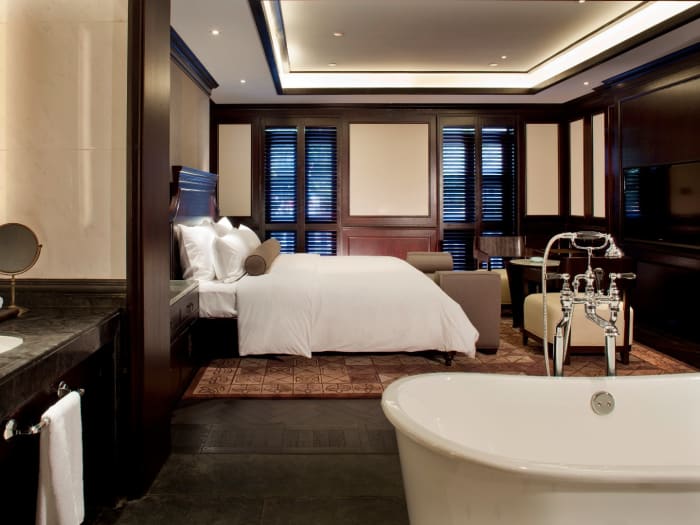
Inside, the elegant, warm, and welcoming atmosphere remains consistent with the spirit of the place. The decor complements the architecture without seeking to dominate it. The materials, colours, and furnishings support a sense of continuity. Modern comfort is present, yet discreet.
The hotel caters equally to couples and business travellers. The former find a conducive setting for leisurely strolls and cultural exploration, while the latter appreciate a serene environment with continuous services. In both cases, the interest remains the same: returning to a place that does not fatigue the eye after a busy day.
Yihe Mansions clearly embraces its character. Its appeal rests on a simple alliance: heritage, garden, comfort, and personalised service. This clarity allows guests to understand what they seek here—a quality of stay founded on precision.
Practically speaking, the hotel serves as an interesting base for exploring Nanjing's historical sites. However, it is not merely a starting point. The place actively participates in the journey, offering a more introspective, landscape-oriented Chinese urban hospitality, attentive to the continuities between memory and contemporary use.
Rooms and Suites
In a hotel like Yihe Mansions, the room extends the overall concept of the place. It reflects, on a more intimate scale, the balance between heritage and contemporary comfort.
The ensemble evokes a calm and well-kept refuge. It remains consistent with traditional architecture and is suited for a high-end, cultural, romantic, or professional stay.
The first luxury here often lies in the proportions. The rooms favour harmony, with pleasant dimensions, fluid circulation, and well-managed light.
This restraint is fitting for a stay in Nanjing. After busy days, returning to a room that promotes visual and mental relaxation transforms the experience.
Modern comfort is integrated discreetly. Technology and amenities accompany the stay without overshadowing the identity of the place.
True refinement lies in making comfort evident without it becoming intrusive. It is a form of silent luxury, in harmony with architectural tradition.
Views of the gardens or the quieter parts of the ensemble contribute to the charm of the rooms. The relationship with the outside becomes an integral part of the stay.
In the morning, light and greenery set the tone. In the evening, they reinforce that sense of retreat characteristic of beautiful urban houses.
The daily service, including regular room maintenance and turn-down service, extends this impression of continuous care. These gestures are as significant as the amenities.
For couples, the rooms and suites at Yihe Mansions offer an experience grounded in calm, texture, and continuity of the place. For business travellers, they provide an inspiring setting with essential services.
The interest lies in the ability to convey the uniqueness of the address even in the details of daily life. The private spaces thus extend the spirit of historic Nanjing.
Dining
At the Yihe Mansions Hotel, dining is expressed through various styles, all with a shared commitment to local produce and the subtleties of Chinese cuisine.
The House of Rong offers a particularly personal interpretation. Chef Jun Wang presents a creative cuisine that remains rooted in local traditions. The dishes strive for a balance between the essence of the place and contemporary flair. The presentation is clear and precise, devoid of unnecessary embellishments.
Wan Guo Chun Chinese Restaurant continues this focus on local flavours. Here, the cuisine aims to express its accents with honesty. The restaurant adopts an approach that allows the ingredients and culinary traditions to speak for themselves.
Wan Guo Chun Garden Restaurant introduces a different atmosphere. The setting suggests a more leisurely dining experience, where meals are savoured at a relaxed pace. This venue maintains a connection to a distinctive Chinese cuisine, conceived in harmony with the ethos of the establishment.
Le Siècle complements this culinary ensemble. Its presence broadens the gastronomic landscape of the hotel, allowing for varied dining experiences throughout one’s stay. Together, these venues create a coherent offering, where each restaurant asserts a distinct identity while never losing sight of the essence of the place.
Concierge & Services
The level of a hotel is often measured by the quality of its support services. At Yihe Mansions Hotel, the benchmarks are clear: 24-hour concierge, 24-hour reception, daily room service, turn-down service, luggage storage, laundry, wake-up service, and multilingual staff. Gathered within a characterful house, these services provide a genuine fluidity to the stay.
The 24-hour concierge is particularly significant in a city like Nanjing. It facilitates the organisation of cultural visits, adjustments to itineraries, transfers, and advice on neighbourhoods or historical sites. The hotel thus becomes a support point for constructing a more serene stay.
The multilingual staff also plays an essential role. They simplify travel and reservations for many international guests. For business clientele, this ease facilitates organisation and helps manage unforeseen circumstances.
The daily room service and turn-down service reflect a more understated hospitality. They instil a sense of continuity and attentiveness. Returning in the evening to a space prepared with care provides a very tangible comfort.
Laundry, luggage storage, and wake-up services cater to practical needs. They become particularly important in a journey marked by early departures, late returns, and schedules to keep.
The difference ultimately lies in how these services integrate into the overall atmosphere. At Yihe Mansions, they naturally accompany the style of the place. For travellers attentive to what a hotel allows them to experience, this quality of support is as important as the facilities.
The Art of Living in Nanjing
Choosing Yihe Mansions Hotel means opting for a particular way of approaching Nanjing. The city is discovered through its transitions, its ancient districts, its tree-lined perspectives, and its places of memory. A hotel situated in a historic neighbourhood allows for this gradual approach. It places the visitor within the city with greater finesse.
Nanjing holds a unique position in Chinese history. Having served as the capital multiple times, it retains a heritage density that transcends the mere accumulation of sites. Its walls, major thoroughfares, hills, lakes, institutions, and residential areas compose a city of layers. For the curious traveller, the challenge is not only to see but to connect. Staying at an address like Yihe Mansions fosters this understanding, as the hotel participates in the conversation between past and present.
The rhythm of a stay in Nanjing often hinges on alternation. A morning dedicated to a historical site, a return to the hotel for a break, followed by a lighter exploration in another neighbourhood. This breathing space prevents saturation and allows for a better perception of the city. An establishment surrounded by gardens and imbued with a peaceful atmosphere thus makes perfect sense. It offers a counterpoint.
Spring and autumn are particularly pleasant for this exploration. The light is often softer, the walks more comfortable, and the gardens more expressive. In a city where the landscape is as significant as the architecture, this seasonal dimension influences how one walks and observes. Yihe Mansions, with its well-maintained outdoor spaces, becomes a privileged observatory of these variations.
The art of living in Nanjing also involves making time for the unplanned. A stroll through the neighbourhood, a detour down a quiet avenue, a moment of reading in a lounge, or tea taken at leisure. Historic cities often reveal themselves better in these interstices than in the accumulation of stops. The luxury of a good address lies in making these moments desirable.
For couples, Nanjing lends itself to strolls and cultural resonances. For business travellers, it can offer, beyond the itinerary, a more nuanced urban experience. In both cases, the hotel acts as a filter. It helps to organise the experience, slow it down when necessary, and enrich it without overwhelming.
Ultimately, the art of living in Nanjing is not a formula. It is a practice of stay based on attention to places, seasons, distances, and atmospheres. Yihe Mansions seems well-placed to accompany this, as it offers a high level of comfort and a just way to engage with the city.
Book via MyConciergeHotel
Booking the Yihe Mansions Hotel through MyConciergeHotel makes perfect sense for a traveller seeking a coherent, well-prepared experience tailored to their priorities in Nanjing. In a venue of character, the choice of intermediary is significant. It is not merely about comparing rates or categories, but about understanding the nature of the place, the type of stay it promotes, and the best way to make the most of it depending on the duration, season, and purpose of the trip.
Yihe Mansions is particularly well-suited to this bespoke approach. The hotel caters to both couples and business travellers. It also appeals to culture enthusiasts due to its location in a historic district. This versatility is a strength, but it requires careful calibration of one’s stay. A long weekend calls for different recommendations than a business trip with a few free hours, or a broader itinerary in Eastern China.
The first advantage is the guidance provided. Knowing when to visit, how many nights to plan, how to balance historical visits with downtime, or whether to anticipate certain local reservations can significantly enhance the experience. Spring and autumn are especially pleasant for exploring the city. A good recommendation also helps to envision how to engage with the locale.
The second advantage lies in understanding the hotel’s positioning. Yihe Mansions is not an impersonal transit address. Its appeal lies in the blend of traditional Chinese architecture, well-maintained gardens, modern comfort, and personalised service. This implies a certain way of staying: taking the time to appreciate the surroundings, planning moments on-site, and organising relevant visits.
The third advantage concerns practical preparation. In a large foreign city, logistical fluidity is invaluable. The hotel’s services include a 24-hour reception and concierge, multilingual staff, luggage storage, laundry facilities, and wake-up service. A well-thought-out stay often begins before arrival: choosing timings, making special requests, organising initial visits, or accommodating a professional agenda or a couple’s getaway.
Booking through MyConciergeHotel also means benefiting from an editorial perspective. For a property like Yihe Mansions, this dimension is significant, as its allure extends beyond a mere list of amenities. What truly matters is the atmosphere, the relationship with the historic district, the quality of retreat it offers within Nanjing, and how it allows one to experience the city differently.
Ultimately, this address will appeal to travellers who appreciate hotels with a clear identity, a strong cultural inscription, and a luxury of continuity rather than ostentation. Booking through MyConciergeHotel enables a more precise and serene preparation for this stay.