History & heritage
Txai Resort Itacaré embodies a form of luxury that does not attempt to dominate its surroundings, but rather to settle into them. In Itacaré, on the Bahian coast, the property stands in a region where rainforest meets the Atlantic, within a landscape that shaped local identity long before high-end hospitality arrived. This part of Brazil retains a strong relationship with nature, the rhythm of the seasons, the sea, unspoilt beaches and a certain culture of chosen remoteness. It is precisely within that spirit that the resort finds its coherence: not merely as a place to stay, but as a way of temporarily inhabiting a singular territory.
Its membership of Relais & Châteaux offers a clear framework. One recognises the emphasis on sense of place, hospitality, cuisine and the overall experience rather than on display. Txai Resort Itacaré is not defined by monumental history or aristocratic heritage in the European sense; its identity rests instead on a dialogue between architecture inspired by local forms, the natural environment and a promise of retreat. In a hotel world often driven by signature effects, this address favours discretion. Luxury here takes the form of space, quiet, open views, an unhurried circulation between buildings and a palpable distance from everyday life.
Even the name suggests a philosophy of connection and harmony, which helps explain the resort’s positioning. The experience is not built around a loud programme, but around a quality of presence: that of the landscape, slowed time, attentive service and a more conscious relationship with the environment. The environmental commitment highlighted among the resort’s defining traits is not a secondary talking point; it is part of its core identity. In a destination whose appeal depends first on natural beauty, preserving the setting is not an optional message but a condition of relevance.
What constitutes heritage at Txai Resort Itacaré is therefore less about age than about continuity of vision. It is the vision of a stay designed around breathing space, in an address that embraces slowness, intimacy and direct contact with the landscape. Guests do not come only to tick off a Brazilian beach destination; they come in search of a feeling that has become rare in international hospitality: that of a place seemingly conceived at the scale of its surroundings, rather than against them. More than any dramatic backstory, it is this coherence that gives the property its lasting character.
The Establishment
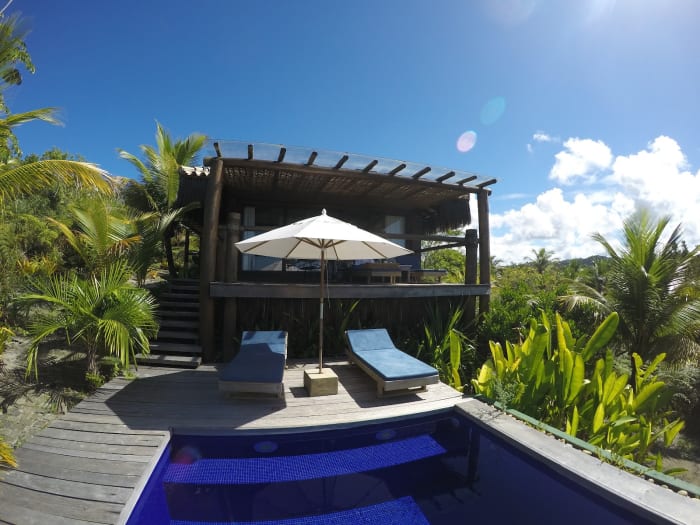
The foremost luxury of Txai Resort Itacaré lies in its location. Nestled between the tropical rainforest and the Atlantic Ocean, the establishment harmonises with a powerful, almost cinematic geography. Here, the landscape is not merely a backdrop to the experience; it is the very essence of it.
The architecture and layout of the resort preserve this sense of immersion. It does not evoke the feeling of a large urban hotel transplanted to the tropics, but rather that of a sophisticated sanctuary, open to its surroundings.
The resort caters to travellers in search of tranquillity. Disconnection is manifested through distances, silences, and a less hurried pace. Guests come to Txai Resort Itacaré to slow down. The setting encourages romantic getaways, relaxation, and days surrendered to leisure.
The proximity to serene beaches enhances this sense of chosen isolation. In Itacaré, certain stretches of coastline retain their unspoilt beauty, far removed from the incessant bustle of more developed seaside resorts. Txai Resort Itacaré benefits from this rare quality, where the sea remains intertwined with a broader ecosystem.
The stay extends beyond merely using a room or a beach; it transforms into a site experience. Txai Resort Itacaré offers the comfort of a grand hotel without severing the connection to nature that justifies the journey.
Rooms and Suites
At Txai Resort Itacaré, the accommodation extends the landscape. Here, a successful room is defined less by its size than by its sense of space. It invites light, opens up views, maintains intimacy, and complements the leisurely pace of your stay. Comfort is important, but the essence lies in balance.
The categories of accommodation cater to varying degrees of retreat, panorama, and closeness to nature. Some are ideal for couples seeking tranquility, while others offer more space for extended stays or shared moments. All are unified by a consistent theme. Materials suited to the climate, a calming palette, simple yet elegant furnishings, create the impression of inhabiting a sanctuary.
Daily housekeeping and turn-down service contribute to this quality of experience. After a day at the beach, a stroll, or a visit to the spa, returning to a tidied space enhances the feeling of fluidity. This is not ostentatious luxury, but rather discreet comfort.
In Itacaré, a room must also provide protection without isolating. It shields from heat, humidity, and the return from the beach, while maintaining a connection with the outdoors. The finest accommodations carefully manage this boundary. Here, one finds a welcome freshness, restful bedding, bathrooms designed for well-being, and sometimes private outdoor spaces.
Choosing a room at Txai Resort Itacaré is less about status and more about how one inhabits the space. Views, intimacy, immersion in vegetation, or a stylish anchor between two days spent outdoors—expectations vary. What remains essential is the accommodation's ability to extend the resort's atmosphere. Here, luxury is primarily defined by the quality of serenity.
Dining
At Txai Resort Itacaré, gastronomy is inseparable from the location. Here, one seeks not only a good meal but a way of dining that resonates with the landscape.
The light, air, rhythm of the days, proximity to the ocean, and abundant vegetation all influence the culinary experience. A meal takes on a broader dimension, becoming a moment of pause, observation, and presence.
As a member of Relais & Châteaux, the resort is expected to deliver quality cuisine, attentive service, and the ability to translate the territory onto the plate. In Itacaré, this entails a focus on seafood, tropical fruits, herbs, and fresh textures. Refinement here is rooted in balance—striking cuisine that is impactful without heaviness or ostentation.
Breakfast is nearly as significant as dinner. It accompanies the awakening of the landscape and sets the tone for the day. Lunch often calls for a controlled lightness, while dinner becomes the time to truly unwind, with a more enveloping service.
In a resort designed for disconnection, dining also plays a subtle social role. It structures the days without imposing rigidity. For couples, it often becomes one of the focal points of their stay.
Being part of Relais & Châteaux suggests a certain standard in the art of service. Attention to detail, the ability to advise without being pushy, and a hospitality that is present without being intrusive. In a setting as striking as Itacaré, the finest gastronomy complements the landscape rather than competes with it.
Spa & wellbeing
Wellbeing sits at the heart of the promise at Txai Resort Itacaré. This begins with the setting itself: an environment in which nature already acts as a first treatment through light, air, relative quiet, proximity to water and a sense of distance from the everyday. In that context, the spa does not feel like an ancillary facility added to complete the offer; it extends an inner disposition that the place establishes almost immediately. The Concierge’s advice to book a treatment upon arrival is revealing: the spa is one of the stay’s structuring experiences.
In a resort where the atmosphere encourages switching off, wellbeing is not limited to a sequence of treatments. It belongs to a broader approach to time and the body. Guests come to recover a breathable rhythm, repair accumulated fatigue, release tensions linked to travel or daily life, and sometimes simply grant themselves permission to do nothing. The best spas in this kind of address know how to answer that expectation without excessive theatricality. They favour the quality of touch, coherence of setting, discreet service and an unapologetic slowness.
The tropical climate, the sea and the forest naturally shape travellers’ needs. After a day in the sun, a walk on the sand or an excursion nearby, the body calls for recovery, hydration, muscular release and recentring. The most appreciated rituals are often those that adapt to the guest’s actual condition rather than imposing a rigid protocol. That is why a personalised approach to wellbeing makes particular sense here: listening to the moment, adjusting intensity, suggesting a massage, facial or more enveloping ritual according to the day’s energy.
The spa also plays an important role in the experience of couples, who are especially well suited to this kind of destination. It offers an additional space of retreat, a shared interlude that depends neither on the weather nor on an outside programme. Booking a treatment for two, arranging a late-afternoon pause or simply creating a silent interval between beach and dinner forms part of the art of staying in a resort like this. Wellbeing then becomes a language of travel: a way of marking the transition between outside and inside, activity and rest.
More broadly, Txai Resort Itacaré seems to defend an idea of luxury in which one leaves feeling better than on arrival. That may be the most accurate definition of hotel wellbeing when it is done well: not multiplying promises, but creating the conditions for genuine calm. In a place already sustained by natural beauty and environmental commitment, the spa gives concrete form to that ambition. It turns simple relaxation into a fully realised experience of renewal.
Concierge & Services
In a resort of this nature, the quality of service is measured by the fluidity of the stay. Txai Resort Itacaré features a 24-hour concierge service and a reception that operates continuously. Additional offerings include daily housekeeping, turndown service, luggage storage, laundry, wake-up calls, and a multilingual staff.
The concierge plays a vital role here. It organises transfers, adjusts schedules, recommends a beach, structures a day, anticipates spa bookings, and responds to last-minute requests. Its 24-hour availability reassures and lightens the experience, especially after a long journey.
The daily room service and turndown service reinforce this continuity. In a stay marked by tropical humidity, beach returns, and rest periods, these attentions remain very tangible. They keep the room pleasantly fresh and provide genuine flexibility to the stay. The laundry service follows the same discreet and essential logic.
The presence of a multilingual staff is also noteworthy. It facilitates communication, allows for precise requests, and ensures recommendations are understood without ambiguity.
In a place dedicated to disconnection, the right service tactfully eases life. Being present without being intrusive, anticipating without overwhelming, resolving without dramatizing: this is the balance expected here.
The Art of Living in Itacaré
Staying at the Txai Resort Itacaré is also about connecting with a particular vision of Itacaré. The town and its surroundings hold a special place on the Bahia coast, where nature remains ever-present. The beaches are intertwined with the forest, and the journey retains a sense of gentle adventure. The local art of living is rooted in an instinctive relationship with the climate, the coastline, walking, and time spent outdoors. Visitors come for the sea, but also for the feeling of being in a landscape that is still very much alive.
The tranquil beaches encapsulate the allure of Itacaré. They invite you to swim, stroll, sit for long periods, observe the changing light, and listen to the waves. Itacaré possesses a unique texture, characterised by its reliefs, vegetation, sometimes more secluded access points, and an organic relationship with the coast. For travellers accustomed to large, standardised resorts, this distinctiveness is significant.
The environment also lends itself to outdoor activities that naturally extend the resort experience. Hiking, exploring the surroundings, swimming, spending time on the beaches, or leisurely discovering the region are all on offer. The aim is not to maximise performance but to vary the ways of inhabiting the landscape. A morning of chosen stillness can be followed by a walk. A day at the beach might lead to a spa treatment. A late lunch can precede an outing in the late afternoon. Itacaré is well-suited to this flexibility.
It is also important to highlight the quality of disconnection that the destination offers. This is not an austere isolation but a form of fertile distance. Here, you feel far enough away to change your pace without sacrificing comfort. It is a destination well-suited for couples and travellers seeking rest. Luxury, in this context, is not about filling every hour but having the choice not to do so.
The best way to approach Itacaré is undoubtedly to allow it to set its own tempo. Do not strive to see everything. Embrace moments of latency. Prioritise a few well-chosen experiences over a packed itinerary. The Txai Resort Itacaré provides an ideal setting for this, as it does not disconnect you from the territory. It offers a serene interpretation of the local way of life. From the resort, the local art of living reveals itself in the details: the quality of the air at the end of the day, the constant presence of greenery, the call of the sea, and the simplicity of a quiet beach. It is often these elements that lend depth to the journey.
Booking via MyConciergeHotel
Booking the Txai Resort Itacaré through MyConciergeHotel means approaching your stay with the right methodology: a journey thoughtfully planned in its useful details, without compromising the spontaneity of Itacaré. An address like this does not lend itself well to a purely transactional reservation. The place, its rhythm, its natural surroundings, and its wellness dimension call for measured preparation. It is about anticipating the right period, the type of room, arrival times, spa treatments, and balancing rest with exploration.
The ideal season extends from December to March. Depending on your plans, it may be beneficial to refine your reservation according to your priorities: more sunshine, a livelier atmosphere, or greater intimacy. MyConciergeHotel supports this type of decision-making, taking into account availability and the desired travel style.
The choice of accommodation is another crucial factor. In a resort where the relationship with the landscape is central, not all rooms meet the same expectations. Some travellers prioritise the view, while others prefer proximity to communal areas or a sense of seclusion. Being advised in advance helps avoid a too-generic booking. This way, the stay gains in precision. The same applies to the services to anticipate: transfers, arrival or departure times, special requests, or couples' stays.
The spa deserves particular attention. Booking your treatment upon arrival can also be prepared in advance, especially if wellness is at the heart of your stay. Anticipating certain time slots, choosing the right moment for a recovery ritual, or organising a couple's experience allows for better enjoyment of the resort. In such a setting, well-managed logistical details have a direct impact on the quality of rest.
Booking through MyConciergeHotel means benefiting from support that respects the uniqueness of the place. The Txai Resort Itacaré is not merely a list of amenities; it is a destination in itself, with a tempo, an atmosphere, and a particular way of being experienced. Booking intelligently is already the beginning of the journey.