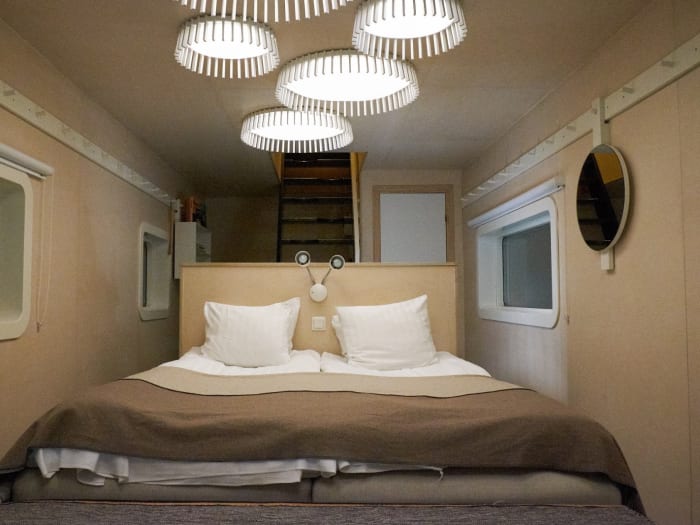
Tree Hotel Harads: a design-led retreat in the boreal forest
In Harads, in northern Sweden, Tree Hotel unfolds within a landscape where the forest seems to set the pace of the stay. Rather than presenting itself as a single building placed in nature, the hotel appears as a constellation of treehouse cabins, suspended among the pines and conceived to extend the experience of the setting rather than dominate it. This explains what makes Treehotel so distinctive for travellers: contemporary, often daring architecture that uses reflection, suspension and restraint to converse with the boreal landscape.
Harads is central to that impression. This is northern Sweden, where space, light and silence take on an almost tangible quality. In summer, the long days bathe the forest in a continuous, slanting glow. In winter, snow redraws every outline and turns each movement outdoors into a sensory experience. Autumn brings muted colours and a sense of retreat; spring reawakens the woods and waterways. Tree Hotel speaks directly to travellers seeking that immersion without giving up the comfort of a high-end address.
The property also answers a question often raised by guests discovering Treehotel Sweden or Treehotel Harads: is it a design hotel or a nature hotel? The answer lies in the balance. Each cabin has its own architectural language, yet the whole remains rooted in a simple idea: inhabiting the forest lightly. Sustainable materials, careful landscape integration and uninterrupted views over the surrounding trees give the experience unusual coherence.
This is neither a rustic lodge in the traditional sense nor a conceptual exercise detached from reality. Tree Hotel instead reconciles two contemporary desires: to slow down, and to stay somewhere with a clear point of view. Travellers may first arrive for the tree hotel photos, for the image of a mirrored cube or a cabin hovering among the branches, and then discover a quieter, more tactile and more contemplative reality on site. Luxury here is not about display. It lies in the feeling of being alone with the forest while still benefiting from attentive service and modern comfort.
For couples, architecture enthusiasts and travellers looking for a Nordic escape beyond familiar routes, the hotel offers a very current form of retreat. It does not attempt to transplant the codes of a grand urban hotel into a natural setting. Instead, it has developed its own way of welcoming guests, somewhere between contemporary treehouse, landscape observatory and Scandinavian hideaway.
Innovative architecture blended into nature
Tree Hotel owes its international reputation to an idea that sounds simple but is demanding in execution: turning each cabin into a piece of inhabitable architecture without disturbing the balance of the forest around it. In many nature-led properties, the landscape acts as a backdrop to the hotel. In Harads, the opposite is almost true. Architecture serves the setting, suspending itself within it, reflecting it, slipping into it, and allowing the forest to remain the main subject.
That approach is first visible in the diversity of the accommodation. Each cabin has its own distinct design, which is one of the defining features most often associated with Treehotel: no two stays feel exactly alike. Some structures favour discretion, others a more sculptural silhouette, and others still use reflective surfaces to blur the boundary between construction and environment. The best known is the Mirrorcube, often sought out by travellers asking where the Mirror Cube hotel is located. It is here, in Harads, within this group of cabins that has become emblematic of contemporary hospitality in the natural world. Its visual principle, based on reflecting the surrounding landscape, neatly captures the spirit of the property: to be present without imposing itself.
The value of this architecture is not merely photographic. It changes the way guests inhabit space. Climbing towards a cabin, crossing a walkway, feeling the wind in the trees, watching the light shift at branch height: all of this forms part of the experience. The room is no longer just an interior, but the continuation of a journey through the site. Guests do not simply arrive at accommodation; they enter into a more attentive relationship with the landscape.
The use of sustainable materials and an eco-conscious approach strengthens that coherence. In a setting this powerful, any grand gesture would feel misplaced. The project instead embraces a Scandinavian sense of precision: clean lines, measured interventions and modern comfort, combined with a clear awareness of the natural environment. Restraint does not limit invention here; it gives it purpose.
For design-minded travellers, Tree Hotel offers far more than a collection of unusual treehouses. It proposes a practical reflection on how to build within a fragile landscape without overwhelming it. For others, the effect is more immediate: sleeping among the trees, facing the forest, in a place designed to make the outside world feel even more present.
Treehouse cabins that change your perspective
Staying at Tree Hotel means accepting that a room can become a spatial experience in its own right. The treehouse cabins are not a decorative theme or a nostalgic nod to childhood; they are the core of the hotel’s identity. Each offers a different relationship to the forest, the light and privacy, which is why so many travellers look into Treehotel prices or Tree hotel Sweden prices before even choosing their dates. Selecting a cabin matters almost as much as the trip itself, as the atmospheres vary markedly from one to another.
What they share is the sensation of being suspended within the landscape. From the windows, walkways and openings, the eye settles on trunks, canopies and the changing northern light. Those views over the surrounding forest are not a secondary amenity; they shape the rhythm of the stay. In the morning they frame the first moments of the day. By afternoon they turn time spent indoors into a form of observation. In the evening they create a sense of retreat, almost monastic in its calm.
Modern comfort is never sacrificed to the idea of escape. Tree Hotel belongs to a generation of properties that understands that immersion in nature only works when accompanied by genuine attention to use and ease. Interiors favour a contemporary, often pared-back aesthetic that leaves room for the landscape. Materials, lines and openings all serve the same purpose: to intensify the presence of the forest while preserving the standards expected of a high-end stay.
This approach naturally appeals to couples, design enthusiasts and travellers seeking something out of the ordinary, but it also speaks to those who simply want to disconnect. In a world saturated with images, it is rare for a much-photographed place to retain its power of surprise in person. At Tree Hotel, the opposite often happens. The images inspire the trip; the lived experience deepens it.
The stay takes on a very particular tone. Guests read more, observe longer, speak differently, go outside in order to return more fully. The hotel becomes both an observatory over the boreal forest and a refuge within it. Few destination hotels make the accommodation itself the primary reason for the journey. Tree Hotel Harads does so with unusual clarity.
Concierge services and discreet comfort in a remote setting
One of Tree Hotel’s real strengths lies in its ability to reconcile a feeling of remoteness with the practical expectations of a high-end stay. In a setting where forest, snow and distance naturally alter the rhythm of the day, service matters enormously. Here it is not expressed through display, but through a fluid organisation designed to make the experience feel easy and calm. A 24-hour front desk, round-the-clock concierge, daily housekeeping, turndown service, luggage storage, laundry, wake-up service and multilingual staff together create a level of comfort that is especially valuable in such an unusual location.
That discreet presence changes the tone of the stay. It allows guests to travel lightly, whether they are on a romantic escape, a broader Scandinavian itinerary or a nature-focused journey. Arrival itself requires a shift in mindset: urban reference points fall away, replaced by a quieter and more spacious geography. Knowing that the welcome remains structured, available and attentive immediately sets the tone. Luxury here lies not in performance, but in continuity of care.
The concierge has a particular role in a property like this. In a city hotel, it often secures tables or cultural access. In Harads, it supports an experience of place. It helps shape the rhythm of the stay, simplify logistics and adapt the experience to the season and to each traveller’s priorities. This matters all the more because guests often come with a clear intention: to see the forest under snow, to enjoy the long summer light, to watch for the northern lights when conditions allow, or simply to spend a few days in a cabin of contemporary design.
Daily service also preserves the sense of an ordered refuge, which is essential when the outdoors occupies such an important place. Returning from an excursion to a cabin that has been carefully prepared extends the feeling of comfort. It prevents the treehouse concept from slipping into novelty. Guests are not merely sleeping in the trees; they are staying in a hotel that understands the codes of modern comfort and adapts them to an exceptional environment.
That is perhaps where Tree Hotel stands apart from many nature-inspired properties. The experience is neither austere nor theatrical. It rests on a calm precision, Scandinavian in spirit, where each service seems designed to support the stay without weighing it down.
Harads, the seasons and the northern way of life
Choosing Tree Hotel also means choosing Harads and, with it, a certain idea of Nordic travel. This is not a fashionable village seeking animation or the cultural density of a capital. Its appeal lies elsewhere: in a direct relationship with landscape, seasonality and a form of simplicity that restores value to time spent outdoors. Many travellers come for the singular hotel and then discover a territory where nature is not a backdrop but a constant presence.
Winter has a particular force here. Short days, snow, dark tree lines and clear skies create an almost graphic atmosphere. It is the season often chosen by those hoping to see the northern lights, a phenomenon tied to the mythology of the North but experienced on site as a matter of patience, clear weather and attention. Tree Hotel then becomes an ideal base: time indoors alternates with excursions, quiet waiting with the comfort of returning to one’s cabin.
Summer tells another story. The long bright days change the perception of the place completely. The forest feels more open, movement becomes easier, and outdoor activities and walks take on a different rhythm. Between those extremes, autumn and spring lend the stay a more intimate tone. Colours shift, sounds change, and the hotel feels like a contemporary refuge for attentive travellers.
This northern way of life depends less on an accumulation of activities than on the quality of one’s presence in the landscape. Guests walk, observe, breathe and accept a beneficial form of simplicity. Tree Hotel supports that state of mind particularly well because it does not try to distract constantly. It provides a setting, a rhythm and an architecture that invite closer attention.
Harads also helps explain Tree Hotel beyond its iconic imagery. The famous photographs and distinctive cabin silhouettes may draw the eye, but the real memory is built through the hours spent there: the sound of snow underfoot, filtered light between the pines, the feeling of isolation without unease, and the comfort of returning indoors after the cold.
What to know before a stay at Treehotel
Tree Hotel inspires a great deal of curiosity, which is only natural for a property whose image has travelled far beyond Sweden. Certain questions come up repeatedly among travellers planning a stay. The first concerns what makes Treehotel unique. The answer lies not in a single feature but in the combination of several elements rarely brought together with such coherence: treehouse cabins in the heart of the forest, innovative architecture blended into nature, accommodation with distinct individual designs, constant views over the boreal landscape and an approach attentive to sustainable materials. Many nature hotels offer silence; many design hotels offer a visual signature. Here, the two meet without contradiction.
Another frequent question is where the Mirror Cube hotel is located. It forms part of Tree Hotel in Harads and has become one of the property’s most recognisable images. Its reflective surfaces, which visually extend the forest, helped establish the hotel in the contemporary travel imagination. Yet reducing the address to that single cabin would miss the point. The project as a whole is based on the idea that each unit offers a different way of inhabiting the landscape.
Questions about ownership also arise, often because travellers want to understand whether the property belongs to a large group or reflects a more independent vision. What matters most for the guest experience, however, is the clarity of the concept. Everything about the hotel suggests a strong direction in which architecture, environment and hospitality all answer the same intention.
Other questions circulating online concern hotels more generally, such as the absence of certain room numbers in some properties. Those conventions usually relate to cultural or symbolic considerations and have no direct bearing on the experience in Harads. Tree Hotel stands apart not because of numbering customs, but because of the way it treats accommodation itself as a destination.
Ultimately, this is a stay best suited to travellers willing to journey for a place as much as for service. Treehotel Sweden is not chosen for a crowded social calendar. It is chosen for silence, for the relationship with the forest and for the chance to spend time inside architecture that changes the way one looks at the world.
Book Tree Hotel Harads with MyConciergeHotel
Booking a stay at Tree Hotel requires a slightly different approach from reserving a conventional hotel. Here, both the season and the choice of cabin have a profound effect on the experience. Some travellers favour winter for snow, boreal atmosphere and the possibility of seeing the northern lights when conditions allow. Others prefer summer, with its long days and more expansive relationship to the forest. The shoulder seasons appeal to those seeking greater quiet and subtler light. In every case, planning ahead matters, because the individuality of the cabins makes availability more sought after than that of a standard room category.
Booking through MyConciergeHotel brings greater clarity to that choice. At a property such as Treehotel Harads, the aim is not simply to secure a night, but to shape a stay that matches one’s expectations. Some guests are drawn above all by the experience of an iconic cabin. Others are looking for a romantic retreat, a discreet celebration, a digital detox or a memorable stop on a wider Scandinavian journey. The value of dedicated guidance lies in turning the reservation into a considered travel plan, taking into account season, pace and each guest’s affinity for design, nature or seclusion.
This is a place best appreciated when travellers arrive with a clear understanding of what it offers. Tree Hotel is not a resort built around a succession of restaurants, a dramatic spa and constant activity. Its luxury is quieter and rarer. It lies in the quality of the architecture, the sense of immersion, the views over the forest and the precision of the services supporting the whole.
For couples in particular, this preparation matters. The stay can feel very different depending on whether the focus is snowy landscapes, long summer walks, time spent simply inhabiting the cabin, or a balance between indoor retreat and outdoor discovery. The right booking is the one that honours that original intention.
Tree Hotel Harads belongs to that rare category of properties not consumed lightly. Guests come to experience something specific, memorable and difficult to replicate elsewhere. Thoughtful booking is therefore already part of the journey.