MyConciergeHotel
5★

The Raj Palace

The Raj Palace, Jorawar Singh Gate, Amer Rd, Chokdi Gangapol, Jaipur, Rajasthan 302002, Inde, Jaipur

Hotel 5-star in Jaipur, India, 842 m from Kale Hanuman Ji Mandir, featuring breakfast in the gardens, lounge and 24-hour concierge.

Hotel gallery

Elegant The Raj Palace Jaipur

1 / 10

Elegant The Raj Palace Jaipur

About

The Raj Palace is located in Jaipur, India. This 5★ hotel stands out for its elegance and royal ambiance. Situated in a historic area, it offers immersion in local culture. As a member of Small Luxury Hotels of the World, it ensures quality service.

What sets this hotel apart is its traditional architecture and sumptuous decor. Travelers appreciate the authentic atmosphere and discreet luxury. Common areas, such as gardens and lounges, invite relaxation. Guests enjoy special attention and warm hospitality.

Before you go, know that the hotel is perfect for couples and travelers seeking tranquility. The ambiance is conducive to relaxation and exploration. The best times to visit Jaipur are from November to March when the weather is more pleasant. Be sure to check local events to enrich your stay.

_My tip from the Concierge: book a spa treatment for a unique wellness experience after a day of sightseeing._

History & Heritage

In Jaipur, a city conceived as a princely capital and still shaped by the culture of Rajasthan’s former courts, The Raj Palace belongs to a broader heritage rather than merely the category of a luxury hotel. The experience begins with the sense of a historic residence still carrying the memory of its setting. The very name of the property sets the tone: a stay in dialogue with the world of Indian palaces, without reducing it to a decorative cliché. What distinguishes the hotel is its direct relationship with traditional architecture, ceremonial volumes, reception rooms and an aesthetic in which ornament speaks as much of a way of life as of taste.

In a city such as Jaipur, heritage is never just a backdrop. It structures urban perspectives, façades, the rhythm of the day, and the way light falls across stone and inner courtyards. Staying at The Raj Palace therefore means inhabiting, for a few nights, a fragment of this aristocratic and urban history. The property does not simply allude to the past; it stages it with restraint through a vocabulary of materials, motifs, reception rooms and transitional spaces reminiscent of palace life in northern India. The overall impression is not that of a museum, but of a preserved residence adapted to contemporary expectations without breaking with its original spirit.

What is striking in this kind of address is the balance between grandeur and intimacy. The décor may be opulent, yet it does not overpower the experience; it supports it. Decorative details, woodwork, textiles, carved or painted elements, symmetrical compositions and views over the gardens all contribute to a royal atmosphere that remains legible without becoming theatrical. This nuance matters. It explains why some travellers choose such a house over a more standardised international hotel: to recover cultural depth, a true sense of place, and a distinctive way into Jaipur.

Membership of Small Luxury Hotels of the World adds a more contemporary reading to this heritage. It suggests a characterful property, more intimate than certain large-scale resorts, where architectural identity and attentive service matter as much as comfort. In the case of The Raj Palace, that affiliation sits naturally with the idea of understated luxury, grounded less in display than in the quality of hospitality, the personality of the spaces and the coherence of the whole.

For travellers, The Raj Palace is best understood as a gateway to a particular idea of Jaipur: refined, historic and deeply local. The hotel does not attempt to erase its context; it is anchored within it. That is precisely its value. One comes here to sleep in elegant surroundings, certainly, but also to feel the continuity between the Pink City, its princely legacy and contemporary hospitality. That narrative depth gives the stay a tone richer than a mere comfortable interlude.

The Property

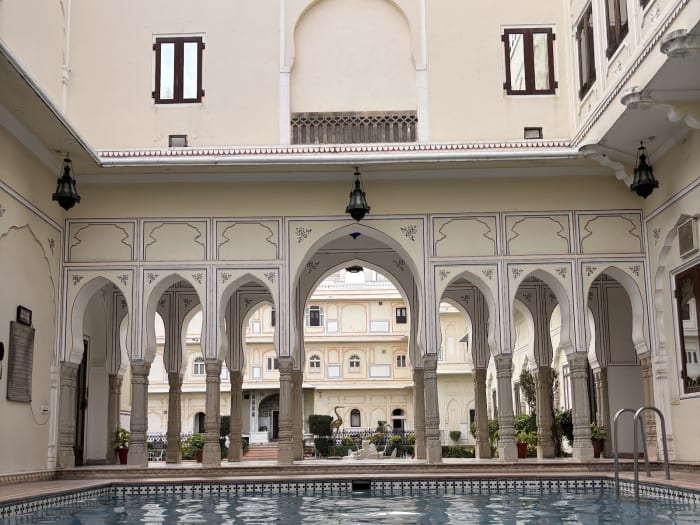
The Raj Palace first reveals itself as a place of composition. In one of Jaipur’s historic quarters, the hotel unfolds through a sequence of spaces that belong as much to residential architecture as to palatial staging: entrances, lounges, courtyards, gardens, shaded passages and reception rooms create a gradual, almost cinematic experience. One does not enter as one would a generic hotel. Instead, there is the sense of crossing one threshold and then another until finding one’s own rhythm within a setting designed to slow the eye.

This spatial quality owes much to the traditional architecture referenced in the brief. In Jaipur, that often means rhythmic façades, carefully worked openings, ornamental detail, generous ceiling heights and a subtle relationship between indoors and outdoors. The Raj Palace appears to cultivate precisely that balance. The gardens and lounges, explicitly described as spaces for relaxation, are not mere extras; they are part of the property’s identity. They provide breathing room between visits, moments for reading, conversation or silence, in a city whose visual and sonic intensity can be stimulating from morning to night.

The authentic atmosphere mentioned in the short description deserves emphasis. In the luxury segment, many addresses borrow a few local decorative signs without ever achieving real coherence. Here, authenticity seems to arise from a deeper continuity between the building, its décor and its urban setting. Luxury is understated in the sense that it relies not on a multiplication of contemporary effects, but on the poise of the spaces themselves: balanced proportions, tangible materials, furnishings in keeping with the spirit of the house, and an easy flow between more ceremonial areas and more intimate corners.

For travellers discovering Jaipur, the location within a historic district also has practical and emotional value. It allows the city to be felt from within rather than from an isolated fringe. One senses daily life more clearly, the proximity of monuments, and the cultural density that makes Jaipur one of the major stops in northern India. Returning to the hotel after a day spent among palaces, bazaars, workshops and landmark sites then takes on another meaning: it feels like returning to a residence that extends the experience of the city rather than contradicting it.

The character of The Raj Palace also lies in its ability to accommodate several readings of a stay. Some will see it as a calm refuge, almost introspective, thanks to the gardens and lounges. Others will seek an aesthetic immersion shaped by opulent décor and the memory of the place. Others still will simply appreciate attentive service in a setting with strong personality. That is often the mark of a good house: it does not impose itself in only one way, but allows each traveller to inhabit it differently. In Jaipur, where visual abundance can at times be tiring, that flexibility is especially valuable.

Rooms and Suites

At a property such as The Raj Palace, rooms and suites are not merely places to sleep; they extend the narrative of the house. One expects to find here, on a more intimate scale, the codes that define the hotel’s character: traditional architecture, richly composed décor, an authentic atmosphere and understated luxury. That last point matters. Comfort does not need to be showy in order to be real. It is felt in the quality of sleep, in the sense of space, and in the way a room shields guests from the bustle outside while maintaining a subtle connection with Jaipur.

In hotels set within heritage buildings, uniformity is rarely the rule, and that is often good news. Volumes may vary, as may perspectives, with some rooms favouring height, others depth, and others a relationship with a courtyard, a garden or a more ceremonial corridor. This variety adds to the interest of a stay: it reminds guests that they are sleeping in a residence with character rather than in a standardised chain property. At The Raj Palace, the likely individuality of the accommodation is very much part of the appeal for travellers drawn to heritage.

The opulent décor mentioned in the brief suggests interiors where materials and details matter as much as amenities. Textiles, traditionally inspired furnishings, carefully worked decorative elements and a colour palette echoing Rajasthani aesthetics may all give each room its own identity. In such an address, the challenge is to preserve the historic spirit without sacrificing ease of use. Today’s traveller expects a room that is beautiful, but also legible, comfortable and well maintained. The daily housekeeping and turndown service noted in the brief support that expectation, reinforcing the impression of continuous, discreet yet tangible care that distinguishes attentive houses.

The hotel appears especially well suited to couples, and that is easy to understand. Rooms and suites in a converted palace often offer a form of gentle theatricality well suited to travelling as two: generous volumes, a hushed atmosphere and the feeling of being removed from ordinary rhythms. Yet the property can just as easily suit solo travellers or culture-minded guests seeking an inspiring base between days of exploration. In every case, the room becomes more than a place to sleep; it works as a private sitting room, a retreat in which to recover a sense of slowness after the intensity of the city.

In Jaipur, a destination of contrasts, the quality of a room is also measured by its ability to provide transition. After the bright light on façades, the animation of the streets, and visits to forts and palaces, returning to a calm interior prepared with care has real value. The Raj Palace seems to answer that expectation with a coherent proposition: accommodation that embraces its historic identity while offering the gestures of comfort expected of a five-star hotel. For many travellers, it is precisely this balance between character and serenity that makes a stay successful.

Dining

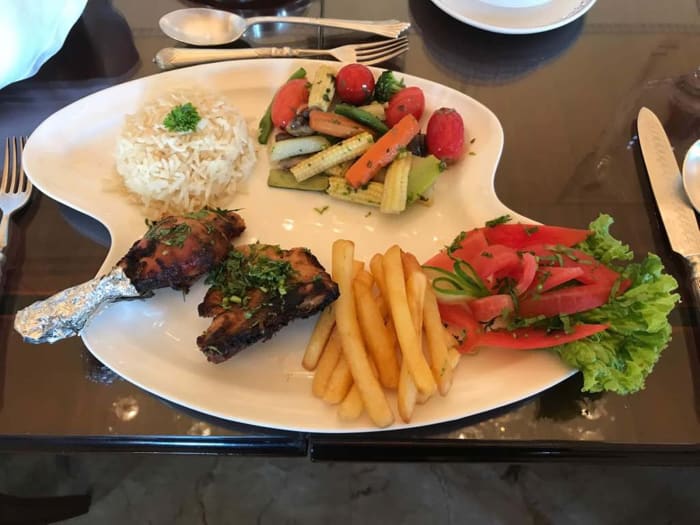
Although the precise details of the restaurants or any specific culinary signature are not provided here, dining at The Raj Palace can still be understood as a natural component of the overall experience. In a historic residence in Jaipur, food is never merely functional; it contributes to immersion. The setting, the rhythm of service, and the way breakfast, lunch or dinner is taken in lounges, courtyards or spaces opening onto the gardens matter almost as much as the plate itself. In this kind of address, dining often becomes another way of inhabiting the place.

Jaipur, capital of Rajasthan, has a strong culinary culture shaped by spices, slow cooking, contrasting textures and a long-standing sense of hospitality. Even when a hotel adopts a menu open to several influences, travellers generally expect some acknowledgement of the regional context. At The Raj Palace, the authentic atmosphere and heritage setting suggest precisely such an approach, one in which cuisine may converse with the destination rather than detach itself from it. This may take the form of dishes inspired by local traditions, service that values the time of the meal, or simply an elegant staging faithful to the spirit of the house.

The hotel’s opulent décor also plays an important role. In the best heritage properties, gastronomy is not conceived as a separate universe, but as the continuation of an art of receiving. Breakfast in a light-filled salon, tea served in a calm space after a morning of sightseeing, dinner in a more hushed atmosphere: these are the sequences that give a stay its texture. Travellers are not looking only for sound culinary execution; they are looking for overall rightness. The memory of a meal then depends as much on the quality of the moment as on the contents of the menu.

For guests spending several days in Jaipur, this dimension is especially valuable. The city encourages going out, exploring, tasting street food and local tables. Yet it is equally pleasant to return to a more composed setting, where service understands the traveller’s rhythm and where one can dine without complicated logistics after a full day. In a hotel that belongs to Small Luxury Hotels of the World, this ability to combine character, attentiveness and apparent ease is exactly what one hopes to find.

It is also worth remembering that, in understated luxury, successful dining is not necessarily the most demonstrative. It is often the dining experience that knows how to match the tone of the place. At The Raj Palace, one can readily imagine an approach that privileges elegance, calm and coherence with the architecture. The meal then becomes a structuring pause in the day, almost a ritual. For couples, it may take on a more intimate dimension; for curious travellers, it extends the sensory discovery of Jaipur. In every case, dining contributes to the rare impression of being received in a house with its own tempo, far from the anonymity of larger establishments.

Spa and Wellness

The existing concierge tip explicitly recommends booking a spa treatment after a day of sightseeing. Even in its brevity, that advice is enough to show that wellbeing plays a genuine role in the experience offered at The Raj Palace. In Jaipur, where days can be long, bright and filled with movement between historic sites, markets and old quarters, the idea of returning to calm is not an optional extra; it is an essential part of the stay. In this context, the spa acts as a transitional space between the intensity outside and the restored slowness of the house.

In a characterful hotel, wellbeing is not limited to a treatment menu. It often begins much earlier, in the way the common spaces are conceived. The gardens and lounges designed for relaxation, mentioned in the brief, already belong to that logic. They create mental space and breathing room. One can extend the effects of a massage there, read, take tea, or simply let the fatigue of the day subside. The treatment then becomes one stage in a broader continuum: that of a stay designed to rebalance one’s rhythm.

Without inventing specific protocols, one may reasonably expect from a spa in this kind of five-star property an attentive, personalised approach adapted to the traveller’s needs. After a day spent exploring Jaipur, many guests are looking above all for recovery: easing the legs, releasing tension, regaining energy without stimulation. Others may prefer a more sensory interlude in keeping with the enveloping aesthetic of the place. In both cases, the setting matters greatly. At an address such as The Raj Palace, the treatment experience is likely to be enhanced by the general atmosphere of the house rather than by technological display or spectacle.

This measured relationship to wellbeing aligns well with the idea of understated luxury. A spa does not need to be monumental in order to feel right. It simply needs to answer what the traveller expects at that particular moment: silence, skill, gentleness of service and the feeling of being cared for without excess. That is often what remains most vividly from a stay in an intense cultural city. Not only the monuments visited, but the quality of the return to oneself between moments of discovery.

For couples, time at the spa can also become a travel ritual, a way of marking the transition from day into evening. For solo travellers, it offers a valuable moment of re-centring. And for everyone, it is a reminder that a great hotel is not merely an elegant base, but a place capable of responding to the physical and emotional needs of travel. At The Raj Palace, wellbeing seems to fit into a broader logic: that of a historic residence sought out for beauty, tranquillity and a gentle form of restoration after the bustle of Jaipur.

Concierge and Services

The luxury of a hotel such as The Raj Palace is expressed as much through atmosphere as through the quality of its daily services. The brief mentions a 24-hour concierge, a 24-hour front desk, daily housekeeping, turndown service, luggage storage, laundry and a wake-up service. Taken separately, these may seem standard in a five-star hotel; taken together, however, they define an important promise: that of a smooth, well-supported stay in which logistics do not interfere with one’s relationship to the place.

In Jaipur, that smoothness has particular value. Days often begin early in order to enjoy softer light, avoid the warmer hours or organise visits under the best conditions. A front desk available around the clock allows the stay to adapt to the traveller’s rhythm, whether for a late arrival, an early departure or a last-minute request. The concierge plays an especially important role in a destination of such cultural density. Beyond reservations or practical information, the team can help shape a more intelligent way of discovering the city: choosing the right time to visit, suggesting a balanced itinerary, recommending a pause, and helping to organise transport without unnecessary friction.

Daily housekeeping and turndown service belong to another register, quieter but equally essential. They create a sense of continuous care. In the best houses, that care is not expressed through showy gestures, but through a general impression of order, freshness and comfort restored at the right moment. After a day spent outside, returning to a room prepared with attention genuinely changes the quality of a stay. It may seem a small detail, yet it is often in such details that the difference between a correct hotel and a memorable address is measured.

Luggage storage and laundry, meanwhile, respond to the very practical needs of international travellers or those on a wider itinerary. Jaipur is often part of a broader journey through northern India. Being able to simplify organisation, have clothing cared for, or manage a train or flight schedule without discomfort all helps preserve the traveller’s energy. The wake-up service may seem almost old-fashioned in principle, but it remains useful in a city where early departures for excursions or transfers are common.

Beyond the list itself, what matters is the tone of service. Membership of Small Luxury Hotels of the World suggests hospitality that is more personal than industrial, marked by warmth and individual attention. In a converted palace, that relational dimension matters even more: service must know how to be present without disturbing the serenity of the place. When well judged, it gives the traveller the feeling of being received rather than processed. That is precisely what one hopes for at The Raj Palace: a team capable of translating the refinement of the décor into lived comfort that feels simple, efficient and deeply welcoming.

The Jaipur Way of Life

Staying at The Raj Palace also means choosing a particular way of approaching Jaipur. The city cannot be reduced to a list of monuments, however remarkable they may be. It is discovered through a combination of rhythms, colours, forms of craftsmanship and everyday scenes that together make up a genuine urban way of life. As the capital of Rajasthan, Jaipur brings together princely heritage, historic urban planning, living craftsmanship and contemporary energy. For the traveller, the challenge is to find the right tempo: to see much, without reducing the city to a sequence of boxes ticked.

The hotel’s location in a historic quarter supports precisely this more sensitive approach. One is closer to a lived-in city than to a frozen backdrop. In the morning, the light on the façades, the gradual movement through the streets, and the opening of shops and workshops already set a tone. Then come the major sites, certainly, but also the intervals: a silent courtyard, a specialist shop, a pause in the shade, a drive that helps one understand the city’s distinctive geometry. Jaipur is one of those destinations where the strongest experience often arises from the alternation between the exceptional and the ordinary.

In this context, The Raj Palace serves as a coherent anchor point. Its royal atmosphere and understated luxury echo Jaipur’s identity without caricaturing it. Returning to the hotel after a day of discovery means extending the city in another register. One remains within the world of history, architecture and refinement, but in a calmer, more inward mode. This continuity is valuable: it avoids the rupture between an intense city and accommodation with no real connection to it.

The best period to visit Jaipur, from November to March according to the brief, corresponds to months when exploring on foot or by car is more pleasant. It is also the season in which gardens, terraces and the transitional spaces between indoors and outdoors can be enjoyed most fully. For travellers interested in local culture, it can be worthwhile to look into the city’s events, celebrations or seasonal highlights before departure, not in order to overfill the itinerary, but to give the stay greater depth. Jaipur is experienced as much through its visible forms as through its uses.

The local art of living also lies in a particular quality of attention: to textiles, objects, artisanal gestures, the presentation of spaces and hospitality itself. At an address such as The Raj Palace, these dimensions find a natural echo. Travellers can therefore shape a balanced stay: heritage visits, time to rest in lounges or gardens, a spa treatment, unhurried meals and simpler moments of observation. This is often how Jaipur reveals itself best. Not as a city to be consumed quickly, but as a world to be approached gradually, through successive impressions, with curiosity and openness.

Book with MyConciergeHotel

Booking The Raj Palace through MyConciergeHotel means approaching the property with the logic of a stay rather than the simple logic of availability. A characterful hotel set in one of Jaipur’s historic quarters and defined by a strong heritage identity is rarely chosen in the same way as a standard room. One must take into account the rhythm of the journey, the season, the type of experience sought and the way the hotel fits into a wider itinerary in India. The value of editorial and concierge support lies precisely there: helping to turn a booking into a coherent stay.

In the case of The Raj Palace, several traveller profiles may be drawn to the address. Couples will find a setting particularly suited to an elegant interlude combining heritage, relaxation and intimacy. Lovers of architecture and history will appreciate the continuity between the city and the hotel. Travellers in search of tranquillity, meanwhile, may choose the property for its gardens, lounges and more composed atmosphere. Booking intelligently therefore means clarifying one’s priorities: is the aim to explore Jaipur intensively, or to alternate visits with periods of rest? Is a short, concentrated stay preferred, or a slower stop within a broader Rajasthani journey?

The period from November to March, mentioned in the brief, remains the most favourable for enjoying Jaipur in pleasant weather. It is also often the time when planning ahead makes the most sense, especially for travellers wishing to shape their stay carefully. Booking in advance makes it easier to coordinate arrival times, transfer needs, sightseeing and moments of wellbeing, such as the spa treatment recommended by the concierge. In a destination this rich, the quality of the stay often depends on that discreet orchestration.

Booking through MyConciergeHotel also means benefiting from an editorial perspective that places the hotel within its real context. The Raj Palace is not simply a five-star hotel in Jaipur; it is an address that speaks to those seeking luxury of setting, atmosphere and memory. That nuance matters when booking. It helps avoid poorly calibrated expectations and encourages guests to choose the property for what it genuinely offers: immersion in a palatial aesthetic, attentive service, a historic location and a more intimate experience than an impersonal large-scale resort.

In practical terms, booking this house thoughtfully means considering the stay as a whole: ideal length, daily rhythm, balance between discovery and rest, and practical needs on arrival and departure. It also means giving oneself the possibility of asking for tailored advice, whether to optimise a first visit to Jaipur, organise a romantic stop or build a wider northern India itinerary. At The Raj Palace, the promise is not that of abstract luxury. It is the promise of a singular place. And that is exactly what a well-supported booking should help preserve.

Signature experiences

Exclusive on-site programmes that define this property's character, beyond the room key.

  • Breakfast in the Gardens

    Beginning the day in the gardens, or beside a lounge opening onto the outdoors, offers a gentle introduction to Jaipur. This experience is defined by the calm of the morning, the softer early light and the contrast between the city waking up and the serenity of the house. Ideal for couples as well as reflective travellers.

    Moment signatureReservation required
  • Tea in a Historic Lounge

    After a morning of sightseeing, taking tea in one of the hotel’s lounges extends the heritage experience in a more intimate register. The décor, the volumes and the unhurried rhythm of service give the moment an almost residential quality. A graceful way to pause without leaving the refined atmosphere of the palace.

    Included in your stay
  • Post-Sightseeing Recovery Treatment

    Designed for travellers spending their days exploring Jaipur, this wellbeing moment is intended above all to release tension and restore energy. It fits naturally into a dense cultural programme and turns the return to the hotel into a genuine end-of-day ritual. Especially appealing during stays of several nights.

    Conseil du ConciergeReservation required
  • Reading and Relaxation in the Lounges

    Some luxury experiences depend on very little: a well-chosen armchair, a quiet lounge, a moment with no programme at all. At The Raj Palace, the common spaces seem to invite precisely this kind of elegant retreat. One settles in to read, talk or simply watch the light shift across the décor through the afternoon.

    Included in your stay
  • A Calm Return After the City

    This is not an activity in the conventional sense, but one of the truest pleasures of the stay: returning to the hotel after the intensity of Jaipur and finding the gardens, the lounges and a room prepared with care. For many travellers, this is where the property truly succeeds, in its ability to offer a soothing transition between discovery and rest.

    Included in your stay
  • Jaipur Itinerary with the Concierge

    To enjoy the city without feeling scattered, the concierge can help shape a day or an entire stay around your priorities: heritage, craftsmanship, pauses and the most pleasant visiting times. This tailored approach allows Jaipur to be discovered more fluidly and helps avoid the feeling of an overfilled or poorly paced itinerary.

    Sur mesureReservation required

Highlights

  • Set in Jaipur’s historic quarter
  • Traditional architecture and opulent décor
  • Gardens and lounges designed for relaxation
  • Authentic atmosphere with understated luxury
  • Member of Small Luxury Hotels of the World

Services & amenities

Wellness

  • Spa

Dining

  • Bar
  • Afternoon tea

Services

  • 24-hour concierge
  • Laundry service

Connectivity

  • Free Wi-Fi

Accessibility

  • Elevator

Other amenities

  • 24-hour front desk
  • Air conditioning
  • Bathrobes and slippers
  • Blackout curtains
  • Breakfast service
  • Daily housekeeping
  • Flat-screen TV
  • Garden
  • In-room safe
  • Lounge
  • Luggage storage
  • Massage treatments
  • Minibar
  • Multilingual staff
  • Nespresso machine
  • Non-smoking property
  • Premium toiletries
  • Restaurant
  • Turndown service
  • USB charging ports
  • Wake-up service

Rooms & suites

Room catalog coming soon.

Stay policies

Check-in & check-out

Check-in
From 14:00 to 23:59
Check-out
Until 12:00

Pets

Pets are not allowed.

Wi-Fi

Complimentary high-speed Wi-Fi in all rooms and public spaces.

Location & access

Address: The Raj Palace, Jorawar Singh Gate, Amer Rd, Chokdi Gangapol, Jaipur, Rajasthan 302002, Inde

Map showing the location of The Raj Palace
Map data © OpenStreetMap contributors · Tiles courtesy of the Wikimedia Foundation

View on the map

Less than 17 minutes on foot from the heart of the neighbourhood: museums, Michelin tables, and the everyday shops you actually need.

What we visit in the neighbourhood

Three places I send my guests to on their first day.

My tip: start early — you save 30 minutes at the door.

  • Kale Hanuman Ji MandirTemple
    842 m · 10 min walk
  • EidgahPlace of worship
    1.1 km · 13 min walk
  • SHRI GARH GANESH Ji TEMPLETemple
    1.2 km · 15 min walk
  • THIKANA MANDIR SRI GOVINDDEVJI , JAIPURTemple
    1.3 km · 15 min walk
  • Gaitor Ki ChhatriyanTourist attraction
    1.3 km · 15 min walk
  • Palais des ventsTourist attraction
    1.5 km · 18 min walk
  • City Palace de JaipurHistoric place
    1.5 km · 18 min walk
  • Yantra MandirTourist attraction
    1.5 km · 19 min walk

What we do nearby

What I book for them when they have a free half-day.

My tip: book the day before — the best tables close fast.

  • Central ParkPark
    4.3 km · 51 min walk
  • Sisodia Rani ka BaghGarden
    4.7 km · 57 min walk

Distinctions & affiliations

Labels & distinctions
Small Luxury Hotels of the World

Sources & verification

The factual information on this page is sourced from and verifiable against open encyclopaedias and reference databases.

External references

Data collected on 31 May 2026.

Why book with MyConciergeHotel?

  • IATA-accredited agency

    GDS net rates negotiated directly, no intermediary, no markup.

  • APST financial guarantee

    Your payments are protected by the Association Professionnelle de Solidarité du Tourisme.

  • Secure 3DS2 payment

    Amadeus Payments — PCI DSS level 1, 3-D Secure strong authentication.

  • Data hosted in the EU

    Supabase Europe hosting — GDPR-compliant, your details are never resold.

  • Advisors 7 days a week

    A French-speaking team replies to your enquiries by email within 24 business hours.

Why choose The Raj Palace?

The Raj Palace is an exceptional address in Jaipur, chosen by the Concierge for its location, service and character. This page gathers verified facts — rooms, dining, amenities, access and policies — together with the Concierge's tip, the operational secret worth knowing before you go. Updated 31 May 2026.

The Concierge's 5 top answers about this hotel

The questions my guests ask me most. Direct answers, no fluff.

  1. Does the hotel have parking facilities?

    The hotel has on-site parking, but spaces are limited. It is recommended to reserve a spot through the concierge to ensure availability.

    My tip : Précisez votre heure d'arrivée la veille, cela aide la conciergerie à vous réserver une place.

  2. What kind of breakfast is served?

    The breakfast served is buffet-style, with continental options. It is usually included in the room rate, but it is advisable to check the timings.

  3. Is Wi-Fi available throughout the hotel?

    Yes, Wi-Fi is available for free throughout the hotel, including in the rooms and common areas.

  4. How far is the hotel from the airport?

    The hotel is located approximately 12 km from Jaipur International Airport, which is about a 30-minute drive.

  5. Is early check-in available?

    Early check-in is subject to availability. It is advisable to contact the concierge in advance to check the possibilities.

    My tip : Indiquez votre heure d'arrivée dès la réservation, cela facilite la préparation d'une chambre plus tôt.

Frequently asked questions

Before your stay

  • Does the hotel have parking facilities?

    The hotel has on-site parking, but spaces are limited. It is recommended to reserve a spot through the concierge to ensure availability.

  • What kind of breakfast is served?

    The breakfast served is buffet-style, with continental options. It is usually included in the room rate, but it is advisable to check the timings.

  • Is Wi-Fi available throughout the hotel?

    Yes, Wi-Fi is available for free throughout the hotel, including in the rooms and common areas.

  • Are pets allowed at The Raj Palace?

    Pets are not allowed at The Raj Palace. For special requests, please contact the concierge.

  • How far is the hotel from the airport?

    The hotel is located approximately 12 km from Jaipur International Airport, which is about a 30-minute drive.

  • Does the hotel have a pool?

    Yes, the hotel has an outdoor pool. It is open year-round and accessible to hotel guests.

  • Is early check-in available?

    Early check-in is subject to availability. It is advisable to contact the concierge in advance to check the possibilities.

  • Are airport transfers offered?

    Yes, private airport transfers are offered, usually at an additional cost. The concierge can arrange these services for you.

  • What is the hotel's cancellation policy?

    The hotel's cancellation policy varies depending on the rate and season. Generally, cancellation is free up to 24-72 hours before arrival. Please contact the concierge for more details.

  • Are there any tourist taxes to pay?

    Yes, local tourist taxes are to be paid on-site. The amount varies per night and per person.

Loyalty rewards from the first night for Little catalog hotels.