History & heritage
In Istanbul, few addresses express the city’s intimate relationship with water as convincingly as Sumahan on the Water. The hotel belongs to that sensitive geography of the Bosphorus shoreline, where houses, landing stages and working buildings long shaped a life oriented towards the strait. What makes the property compelling is not only its dramatic setting, but the way it extends an Ottoman architectural heritage and a domestic culture specific to the waterside districts on the Asian shore. Guests do not step into a hotel conceived as an abstract set; they enter a place that speaks to Istanbul’s memory, its materials, its proportions and the shifting light that moves constantly across the water.
The traditional Turkish architecture associated with the house sets the tone from the outset. It is not handled as a decorative cliché, but as a living structure: restrained façades, a direct relationship with the quay, windows designed to frame the landscape, and a measured use of wood, stone and natural tones. In a city often told through its imperial monuments, this address is a reminder that Istanbul is also understood through its inhabited waterfronts, its quieter neighbourhoods and its buildings that watch ferries, cargo ships and private boats pass by. The Bosphorus is not merely a view here; it is a defining element of the stay, almost a constant presence.
That fidelity to place continues indoors, where modern style and local heritage coexist without cancelling one another out. Luxury does not rely on effect. It works through balance: contemporary lines, discreet comfort, details drawn from Turkish domestic vocabulary, and a willingness to let space breathe rather than overload it. This restraint matters in Istanbul, a city of intensity and contrast, because it allows guests to feel something beyond a hotel interlude: a sense of being grounded. It quickly becomes clear that the property is intended for travellers who want to inhabit the city differently, taking time to observe, listen and slow down.
Even the hotel’s name summarises that promise. To be on the water is not a superficial claim. It is a way of organising the stay around a more fluid, contemplative, almost maritime rhythm. In the morning, light rises over the strait; during the day, the scene fills with movement; by evening, reflections lengthen and one rediscovers that rare sensation of being in a major metropolis while remaining at a remove from its agitation. It is in that in-between state, so characteristic of Istanbul, that Sumahan on the Water finds its identity: a property with character, rooted in the Bosphorus more than in the conventional idea of the grand urban hotel.
The property
What strikes first at Sumahan on the Water is the quality of the quiet. Not absolute silence, which would be impossible in a port city, but a calm inhabited by the lapping of water, the distant passage of boats and the breath of the strait. In a metropolis as dense as Istanbul, that sense of retreat has particular value. The hotel sits in a peaceful district away from the most immediate bustle, making it less a fashionable urban stage than a waterside refuge. Guests come here to recover a more human scale of the city, to look at the Bosphorus without mediation and to experience Istanbul from its shoreline rather than from its busiest arteries.
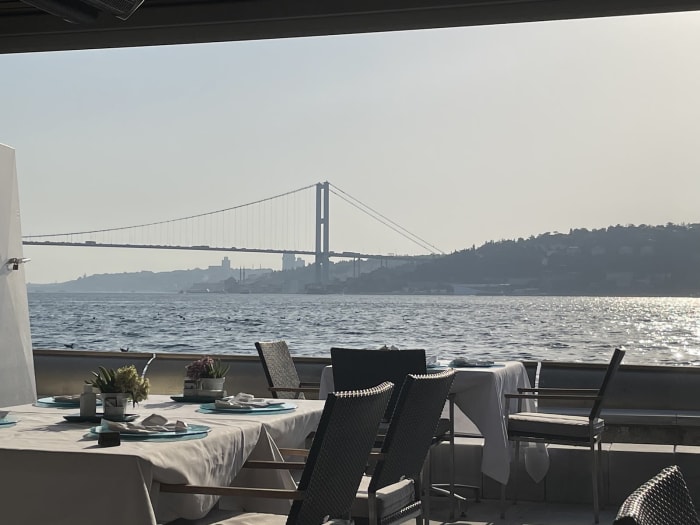
The property draws much of its strength from this direct relationship with the landscape. The Bosphorus is never pushed into the background: it structures the views, accompanies the day’s different moments and sets its own tempo. From the shared spaces as well as from rooms facing the water, the eye naturally settles on this singular maritime corridor that both separates and connects two continents. The view is never static. It changes with the weather, the season, the density of marine traffic and the tones of the sky. That constant movement is what makes the stay especially compelling. Even without a fixed plan, one can spend long stretches simply watching the city unfold on the opposite bank.
Architecture and interior design extend that impression of calm. Modern elements do not erase local heritage; they clarify it. The volumes seem designed to welcome light, the materials retain a tactile presence, and the whole avoids display. The result is an atmosphere that feels welcoming, at times almost domestic, without abandoning the expectations of a five-star hotel. That balance matters: it allows the property to keep a distinct personality, far from the interchangeable establishments that could belong to any capital. Here, the décor speaks of Istanbul without turning it into caricature.
Sumahan particularly suits those seeking a city experienced over time, with its pauses and margins. Couples will naturally find a setting conducive to slowness, but the address also appeals to solo travellers, architecture enthusiasts and guests who prefer characterful hotels to large urban machines. After a day spent among palaces, mosques, museums or boat crossings, returning to the Bosphorus takes on an almost ritual quality. One leaves the tumult behind to recover a horizon line, a terrace, a room facing the water, and that rare impression of having found in Istanbul a place that does not try to compete with the city, but instead interprets it with tact.
Rooms and suites
At Sumahan on the Water, rooms and suites are best understood through their relationship with the landscape. In a city where so many hotels claim a view, here it genuinely feels like the centrepiece of the stay. Booking a room facing the Bosphorus alters one’s sense of time: morning begins with clear light on the water, the day unfolds to the rhythm of passing vessels, and evening brings a form of suspension as the shores resolve into shadows and reflections. This constant presence of the strait gives the private spaces unusual depth. One does not merely sleep here; one observes, withdraws and reconnects with the city without having to absorb its noise.
The interiors rely on a measured dialogue between modern style and local heritage. The décor seeks neither ostentation nor historical reconstruction. Instead, it favours restrained elegance, with clean lines, natural materials and details that evoke the region’s cultural inheritance without freezing it in time. This approach suits Istanbul particularly well, given how visually intense the city can be outside. In the room, everything appears designed to restore balance: a calming palette, volumes that allow light to circulate, and a composition that encourages both rest and contemplation. The overall effect is one of mature comfort, more lasting than demonstrative luxury.
What also distinguishes these accommodations is their ability to create intimacy. The hotel is often chosen by couples, and it is easy to understand why: proximity to the water, the quiet district and the restraint of the décor combine to produce a setting conducive to time together. Yet that intimacy does not exclude functionality. The services expected of a five-star property support the stay discreetly, whether through daily housekeeping, turndown or attention to each guest’s rhythm. Nothing disturbs the impression of inhabiting a calm, almost private place on the edge of one of the world’s most storied straits.
For travellers already familiar with Istanbul, these rooms offer a different experience of the city: less vertical, less conventionally urban, more oriented towards the horizon and the movement of water. For first-time visitors, they provide an especially accurate introduction, because they reveal one of the metropolis’s deepest truths: its maritime identity. Between traditional Turkish architecture and contemporary comfort, the rooms and suites at Sumahan do not rely on accumulation, but on coherence. They offer a way of staying in Istanbul that privileges light, calm and a direct relationship with the Bosphorus — three qualities that, taken together, often define the places one remembers.
Dining
Dining at Sumahan on the Water is organised with welcome simplicity around the experience of the shoreline. The Waterfront restaurant sets the tone: a table designed to accompany the day rather than dramatise it, with Turkish and Mediterranean cuisine that feels entirely at home beside the Bosphorus. In a hotel where the landscape plays such a central role, eating is never detached from place. Meals form part of a continuous sequence of sensations: light on the water, the movement of boats, the air of the strait, and that impression of taking one’s time in a city that often encourages speed.
In the morning, the serpme kahvaltı is perhaps the most accurate way to enter the spirit of the house. This generous Turkish breakfast, served through multiple plates intended for sharing, expresses a particular idea of local hospitality. It is not simply a way to begin the day, but to open it with abundance and variety: breads, savoury preparations, sweets, fresh produce, textures and flavours that invite guests to linger. Taken by the water, it becomes more than a meal service; it takes on the quality of an Istanbul ritual, at once everyday and deeply tied to the pleasure of the table.
Later in the day, the Waterfront menu continues that conversation between Turkey and the Mediterranean. The appeal lies not in excessive sophistication, but in a cuisine that is legible and suited to the rhythm of the place. One readily imagines long lunches and dinners to which guests return less for performance than for the balance between setting, service and flavours familiar to the region. This approach suits the property particularly well: it allows the Bosphorus to speak without trying to divert attention from it. The restaurant thus becomes a natural extension of the hotel, faithful to its discreet elegance and sense of proportion.
In a city as abundant as Istanbul, where the gastronomic scene can be highly theatrical, that restraint feels valuable. It is a reminder that a good table does not always need to do more when the place itself already possesses a strong identity. At Sumahan, dining supports the experience rather than dominating it. It allows guests to inhabit the waterfront from morning to night, to pause between crossings of the city, or to decide deliberately not to go out in order to enjoy the calm of the property. For travellers who value atmosphere as much as what is on the plate, Waterfront captures the spirit of the house: an address where one comes as much for the quality of a moment as for the meal itself, and where the Bosphorus remains, from first coffee to final drink, the most constant of companions.
Concierge & services
Luxury at Sumahan on the Water is also measured through the quality of its services, designed to support the stay without weighing it down. In a property where atmosphere matters as much as comfort, the presence of a 24-hour concierge and front desk is essential. It helps preserve the sense of ease travellers seek when choosing a characterful hotel over a large impersonal structure. Whether for a late arrival, an early departure, a practical request or simple advice on how to shape the day, the support is intended to be continuous, discreet and responsive to each guest’s rhythm.
That discretion continues in the daily gestures that shape the perception of a stay. Daily housekeeping maintains the rooms with consistency, while turndown introduces, at the end of the day, a gentle transition between the city and the night. After hours spent exploring Istanbul, moving through its districts or crossing between its shores, returning to a room prepared with care has something deeply calming about it. These are attentions that do not seek to draw notice, yet they help create an impression of continuity and controlled comfort.
Among the useful services, luggage storage, laundry and wake-up calls answer very practical needs, especially valuable in a destination where flight times, crossings and sightseeing schedules can be demanding. The appeal of these amenities lies precisely in their functional simplicity. They save time, lighten organisation and allow guests to devote more energy to the experience of the city itself. In a hotel set within a peaceful environment, this quiet efficiency makes particular sense: it prevents logistics from disturbing the quality of the stay.
Multilingual staff also contribute to that overall ease. In Istanbul, a crossroads for travellers from very different backgrounds, the ability to welcome without friction, to explain, guide and reassure clearly, forms part of hospitality itself. At Sumahan, these services are not conceived as an accumulation of options, but as a framework of confidence. They support both short stays and longer interludes, romantic escapes and more contemplative trips. Ultimately, the concierge and service culture extend the philosophy of the property: to offer a calmer relationship with Istanbul, where everything feels simpler because the essentials are handled with tact. In a city as rich and at times as demanding as this one, that quality of attention often marks the difference between a good hotel and an address remembered long after returning home.
Istanbul living, from the Bosphorus
Staying at Sumahan on the Water means choosing a particular way of approaching Istanbul. Rather than being immediately absorbed by the scale of the city, one begins with its breath, its waterline, with the strait that reveals its deeper structure. The Bosphorus is not merely a geographical boundary between Europe and Asia; it is a way of life, a daily stage, an axis of circulation, contemplation and memory. From this peaceful address, one better understands why so many travellers, writers and residents have seen the shores of Istanbul as one of the city’s most subtle faces.
The great privilege of the place is precisely that it allows for this more nuanced reading. From the quay, the restaurant or a room opening onto the water, Istanbul appears less as an accumulation of sights than as a succession of rhythms. In the morning, light cuts across the hills and built silhouettes; at midday, marine traffic reminds one that the city lives through constant exchange; by evening, the strait becomes almost theatrical without ever losing its everyday truth. This relationship with the landscape encourages slowness. It makes one want to move through the city differently, alternating visits with returns to calm, and allowing moments of observation to matter as much as the itineraries themselves.
For a first stay, this position provides a valuable counterpoint to the intensity of the historic districts. After domes, bazaars, museums and imperial perspectives, returning to the Bosphorus restores a more intimate, more breathable Istanbul. For repeat visitors, the experience is different again: it is a reminder that the city is never reducible to its emblems. It also exists in its quieter margins, its houses turned towards the water, its table habits, its crossings and its suspended moments. Sumahan supports this approach perfectly because it imposes no theatrical narrative; it lets the city reveal itself naturally.
This is perhaps where its true art of living lies. The point is not to multiply activities, but to choose the right tempo. A long breakfast facing the strait, a day of discoveries, a return in late afternoon as the light softens, a simple well-situated dinner, then the night in a room where the water remains present even after the curtains are drawn: that sequence alone is enough to compose an experience that feels deeply of Istanbul. At a time when so many hotels try to compress a destination into a concept, Sumahan on the Water offers something else: an anchor point. A place from which Istanbul can be read with more calm, more depth and, ultimately, more truth.
Book with MyConciergeHotel
Choosing Sumahan on the Water through MyConciergeHotel means favouring an address whose value rests on concrete and lasting qualities: a position on the Bosphorus waterfront, a peaceful district in a city of rare intensity, traditional Turkish architecture interpreted with restraint, and interiors that combine contemporary comfort with local heritage. This is not a hotel reserved simply to tick off a list of amenities, but for the coherence of an experience. Everything contributes to the same sensation: inhabiting Istanbul from a calmer, more contemplative point of view, one rooted in the city’s intimate geography.
The property particularly suits travellers who know what they seek from a major urban stay. Couples will find a setting naturally conducive to slowness and closeness, but the hotel is equally well suited to those who want to discover the city differently, building pauses into their days. Booking here means choosing a rhythm: breakfast facing the water rather than in the middle of the bustle, returning at day’s end to a quieter shore, and sleeping in a room where the Bosphorus view becomes an essential part of the journey. For many guests, it is precisely this continuity between place, landscape and service that turns a stay into a lasting memory.
MyConciergeHotel allows the reservation to be approached with the same level of care expected from the hotel itself: precision, relevance and attention to detail. The point is not merely to select a room category, but to understand what will make the difference once on site. Here, orientation, relationship to the water, the tempo of the stay and the use of the shared spaces genuinely matter. A room with a Bosphorus view, for instance, is not an incidental upgrade; it shapes an entirely different way of experiencing the property, from first light to the last reflections of evening.
For a stay in spring or autumn, when the climate is particularly well suited to exploration and time spent outdoors, Sumahan reveals its full accuracy. Yet whatever the season, the essentials remain the same: a characterful house turned towards the water, capable of offering a rare counterpoint to Istanbul’s energy. Booking through MyConciergeHotel therefore means choosing more than a five-star hotel. It means selecting an address with a genuine reading of its setting, one that offers guests an experience of the city grounded in calm, light and the Bosphorus. In a destination as rich as this, that clarity of intention is often what separates the hotels one enjoys from those one recommends without hesitation.