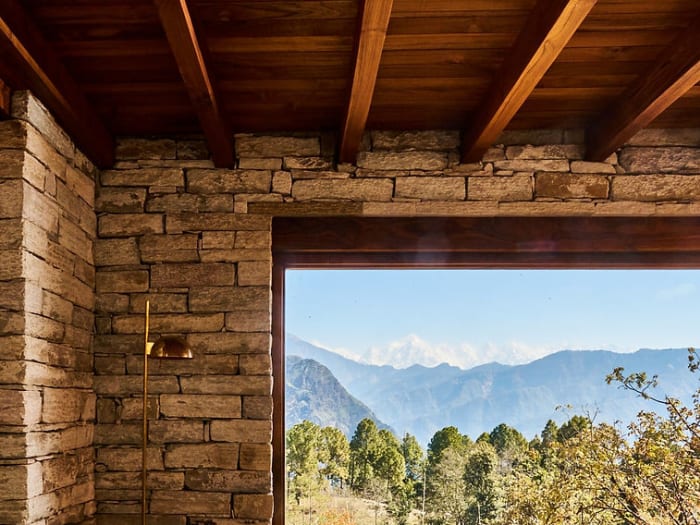
An idea of retreat, rather than a palace narrative
Shakti Prana is not told like a grand urban hotel shaped by dynasty, society history or a listed monument. Its identity is closer to a contemporary idea of retreat: a place conceived for slowing down, looking outward and recovering a more direct relationship with the landscape. In Kumaon, in northern India, the experience immediately takes on a different tone. Here, the architecture of the stay is not built on display but on attention. The point is not to multiply effects, but to create the conditions for a genuine presence to the territory, the light, the silence and the mountain contours.
Even the name suggests this orientation, evoking breath, vital energy and inner balance, entirely in keeping with a destination where the mountains naturally impose another rhythm. In this part of the Indian Himalayas, travel is not merely geographical. It also involves a way of inhabiting time: rising with the morning light, watching colours shift across the slopes, listening to the changing wind, and accepting days shaped by walking, rest, contemplation and the simple rituals of well-made hospitality.
That is perhaps what explains Shakti Prana’s particular place in the imagination of travellers drawn to hotels with a strong point of view. Its inclusion in The World’s 50 Best Hotels 2025 speaks not only of international recognition; it also underlines the relevance of a form of hospitality that does not attempt to reproduce metropolitan codes, but instead articulates an experience coherent with its surroundings. In a hotel landscape often dominated by performance, the property chooses restraint, precision and balance.
This approach places Shakti Prana within a broader story: that of luxury redefined around space, calm and authenticity. Prestige here does not come from an accumulation of signs, but from a subtler rarity: the possibility of truly stepping away from urban noise without giving up comfort or service. A stay becomes a carefully held parenthesis, almost a gentle discipline, in which each detail appears directed towards a single aim: making travel feel more inward.
This is the lens through which the address is best understood. Shakti Prana is not a hotel that tries to impress at every turn; it is a place that settles gradually into memory. What remains is less a theatrical décor than a lasting sensation of clarity, air, openness and peace. In the vocabulary of contemporary travel, that is a form of heritage in itself: the ability to offer an experience that outlasts fashion and finds its value in the quality of presence it makes possible.
The setting, between open horizons and chosen seclusion
Shakti Prana’s first luxury is its setting. Kumaon has that rare ability to combine visual breadth with a sense of intimacy. The views open generously across the surrounding landscapes, yet the experience remains one of retreat. This tension between openness and shelter defines the character of the place. One does not come here to be at the centre of things, but to place oneself deliberately at a distance: from noise, from speed, from the constant demands that shape urban life. The stay begins, therefore, with a shift in perspective, both literal and inward.
In such an environment, the hotel acts as a discreet interface between traveller and mountain. It does not attempt to dominate the site, but to accompany it. Nature is not merely scenery arranged around the property; it is the primary sensory material of the stay. Morning light, clear air, the lines of the terrain and the depth of the views all contribute directly to the quality of the experience. At certain hours, the landscape seems almost abstract, reduced to successive planes of hills, mist and sky. At others, it regains a more tactile, vegetal and earthly presence. That variability gives the place a particular density: one is never quite looking at the same scene.
The overall atmosphere, often described as peaceful and suited to contemplation, is not a brochure cliché. It rests on a physical reality. Distance from urban bustle alters the perception of time and sound. Days feel longer, transitions gentler, gestures more legible. One notices details more readily: a cup placed in exactly the right spot, a current of air on a terrace, a shadow moving across a wall, the silence between two conversations. It is within this economy of attention that Shakti Prana finds its singularity.
The address particularly suits those who see travel as a form of recalibration. Couples seeking a discreet retreat, solo travellers wishing to recentre themselves, readers, walkers and lovers of landscape all find a setting that imposes little and allows much. The mountains do not demand performance; they invite availability. One may choose stillness and contemplation just as easily as gentle exploration of the surroundings.
The dry season remains the most favourable time to appreciate the environment fully, when the climate is more stable and the views clearer. It is also worth accepting that such a location implies a different sort of logistics from a city hotel. Access forms part of the experience: one reaches a place that asks to be earned, if only slightly, and it is precisely that small remove that preserves its power of disconnection. On arrival, what strikes one is not only the beauty of the setting, but the very distinct sensation of having left a world of friction for a space of breath.
Rooms and suites, the art of letting the landscape in
At Shakti Prana, the idea of comfort appears inseparable from a certain visual restraint. In surroundings of such force, the ideal room is not meant to compete with the outdoors, but to make space for it. One imagines interiors conceived as calm refuges, where the quality of the stay depends less on ornament than on a sense of balance: good proportions, well-received light, pleasing materials, and a fluid relationship between inside and horizon. The true luxury here lies in being able to withdraw without severing oneself from the sensory world around the hotel.
That relationship to the landscape turns the room into an intimate viewing point. In the morning, it supports waking gently; during the day, it becomes a place for reading, resting or simply contemplating; in the evening, it regains a more enveloping sense of retreat. In a destination such as Kumaon, the accommodation experience is not limited to sleep. It includes time spent watching the light change, listening to silence and allowing the mountains to set the rhythm. A successful room in this context is one that accommodates those uses without emphasis.
Daily service naturally contributes to this impression of peaceful continuity. Careful housekeeping, evening turndown, discreet attention to personal effects: these are the gestures that sustain the idea of a stay without friction. Nothing demonstrative, but a form of domestic precision that matters greatly in places of retreat. One returns from a walk, a moment in the sun or a pause on a terrace, and the space seems to have been restored with exactly the right measure. That sense of obviousness is often one of the most reliable markers of fine resort hospitality.
For couples, the room readily becomes a cocoon opened towards the landscape, suited to stays in which one speaks little and looks often. For solo travellers, it becomes a space of recentring, almost a cell of calm. In both cases, the appeal of the address lies in its ability to offer an intimacy that is not closed, but breathable. One feels protected without being shut in, looked after without being interrupted.
It is worth noting, finally, that a place such as Shakti Prana invites guests to rethink their expectations. One does not necessarily come here in search of a visible accumulation of amenities or the theatrical effect of décor. One comes instead for a quality of presence: that of a room that soothes immediately, frames the landscape intelligently, and allows one to experience fully what brought one to Kumaon in the first place — silence, space, and that rare impression that time, for a few days, has recovered its proper pace.
Wellbeing as rhythm, silence and breath
Every retreat now speaks the language of wellbeing; few, however, give it a credible form without reducing it to a menu of treatments. At Shakti Prana, the notion appears broader and more organic. It begins with the site itself. The relative altitude, the clearer air, the openness of the views, the distance from the city and the simplicity of the daily rhythm create the conditions for a calm that precedes any formal intervention. Even before a massage, a guided session or a particular ritual, there is already a very tangible sense of release: the body slows, attention shifts, the mind clears.
In this kind of address, wellbeing is not confined to a dedicated area; it informs the way the stay is lived. Rising early to catch the light, taking time over tea facing the hills, walking gently, returning to rest, read, breathe and sleep better: these simple gestures recover an almost structuring value here. The mountains act as a corrective to pace. They remind one that it is not necessary to fill every hour in order to feel that a day has been fully lived.
The peaceful atmosphere, explicitly associated with contemplation, plays a central role. Silence here is not an absence but a quality. It allows subtler sensations to register: the temperature of the air at daybreak, the gradual release of the shoulders, the healthy fatigue after a walk, the effect of a meal taken without haste. In a world saturated with demands, this sensory recovery is already a form of care. It helps explain why such places appeal so strongly to travellers seeking not only rest, but recalibration.
For couples, wellbeing often takes the form of a recovered intimacy, less talkative and more attentive. For solo travellers, it can become a particularly fertile experience of recentring. The setting lends itself to discreet retreats, reading pauses, moments of personal meditation or simply the practice of a calmer presence to oneself. Nothing is imposed; everything is suggested. That is a precious quality, because the true luxury of wellbeing often lies in the absence of instruction.
Shakti Prana thus belongs to a mature vision of resort life: one comes less to consume activities than to inhabit a state. A stay may of course be organised around appointments, guidance or more formal interludes, but its success depends above all on this discreet alchemy between landscape, silence, service and recovered time. In the best cases, one leaves not dramatically transformed, but reset: clearer, more rested, more available. It is a modest promise on the surface, yet a profoundly rare one.
Concierge and services, discretion as a form of precision
In destination hotels, quality of service is measured less by the multiplication of features than by the ease with which a stay unfolds. Shakti Prana appears to belong to that demanding school in which hospitality becomes almost invisible. A round-the-clock front desk and 24-hour concierge immediately establish the tone: reliable presence, able to support practical needs without disturbing the sense of retreat that gives the place its value. In a mountain setting, such availability is not merely a comfort; it contributes directly to the overall serenity of the journey.
The great merit of well-conceived service lies in handling details before they become concerns. Luggage storage, wake-up calls, laundry, daily housekeeping, evening turndown: these elements, sometimes taken for granted, assume particular importance here. When one chooses a stay oriented towards calm, one expects precisely that no logistical matter should interrupt that continuity. Luxury lies not only in what is offered, but in what is spared the traveller: hesitation, unnecessary waiting, minor friction, reminders of ordinary life.
Multilingual staff add an essential layer of comfort for an international clientele. In a place where guests often come seeking a form of withdrawal, the quality of exchange matters greatly. One must be able to ask simply, understand quickly and organise without effort. A good concierge in this context does not merely answer; it reads the rhythm of the stay. It knows when to suggest a walk, when to facilitate a transfer, when to preserve privacy and when to step in with tact. That relational intelligence often marks the difference between correct service and true hospitality.
It is also worth remembering that a hotel set away from urban centres requires particular attention to organisation. Arrivals, departures, timings, daily needs and any wish to explore all call for precise support. When that support is well handled, the traveller notices only the result: a sense of simplicity. It is one of the most elegant paradoxes of luxury hospitality. The more accomplished the service, the less it needs to show itself.
At Shakti Prana, that discretion appears entirely coherent with the spirit of the place. One does not expect the theatricality of a classical palace here, but a calm, continuous quality of presence without stiffness. The ideal service is one that protects silence rather than invading it, supports the retreat experience rather than overloading it, and accompanies without imposing. For travellers accustomed to great hotels, this is often where a truly right address reveals itself: in its ability to do a great deal while leaving the stay its apparent simplicity.
The art of living in Kumaon, travelling in order to look differently
To stay in Kumaon is to accept that travel is not measured only in activities ticked off, but in quality of attention. The region invites a way of living that privileges slower rhythms, a relationship with relief, light and a sense of space. Shakti Prana belongs fully to that logic. The hotel is not merely a comfortable base; it becomes a vantage point onto a different way of inhabiting the world, one that is quieter, more restrained and more receptive.
In mountain landscapes, the eye quickly learns to expand. One stops looking for immediate events and begins to appreciate nuances instead: shifting mist, the depth of valleys, the quality of the air after sunrise, the way the sky redraws the lines of the land. This education of the gaze transforms the stay. It restores value to elementary pleasures that cities tend to make abstract: walking without a fixed purpose, sitting still for a long time, listening, observing, waiting for the right light. These are modest gestures, yet together they create a particularly dense travel experience.
Kumaon also possesses that inward dimension characteristic of highland destinations. The mountains are not only spectacular; they act as a mental frame. They help place things at a distance, reorder priorities and recover a form of simplicity. It is no accident that solo travellers often feel especially at ease here. The territory encourages a clearer presence to oneself, without ever excluding shared experience. For couples, it offers a setting suited to a calmer intimacy, built on time together rather than programmed distraction.
The local art of living, in its most successful hotel expression, therefore consists in not overloading the experience. Tea facing the landscape, a reading pause, a gentle walk, time in the room, a quiet dinner, deep sleep: this sequence of simple moments can be enough to create days that feel very full. Refinement here comes from coherence. Anything that distracts from the essential seems superfluous; anything that helps one feel the place more fully becomes valuable.
This is how Shakti Prana answers the expectations of a discerning contemporary traveller. Not by promising a spectacular version of the mountains, but by offering the conditions for a more accurate encounter with them. Kumaon is not scenery to be consumed quickly. It is a territory that asks for a little time, a little silence and a degree of availability. In return, it offers something few addresses still know how to preserve: the possibility of leaving with memories that are not only images, but lasting sensations — a quality of light, a way of breathing, a recovered sense of space.
Booking Shakti Prana, choosing the right tempo
Booking a stay at Shakti Prana does not quite follow the same logic as reserving a hotel for transit. One does not come here to optimise a crowded itinerary, but to create a pause. That nuance changes everything. The best stay is often the one planned around the rhythm one hopes to recover: a few days to breathe, a retreat for two, a solo journey to recentre, or a longer stop within an Indian itinerary shaped by nature and calm. The address calls less for quick consumption than for a chosen form of availability.
The dry season remains the most obvious period in which to enjoy the setting under favourable conditions, with generally more pleasant weather and clearer views across the surrounding landscapes. It is also when the appeal of the place is felt most strongly by travellers seeking mountains, air and silence. Booking ahead therefore makes particular sense, especially as the most sought-after retreat properties often operate on a logic of rarity. If one has precise dates in mind, a romantic stay or a period of high demand, it is wise to plan early in order to preserve both choice and peace of mind.
Access should also be considered part of the journey. A hotel in a mountain region requires a degree of practical preparation, particularly regarding transfers and timings. The value of attentive support lies precisely in simplifying that equation. A well-managed reservation does not merely confirm a room; it aligns the entire stay coherently, from arrival to departure, taking local rhythm and personal expectations into account. This is especially true for international travellers, for whom logistical ease has a direct impact on the quality of the experience.
Choosing Shakti Prana also means accepting that part of the stay’s value lies in what it does not promise. No excess, no agitation, no programme imposed hour by hour. The luxury is subtler: the possibility of withdrawing into a recognised setting, benefiting from continuous service, and spending a few days in which horizon, silence and time recover their place. That promise deserves to be approached accurately. It is better to arrive wanting to slow down than expecting constant entertainment.
Booking through MyConciergeHotel allows the address to be approached in exactly that spirit: as a stay composed with care, where every practical detail serves a broader experience. For a romantic retreat, a solo journey or an escape far from the city, the essential thing is not merely securing a room, but finding the right moment, the right length and the right balance. At Shakti Prana, it is often this quality of preparation that turns a simple stay into a true breath of space.