History & heritage
Staying at Schlossle Hotel means stepping into a different sense of time, shaped by Tallinn’s Old Town, where cobbled lanes, merchants’ façades and medieval walls still speak of the city’s Hanseatic past. The hotel occupies a medieval building, a detail that matters in a destination where built heritage is one of the principal reasons to visit. Here, architecture is not merely a backdrop: it shapes the experience, sets the rhythm of movement through the property, creates a more intimate scale, and constantly reminds guests that they are sleeping in a place formed long before contemporary hospitality.
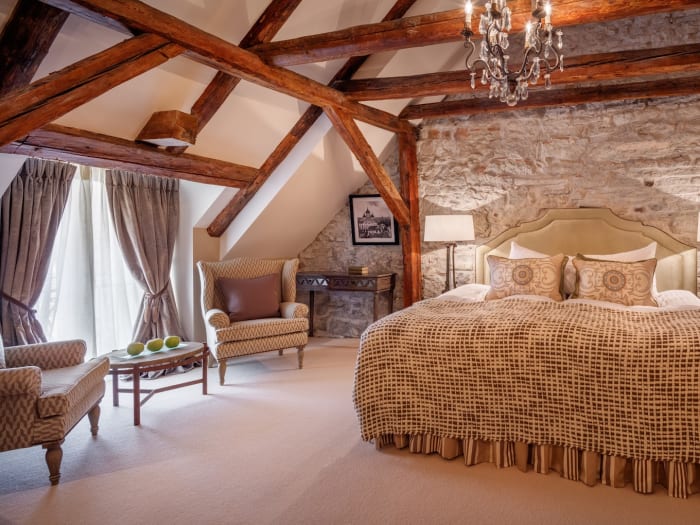
What stands out in an address of this kind is not monumentality but continuity. Thick walls, historic volumes, preserved details and the irregularities typical of medieval structures create an atmosphere that cannot be replicated. Schlossle Hotel follows this logic of careful preservation: it does not attempt to erase the building’s age, but rather to work with it. The preserved historic features contribute to this tactile reading of the place. They add depth to both the public spaces and the rooms, suggesting that luxury here lies as much in authenticity as in comfort.
Tallinn has one of the best-preserved old towns in Northern Europe, and this urban setting gives Schlossle Hotel particular resonance. It belongs to that category of hotels where one immediately understands why location matters as much as service. Step outside and the ancient layout of the city returns at once: narrow perspectives, church spires, discreet courtyards and squares that shift in mood with the time of day. Step back in and there is a sense of retreat, almost domestic in feel, which contrasts with the livelier flow of the most visited streets.
Its membership of Small Luxury Hotels of the World also helps define its positioning. The affiliation suggests less ostentation than a certain idea of high-end hospitality: smaller-scale houses rooted in their destination, where the experience depends as much on the character of the place as on the quality of the welcome. In the case of Schlossle Hotel, that membership feels entirely coherent with the spirit of the property. Guests come here less to tick off a spectacular address than to inhabit, for a few days, a refined and quietly atmospheric version of Tallinn.
The appeal of such a hotel ultimately lies in its ability to reconcile two demands that often pull in different directions: fidelity to heritage and the expectations of the modern traveller. A medieval building comes with constraints, yet here those constraints become part of the narrative richness. They remind guests that this is not an interchangeable hotel, but an address whose singularity is inseparable from its material history. For travellers drawn to places with memory, Schlossle Hotel offers exactly that: not a reconstruction, but a genuine sense of the past, made liveable through elegant and measured interpretation.
The property
Schlossle Hotel’s first strength is the immediacy with which it places guests in the historic heart of Tallinn. The address sits close to what is most distinctive about the Estonian capital: a dense old town best understood on foot, where monuments, historic houses, galleries and cafés unfold without the need for a rigid plan. For travellers who want to grasp the city through walking, the location is a decisive advantage. One can set out early, before day visitors arrive, and find the streets almost silent; return in mid-afternoon for a pause; then head out again in the evening when the cobbles soften in tone and the city regains an almost theatrical calm.
This centrality does not prevent a sense of shelter. It is one of the successful paradoxes of hotels set within historic urban fabric: they are central without feeling exposed. Schlossle Hotel cultivates that discreet refuge-like quality. The medieval building itself encourages a degree of withdrawal. Guests do not enter a property designed to impress through dramatic scale or overt staging, but rather a house of character, where human scale comes first and the atmosphere feels more hushed than demonstrative.
The public spaces appear to extend this idea of intimacy. After a day spent exploring churches, towers, squares and museums in the old town, it is especially welcome to return to an interior that does not compete with the city, but offers a calmer interpretation of it. As travellers often note, the décor favours comfortable elegance over disruptive luxury. That suits Tallinn particularly well, a city of subtle contrasts where medieval and contemporary, stone and timber, lively public space and enveloping interiors are in constant dialogue.
Schlossle Hotel will naturally appeal to couples seeking an atmospheric stay, but also to culturally minded travellers who want to make the most of their time in the city. Its proximity to the main sights allows guests to see a great deal without relying on a car. This matters in a city where the most rewarding experience is often pedestrian. The neighbourhood encourages intelligent wandering: one lane leads to a courtyard, a courtyard to an artisan shop, a shop to a square, then to a viewpoint or a church. Returning to the hotel between visits is therefore not a logistical interruption, but a natural extension of the stay.
The property also suits business travellers or short-stay guests because it combines centrality, service and character. A 24-hour front desk and 24-hour concierge provide the flexibility needed for late arrivals, early departures or changing schedules. In a heritage setting, that continuity of service becomes even more valuable: it allows guests to enjoy the charm of a historic address without giving up the practical standards expected of a five-star hotel.
In short, Schlossle Hotel is not merely well located. It turns its setting into a genuine hospitality language. It offers a way of inhabiting Tallinn from within the city’s own urban narrative, while preserving the distance, comfort and discretion expected from an upscale address. For travellers seeking an experience aligned with the spirit of the old town, this coherence between place, architecture and use makes all the difference.
Rooms and suites
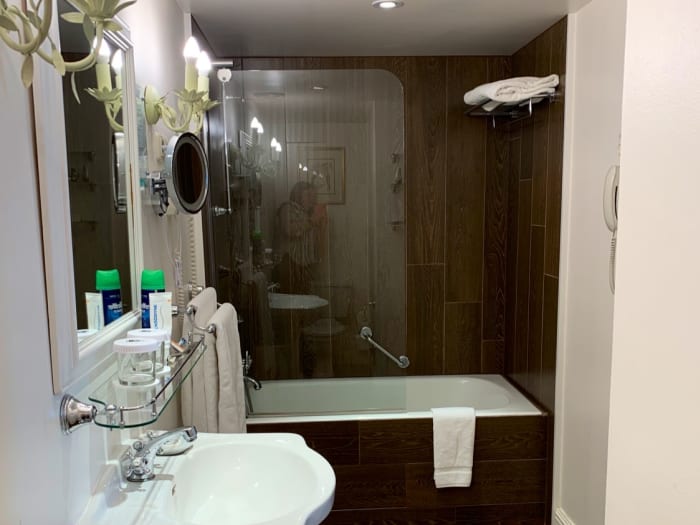
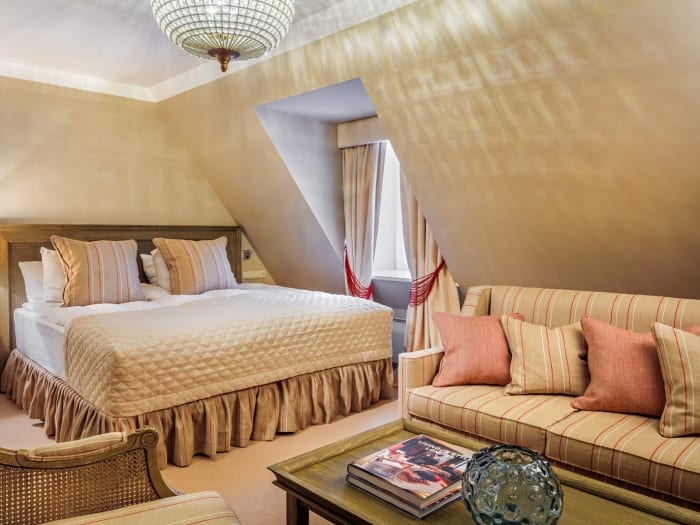
In a characterful hotel housed within a medieval building, rooms are rarely intended to feel identical. That is, in fact, a central part of their appeal. At Schlossle Hotel, one can reasonably expect volumes, sightlines and details to vary from one category to another, and sometimes from one room to the next, according to the historic configuration of the property. This diversity gives the stay a more personal tone than one finds in a large standardised hotel. It is a reminder that old architecture imposes its own drawing, with its angles, wall thicknesses, openings and rhythms.
The overall atmosphere appears to rest on a balance between classical refinement and contemporary comfort. In a house of this kind, luxury is expressed not through excess, but through the quality of the envelope and the sense of harmony. The preserved historic features play a decisive role here: they bring texture, depth and individuality, while still allowing the hotel to provide the comforts expected of a five-star address. It is precisely this coexistence of old and current that appeals to travellers seeking something more embodied than simply high-end accommodation.
The rooms at Schlossle Hotel seem designed to extend the sense of retreat already felt in the public spaces. After the cobbles, stairways, viewpoints and activity of the old town, guests return to an interior conducive to rest. Based on the available information, the décor favours warm elegance rather than museum-like austerity. This matters in a historic building: the mistake would be to freeze the design in an overly literal heritage approach. Here, the challenge is instead to make the age of the place felt while preserving genuine softness of use.
For couples, this atmosphere naturally contributes to the romantic dimension of the stay. Tallinn lends itself well to travelling as a pair, especially outside peak season, when the light drops lower, the streets empty earlier, and returning to the hotel becomes all the more welcome. In that context, a well-conceived room is not merely a place to sleep: it becomes a space for pausing, reading, talking and slowing down. Turndown service reinforces this idea of discreet, almost domestic attention, which often distinguishes the best small luxury houses.
Business travellers or guests on shorter stays will also find a real advantage here. A calm, well-kept room, combined with daily housekeeping, helps maintain a sense of order and continuity even within a tight schedule. Schlossle Hotel therefore seems to answer two different uses of travel: the immersive escape and the efficient stay. In both cases, the room plays a central role because it translates the hotel’s promise into lived reality: to experience heritage without giving up comfort.
When booking, it is wise to consider not only the chosen category but also the nature of an old building itself. Some travellers will seek authenticity above all; others may prioritise space or a simpler layout. This is exactly where personalised guidance becomes valuable. In a hotel like this, choosing the right room means refining one’s experience of the city. Guests are not simply reserving a number of square metres; they are selecting a way of inhabiting, for a few days, Tallinn’s history in a setting that is both polished and deeply individual.
Dining
The subject of dining at Schlossle Hotel is approached with a sense of balance. Nestled in the heart of the old town, the hotel embodies a way of life in Tallinn.
Dining here takes on a role of punctuation rather than mere display.
Breakfast often ranks among the most cherished moments of a stay. The setting and the rhythm it establishes contribute significantly to this.
Starting the day in a medieval building before venturing out to explore the ancient streets lends a unique coherence to the journey. One transitions from a historically rich interior to a city equally steeped in history.
For travellers mindful of the overall experience, this continuity is essential. A good heritage hotel does not compartmentalise moments.
Schlossle Hotel boasts a major advantage: its immediate proximity to key attractions. This also opens the door to a variety of restaurants, cafés, and local spots.
In Tallinn, one can alternate between structured meals, informal stops, and spontaneous discoveries. The hotel thus becomes a central hub.
It is a place from which to organise one’s days. Guests return here to rest. They can also seek advice based on the time, mood, or occasion.
For a romantic dinner, an afternoon break, or a final drink, the value of a good concierge service is paramount. The 24-hour concierge makes this proximity seamless.
In a destination where offerings vary with the season and crowds, being well-informed often makes a significant difference. The role of the hotel extends beyond mere nourishment.
The atmospheric dimension must also be considered. In a boutique establishment, the dining experience often extends the comfort.
Guests seek tranquillity, clarity, and consistency in service. After a day of sightseeing, many appreciate a calm setting that aligns with the spirit of the house.
This is particularly true in Tallinn, where variations in light and climate enhance the enjoyment of welcoming interiors.
Schlossle Hotel caters to travellers for whom dining is an integral part of the journey. The establishment favours an elegant and measured approach, in harmony with its architecture and location.
For those keen on local discoveries, the best use of the hotel is to combine the comforts of home with the exploration of the city. Each meal thus becomes a natural milestone of the stay.
Spa & wellness
The advice already associated with the hotel — to book a spa treatment after sightseeing — says something accurate about the way Schlossle Hotel can be experienced. Even without a detailed inventory of facilities, it is clear that wellness here serves a function of recovery, re-centring and slowing down. In a city such as Tallinn, travel is a physical experience: one walks extensively, often on cobbles, climbs towards viewpoints, moves through subtly varied terrain, and shifts between outdoor cold and indoor warmth depending on the season. In that context, a treatment is not a decorative extra; it becomes a genuine instrument of comfort.
Wellness in a heritage hotel is not necessarily conceived in the same way as in a large resort. The aim is not always to multiply facilities, but to offer a pause consistent with the spirit of the place. At Schlossle Hotel, one may reasonably imagine a more intimate, quieter approach, where the quality of attention matters as much as the technical protocol itself. That scale suits guests who choose the property for its character, discretion and relationship to time. After a full day in the old town, many travellers seek not stimulation but simple, deep unwinding.
A treatment then takes on an almost narrative role within the stay. It marks a transition between outside and inside, between the intensity of discovery and a return to oneself. For couples, it can become a distinct moment that adds another layer of breathing space to the trip. For solo or business travellers, it is often an efficient way to restore energy without leaving the hotel. In both cases, the value lies in its ability to rebalance the stay, especially when visits, meetings or movement follow one another closely.
Tallinn is particularly well suited to this alternation between cultural activity and retreat. The city has a strong visual density: walls, towers, churches, courtyards, rooftops, stairways and shifting perspectives. Even short stays can be rich in impressions. A wellness space or treatment service, however discreet, therefore has real value within the economy of the trip. It helps prevent accumulated fatigue from taking over and allows guests to enjoy the following hours more fully, whether that means dinner, an evening stroll or simply a quiet night in the room.
For interested travellers, the wisest approach is probably to plan ahead. In smaller-scale hotels, treatment slots may be more limited than in large urban properties. Booking in advance makes it possible to integrate this moment into the rhythm of the stay rather than trying to secure it at the last minute. This is especially relevant during busier periods, when the old town draws more visitors and the hotel operates at a more sustained pace.
Ultimately, wellness at Schlossle Hotel should be understood not as a spectacular promise, but as a subtle component of the overall experience. It extends the house’s central idea: to offer, in the middle of a dense historic environment, a refined refuge where one can both feel the city and withdraw from it. In that sense, a treatment after sightseeing is not merely pleasant; it is a particularly apt way of inhabiting Tallinn without rushing through it.
Concierge & Services
At the Schlossle Hotel, the quality of service is paramount, especially within such an intimate setting. Luxury boutique hotels stand out through the precision of their attention and the fluidity of daily gestures.
The Schlossle Hotel offers 24-hour concierge and reception services. Additionally, guests can enjoy daily room service, turndown service, luggage storage, laundry, wake-up calls, and a multilingual staff.
The round-the-clock reception provides invaluable flexibility. Late arrivals are not uncommon in Tallinn, and having a welcome available at any hour simplifies the organisation of one’s stay. This continuity is equally beneficial upon departure, whether for an early transfer or a business appointment.
The 24-hour concierge plays a central role in enhancing the experience. In a historic city, it assists in both organising and orienting one’s stay. Advising on an itinerary based on the weather, recommending a quieter time to visit, or suggesting a suitable restaurant all contribute to the overall experience.
The daily room service and turndown service extend this impression of continuous care. In a centrally located hotel, the room becomes a vibrant space. Returning to a tidied room, prepared for the night, enhances the sense of comfort.
Luggage storage and laundry services cater to very practical needs, proving useful for itinerant, extended, or business stays. The wake-up call service remains relevant for early departures.
Finally, the presence of multilingual staff facilitates communication. In an international capital like Tallinn, it streamlines requests and reinforces the feeling of being understood.
At the Schlossle Hotel, these services are less about ostentation and more about precision. They accompany the stay with discretion, in a manner consistent with the scale and history of the establishment.
The Tallinn way of life
Choosing Schlossle Hotel also means choosing a particular way of discovering Tallinn: not from its edges, but from its historic core. That position turns the stay into an immersive experience. The city then reveals itself less as a sequence of sights to tick off than as a set of rhythms, textures and lights. One quickly learns that Tallinn cannot be reduced to its medieval postcard image. Its old town is certainly remarkable for its preservation, but above all it remains alive through the uses that run through it: residents, cafés, cultural institutions, shops, passages, squares and viewpoints together form a city that is both heritage-rich and inhabited.
From the hotel, the local way of life is first discovered on foot. This is the best way to grasp the shifts in scale that give the Estonian capital its charm. A narrow lane opens onto a square; an ascent leads to a panorama; a discreet doorway reveals a courtyard; an austere façade may conceal a warm interior. Attentive travellers soon understand that Tallinn is read as much in details as in monuments. Stone textures, rooftops, signs, low seasonal light and the relative silence of certain alleys all contribute to a highly distinctive, almost tactile urban experience.
One of the privileges of a central hotel is the possibility of several visiting tempos. Guests can head out early to enjoy an old town still at rest, return to warm up or pause, then go out again towards evening when the atmosphere shifts. This freedom is valuable because Tallinn changes markedly according to the hour, the weather and the season. In winter, interiors become all the more important; in fairer weather, walks lengthen and terrace pauses feel more natural. In every case, having a base in the historic centre makes it easy to adapt one’s rhythm.
Schlossle Hotel particularly suits those who enjoy cities of readable scale, where heritage, culture and wandering can be combined. Proximity to the main sights makes churches, museums, towers and emblematic squares easy to reach, but the real interest of the stay also lies in what was not planned: a shop noticed at the turn of a street, a café chosen for its quietness, a courtyard crossed by chance, a viewpoint discovered by climbing a few more steps. It is often in this element of openness that the truest memory of Tallinn is formed.
The address can also serve as a base from which to understand the dialogue between old and new that characterises the city. Tallinn is not frozen in its past; it combines medieval heritage, Nordic culture, digital habits and a creative scene. Returning in the evening to a hotel set within a medieval building sharpens that reading further. One better understands what makes the city distinctive: an ability to preserve without turning into a museum, to modernise without erasing.
For couples, this atmosphere naturally encourages a discreet form of romance, far from cliché. For history lovers, it offers an exceptional field of observation. For business travellers, it lends real density to a short stay. In every case, Schlossle Hotel acts as a destination revealer. It does not merely accommodate; it places the traveller in the right conditions to feel Tallinn from within.
That is perhaps its most lasting quality: to offer not only somewhere to sleep, but a setting from which the city becomes more legible, more sensory and more memorable.
Book with MyConciergeHotel
Booking Schlossle Hotel with MyConciergeHotel makes particular sense because this is not an interchangeable address. In a hotel set within a medieval building in the historic heart of Tallinn, the experience depends on nuances that often escape a purely automatic booking: the room type best suited to one’s way of travelling, the value of a longer stay in order to enjoy the city at different times of day, the relevance of planning a wellness treatment, or the advantage of arranging practical services in advance. This is where editorial and concierge guidance becomes especially valuable.
The point is not merely to secure a room, but to book well. For some travellers, the priority will be romantic atmosphere and the charm of a heritage hotel. For others, it will be the smoothness of a cultural stay with everything within walking distance. Others still may seek an elegant, central base for a business trip. Schlossle Hotel can answer these varied profiles, though not necessarily in the same way depending on season, length of stay or comfort expectations. Receiving advice beforehand helps refine the choice and avoid approximation.
Tallinn is a destination that benefits from being thought through in terms of rhythm. A stay of two or three nights, for instance, is not experienced in the same way as a simple stopover. The old town changes according to the hour; the real advantage of a central hotel lies precisely in the possibility of exploring it early in the morning, pausing during the day, then heading out again in the evening. Booking through MyConciergeHotel makes it possible to shape that tempo more coherently: arrival, departure, free time, neighbourhood recommendations and moments of relaxation can all be considered as part of a whole rather than as a mere sum of services.
This guidance is equally useful in making the hotel’s services work to their full advantage. A 24-hour concierge, 24-hour front desk, luggage storage, laundry and turndown service matter differently according to the traveller’s profile. A couple on a city break will not have the same needs as a business traveller or someone on a multi-stop Northern European itinerary. MyConciergeHotel’s role is precisely to translate these details into concrete benefits, so that the chosen address genuinely matches the intended use.
In a house that belongs to Small Luxury Hotels of the World, the promise rests on character, intimacy and quality of welcome. These are dimensions particularly well suited to an accompanied booking process. Guests are not simply choosing a hotel category; they are choosing an atmosphere, a scale and a relationship to the city. Schlossle Hotel appeals to travellers who prefer depth to effect, coherence to display. Booking it in that spirit, with the right guidance, allows them to draw the best from it.
In practical terms, booking through MyConciergeHotel means benefiting from a specialised editorial perspective on characterful hospitality and decision support grounded in the real use of the stay. In Tallinn, that means turning a fine address into a well-calibrated experience: a historic hotel from which to live the old town from within, without giving up comfort, service or flexibility. And it is often that degree of precision that makes the difference between a good trip and a truly memorable stay.