History & heritage
In Vaduz, where the scale of the country encourages a more intimate reading of place, Park Hotel Sonnenhof belongs to a tradition of hospitality shaped by restraint, discretion and close attention to setting. Its membership of Relais & Châteaux offers an immediate clue: the experience here is not built on display, but on a certain idea of the characterful house, rooted in its landscape and in local rhythm. In a capital of modest proportions, where institutions, museums and vineyards sit only minutes apart, the hotel occupies a distinctive position, close to the centre yet slightly set back in a quieter environment.
The Sonnenhof’s heritage is first expressed in the way it combines the spirit of an independent hotel with the codes of a European five-star address. It has the qualities seasoned travellers seek in fine Alpine and Rhine Valley properties: personalised hospitality, spaces designed to endure, and a constant dialogue with light and landscape. The carefully kept garden, the views of the surrounding mountains and the sense of air and openness all contribute to an identity that is subtle rather than showy. This is not a hotel that tries to impress at every turn; it is one that establishes, from arrival, a feeling of calm confidence.
That impression is reinforced by the scale of Vaduz itself. As the political capital of Liechtenstein, the town has none of the saturation of a large metropolis. It is discovered on foot, in gentle sequences: a quiet street, a museum, a view across the slopes, an official building, then once again the mountains in the background. In that context, Park Hotel Sonnenhof feels like an address that understands its environment perfectly. It does not attempt to detach itself from it; it interprets it. Its place within a collection of characterful houses, its cuisine attentive to local produce and its peaceful atmosphere all follow the same logic: to make the guest feel they are staying here, not in an interchangeable hotel.
The notion of heritage also lies in the continuity of a certain art of receiving. In truly accomplished properties, luxury is not merely a list of facilities; it resides in the coherence between place, service and the tempo of a stay. Sonnenhof appears to belong to that category. The personalised service noted by guests, the care given to detail, the quality of the shared spaces and the upkeep of the gardens all suggest a house culture rather than a simple operational standard. That matters especially in a destination such as Liechtenstein, where visitors often come in search of something rarer, more confidential and less demonstrative than in other European capitals.
To stay here is therefore to enter a refined Central European style of hospitality, where comfort is accompanied by a sensitive relationship with landscape and season. Summer opens up terraces, walks and excursions towards the nearby heights; winter draws one closer to interiors, lower light and escapes to ski areas within easy reach. Between those two poles, the hotel retains an essential quality: that of being an address of continuity, equally suited to a short cultural break or a longer restorative pause. In a country where everything seems within reach, Park Hotel Sonnenhof reminds one that a great hotel is not simply a base, but a place that gives tone to the journey.
The Establishment
The foremost luxury of the Park Hotel Sonnenhof may well be its location. Situated in Vaduz, the capital of Liechtenstein, the hotel combines tranquillity, meticulously maintained gardens, and breathtaking mountain views. Cultural landmarks in the city are easily accessible, yet the address retains a genuine sense of seclusion. The silence, light, and changing landscapes provide a unique rhythm to one’s stay.
The establishment fully capitalises on this advantageous position. Elegant communal spaces seamlessly extend into the gardens and views, inviting guests to enjoy a coffee, read, or take a break between visits. The Sonnenhof thus cultivates a fluid and comfortable experience.
The peaceful setting influences the way guests experience the hotel. Couples find a backdrop conducive to intimacy, while solo travellers appreciate the rare serenity found in a capital city. The garden enhances the experience, allowing guests to start their day outdoors, read in solitude, or observe the play of light on the mountains.
As a member of Relais & Châteaux, the hotel embodies a certain standard of excellence. Here, one expects sustainable materials, harmonious proportions, and an atmosphere that withstands the test of time. In Vaduz, this quality is particularly meaningful. The hotel serves as both a vantage point over the city and a refuge after a day of exploration.
The charm of the Sonnenhof lies in its discreet versatility. It is suitable for a romantic getaway, a cultural escape, a stop on an alpine itinerary, or a few days of relaxation. In summer, outdoor activities enrich the stay, while in winter, nearby ski resorts naturally extend the journey. The hotel remains a flexible anchor, allowing each guest to set their own pace.
Rooms and Suites
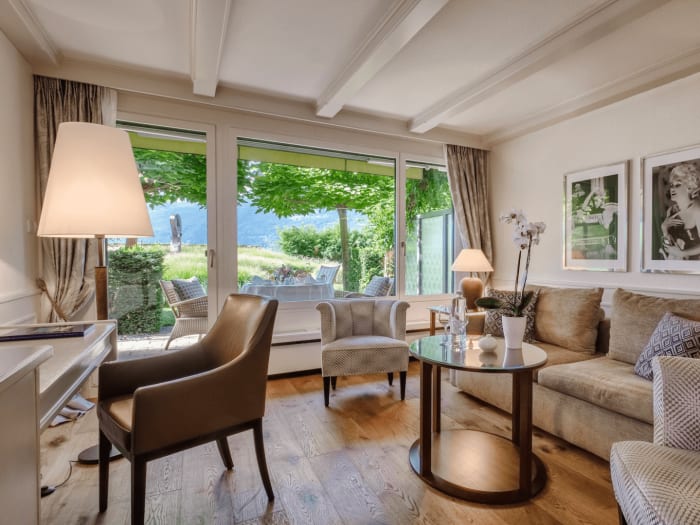
At the Park Hotel Sonnenhof, the rooms and suites extend a particular vision of a stay characterised by calm, light, and discreet attention.
In this Relais & Châteaux property, set in a peaceful environment and renowned for its personalised service, the accommodation prioritises coherence with the overall experience. Genuine comfort, a carefully curated atmosphere, a connection to the landscape or garden, and a sense of being welcomed into a thoughtfully designed space for longevity.
The view plays a significant role here. The surrounding mountains become an integral part of the experience. In the morning, they add depth to the awakening. At the end of the day, they naturally accompany the return to the hotel. This visual relationship with Vaduz and the surrounding terrain contributes to the uniqueness of the experience.
Comfort is less about effect and more about precision. Good bedding, smooth circulation, pleasant materials, well-designed bathrooms, and impeccable maintenance. The turn-down service reinforces this attention to the rhythm of the stay. The daily housekeeping extends this impression of freshness, without being intrusive.
For couples, the appeal of a room at the Sonnenhof lies in this combination of refinement and tranquillity. The overall ambiance suggests a contained elegance, conducive to stays where one seeks to slow down. For solo travellers, this quality takes on another form: that of an orderly cocoon, ideal for reading, writing, or contemplating the landscape.
The suites add a residential dimension, offering more space and a clearer separation between different aspects of the stay. At the Park Hotel Sonnenhof, the spirit of the place calls for accommodations designed as refined retreats. The ideal room allows for silence, quality sleep, and the presence of the landscape. In Liechtenstein, this controlled simplicity gives luxury a particularly authentic expression.
Dining
Gastronomy plays a significant role in the experience at Park Hotel Sonnenhof. The cuisine highlights local produce, making it wise to reserve a table upon arrival.
The restaurant serves as one of the focal points of the stay. In Liechtenstein, this emphasis on local ingredients takes on a particular significance, reflecting the territory on the plate, influenced by the changing seasons and neighbouring culinary traditions.
In Vaduz, dinner can become a true highlight of the day. After visiting museums, exploring the city, or embarking on an excursion, returning to the hotel for dinner naturally extends the day. The dining experience prioritises precision, the quality of ingredients, and a measured service.
The restaurant seems to attract guests beyond just hotel residents, often a sign of a venue with its own distinct character.
The focus on local products creates a clear culinary narrative. In this region influenced by Alpine, Swiss, Austrian, and Rhenish traditions, the cuisine finds a rich ground for expression. The essence lies in a faithful interpretation of the territory, supported by skilled execution.
The setting also matters. In this hotel renowned for its well-maintained gardens and stunning mountain views, the dining area benefits from an environment that complements the experience. Enjoy a bright lunch, a dinner with a view of the landscape, or a peaceful breakfast: the location enhances the meal.
For the traveller, the comfort is palpable. There is no need to leave the hotel to enjoy a genuine dining experience. In a destination focused on tranquillity, this is a significant advantage.
Concierge & services
The most convincing luxury is often the kind one barely notices. At Park Hotel Sonnenhof, the list of known services outlines precisely that form of discreet efficiency which turns a good stay into a fluid experience. A 24-hour front desk, 24-hour concierge, daily housekeeping, turndown service, luggage storage, laundry, wake-up service and multilingual staff: taken separately, these are expected features of a five-star hotel; taken together, they describe an organisation designed to accompany the traveller at every stage without visible rigidity.
The presence of a concierge available at all hours is particularly valuable in a destination such as Vaduz. Liechtenstein attracts varied visitors: couples on a short break, solo travellers, culture-minded guests, those passing through on an Alpine itinerary, and business travellers in search of a calmer setting. Not all have the same needs or the same rhythm. An effective concierge makes it possible to adjust the stay accordingly: arranging transport, suggesting a route through town, facilitating a reservation, or advising on the best moment for a visit or walk. In a compact country, where much appears close at hand, the real added value lies not in distance but in the relevance of the advice.
Multilingual staff contribute to that quality of welcome. In an international hotel, especially in a capital city, the ability to understand the expectations of a diverse clientele goes beyond translation. It requires listening, flexibility and a tactful way of reframing needs. This is often where the difference lies between service that is merely correct and service that is genuinely hospitable. Sonnenhof, appreciated for its personalised approach, seems to belong to the latter category: houses where one does not simply execute, but accompanies.
Room-related services reinforce this sense of continuity. Daily housekeeping and turndown maintain a stable level of comfort, almost invisible because it feels so natural when well done. Laundry, luggage storage and wake-up calls may appear secondary on paper; in the reality of travel, they matter greatly. They allow one to travel lighter, manage an early arrival or late departure, and keep to a schedule without unnecessary friction. Great hotel service is often measured by its ability to absorb small constraints before they become noticeable.
It is also worth noting that in a house with a peaceful atmosphere, the quality of service depends on proportion. Too much presence becomes intrusive; too much distance creates coldness. The desired balance is one of constant availability without weight. That matters especially for travellers who come here seeking calm, discretion and a degree of retreat. Park Hotel Sonnenhof appears to understand that expectation. Its services are not intended to overload the stay with options, but to make it simpler, more flexible and more comfortable.
Ultimately, concierge and service form the silent structure of the experience. They allow the hotel to fulfil its main promise: to offer in Vaduz a refined, serene and attentive address where one feels looked after without ever losing one’s freedom. In the world of contemporary luxury, that intelligence of service remains one of the surest markers of houses that endure.
The Art of Living in Vaduz
Staying at the Park Hotel Sonnenhof also means discovering a European capital that defies conventional formats. Vaduz is neither a large museum-like city nor a frenetic urban centre. It is a small-scale capital, comprehensible and calm. One can swiftly transition from institutions to nature, from culture to landscape.
This uniqueness alters the way one travels. People do not come here to accumulate addresses; they come to walk, observe, visit, return, dine, and then start again. The Sonnenhof, with its location and atmosphere, aligns perfectly with this rhythm.
The local art of living is primarily about proximity. From the hotel, Vaduz can be explored at a leisurely pace. Museums, institutional architecture, views of the princely castle above the city, and the presence of vineyards in the landscape all contribute to an experience where culture remains intertwined with the natural setting. Even during a visit, one’s gaze returns to the hills, mountains, and light over the valley.
This relationship with the landscape also explains the importance of the seasons. Summer is particularly suited to outdoor activities. The fine weather encourages guests to extend their time outdoors—strolling, embarking on excursions, enjoying terrace breaks, and exploring routes to nearby elevations. Travel becomes more mobile without sacrificing the comfort of a refined base.
In winter, the tone shifts without losing its essence. Winter sports enthusiasts find nearby ski resorts. The Sonnenhof then offers a return to calm after these outdoor adventures.
Vaduz also cultivates a form of luxury tied to rarity. Few European capitals offer such security, clarity, and proximity to the mountains. The stay takes on a confidential tone, revealing a place preserved from the heaviest tourist automatism.
This does not exclude sophistication. Refinement is evident in the quality of cultural institutions, the care given to public spaces, and the relationship with wine, gastronomy, and landscape. It is an art of living without ostentation, yet not without demands.
In this context, the Park Hotel Sonnenhof acts as an interpreter of the territory. It allows one to experience Vaduz not merely as a stopover but as a destination in its own right. Here, one finds the charm of well-maintained small capitals. Everything can be done at one’s own pace, varying pleasures without distraction, while maintaining a sense of mastery. Vaduz does not seek to impress through excess; it convinces through its authenticity. The Sonnenhof provides a particularly accurate interpretation of this.
Booking via MyConciergeHotel
Booking the Park Hotel Sonnenhof through MyConciergeHotel means choosing a travel approach that prioritises relevance over mere transaction. An address like this cannot be reduced to a price, a room category, or a list of amenities. Its appeal lies in finer balances: the right time according to the type of stay sought, the importance of a well-located room, the opportunity to reserve a table at the hotel in advance, and the way to weave together the discovery of Vaduz, relaxation time, and excursions in the region.
The summer season is particularly suited to outdoor activities, while winter opens the door to nearby ski resorts. These two periods do not imply the same use of the hotel. In summer, one enjoys the gardens, the light, and the walks more fully. In winter, the comfort of returning, the quality of the dining experience, and the serenity of the indoor spaces are highlighted. It is therefore advisable to first define the intention of the stay: a romantic interlude, a cultural escape, an alpine stopover, or a solo journey focused on calm and gastronomy.
Another essential point concerns the restaurant. It is advisable to reserve a table as soon as one arrives, or even in advance when possible. In a hotel where the cuisine highlighting local produce is one of the major attractions, it would be a shame to leave this moment to chance. Anticipating allows for a more harmonious structuring of the stay.
The Park Hotel Sonnenhof is particularly suited to couples and solo travellers. It can also appeal to guests seeking a discreet luxury, away from the main tourist circuits. This address is not chosen for constant entertainment or garish decor; it is chosen for its tranquillity, its views, its personalised service, its affiliation with Relais & Châteaux, and its ability to make Vaduz a destination in its own right.
For the Park Hotel Sonnenhof, the essentials can be summarised in a few simple guidelines: choose the right season, reserve a table, allow time to enjoy the setting, and approach Vaduz with curiosity.