History & sense of place
More than a high-end safari camp, ol Donyo Lodge belongs to a very particular idea of African travel: a discreet retreat deeply tied to its landscape, where luxury is measured less by display than by the quality of experience. Set in the Chyulu Hills, between the great plains of southern Kenya and horizons shaped by Kilimanjaro, the lodge reflects a model of hospitality that brings together refined comfort, wildlife conservation and a closer relationship with local communities.
The setting says much about its identity. The Chyulu Hills hold a singular place in East Africa’s geography and imagination: volcanic ridges, old lava flows, open grasslands and denser woodland at the edge of ecosystems used by elephants and other iconic species. In such a transitional landscape, ol Donyo Lodge feels conceived not as an object placed upon nature, but as an address that follows its contours, materials and rhythms.
Its Relais & Châteaux affiliation also helps define the spirit of the house. It suggests a certain standard in hospitality, dining and service, but also an emphasis on individuality and sense of place. Here, that individuality lies in the balance between intimacy and vastness. Guests come for the rare feeling of almost limitless space, paired with attentive, warm and highly polished hosting.
The lodge’s deeper legacy is also tied to local sustainability. In a region where wildlife corridors, careful resource use and cooperation with surrounding communities matter profoundly, staying here carries a meaning beyond leisure. The guest is not merely observing an exceptional landscape, but entering, for a few days, a form of hospitality that seeks to protect what makes that landscape possible.
The lodge in the Chyulu Hills
Staying at ol Donyo Lodge means choosing an Africa of space, light and silence. Its position in the Chyulu Hills, close to Amboseli National Park, gives the experience a very different tone from lodges set within busier safari circuits. Here, the landscape seems to stretch endlessly in every direction. Rolling hills, open savannah, scattered trees, dusty tracks and, when conditions allow, distant views towards Kilimanjaro create a setting of remarkable visual power.
This location shapes the atmosphere of the house. The lodge favours a rare sense of intimacy. Guests do not come here for constant activity, but to inhabit the landscape fully. Shared spaces are conceived as comfortable vantage points over the bush: open terraces, restful lounges and dining areas that remain connected to the outdoors.
Its proximity to Amboseli is another important asset. Without attempting to replicate the experience of a national park, ol Donyo Lodge offers access to a territory where wildlife, scenery and human presence are closely intertwined. That nuance matters. Guests encounter not only animals, but a lived-in geography shaped by long-standing balances between conservation, movement and local life.
The lodge particularly suits travellers seeking retreat: honeymooners, photographers, families drawn to an educational stay in nature, or solo guests in search of disconnection. The rhythm is not imposed; it unfolds through dawn departures, late-afternoon returns, quiet interludes and conversations with the team. In that sense, the lodge is not merely a base for exploration, but a destination in its own right.
Suites, privacy and immersion
At a lodge of this kind, the room is never merely a place to sleep between game drives. It extends the landscape experience and plays a central role in the feeling of retreat that guests seek. At ol Donyo Lodge, accommodation appears to be shaped around three essential ideas: space, privacy and openness to the outdoors.
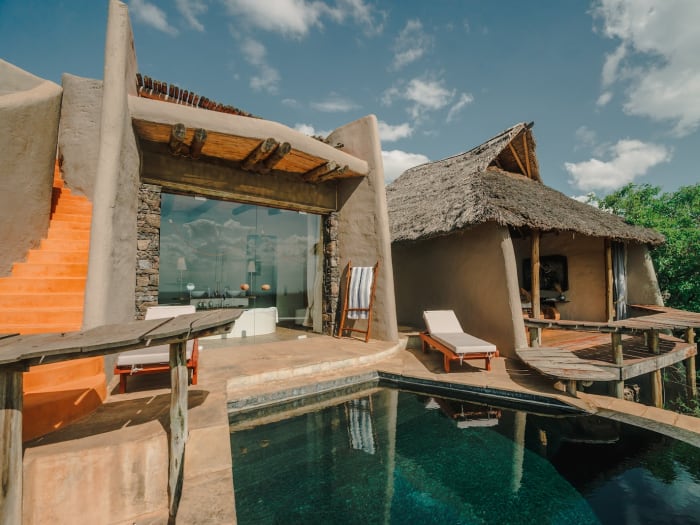
The first luxury is distance. In a property of this sort, suites or villas are not lived in through proximity to others, but through a more personal relationship with the land. Guests return via discreet pathways to a terrace, sitting area or resting space that seems suspended between architecture and wilderness.
The decorative language is generally one of restrained elegance: natural materials, earthy or mineral tones, comfortable furnishings without excess, and artisanal touches that acknowledge East Africa without becoming theatrical. The aim is not to distract the eye, but to allow the landscape to remain central.
For couples, this creates a deeply romantic setting. For families, it balances adventure with comfort. For solo travellers, it offers something increasingly rare: the luxury of chosen solitude, softened by attentive and discreet service. Daily housekeeping and evening preparation further reinforce the sense of ease, allowing guests to focus on what matters most: rest, observation and immersion.
Dining, between hospitality and landscape
In the world of high-end safari travel, dining matters more than one might first assume. It is not merely an amenity; it shapes the day, supports early departures, marks the return from excursions and creates the convivial moments that give a stay its emotional texture. At ol Donyo Lodge, the culinary experience appears to follow that rhythm and context.
Guests do not come here for a detached gastronomic performance, but for thoughtful, well-executed cuisine suited to life in the bush and served in settings where the landscape remains ever-present. Mornings call for clarity and energy; lunches often feel more relaxed; dinners take on a more ceremonial tone as the light fades and stories of the day are exchanged.
What matters in a lodge of this calibre is not excessive complexity, but precision: good timing, attentive service, balanced flavours and the ability to adapt to guests’ preferences. The possibility of varied dining settings also contributes greatly to the sense of travel, preventing repetition and deepening the impression of a stay considered in detail.
Ultimately, dining here is part of the lodge’s wider hospitality. It is where warmth of service, memory of preferences and sensitivity to each guest’s pace become most visible. In such a dramatic environment, the table must remain elegant without competing with the landscape.
Concierge, guidance and daily life at the lodge
The experience of a remote lodge depends as much on the quality of support as on the beauty of its setting. At ol Donyo Lodge, the known services suggest a house organised to make the stay feel effortless despite its relative distance from major urban centres. A 24-hour concierge and front desk are especially valuable in safari travel, where schedules may shift, departures are often early and returns depend on sightings or conditions in the field.
This availability matters first in planning. Safaris, hikes and cultural visits benefit from careful organisation, not only for practical reasons but because they shape the quality of the entire stay. A good concierge does more than take requests; it helps guests build a rhythm, balancing exploration with rest.
Daily housekeeping, turndown service, laundry, luggage storage and wake-up calls all contribute to a sense of ease. In an environment where one leaves early, returns dusty and moves through changing temperatures, such attentions have real value. They allow guests to travel lightly and focus on what matters.
The true luxury here is not an excess of options, but precision of service: a well-timed departure, a room quietly restored, a useful recommendation, a day that unfolds naturally. In a wilderness lodge, hospitality should remain discreet. It does not interrupt the landscape experience; it makes it possible.
The way of life of the Chyulu Hills and Amboseli
To speak of a way of life in the Chyulu Hills may seem paradoxical if one associates the term only with urban pleasures. Yet at a place like ol Donyo Lodge, there is indeed a way of living well; it simply takes another form, more elemental, more sensory and more closely tied to the long rhythm of the landscape.
The region encourages this quality of attention. Nature here is not a passive backdrop. It sets the pace, the distances and the silences. Guests quickly learn to slow down: rising before dawn, heading out while the air is still cool, resting at midday, then returning to the field as the light softens. One no longer consumes activities, but enters a cadence.
Cultural visits add depth by reminding travellers that these landscapes are not empty. They are shaped by histories, practices and long relationships between people, livestock and land. Luxury, in that sense, becomes more intelligent: not an escape from the territory, but a more respectful and meaningful access to it.
There is also an evening way of life particular to the African wilderness. As night falls, sounds shift, conversations soften and the sky becomes a spectacle in itself. In a well-conceived lodge, these hours matter as much as the game drives. They often become the memories that endure.
Booking ol Donyo Lodge with MyConciergeHotel
Booking a stay at ol Donyo Lodge is not simply a matter of choosing a room in an attractive property; it means shaping a nature-led journey that benefits from thoughtful planning. The destination, safari rhythm, seasonal conditions and variety of traveller profiles all make guidance especially valuable. Through MyConciergeHotel, the value lies not only in the booking itself, but in turning a broad desire — to experience the savannah, stay in a characterful lodge and explore the Chyulu Hills near Amboseli — into a coherent and well-paced stay.
The first point to consider is tempo. Some guests will want ol Donyo Lodge to be the sole focus of their trip, allowing for deeper immersion and a slower rhythm. Others may include it within a wider Kenyan itinerary. In both cases, a well-managed reservation takes into account transfers, arrival times, long-haul fatigue and the balance between activity and rest.
It is also wise to plan activities in advance. Safaris, hikes and cultural visits are central to the experience, and their organisation directly affects the quality of time on site. Advance booking helps shape each day according to interests while preserving moments of pause.
Booking with MyConciergeHotel also provides an editorial and practical understanding of the property: who it suits best, what kind of atmosphere to expect, and how to approach the stay with the right expectations. That alignment is often what turns a good trip into a memorable one.