History & camp spirit
Mara Plains Camp belongs to a safari tradition that values immersion over spectacle. Luxury here is not about display, but about attentive engagement with the landscape, time given over to observation, and a level of comfort that never distracts from the savannah. The camp reflects a more contemporary generation of high-end wilderness lodges, where conservation and environmental responsibility are not decorative themes but part of the very logic of the stay.
Its identity lies in balance. The familiar codes of East African safari are all present — generous tented accommodation, wide views, thoughtful service, days shaped by light and wildlife movement — yet they are interpreted with restraint. Guests experience the classic rhythm of the bush: early departures, long sightings, midday pause, and evening drives under changing skies. What distinguishes the camp is the way this structure is paired with a clear awareness of ecological fragility and of the need to travel through such places with care.
Its membership of The Leading Hotels of the World also signals a certain standard: polished hospitality, consistency, and attention to detail. But Mara Plains Camp does not feel like an urban luxury hotel transplanted into the wild. It remains rooted in its environment, allowing nature to remain the principal focus.
Within the wider context of the Masai Mara — one of Africa’s most recognisable safari landscapes — the camp offers a more intimate reading of place. It does not compete with the reserve through architectural bravado; instead, it settles into the land with discretion, creating a dialogue between hospitality, wildlife viewing and respect for the environment.
Its heritage, then, is less about a single date or grand origin story than about a particular philosophy of travel in East Africa: one in which elegance is measured by the relevance of the setting, the quality of silence, the intelligence of service and the ability to reveal, without artifice, the richness of the natural world.
The camp, in the heart of the Masai Mara
A stay at Mara Plains Camp begins with the understanding that place will dictate the rhythm of the journey. Set in the heart of the Masai Mara, the camp opens onto a landscape that seems perpetually in motion: grasses shifting in the wind, acacia silhouettes, antelope crossing the plains, giraffes in the distance, birds moving overhead. It is a setting that creates immediate immersion. Guests do not come here simply to withdraw from ordinary life; they come to enter another system of attention, one shaped by light, sound, tracks and distance.
The Masai Mara remains one of East Africa’s defining safari landscapes, and with reason. Its wildlife density, open terrain and sense of scale make it especially rewarding for observation. From the camp, the outdoors is never secondary. The eye travels far, weather changes alter the mood of the plains, and each hour of the day redraws the scene. Dawn brings cooler, silvery tones; midday flattens the land under hard light; evening restores depth and softness. This natural drama gives the stay much of its emotional force.
Part of the camp’s appeal lies in how it mediates between wilderness and comfort. After game drives, guests return to a stable, carefully considered base that allows for rest without severing the connection to the landscape. In a property of this kind, continuity matters: the camp must extend the Mara rather than contradict it. Shared spaces, mealtimes and quiet intervals between excursions all contribute to that sense of ongoing contact with the natural world.
Its relative remoteness is central to the experience. Access may require specific logistics and a four-wheel-drive transfer, yet that very distance protects the feeling of being elsewhere. This is not a destination for endless ancillary entertainment; it is a place to inhabit the territory itself. Couples will find emotional intensity, wildlife enthusiasts a privileged base for observation, and seasoned travellers a more essential interpretation of luxury.
What matters most is that the camp does not merely occupy an exceptional site; it assumes responsibility towards it. In an ecosystem as sensitive as this, location, use and local relationship matter as much as the view. That is what gives Mara Plains Camp its coherence: it does not attempt to dominate the Masai Mara, but to belong to it intelligently.
Spacious tents, measured comfort
At Mara Plains Camp, accommodation takes the form of spacious tents with refined comfort, in keeping with the classic safari tradition yet without theatrical excess. In East Africa, a tent is not a compromise; it is often the most appropriate way to remain close to the landscape. It creates a particular permeability between indoors and outdoors, between shelter and exposure, privacy and constant awareness of the world beyond. When thoughtfully designed, it can offer a richer experience than a room sealed off from its setting.
The key word is restraint. Comfort is clearly present, but it never overwhelms the place. Guests can expect generous proportions, welcoming bedding, room to unpack, read and recover after excursions, and a bathroom conceived to meet the expectations of a high-end stay. Daily housekeeping and turndown service reinforce that sense of discreet care which matters so much in a camp of this calibre. Returning from a drive to a refreshed tent, a calm atmosphere and the feeling that needs have been anticipated is part of the experience.
A successful safari interior should remain connected to context. Materials, tones and objects ought not to compete with the savannah but to accompany it. Natural colours, travel-inspired textures and details that evoke East Africa or local craft make more sense here than overly abstract design. Elegance lies in coherence: a space that speaks of the bush without caricature, that embraces refinement while allowing the landscape to remain central.
This style of accommodation also changes the experience of sleep and listening. At night, one is never entirely cut off from the outdoors. Sounds travel differently, air moves differently, and the sense of being settled within a living environment gives the stay unusual intensity. For many travellers, this becomes one of the camp’s most lasting memories.
The tents are particularly well suited to couples and travellers seeking authenticity because they enable a more essential form of luxury. There is enough comfort to feel fully looked after, and enough simplicity to remain true to the territory. In a hotel world often drawn to excess, Mara Plains Camp suggests a subtler equation: space, silence, precise service and the continuous presence of the landscape.
Dining, between safari rhythm and hospitality
In a safari camp, dining is never merely an ancillary service. It structures the day, supports early departures, marks the return from long hours of wildlife viewing and contributes to the reassuring sense of being cared for in a remote setting. At Mara Plains Camp, guests come first for the Masai Mara, yet the culinary experience matters because it gives the stay its daily rhythm, comfort and conviviality. Luxury here is not about disconnected gastronomic performance, but about timing, quality and suitability to safari life.
Days begin early, which calls for flexibility. A camp of this level understands how to respond: hot drinks before departure, breakfast at changing hours, lunch adapted to the day’s programme, and dinner as the evening’s gathering point. This rhythm is essential. It allows guests to engage fully with the drives without feeling burdened by logistics. After hours out in the bush, returning to a welcoming table is part of the pleasure.
Setting matters as much as the food itself. In the savannah, a meal gains depth when it remains connected to the landscape: an open terrace, a dining space that admits air and light, a softly lit dinner after sunset, a quiet breakfast at first light. Even without theatrical flourishes, such moments become memorable because they extend the relationship with the outdoors.
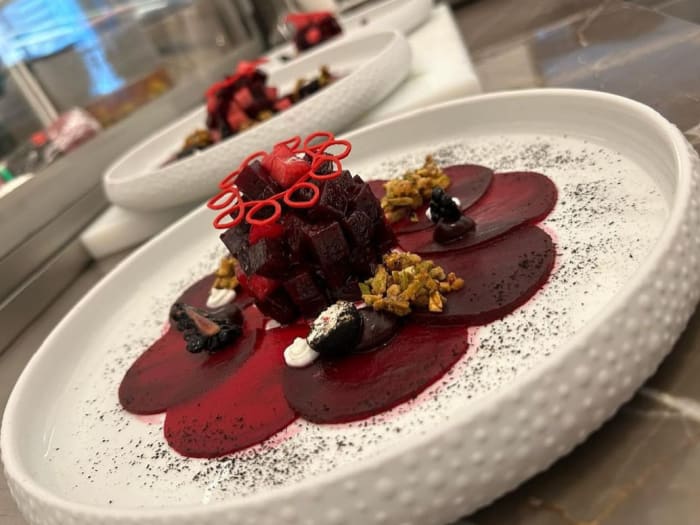
Within this context, the cuisine should above all be clear, generous, well executed and responsive to an international clientele. One expects attention to freshness, variety and individual preferences, as well as the ability to adapt service to the safari schedule. True refinement often lies in precisely that: meals that feel right, neither heavy nor overworked, served with warmth and precision.
Dining is also a place of storytelling. It is often over meals that the day’s sightings are revisited, guides interpret what was seen on the plains, and travellers compare impressions or photographs. Dinner becomes more than a meal; it becomes a second reading of the safari itself.
In that sense, the table is fully part of the camp’s identity. It does not need to overstate its ambitions. In a setting this powerful, what matters most is a cuisine and service capable of accompanying the journey with intelligence, consistency and genuine hospitality.
Concierge, support and stay logistics
One of the defining strengths of an upscale camp in a remote setting is its ability to make simple what is, in reality, logistically complex. Mara Plains Camp offers the expected fundamentals of a five-star address — 24-hour concierge, 24-hour front desk, daily housekeeping, turndown service, luggage storage, laundry, wake-up service and multilingual staff — yet the real value lies not in the list itself, but in the way these services support the safari experience without weighing it down.
Time in the Masai Mara does not follow the pattern of an urban stay. Departures are early, returns vary according to sightings, weather and wildlife movement, and guests’ needs shift from one day to the next. Service therefore needs to be flexible, responsive and exact. A wake-up call, for instance, is not a trivial detail; it may determine the quality of the morning drive. Laundry after a dusty day, luggage management between travel stages and the quiet preparation of the tent all contribute to the overall smoothness of the stay.
The concierge has a particularly important role here. In a safari camp, it is not merely about arranging reservations or transfers. It becomes a point of coordination between guest expectations, field realities and the camp’s own rhythm. Advising on timing, helping prepare excursions, anticipating preferences and responding to practical requests in a remote environment all take on greater significance. This kind of support reassures first-time safari travellers while also meeting the expectations of experienced guests who value seamless execution.
Multilingual staff further enhance the sense of well-managed hospitality. In an international setting, clarity matters — whether explaining the day’s schedule, answering a specific request or simply making the relationship with guests feel more natural. Luxury in a camp like this is often measured by quality of presence: a team that is available, attentive and warm without becoming intrusive.
Most importantly, service here protects time. It allows guests to devote themselves to what matters — observing, understanding and feeling — rather than to practical details. In a destination where each dawn may bring a different encounter and evening light lasts only a moment, that economy of attention is of real value.
The Masai Mara way of life
To speak of a way of life in the Masai Mara may seem paradoxical in a landscape so readily associated with raw nature. Yet Mara Plains Camp does suggest a distinct form of living well, founded not on endless activity but on quality of presence. Days here are simpler and more legible, and that simplicity is not rudimentary. On the contrary, it reflects a rare luxury: the ability to devote time to watching, waiting and understanding a landscape and the lives within it. The stay encourages guests to slow down without ever becoming dull, to remain available to what unfolds rather than trying to over-programme every moment.
Safari is the clearest expression of this. Observing wildlife in its natural habitat is not merely an activity; it is a discipline of attention. One learns to read signs, distinguish behaviour and notice subtle changes across the plains. A herd that suddenly stills, a warning bird, tracks in dust, a shift in silence — all these elements give the landscape narrative depth. This way of inhabiting time changes the journey. It asks for patience, but offers in return a kind of intensity that few modern experiences can still provide.
Immersion in local culture adds another essential dimension. In a region as strongly identified as the Masai Mara, travel only becomes meaningful if it acknowledges human presence, knowledge, customs and stories. Without claiming to grasp everything in a few days, a thoughtful camp can open useful doors: conversation, context and a more nuanced understanding of the relationship between communities and environment. When approached respectfully, this enriches the safari immeasurably.
The camp’s clear commitment to sustainability is also part of this way of life. It is not only about reducing impact, but about proposing a more responsible way of being present in a fragile ecosystem. For the traveller, this shifts perception: one is no longer consuming scenery, but entering an equilibrium that deserves protection. Far from diminishing pleasure, this gives it greater meaning.
Then there are the quieter intervals: returning to camp after a drive, the suspended hours of afternoon, fading light, evening conversation, and the feeling of being both very far away and exactly where one should be. That, perhaps, is the Masai Mara way of life at its most compelling.
Booking Mara Plains Camp with MyConciergeHotel
Booking Mara Plains Camp calls for more consideration than an ordinary hotel stay. A journey to the Masai Mara involves several interlocking factors: season, weather conditions, interest in wildlife, the desired balance between excursions and rest, and the practicalities of reaching the camp. This is precisely where MyConciergeHotel becomes valuable. Our role is not simply to confirm a reservation, but to help shape a stay that is coherent, well timed and suited to the realities of the destination.
For travellers drawn by the Great Migration, timing has a strong influence on the experience. Others may prefer quieter periods, when the reserve reveals itself differently, less through a single emblematic phenomenon than through the overall quality of wildlife viewing and the beauty of the landscape. In all cases, advance planning matters. Safaris are central to the stay, and camps of this kind have naturally limited capacity, so booking ahead helps secure availability and preserve the smoothness of the experience.
MyConciergeHotel can also help determine whether Mara Plains Camp matches the traveller’s profile. It is especially well suited to couples, nature lovers, guests attentive to sustainability, and those seeking authenticity without giving up comfort. It is less about resort-style variety than about a concentrated, place-led experience. That distinction matters, because satisfaction often depends on the fit between destination and expectation.
Our support also extends to practical preparation: access, transfers, suitable luggage, daily rhythm, and advance booking of safari activities. These details may seem secondary when choosing a hotel, yet they become decisive once on site. In a remote environment, good anticipation significantly improves comfort and enjoyment.
Booking through MyConciergeHotel also means benefiting from an editorial eye and a considered selection. We recommend properties for their coherence, their sense of place and the genuine quality of the experience they offer. Mara Plains Camp stands out for travellers wishing to discover the Masai Mara in a high-end setting, with a clear commitment to sustainability, sincere immersion in nature and service that supports the journey without distorting it.
For a destination of this kind, booking is not a mere formality; it is already part of the journey. When thoughtfully prepared, it turns a few days in the savannah into a stay that feels fluid, intense and deeply memorable.