History & heritage
Londolozi Game Reserve belongs to a South African tradition in which refined hospitality serves the land before it serves its own image. Here, luxury is not reduced to ornament or display: it takes the form of a direct relationship with the bush, a slower sense of time, and a sustained commitment to conservation. The lodge is a member of Relais & Châteaux, an affiliation that aptly reflects its positioning: a characterful address where the experience rests as much on the spirit of place as on the quality of welcome.
In the imagination of the African safari, certain properties helped move the genre away from a purely expeditionary model towards something more intimate and residential in tone. Londolozi belongs to that family of lodges that understood early on that wildlife viewing could not be separated from an ethic of conservation. A stay here is not conceived as a spectacular interlude detached from reality, but as an immersion in a fragile ecosystem, with all the respect, discretion and interpretation that implies.
The name Londolozi is often associated, in the safari world, with a particular idea of southern Africa: a place one visits not only to see, but to learn how to look. That distinction matters. In a great bush lodge, the most memorable experience is not always the number of animals spotted, but the way the landscape reveals itself over the course of the day: morning light over dry grasses, the silence before departure, tracks read in the earth, the direction of the wind, and the return to camp as the day closes around the fire.
Its heritage lies in that balance. On one side, a promise of high-end hospitality, with the expected hallmarks of a luxury address: attentive service, considered comfort, smooth organisation. On the other, a fidelity to the spirit of the bush, which requires restraint. Architecture, materials, and the flow between indoor and outdoor spaces all seem designed to allow the reserve itself to remain the true protagonist of the stay.
That depth of positioning also explains the loyalty the property inspires, both among returning travellers to South Africa and among first-time safari guests. One does not come only to tick off the Big Five, although that possibility is naturally part of the appeal. One comes to inhabit, for a few days, a different rhythm—older, more attentive—where hospitality becomes a form of mediation between guest and wilderness.
In a sector where promises can sometimes blur together, Londolozi retains a clear identity: that of a benchmark lodge grounded in continuity, field knowledge and a stated commitment to conservation. Its heritage is not simply a chronology, but a house culture—one that values transmission, quality of presence, and that rare kind of sophistication able to step back before the force of the landscape.
The setting
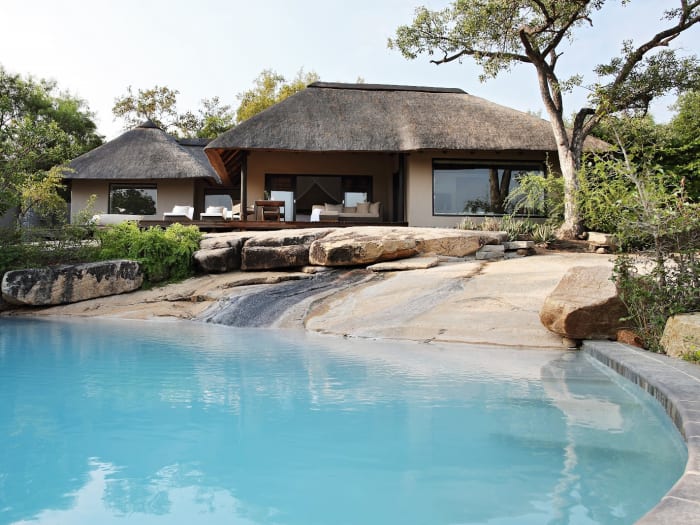
To stay at Londolozi is first to accept that the principal setting is neither a lobby, nor a terrace, nor even a suite, but a territory. Located within the ecosystem of Kruger National Park, the lodge benefits from one of southern Africa’s most emblematic environments for wildlife viewing. That location immediately defines the place: this is not a resort detached from its context, but an address conceived as an anchoring point within the bush.
The landscape sets the grammar. Depending on the hour, it reads differently: low tree lines, open clearings, sandy tracks, oblique light over the savannah, the near-imperceptible rustle of vegetation. The experience of place often begins before the first game drive, in that particular sensation of being received by a space larger than oneself. It is one of the privileges of great wilderness lodges: they offer less a view than an immersion. Boundaries between indoors and out are deliberately softened so that air, sound, the scent of warmed earth and shifts in light fully participate in the stay.
Londolozi cultivates this direct relationship with the landscape with notable restraint. The expected aesthetic vocabulary of a high-end safari lodge is present—natural materials, muted tones, open spaces, wood and textiles—but without decorative excess. The whole seeks to extend the territory rather than oppose it with an artificial world. That restraint matters: it allows guests to feel they are truly inhabiting the place rather than a themed set inspired by the bush.
Daily life is organised around the natural rhythm of the reserve. Early departures, returns between outings, rest during the hottest hours, then renewed activity in the late afternoon create a day structured by light and animal movement. This cadence, so different from that of an urban or seaside hotel, alters one’s sense of time. One quickly learns to value the in-between moments: coffee before dawn, a silent pause on a terrace, the return from safari as the sky changes colour.
The property is also compelling in the way it accommodates different kinds of travellers without diluting its identity. Couples seeking a memorable journey, wildlife photographers, families wishing to share a nature-led experience, and guests already familiar with South Africa can all find a clear framework here, where comfort never cancels the sense of adventure. It is one of the hardest balances to achieve in safari hospitality, and one of the most valuable when done well.
Finally, the lodge stands out through the coherence between its setting and its philosophy. Big Five viewing, game drives, guided walks and wildlife workshops are not peripheral activities added to a conventional hotel offer; they form the very core of the stay. The lodge acts as an elegant interface between the visitor and the living world. At Londolozi, the setting is not merely a backdrop: it is the reason the experience exists.
Rooms and suites
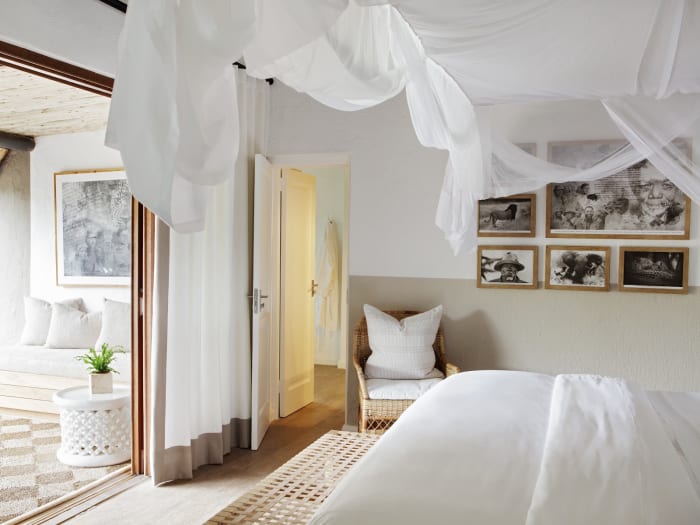
In a lodge of this kind, the room is not meant to distract from the landscape; rather, it should offer a form of refuge that extends the bush experience. At Londolozi, accommodation follows that logic of a retreat open to the outdoors. Comfort is essential, of course, but it is not presented as a rupture with the environment. Instead, it acts as a discreet mediation between the intensity of game drives and the need for rest, between the adventure lived outside and the sense of shelter sought on return.
At this level, one expects excellent bedding, volumes designed for relaxation, a pleasant bathroom, well-integrated storage and an easy flow. Yet in the context of a safari lodge, other elements matter just as much: the way light enters the room, the presence of an outdoor or semi-open space, the possibility of sitting down to read, observe or simply listen to the silence. It is often these details, more than decorative display, that determine the success of a stay.
The aesthetic is best understood as an extension of the site. Natural materials, earthy tones, textiles chosen for visual and tactile softness, and the use of wood all contribute to a calming atmosphere. In such a setting, the finest luxury lies in not overloading the space. A successful safari room must breathe. It must leave room for the outside, for changing light, for the sounds of the bush, for that particular sensation of being both protected and connected to a living environment.
For couples, this arrangement encourages an almost cinematic experience of travel: waking before dawn, returning after the morning drive, resting during the hottest hours, then preparing for the late-afternoon outing. For families or guests staying several nights, the importance of well-conceived accommodation becomes even clearer. Between activities, the room is not merely a place to pass through; it becomes a space for recentring, conversation, contemplation and recovery.
Daily housekeeping and turndown service, when well executed, take on a particular significance here. They support the rhythm of the lodge without ever weighing it down. One returns to a room restored after an outing, ready for rest or for the night, with that precious sense that everything has been anticipated without ostentation. In high-end wilderness hospitality, true refinement often lies in this invisible efficiency.
What appeals at Londolozi is therefore less the idea of a spectacular suite than that of accommodation that feels right—right in its proportions, right in its relationship to the landscape, right in its ability to provide comfort without severing the link to the wild. After hours spent tracking, observing wildlife and reading the land with guides, returning to a calm, elegant space in harmony with the setting becomes one of the deepest pleasures of the stay. The room is not an autonomous décor: it is the echo chamber of the bush.
Dining
At Londolozi, dining forms an integral part of the safari rhythm. It is not a separate chapter of the stay, still less a simple convenience between outings: it accompanies the hours of the day, sustains the traveller’s energy, and creates moments of sociability that matter as much as the wildlife encounters themselves. In a lodge of this calibre, eating well does not necessarily mean multiplying stylistic effects; above all, it means understanding the particular tempo of a day spent in close contact with nature.
Mornings begin early. Before departure, one generally seeks something simple, comforting and easy to take without breaking the concentration of dawn. Then comes the return, when appetite settles more fully and breakfast becomes a true moment of re-entry. At midday, the cuisine must remain clear, fresh, suited to the climate and to the need to preserve energy for the rest of the programme. In the evening, however, the meal takes on another depth. After the late-afternoon drive, it becomes a time for storytelling, sharing and decompression. Guests revisit what they have seen: the light, the tracks, the animal encounters that shaped the day.
In the world of high-end safari hospitality, the finest tables are often those that combine generosity, precision and a sense of place. The setting matters greatly: an open terrace facing the bush, an intimate dining room, dinner under the stars when conditions allow, or a pause in the wilderness during an outing. Such shifts in staging only matter if they remain coherent with the spirit of the house. At Londolozi, one expects above all a culinary experience that is fluid, warm and rooted in lodge life.
Its Relais & Châteaux affiliation suggests particular care for the art of hospitality and the quality of the table. Without over-reading the point, one may reasonably say that dining contributes to the overall identity of the stay. Service should know how to be present without interrupting conversation, attentive without stiffness, and able to adapt to the shifting schedules that wildlife sometimes imposes. That sense of flexibility is essential: in a lodge, the best hospitality often follows reality rather than trying to control it.
In such a setting, cuisine benefits from favouring clarity of flavour, freshness of produce and a certain readability on the plate. After hours spent outdoors, under the sun or in the morning chill, the body seeks food that comforts without weighing it down. Pleasure arises from balance: enough refinement to reflect the level of the address, enough simplicity to remain in harmony with the nature of the experience.
Ultimately, what one remembers is not only a particular dish, but the way dining structures the memory of the stay. Coffee before dawn, a quiet lunch between drives, a sundowner at sunset, a dinner that extends conversation after a full day: these sequences give the journey its emotional texture. At Londolozi, the table is not an autonomous spectacle. It is one of the languages through which the lodge turns adventure into a way of life.
Wellbeing & reconnection
In a place such as Londolozi, wellbeing is not limited to a treatment menu or a dedicated space, even if such elements may naturally form part of the experience. It arises first from a quality of presence in the world, from a different way of breathing, from making oneself available to an environment that requires one to slow down. Safari, paradoxically, is one of the forms of travel most conducive to reconnection: one rises early, listens more, looks for longer, and accepts not being in control of everything. That inner disposition profoundly changes the sensation of rest.
The first luxury here is silence—or rather the replacement of mechanical noise by a living soundscape: birds, wind, insects, moving branches, distant calls. For many travellers, this simple change in acoustic environment has an immediate effect. The body relaxes differently. Attention shifts. Gestures slow. Between outings, time spent on a terrace, in an open lounge or in the privacy of one’s room becomes a genuine decompression practice, without needing to be labelled as such.
If the property offers treatments or moments of relaxation, they make most sense when they fit within this broader logic. After a morning drive or on returning from an evening safari, a massage, a period of rest or a simple calming ritual can extend the experience rather than compete with it. In high-end wilderness hospitality, the most convincing wellbeing is not the kind that imposes a separate universe; it is the kind that responds to the body’s real needs after effort, emotion and sensory intensity.
The climate, the light and the lodge rhythm also encourage a form of gentle discipline. One often goes to bed earlier than in the city, wakes before dawn, spends more time outdoors, and rediscovers a more instinctive relationship with the cycles of the day. This apparent simplicity has deep effects. It reorders priorities, lightens mental fatigue and restores value to elemental sensations: drinking, walking, breathing, resting, observing.
For couples, this dimension of reconnection is often one of the stay’s greatest attractions. Far from urban demands, travel regains a rare quality of conversation and presence. For solo travellers, the lodge can become a particularly fertile space for recentring. Families, meanwhile, often discover a different relationship to shared time—less fragmented, more attentive, structured by experiences lived together rather than parallel distractions.
Wellbeing at Londolozi is therefore best understood as an ecology of the stay. It results from the alignment between place, rhythm, hospitality and the living world. Whether it takes the form of a treatment, a post-lunch nap, waking in the cool morning air or simply standing still before the landscape, it recalls an often-forgotten truth: the most lasting rest is sometimes born of sincere immersion in nature. Here, feeling better does not come from a prescribed programme, but from a gradual readjustment to a world that is larger and calmer.
Concierge & services
In a high-end safari lodge, the quality of service is measured less by the multiplication of formalities than by the fluidity of the experience. Londolozi appears to belong to that tradition of hospitality in which everything should feel simple, even when the underlying logistics are in fact demanding. Life in the bush follows particular constraints—very early departures, alternation between activities and rest, adaptation to natural conditions—which make precision in service all the more important. When well conceived, it becomes almost invisible.
The presence of a concierge and front desk available at all hours answers that need for continuity. For the traveller, this means a reassuring framework, capable of handling practical requests as well as last-minute adjustments. In the context of safari, such availability is not merely a marker of standing: it contributes directly to comfort. Whether organising the rhythm of activities, managing personal belongings, coordinating departures or responding to a specific request, the quality of assistance shapes the overall sense of ease.
Daily housekeeping, turndown service, luggage storage, laundry and wake-up service form a set of amenities that take on particular significance here. In the city, such services may seem self-evident. In a wilderness lodge, they become concrete levers of comfort. Returning to clothes that have been cared for, to a room restored between outings, to luggage handled attentively, or being woken at exactly the right time before a dawn departure all profoundly improve the quality of travel. Refinement often lies in this ability to anticipate needs without ever weighing down the atmosphere.
Multilingual staff, where available, add an important dimension to the international welcome expected of an address at this level. In a stay where the experience depends greatly on exchange—with the hospitality team, but also around activities, briefings and field stories—clarity of communication matters enormously. It helps put guests at ease immediately, smooths interactions and creates that impression of a well-run house that distinguishes the most coherent properties.
It is also worth noting that, in the safari world, service is not limited to visible infrastructure. It depends on a culture of attentiveness. Knowing when to propose and when to step back, understanding the level of guidance desired by each guest, respecting moments of silence as much as the need for conversation: this relational intelligence is one of the most sophisticated forms of contemporary luxury. It is not proclaimed; it is felt.
Booking a stay at Londolozi therefore means choosing a place where services support the experience without standardising it. The aim is not to reproduce the reflexes of an urban palace in the middle of the bush, but to shape a hospitality suited to the territory—precise without rigidity, warm without intrusiveness, structured without breaking the sense of freedom. It is in that nuance that the success of a great lodge is decided. And it is often what travellers remember most enduringly: the feeling that everything was in its place, at exactly the right moment.
The Kruger safari way of life
There is a very particular way of inhabiting time in the world of safari, and Londolozi offers an especially accomplished version of it. This way of life is not ostentatious. It rests on simple, repeated, almost ritual gestures: rising before sunrise, drinking something warm in the half-light, setting out while the air is still cool, returning later with the sensation of having already lived a full day, then beginning again to the rhythm of evening. Very quickly, the traveller understands that the luxury of safari lies as much in this structure of time as in the rarity of sightings.
In the Kruger region, nature is not a distant backdrop contemplated from afar; it organises the day in concrete terms. The hours most favourable to animal activity become the defining hours of the stay. Midday invites withdrawal, rest, reading, conversation or simple contemplation. Then the world begins to move again with the fading light. This alternation between intensity and suspension creates a quality of presence that few other forms of travel allow.
The safari way of life also depends on a certain discipline of looking. One learns to observe differently: no longer in the urgency of seeing everything, but in attention to signs. A footprint in the earth, a change in bird behaviour, a scent, an unusual silence, a line of sight through the vegetation—these are the clues that compose a reading of the land. Even for first-time guests, this implicit pedagogy transforms the experience. The bush ceases to be an exotic abstraction; it becomes a legible, complex and inhabited world.
To this is added a particular form of sociability. Safari generates conversations unlike those of urban travel. One speaks less about schedules and more about sensations, light, patience, chance and memory. Meals, returns from outings, time spent around a fire or on a terrace acquire a singular density. The days are full, but never overloaded. They leave room for interpretation, storytelling and delayed emotion.
For couples, this form of travel carries an almost initiatory intensity. For families, it becomes a remarkable space of transmission, where children discover wildlife, natural rhythms and the ethics of observation. For solo travellers, it offers a framework that is both structured and contemplative, conducive to reflection. In every case, the experience exceeds the mere accumulation of images. It touches something more lasting: a renewed way of paying attention.
That, perhaps, is where the true way of life associated with Londolozi—and more broadly with the great South African safari—resides. Not in the idea of spectacular luxury, but in the possibility of living for a few days according to a different hierarchy of things. Light matters more than the exact hour. Silence more than social noise. The quality of a moment more than the speed of its succession. To return from such a stay is often to carry home more than a travel memory: another measure of time, and perhaps another way of looking at the world.
Book with MyConciergeHotel
Booking Londolozi through MyConciergeHotel means approaching the stay not as a simple sum of nights and activities, but as an experience to be composed with care. A successful safari depends greatly on good preparation: length of stay, desired pace, traveller profile, travel period, expectations in terms of wildlife viewing, need for rest, and the possible presence of children. Unlike an urban hotel, where one may improvise more easily, a lodge of this kind benefits from being planned in advance so that each day finds its proper balance.
The value of editorial and concierge guidance lies first in this search for coherence. Some travellers come for a first safari and wish to be guided step by step; others already know southern Africa and are looking for an address capable of offering a deeper, calmer experience with a strong conservation ethos. In both cases, it is useful to refine the project before departure. The number of nights, for example, directly shapes the quality of the stay: too short and it can feel rushed; properly judged and it allows guests to settle into the rhythm of the bush and fully enjoy the drives, the rest periods and lodge life.
Booking ahead is particularly advisable for an address of this kind. Well-regarded lodges, especially those offering intimate experiences and limited places on activities, often fill quickly during the most sought-after periods. Planning early also makes it easier to organise game drives, guided walks or wildlife-focused workshops in line with individual preferences. For couples, this may mean prioritising a more secluded atmosphere and a stay centred on observation. For families, it often means checking that the pace and activities suit the children’s ages.
MyConciergeHotel can also help position Londolozi within a broader South African itinerary. A safari in the Kruger region is often combined with other stages very different in energy and landscape. The challenge is then to build a harmonious progression between nature, rest and cultural discovery without overloading the journey. The lodge becomes a defining sequence—almost a foundational one—which should be framed with care.
Beyond the booking itself, the value of support lies in the quality of advice. Which period is best according to one’s expectations? How much time should be devoted to safari in order not to remain on the surface of the experience? How should the trip be designed for a couple, a family or a special occasion? Which services should be requested in advance to smooth arrival and the stay? These are the practical questions that turn a fine address into a truly successful journey.
Choosing Londolozi through MyConciergeHotel therefore means opting for a stay planned with discernment. A stay in which luxury lies not only in the standing of the lodge, but in the relevance of the choices made beforehand: the right moment, the right pace, the right expectations, the right duration. In the world of safari, such preparation takes nothing away from the element of unpredictability that makes travel beautiful. On the contrary, it creates the conditions in which the unexpected can unfold in the best possible way.