History & heritage
In Joucas, high above the Luberon, Hôtel Le Phébus & Spa - Villa des Anges reflects a distinctly Provençal idea of hospitality: a house that converses with its landscape rather than imposing itself upon it. The property is defined less by a dramatic narrative than by a sense of continuity with its surroundings. Here, the experience begins with stone, light and silence. In this part of the Vaucluse, old buildings, dry-stone walls, paths edged with Mediterranean vegetation and open views over the countryside form a heritage that is as sensory as it is architectural. The hotel adopts these codes while interpreting comfort in a contemporary way, remaining faithful to the spirit of great Provençal houses.
Its membership of Relais & Châteaux is a clear indication of its philosophy. This affiliation suggests more than a certain standard of service; it points to a way of welcoming guests rooted in character, cuisine, attention to detail and a strong sense of place. At Le Phébus, this translates into an address that favours authenticity over effect, and treats discretion as a luxury in its own right. Guests come here for a lived-in Provence rather than a stylised one, where elegance arises from the rightness of materials, proportions and the rhythm of the stay.
Even the hotel’s name evokes light, a central element of the experience. In the Luberon, light shapes the day, transforms the contours of the hills, draws out the lines of hilltop villages and alters the colour of stone from morning to evening. The hotel seems designed for precisely this light: the kind that enters rooms softly, accompanies breakfast overlooking the countryside, or lingers on the terrace as the evening cools. This relationship with climate and landscape belongs fully to the Provençal inheritance.
The history of the place is therefore expressed less through a displayed chronology than through fidelity to a regional art of living. A stay unfolds in an environment where one immediately understands the value of slower time: the time of seasons, harvests, markets, walks between villages and long meals. The hotel adopts this tempo and translates it into hospitality. It does not seek to accelerate the experience; it arranges it gently. This approach is especially suited to travellers looking for an address able to offer both the service level of a five-star hotel and a genuine sense of retreat.
In a hospitality landscape where many properties claim exceptionality, Le Phébus & Spa - Villa des Anges asserts a subtler singularity. It lies in the coherence between the setting, the surrounding nature, cuisine shaped by local produce and wellbeing conceived as an extension of the calm outdoors. That coherence is its true signature. It places the hotel within a French tradition of characterful houses where luxury is measured not only by the abundance of amenities, but by the quality of atmosphere and the precision of care.
The property
Le Phébus’s first privilege lies in its setting: Joucas, a village in the Vaucluse removed from the busiest flows, yet close enough to the Luberon’s key landmarks to make it a particularly balanced base. The prevailing feeling is one of chosen retreat. You are in nature, with that rare sense of openness that defines the finest addresses in inland Provence. The view over the surrounding countryside is not merely a backdrop; it shapes the way the place is experienced. It accompanies meals, reading, returns from walks, and constantly reminds guests that they are staying in a region where relief, vegetation and light create a form of immaterial luxury.
The property cultivates a peaceful atmosphere, one of its principal strengths. Here, calm is not simply the absence of noise: it is a quality of environment. The sounds are those of wind, birds and a living countryside that never intrudes. This sense of tranquillity gives the stay a particular depth. It allows guests to slow down without effort and to recover an attention to detail often erased by urban rhythms. For many travellers, this is precisely what they come to the Luberon to find: not complete isolation, but a sense of breathing space.
The architecture and layout contribute to this impression of harmony. In a setting such as Joucas, the most convincing elegance is one that respects local materials and simplicity of line. One expects a house of this category to combine refinement with restraint, and Le Phébus appears to follow that logic. The shared spaces encourage a fluid movement between indoors and outdoors, in a distinctly southern mode of living. One moves naturally from a sitting room to a terrace, from rest to contemplation, from a spa treatment to a lingering lunch. This continuity between uses is part of true comfort.
The address therefore suits several ways of travelling. Couples will find a setting conducive to time together, shaped by calm, dining and wellbeing. Families may appreciate the space, the natural surroundings and the ability to explore the region. Business travellers, meanwhile, encounter another form of efficiency: that of an environment that allows work or meetings in a less standardised, more inspiring setting. In every case, the property retains a human scale that encourages the feeling of being expected rather than merely received.
What ultimately stands out is the coherence between promise and lived reality. Le Phébus does not rely on an over-staged version of Provence; it offers a calm, precise and almost self-evident reading of it. Joucas brings discretion, the landscape brings breadth, and the hotel organises both into a stay where nature is never far away.
Rooms and Suites
In a house like Le Phébus & Spa - Villa des Anges, the room extends the experience of the landscape and tranquility. It offers more than just technical comfort.
A successful room in Provence allows one to rest and truly feel the region. The light shifts throughout the day. The air is cooler in the morning. Nature remains present without being imposing.
The stay thus takes on an almost domestic quality, in the noblest sense of the term. One temporarily inhabits a particularly well-kept country house.
The decor combines elegance and comfort. In the beautiful addresses of the south, elegance is convincing when it avoids unnecessary ornamentation. It favours materials, textures, and soothing tones.
The rooms and suites gain depth as a result. They do not seek to impress immediately. Instead, they establish a lasting sense of well-being.
One can envision spaces designed for true relaxation. The volumes are balanced. The bedding is meticulously chosen. The flow remains simple. The atmosphere invites rest.
The open views of the surrounding landscapes play a crucial role here. In the Luberon, the connection to the outside is a luxury in itself.
Opening the shutters to the countryside, perceiving the nuances of the sky, following the light across the contours: these gestures imbue the stay with a sensory dimension. This visual breathing profoundly alters the experience of the room.
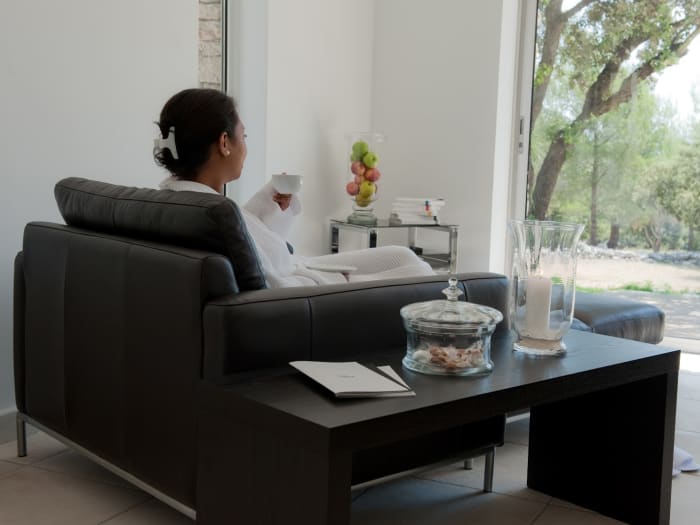
It invites one to slow down. To take the time for a coffee, a read, or a moment of silence before venturing out to the nearby villages.
The suites cater to varied expectations. Extended stays, romantic getaways, family breaks, or a desire for a more independent rhythm.
In such a peaceful environment, the additional space takes on its full meaning. It allows one to experience the hotel differently. To settle in more. To make the room a refuge between two parts of the day.
This is particularly appreciated in summer, when one alternates between outings, relaxation, spa visits, and meals on the terrace.
Beyond the decor, the services also enhance the quality of the in-room experience. Daily service, evening turndown, available concierge, and attention to the guest's rhythm all contribute to a discreet yet essential care.
These elements, subtle but vital, contribute to the fluid sensation expected from a five-star establishment. They maintain an impression of simplicity, supported by precise organisation.
The rooms and suites at Phébus thus embody a certain idea of French hotel luxury. A luxury of lasting comfort, tranquillity, and attention to detail.
The Dining Experience
Cuisine is central to the identity of Le Phébus. In a Relais & Châteaux establishment, the dining experience plays a significant role in defining the place.
At Le Phébus, the menu is rooted in local produce, offering a sensitive interpretation of Vaucluse, guided by the seasons, herbs, fruits, and olive oil.
Sophistication here lies in balance. In Provence, refined cuisine convinces through the clarity of its ingredients, their freshness, and their origins.
In a tranquil setting that opens up to nature, each meal takes on a unique tone. A bright lunch, a more relaxed dinner, a glass facing the landscape, and a gentle breakfast.
Gastronomy thus becomes one of the essential languages of the hotel.
The emphasis on local products connects the establishment to its immediate environment, providing the traveller with a tangible access to the territory.
In the Luberon, this connection takes on a particular strength. The region boasts a distinct agricultural and culinary identity, nourished by markets, producers, and the changing seasons.
The dining experience at Le Phébus is also enhanced by its service environment. A terrace, an elegant dining room without stiffness, attentive service, and a menu designed for various moments of the stay.
As a couple, one might seek a destination dinner. As a family, a table that maintains its quality without sacrificing flexibility.
Ultimately, the dining experience at Le Phébus extends what the hotel already expresses: a Provence interpreted with rigour, without pretension.
Spa & Well-being
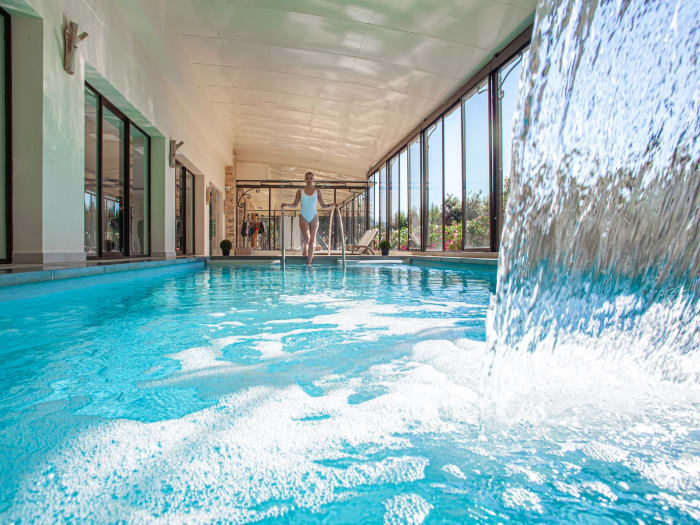
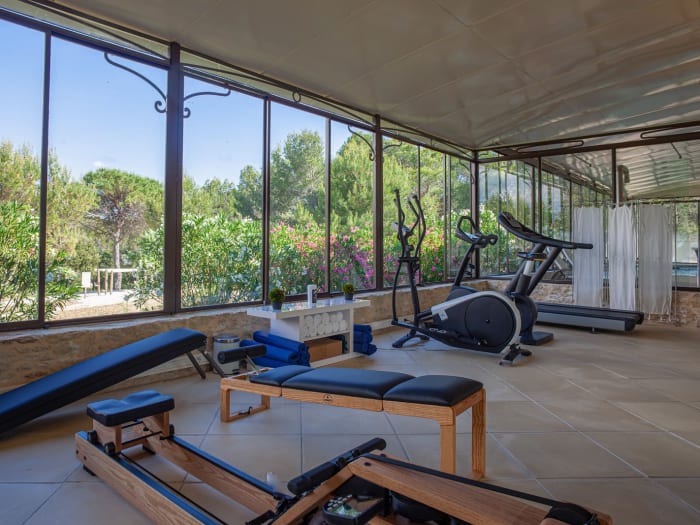
The spa at Le Phébus naturally aligns with the ethos of the location. In a peaceful environment, well-being extends the external calm and offers a more intimate form. The hotel makes rest a structured dimension of the stay. In the Luberon, the light, the scents of vegetation, and the slow rhythm of the days invite relaxation. A well-designed spa acts less as an attraction and more as a deepening of the experience.
In an establishment of this calibre, well-being relies on attentiveness, the quality of the treatment, and coherence with the surroundings. Guests do not come merely to book a treatment; they seek to regain a physical and mental availability that the setting makes possible. After a journey, a day of sightseeing, a walk in the vicinity, or a few weeks of urban intensity, the body responds to this type of environment. The spa then becomes a space of transition. Here, one slows down, releases tension, and reconnects with a sense of inner silence.
The wellness treatments offered make perfect sense in this context. Whether it is a massage, a relaxation ritual, or a targeted recovery session, the key lies in the precision of execution. The spa does not promise dramatic transformations. Instead, it provides a quality, protected time where one feels discreetly cared for. This approach aligns with the spirit of Le Phébus, which prioritises authenticity and serenity.
The relationship between the interior and exterior plays a crucial role here. In the south of France, well-being is often linked to the climate. The dry heat, the light, and the alternation between treatment and rest contribute to this sensation. The spa complements the dining experience, the comfort of the room, and the beauty of the landscape, adding a restorative dimension to the stay.
Thus, the spa attracts a diverse range of travellers. Couples see it as a moment to share. Solo travellers find a conducive environment for re-centering. Guests on longer stays integrate it as a ritual. In summer, it offers a pause between exploration and relaxation.
The practical advice remains simple in a place cherished for its atmosphere: anticipate the booking of treatments. At Le Phébus, the spa is part of those discreet yet decisive experiences that give the impression of having truly changed pace upon departure.
Concierge & Services
The level of a grand stay is often measured by what is not immediately visible. At Phébus, 24-hour reception, 24-hour concierge, daily room service, evening turndown, luggage storage, laundry service, wake-up calls, and multilingual staff create a discreet attentiveness. Here, luxury lies in the elimination of friction.
The presence of a reception and concierge available at all hours alters the relationship to the stay. In the Luberon, where arrivals can be late, this breadth of service provides a welcome freedom. It allows for programme adjustments without stress, seeking advice, confirming a table, or arranging an early departure.
The concierge becomes even more valuable in a village like Joucas, balancing retreat and exploration. A good concierge interprets the stay. They understand whether one seeks a day of perched villages, a leisurely stroll, a gastronomic experience, a moment of wellness, or a family arrangement without complications.
The attentions in the room also contribute to this impression of continuous care. Daily service ensures the upkeep of private spaces. The evening turndown delicately accompanies the transition from day to night. Laundry service, luggage storage, and wake-up calls lighten the travel experience.
The multilingual staff adds an important dimension for an international address. In a region highly appreciated by foreign travellers, the quality of interaction matters. Being understood accurately, receiving clear recommendations, and asking practical questions without hesitation enhance comfort.
At Phébus, the services simplify and refine the experience. They accompany the stay without overwhelming it. This restraint aligns with the spirit of the place, its calm, and a certain idea of hospitality.
The art of living in Joucas and the Luberon
Staying at Le Phébus also means choosing a certain Provence: one of hilltop villages, secondary roads, open landscapes and an art of living better discovered slowly than in haste. Joucas has the rare quality of being both a starting point and a refuge. The village itself, through its discretion, sets the tone. One does not come here for social bustle, but for a deeper relationship with the territory. From the hotel, the Luberon reveals itself in successive touches: morning light on the hills, a market in a nearby village, a pause in the shade, a return at the end of the day when the stone takes on warmer tones.
The local art of living rests on a subtle alliance of nature, culture and the use of time. In this part of the Vaucluse, distances invite wandering rather than performance. Days are composed with flexibility: a walk, a lunch, a visit, a moment of rest, then dinner without hurry. This way of inhabiting a stay corresponds perfectly to the spirit of Le Phébus. The hotel is not merely a place to sleep; it becomes an anchor point from which to enter the rhythm of the Luberon.
The region is especially appreciated for the diversity of its landscapes and villages. What strikes one, when staying here properly, is less the isolated beauty of each site than the coherence of the whole. Everything seems connected: local cuisine, markets, mineral textures, scents of garrigue, dry light, the pleasure of eating outdoors whenever the season allows. Through its setting in nature and open views over the countryside, the hotel allows that coherence to be felt immediately.
Book with MyConciergeHotel
Booking Le Phébus & Spa - Villa des Anges with MyConciergeHotel means approaching the stay with the right degree of preparation and discernment. A property such as this is not chosen solely for its category or its location on a map. It is chosen for an atmosphere, a rhythm, a fit between traveller and place. Our role is precisely to qualify that fit. For a couple seeking a quiet interlude in the Luberon, for a family wishing to combine nature and comfort, or for a traveller accustomed to fine French houses and looking for a more restrained Provence, we help position the experience accurately.
This approach is especially useful in the case of a hotel where several dimensions matter equally: the natural setting, the open countryside views, the dining, the spa, the quality of service and the location in Joucas. Depending on the season, the length of stay and personal expectations, the experience may be lived very differently. Some will favour a long weekend centred on rest, treatments and gastronomy. Others will wish to use the hotel as a base from which to explore the Luberon, its villages, markets and landscapes. Booking through an editorial concierge allows these nuances to be anticipated.
We can also help organise the elements that often make the difference between a good stay and one that is perfectly paced. At a house appreciated for its spa, it is wise to plan treatments ahead. In a gastronomic destination, it helps to think about meals at the right moments of the day. In a region where movement between villages can shape the programme, it is preferable to arrange days with flexibility. This preparatory work does not diminish spontaneity; on the contrary, it makes it more comfortable.