History & heritage
In Saint-Paul-de-Vence, some properties are understood less as hotels than as a way of inhabiting the landscape. Le Domaine du Mas de Pierre belongs to that category. Its identity is rooted first in a distinctly Provençal reading of a stay: a direct relationship with gardens, light, outdoor circulation, and the gentler rhythm of the Riviera hinterland, markedly different from the coast. Here, the notion of an estate matters as much as that of a hotel. It suggests a place conceived at the scale of a setting, with its pauses, views, paths, terraces and moments of calm.
The very name evokes a regional anchoring. In Provence, the word “mas” refers to rural architecture and to an older way of occupying the land, defined by restraint, stone solidity and adaptation to climate. Without claiming historical reconstruction, the property draws on that imagery while pairing it with contemporary comfort. This is where its singularity lies: not in folkloric imitation, but in a measured dialogue between local references and modern high-end hospitality. The result is an atmosphere rather than a set piece, with a sense of coherence shaped by the scale of the buildings, the presence of vegetation and a certain discretion in service.
Its membership of Relais & Châteaux offers another useful lens. Within that collection, the experience is not reduced to amenities alone; it rests on the character of a house, its connection to a destination and a promise of attentive hospitality. At Le Domaine du Mas de Pierre, this translates into a form of restrained elegance. Luxury appears here less as display than as quality of composition: spaces that leave room for silence, attention to the rhythm of a stay, and that sought-after feeling of being close to the Côte d’Azur while already somewhere else.
In the context of Saint-Paul-de-Vence, the address takes on particular meaning. The village, known for its heritage, ramparts, narrow streets and long artistic history, has long attracted travellers sensitive to beauty of setting as much as to culture. Staying nearby means choosing a more inward Riviera, where one comes as much for the light as for the slower pace. Le Domaine du Mas de Pierre fits squarely within that tradition of Provençal art de vivre reinterpreted for contemporary use: more fluid, more comfortable, yet still tied to the landscape.
This idea of heritage should therefore be understood broadly. It lies not only in stone or chronology, but in a continuity of spirit: that of southern hospitality privileging space, the outdoors, the table, rest and the feeling of being received in a place with its own internal logic. In a region where luxury hospitality can sometimes lean towards display, this house is notable instead for its aesthetic steadiness. It offers a calmer version of luxury, nourished by Provence without ever becoming trapped in cliché.
The property
Le Domaine du Mas de Pierre is discovered first as a landscaped estate before it reads as a hotel in the strict sense. That nuance matters. From the moment of arrival, the stay seems organised around a continuous relationship between architecture and nature: lush gardens, outdoor pathways, open views over Provence, and that sense of breathing space which has become rare on a Côte d’Azur so often associated with coastal density. Here, luxury begins with space. Not theatrical space, but well-proportioned space: the kind that allows one to slow down, walk, sit outdoors and let the day take shape on its own.
The immediate setting plays a central role in the experience. Saint-Paul-de-Vence is not a seaside resort but a hilltop village in the hinterland, whose charm lies as much in its heritage as in its relationship to relief and vegetation. From the estate, the views over Provence extend that feeling of openness. They are a reminder that one is staying in a region of hills, gardens, pines, olive trees and shifting light, rather than in a simple holiday backdrop. This depth of landscape gives the place a particular tone: more contemplative, more grounded, quieter too.
The architecture and layout appear to seek balance between local character and modern comfort. The Provençal register is clearly present, yet it does not overwhelm the experience with expected signs. Instead, one finds a palette of materials, volumes and tones that evoke the South without rigid display. This restraint matters, because it allows the estate to retain a lasting elegance. The shared spaces, terraces and outdoor areas seem designed to encourage fluid movement between indoors and out, perfectly suited to the region’s climate for much of the year.
This kind of address particularly appeals to travellers wishing to combine cultural proximity with retreat. On the one hand, Saint-Paul-de-Vence offers an immediate point of reference, with its heritage, galleries, lanes and singular atmosphere. On the other, the estate allows guests to recover a nearly residential calm, far from the movement of the coast. That duality is part of its appeal. One may organise a highly mobile stay, punctuated by excursions, or choose instead to remain on site and simply enjoy the setting, the gardens and the slower tempo naturally imposed by the place.
Membership of Relais & Châteaux reinforces this overall reading. It suggests a house where the identity of the site is not a secondary argument but the core of the proposition. At Le Domaine du Mas de Pierre, this translates into a sense of coherence: nothing feels conceived in isolation, everything seems to participate in the same idea of a stay. The views, vegetation, siting of the buildings, atmosphere of the spaces and quality of service form a legible whole. That is often what separates good addresses from genuinely memorable ones: not one singular effect, but a continuous dialogue between landscape, architecture and the manner of welcoming guests.
Rooms and suites
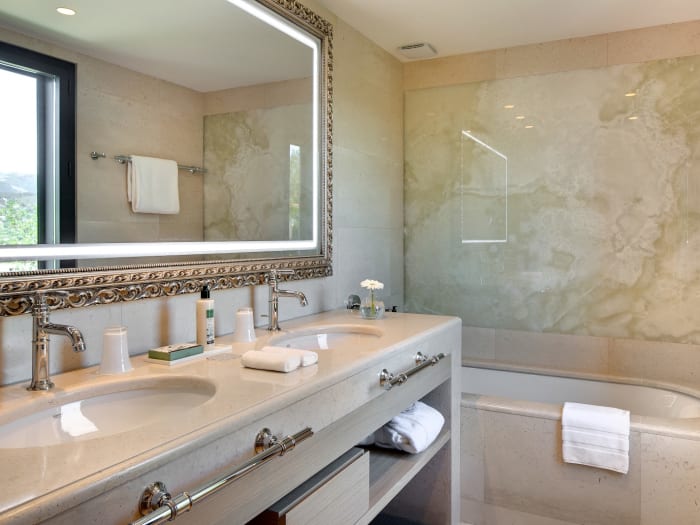
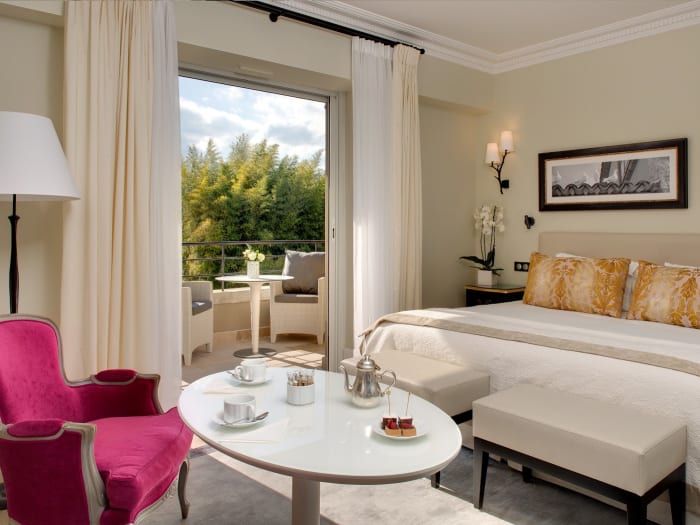
In a property such as Le Domaine du Mas de Pierre, the room is not merely a private space; it extends a certain idea of the Provençal stay. What matters here is less theatrical effect than quality of inhabitation: natural light, a calming relationship to materials, simple circulation and a preserved sense of privacy. The Provençal charm central to the property’s identity finds its most concrete expression here, though always tempered by clearly contemporary comfort. That combination is the point of interest: a warm register, local in inspiration, yet designed to meet the expectations of an international clientele accustomed to five-star standards.
In this context, rooms and suites can be understood as calm refuges after the rhythm of visits or days spent between gardens, terraces and explorations of the hinterland. The expected atmosphere is not one of abstract minimalism, but of enveloping comfort, where details matter without seeking attention. One readily imagines soft tones, materials in dialogue with the landscape, and a treatment of light that follows the hours of the day rather than contradicting them. In the South, this relationship to climate is essential: a fine room is also one that knows how to admit brightness while still offering proper rest.
The true luxury in a place of this nature often lies in continuity between indoors and outdoors. Views over Provence, when part of the experience, are not merely visual additions; they shape the overall feeling of openness. Even without speaking of dramatic panoramas, the presence of landscape is enough to alter the quality of a stay. A well-oriented window, a terrace, a balcony or simply a perspective over the gardens can turn the room into a discreet vantage point on the rhythm of the estate. In the morning, that changes the way the day begins; in the evening, it establishes a very particular calm.
Suites, for their part, generally answer to a different temporality. They suit longer stays, couples seeking greater ease, or travellers who regard the hotel as a destination in itself. In a characterful address, additional space only makes sense if it allows another way of living the place: reading, taking breakfast more slowly, lingering after a walk, or simply enjoying a less constrained rhythm. It is often here that one measures the success of a high-end house: in its ability to make the mechanics of hospitality disappear in favour of an almost residential feeling.
Service finally completes this impression. The presence of daily housekeeping, turndown service and smooth handling of requests contributes to the quality of rest without ever imposing itself visibly. In the best houses, comfort is not only a matter of amenities; it also depends on the way everything seems to function without apparent effort. At Le Domaine du Mas de Pierre, one expects precisely this form of efficient discretion, consistent with the overall spirit of the property. Rooms and suites then become part of a broader experience: that of a stay where, beneath refinement, one finds genuine ease of use.
Dining
At Le Domaine du Mas de Pierre, the gastronomic dimension naturally forms part of the property’s overall spirit. In a Relais & Châteaux address, dining is never merely an ancillary service; it fully contributes to the identity of the stay. Without resorting to grand claims, one may expect here a cuisine attentive to context, seasonality, the rhythm of the South and that idea of measured pleasure particularly suited to Saint-Paul-de-Vence. The setting itself plays a decisive role. In an estate surrounded by gardens, with views over Provence and an atmosphere more inward than seaside, a meal readily takes on a calmer, more contemplative, almost residential tone.
Provence naturally brings certain sensory reference points: olive oil, aromatic herbs, sun-filled vegetables, citrus, Mediterranean fish where appropriate, summer fruit, and a product culture that values clarity of flavour over excess. In the region’s best houses, the challenge is not to freeze that tradition but to render it legible today. One therefore expects a cuisine able to combine local anchoring with contemporary precision, with particular attention to freshness, balance and readability on the plate. Refinement here often lies in restraint.
Breakfast deserves special mention. In this kind of property, it is not merely a functional ritual; it becomes one of the first experiences of the place. Taking coffee facing the greenery, watching the light rise over the gardens, beginning the day in an already soothing environment: this is an essential part of the stay. It is also why travellers accustomed to characterful houses place such importance on terraces, views and the quality of morning service. Luxury often resides in this perfectly orchestrated simplicity.
The practical advice to reserve the main restaurant as soon as the stay is confirmed says something meaningful about the house. It suggests a sought-after table, but above all a property where dining is one of the genuine focal points of the journey. In hotels where the experience is coherent, dinner is not simply a meal; it structures the evening, gives rhythm to the return from an outing, and offers another way to enjoy the estate without having to set out again. For guests seeking comfort, landscape and quality of service in equal measure, that continuity is valuable.
Finally, the table contributes to the broader idea of Provençal art de vivre. A late lunch, a drink prolonged on the terrace, a quiet dinner after a day of visits, or simply allowing time for a meal without haste: all this belongs to the stay. At Le Domaine du Mas de Pierre, one also comes to recover this more supple relationship to time. In such a setting, gastronomy need not be spectacular in order to feel right. It need only be in keeping with the place: precise without rigidity, elegant without ostentation, and sufficiently rooted in its environment to give the journey a genuinely local flavour.
Spa & wellness
In an estate surrounded by lush gardens and open to Provençal views, wellbeing is not limited to the existence of a spa in the technical sense. It begins much earlier: in the quality of the air, in the presence of vegetation, in the possibility of walking for a few minutes between moments of the day without ever leaving a carefully composed environment. At Le Domaine du Mas de Pierre, this dimension seems especially important because it extends the property’s essential promise: to offer a calming stay rooted in a landscape, far from the mere bustle of the most exposed parts of the Côte d’Azur. Rest here is as much an atmosphere as a programme.
In contemporary five-star hospitality, the wellness area has become an expected marker, yet not every house integrates it with equal accuracy. When successful, it does not function as an enclave disconnected from the rest; it takes the codes of the place and translates them into another grammar, quieter and more sensory. Here, one readily imagines an approach centred on relaxation, recovery and attention to individual rhythm rather than on any spectacular display of expertise. That is often what travellers seek in the hinterland: not performance, but a gentle reset in harmony with climate and local temporality.
The Provençal setting is particularly well suited to this idea. Light, vegetation, Mediterranean scents and the relative softness of many seasons encourage a conception of wellbeing that extends beyond the walls of the spa. A morning may begin with a quiet moment in the room, continue with a treatment, and then unfold in the garden or on a terrace. This continuity between treatment, rest and landscape is valuable. It distinguishes places where wellbeing is an added service from those where it becomes a way of inhabiting the stay. In an estate, that logic makes even more sense, because the space itself invites one to slow down.
For travellers, the appeal of such an environment also lies in its flexibility. Some will seek a restorative pause after several stops along the Riviera; others will build their entire stay around rest, reading, walking and a few targeted treatments. Couples often appreciate this possibility of composing a highly personal programme without excessive constraint. In the best houses, the luxury of wellbeing lies precisely in that freedom: being able to choose between activity and retreat, sociability and silence, outward discovery and inward recalibration.
Service, once again, plays a decisive role. A concierge available around the clock, attentive staff and smooth organisation make it possible to integrate wellness moments into the stay without rigidity. Booking a treatment, adjusting an appointment time, or balancing a day between a village visit and a restorative pause all contribute to the quality of the experience. At Le Domaine du Mas de Pierre, wellbeing thus seems to stem less from rhetoric than from overall coherence. The estate, the gardens, the relative calm of Saint-Paul-de-Vence and the property’s contemporary comfort combine to create an environment where one also comes to recover a sense of physical and mental balance.
Concierge & services
In a property of this category, the quality of services is measured not only by their list but by the way they support a stay without weighing it down. Le Domaine du Mas de Pierre offers the fundamentals expected of a contemporary five-star hotel: 24-hour reception, 24-hour concierge, daily housekeeping, turndown service, luggage storage, laundry, wake-up service and multilingual staff. Taken separately, these belong to the standard. Taken together, and above all well executed, they nonetheless transform the experience. They allow the traveller to focus on the place, its rhythm, excursions or rest, rather than on logistics.
The concierge plays a particularly strategic role here. In Saint-Paul-de-Vence, a destination that is both cultural and residential in spirit, guests’ expectations may vary widely. Some wish to organise visits in the village and surrounding area; others prioritise restaurant reservations, transfers, the most favourable times to explore the region, or recommendations suited to a more contemplative stay. A good concierge knows how to calibrate intervention to that level of demand without imposing a standardised programme. In the best houses, it acts as an intelligent filter between the traveller’s wishes and the concrete possibilities of the territory.
Round-the-clock service also brings a form of comfort that is rarely spectacular yet always decisive. Arriving late, departing early, requesting last-minute assistance, storing luggage, arranging a wake-up call or resolving a practical detail: all these situations seem minor until they become essential. True luxury is often recognised in this ability to absorb the unexpected calmly. In a property oriented towards relaxation and fluidity, such continuous availability contributes directly to the sense of serenity.
Daily housekeeping and turndown service belong to another, more intimate register. They do not simply add comfort; they structure the room as a genuinely inhabited space, maintained regularly and prepared for different moments of the day. After a walk in Saint-Paul-de-Vence or an excursion into the hinterland, returning to a room restored to order and discreetly adjusted for the evening is a simple but essential attention. It is precisely this kind of detail that distinguishes well-considered hospitality from merely correct service.
Finally, multilingual staff reflects the property’s international vocation. On the Côte d’Azur and in its hinterland, guest profiles naturally intersect, and the quality of welcome also depends on the ability to communicate with precision, nuance and ease. At Le Domaine du Mas de Pierre, services should be understood as instruments of a broader experience: making the stay easy without making it impersonal. That is a delicate balance. Too much procedure and the soul of the place is lost; too much informality and the level of rigour weakens. The most convincing houses are those that manage to hold that line. Everything suggests that this is precisely the ambition of this address.
The art of living in Saint-Paul-de-Vence
Staying at Le Domaine du Mas de Pierre also means choosing a certain idea of the Côte d’Azur. Not the immediate and often highly visible one of seafronts and seaside resorts, but a more inward Riviera, at once more mineral and more vegetal, where time seems to reorganise itself around relief, light and heritage. Saint-Paul-de-Vence embodies this alternative geography perfectly. One of the South’s best-known hilltop villages, it owes its reputation to the beauty of its site, its ramparts, narrow streets, cultural life and artistic history, which has long associated it with a form of intellectual as well as aesthetic refinement.
What strikes one here is the density of atmosphere. People come to Saint-Paul-de-Vence to walk, look, pause, resume their path, enter a gallery, observe a façade, follow the curve of a lane and suddenly find an opening onto the landscape. The village does not lend itself to hurried consumption. It asks for a degree of availability, a certain slowness, and that is precisely what makes it so compatible with the spirit of the estate. After the relative animation of visiting hours, returning to an environment of gardens and calm gives the stay a beautiful sense of release.
The surrounding hinterland extends this experience. It offers another reading of Mediterranean Provence, less theatrical than certain postcard images yet often more profound. The roads cross gentle relief, discreet residential areas, villages, pines, olive groves and viewpoints that constantly remind one of the sea’s proximity without ever imposing it. For many travellers, this situation is ideal: it allows them to alternate heritage, nature, dining and moments of rest without being absorbed by the coastal rhythm alone.
Local art de vivre also lies in a particular way of occupying the day. Here, the morning may be devoted to discovering the village, midday to a leisurely lunch, the afternoon to a pause at the estate or a short excursion, and the evening to an unhurried dinner. This suppleness is valuable. It allows for a stay that is both rich and restorative, which is not always the case on the Riviera. Le Domaine du Mas de Pierre benefits fully from this contextual quality. It makes it possible to experience Saint-Paul-de-Vence not as a stop to be ticked off, but as a territory to be felt over time.
And then there is the light. In this part of the Alpes-Maritimes, it is never merely decorative. It structures volumes, transforms gardens, softens or sharpens stone, and gives the landscape that silent mobility which has mattered so much in local artistic history. From the estate, the views over Provence constantly recall this dimension. They anchor the stay in something larger than a hotel alone: a region, a visual culture, a way of being in the South. That is perhaps where the true art of living in Saint-Paul-de-Vence resides: in this rare alliance between constructed beauty, inhabited nature and the clear sense that time, here, can still expand.
Book via MyConciergeHotel
Booking Le Domaine du Mas de Pierre through MyConciergeHotel ensures that you approach this destination with the right level of preparation. In Saint-Paul-de-Vence, a characterful establishment is chosen not only for its atmosphere but also for its location and relationship with the landscape. Le Domaine du Mas de Pierre offers a rare coherence: a five-star member of Relais & Châteaux, set within lush gardens, boasting views of Provence, and designed for travellers seeking tranquillity and quality service.
This hotel is ideal for couples, lovers of scenic locations, and those who appreciate the spirit of Saint-Paul-de-Vence. It is also well-suited for a stay that alternates between cultural discoveries and moments of retreat. Depending on the season, the length of stay, and individual priorities, certain categories of rooms, specific orientations, or particular programme rhythms may be more relevant.
The main restaurant should be booked as soon as your reservation is confirmed. Dining is an integral part of the experience, and the best availability tends to fill up quickly. Early booking allows you to secure a time slot and ensures a smooth overall experience.
Saint-Paul-de-Vence requires a minimum of foresight: visiting hours, the most pleasant moments to explore the village, balancing time on-site with excursions nearby, and organising arrivals and departures. The estate can serve as a primary refuge or as a base for exploring the hinterland and the Riviera.
Le Domaine du Mas de Pierre is included in our selection for specific reasons: its deep-rooted presence in Saint-Paul-de-Vence, its natural setting, its views of Provence, its affiliation with Relais & Châteaux, and its blend of Provençal charm and modern comfort.