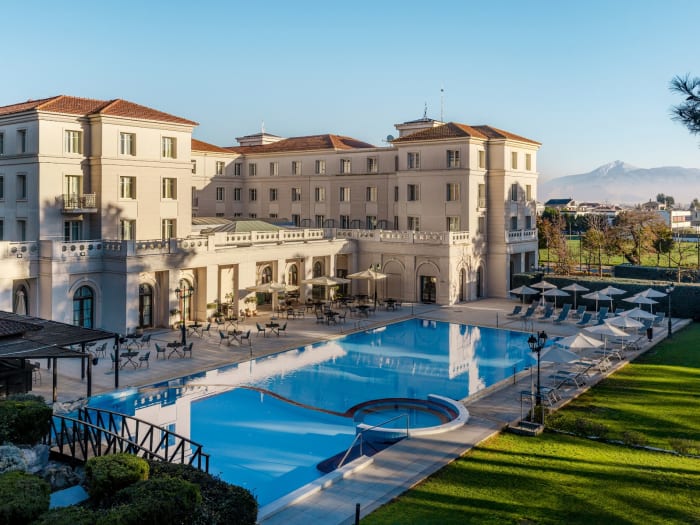
History & heritage
Grecotel Larissa Imperial reflects a contemporary interpretation of upscale Greek hospitality, one built less on grand historical narrative than on service quality, operational ease and a clear sense of welcome. The interest here does not lie in a converted palace or an aristocratic residence steeped in legend, but in a five-star address designed for the needs of the modern traveller in a city with a distinctive place in mainland Greece. Larissa, the historic capital of Thessaly, has long been a crossroads between Athens, Thessaloniki and the mountainous interior. In that context, a Grecotel property naturally becomes a point of anchorage: a place where high standards, smooth organisation and dependable hospitality matter whether one is travelling for business, on a cultural stopover or to explore the wider region.
The Grecotel affiliation is central. The group has established itself within the Greek hotel landscape through a particular idea of the stay: properties able to combine efficiency, comfort and attention to detail while maintaining a connection to their surroundings. At Larissa Imperial, that lineage is expressed through balance. The decorative language remains measured, the public spaces are designed to be lived in without ostentation, and the experience relies less on theatrical surprise than on the feeling of being looked after with precision. It is a quiet form of luxury, especially well suited to a destination that does not seek to overstate itself.
The very name of the hotel, 'Imperial', suggests a certain scale, yet this is felt above all in the generosity of the volumes and in the way the property embraces its multiple roles. It welcomes passing travellers as naturally as longer stays, business appointments as readily as moments of leisure. This versatility is not a compromise; it is part of the hotel’s identity. In a city such as Larissa, active throughout the year, the ability to respond to different rhythms is a genuine mark of relevance.
The hotel also makes sense within the wider context of Thessaly. This region in the heart of Greece carries considerable historical depth, with fertile plains, agricultural traditions, old trade routes and proximity to major natural landmarks. Without resorting to overt folklore, Grecotel Larissa Imperial fits coherently into that geography. It offers a comfortable base from which to discover an inland Greece that is less seaside-oriented, more rooted in daily life and often overlooked by international travellers. In that sense, its heritage is less monumental than contextual: it lies in its ability to represent contemporary Greek hospitality in a city that is both a stopover and a destination in its own right.
This also explains why the address appeals to varied profiles. Some seek the reliability of a major hotel just outside the city; others value the ease of reaching Larissa from Athens in around three and a half hours while enjoying a calmer setting than a dense urban centre can provide. The property does not need to overstate its case: its identity is built over time, through quality of use and through that distinctly Greek way of making a guest feel expected.
The hotel
Just 3 kilometres from the centre of Larissa, Grecotel Larissa Imperial enjoys a particularly appealing position for travellers wishing to combine accessibility with a sense of space. That slight remove from the urban core makes a meaningful difference: one remains close to key points of interest, business appointments and local life, while benefiting from an environment that is easier to reach, calmer in tempo and often more restful. In an active city such as Larissa, this setting allows a stay to unfold without friction, with the sense that one can move into town with ease and then return, at day’s end, to a more composed atmosphere.
Arrival sets the tone for a hotel designed around elegant efficiency. Circulation is clear, the public areas are arranged to support different uses, and the whole retains a coherence that is immediately reassuring. One senses the logic of a five-star property capable of welcoming varied clientele without losing its composure. Business travellers find clarity and convenience; couples read the place as discreetly comfortable; families appreciate the ease of the spaces and the straightforwardness of the services. This versatility, when well executed, is one of the hotel’s most convincing strengths.
The overall style favours a gentle modernity. Rather than aiming for decorative effect, the hotel relies on clean lines, a welcoming atmosphere and a sense of order. This suits the destination well. Larissa is not a frozen postcard city; it is a lively regional capital shaped by economic, academic and cultural movement. A hotel at this level therefore needs to offer more than a setting: it must provide a functional, comfortable and sufficiently flexible environment to support very different types of stay. Grecotel Larissa Imperial does precisely that.
Its location in Thessaly further enhances its appeal. From the hotel, one can move easily across a region that deserves to be approached as more than a place of transit. Thessaly is made up of broad plains, inland roads, villages, distant reliefs and an ancient history that often surfaces without theatrical display. Staying here means choosing a more nuanced mainland Greece, where city appointments, local discoveries and excursions into wider landscapes can readily coexist. The fact that the property is reachable from Athens in around three and a half hours adds to its relevance: it can serve as a comfortable stop on a broader itinerary or as the central base for a stay focused on the region.
The prevailing impression is of a hotel that understands its context. It does not attempt to compete with coastal resorts or imitate the codes of a historic grand address. Instead, it embraces a precise role: to offer a high level of comfort, structured hospitality and a pleasant setting in a city that acts as a gateway to another idea of Greece. For the attentive traveller, that is often where true value lies: in a property’s ability to be exactly where it ought to be.
That sense of rightness is also felt in daily use. One may organise a day of meetings, head into central Larissa afterwards, return without complication and then settle into a quieter rhythm. Equally, the hotel can be approached as a practical retreat before continuing towards other Thessalian horizons. In each case, the place works because it does not force anything. It supports the stay intelligently, and that is often what separates genuinely good hotels from those that merely assemble amenities.
Rooms and suites
At a hotel such as Grecotel Larissa Imperial, the room is not conceived as a mere stopping point but as the natural extension of a stay that should remain fluid from morning to evening. Here one finds the same qualities expressed in the public areas: a search for balance between comfort, restraint and functionality. The approach is not demonstrative decoration; it rests instead on quality of use, clarity of space and the immediate sense of a place that is properly run. For many travellers, especially in a destination that combines leisure and business, this kind of rightness matters more than overt luxury.
The rooms and suites speak to varied profiles. Some will suit a demanding business stop requiring calm, efficiency and proper rest; others will lend themselves to a more relaxed stay for couples or families, with the need for a space in which one can genuinely settle. The value of a property in this category lies precisely in its ability to offer a consistent experience regardless of the reason for travel. One expects a five-star room to be comfortable, well organised, conducive to sleep and pleasant enough that returning to it after a day in town or on the roads of Thessaly feels like part of the pleasure. That is the promise sought here.
The overall atmosphere appears to favour contemporary elegance without excess. Materials, tones and layout are all in the service of rest. Nothing should distract unnecessarily; everything should contribute to a sense of calm. In a hotel open throughout the year, this refined neutrality is a strength. It allows the room to remain relevant in every season, whether for a summer stay, an autumn business trip or a winter stopover. Comfort is then measured less by visual effect than by consistency: good circulation, preserved privacy, daily housekeeping, turndown service and that particularly welcome feeling of returning to a space that has been discreetly reset.
Suites, when chosen, often respond to a longer-stay logic or to a greater need for ease. They make it possible to distinguish more clearly between the different moments of a stay: working, resting, reading, perhaps receiving a guest, or simply enjoying a less constrained rhythm. In a city such as Larissa, where obligations and discoveries can easily alternate, that flexibility is especially valuable. It turns the hotel into a genuine base rather than a simple place to sleep.
Service also matters greatly to the in-room experience. The quality of a major hotel is often revealed in what is barely seen: regular housekeeping, a constantly available front desk, the possibility of arranging a wake-up call, having luggage or laundry handled, and returning at day’s end to a room ready to be occupied without effort. Through its known services, Grecotel Larissa Imperial suggests precisely that discreet mechanism which underpins real comfort.
Ultimately, the rooms and suites contribute to the property’s character by avoiding spectacle. They favour coherence, daily ease and the sense of a quiet luxury designed to endure rather than impress. For the discerning traveller, that is often the best definition of comfort: a place where everything feels simple because everything has been properly anticipated.
Dining
Even without a full list of the hotel’s restaurants or culinary signatures, one can still understand the role dining plays within the experience of a five-star Grecotel address in Larissa. In a property of this kind, food and drink are not merely practical functions; they help structure the rhythm of the stay. Breakfast sets the tone of the day, more informal pauses support the return between appointments, and dinner often becomes the moment when guests choose to remain at the hotel and extend the atmosphere of comfort. In a city active throughout the year, that continuity matters: the hotel must be able to support both a tightly scheduled business agenda and a more leisurely stay.
The Thessalian context adds a particular depth. The region is one of Greece’s major agricultural areas, known for fertile plains and for a product-driven food culture expressed through straightforward, generous, seasonal cooking. Even when a hotel adopts an international register, it benefits from allowing that local foundation to surface: olive oil, vegetables, cheeses, fruit, simple but well-judged preparations, and that Greek way of making the table a moment of presence rather than mere consumption. In a property at this level, one expects precisely this balance between hotel standards and a sense of place.
Breakfast, in a major Greek hotel, is often revealing. The point is not simply abundance, but thoughtful variety and good pacing. The business traveller must be able to eat efficiently without losing time; the leisure guest may prefer to linger, to begin the day more slowly, to find familiar or local flavours in a pleasant setting. If the hotel is true to the Grecotel spirit, one may reasonably expect attention to this first sequence of the day, with service able to be both responsive and relaxed.
At lunch or dinner, hotel dining serves another purpose: that of refuge. After a day spent in Larissa or on the roads of Thessaly, the option of dining on site in a polished environment becomes a genuine comfort. One does not necessarily seek culinary theatre, but rather food that is well executed, legible and suited to varied guests. Couples look for atmosphere; families need flexibility; solo travellers appreciate service that is present without being intrusive. Good hotel dining is often the kind that understands such nuances.
The social dimension of dining spaces also matters. In a hotel welcoming both leisure and business stays, the restaurant, bar or adjoining lounges become transitional places. One takes coffee there before departure, extends a conversation, or finds a little calm at the end of the day. Their success depends as much on atmosphere as on the plate. Balanced lighting, steady service and a menu designed for different uses are what create the sense of a well-managed address.
In short, dining at Grecotel Larissa Imperial should be understood as part of the hotel’s overall comfort. It contributes to that idea of luxury without emphasis, where one eats well because everything has been designed to make the stay simpler, more pleasant and more coherent with the destination. In Larissa, that likely means cooking able to converse with mainland Greece while meeting the expectations of an international clientele.
Wellbeing & the rhythm of the stay
In the absence of a detailed inventory of dedicated wellness facilities, it is wiser to approach the subject with precision and restraint. In a five-star hotel such as Grecotel Larissa Imperial, wellbeing does not necessarily depend on a spectacular spa; more broadly, it lies in the way the property allows the traveller to recover a balanced rhythm. This distinction matters. Not every stay calls for an elaborate treatment programme, yet every stay benefits from an environment in which one can slow down, recover and recentre. In an address suited to both leisure and business, that ability to breathe is part of luxury itself.
The first level of wellbeing lies in the hotel’s organisation. A 24-hour front desk, round-the-clock concierge service, daily housekeeping, turndown, luggage storage and wake-up calls may appear purely functional, yet they have a direct effect on the quality of a stay. They reduce mental load, smooth transitions and allow the traveller to devote energy to what matters most, whether that means an important meeting, time in the city or genuine rest. Psychological comfort is an often underestimated dimension of hotel wellbeing.
The second level concerns atmosphere. A good hotel knows how to create sequences of calm. This depends on well-proportioned public areas, smooth circulation and a room in which one finds relative quiet, order and privacy. After a drive from Athens, a succession of meetings or a day exploring Larissa, that quality of decompression becomes essential. Travellers do not always need a sophisticated ritual; often they simply seek a place where body and mind can come down gently. Grecotel Larissa Imperial, by virtue of its slightly removed position from the centre, appears well placed to offer exactly that.
In the context of Thessaly, wellbeing also takes on a geographical dimension. The region invites a different tempo from that of major capitals or heavily visited islands. Distances feel different, landscapes are more open and the light more continental. A stay here can become an opportunity to relearn a certain slowness: taking breakfast without haste, returning to the hotel after an excursion, valuing sleep quality, regular meals and the comfort of a simple routine. In such a setting, luxury is not necessarily the exceptional; it lies in the possibility of recovering a proper measure.
If the hotel does offer dedicated wellness facilities, they are best understood within this philosophy: not as an autonomous spectacle, but as the natural extension of an otherwise balanced stay. A moment of relaxation, a few lengths, a treatment booked in advance or simply time to oneself all make more sense when they are part of a coherent whole. The traveller is not merely seeking a service; they are seeking a renewed sense of inner availability.
This is perhaps the best way to understand wellbeing at Grecotel Larissa Imperial: as the sum of well-orchestrated details, reliable services and spaces designed to make a stay more breathable. In a hotel world often tempted by excess, this more discreet approach has much to recommend it. It suits a clientele that does not confuse sophistication with agitation and understands that a good stay often begins with the simple possibility of feeling well.
Concierge & services
The true level of a hotel is often measured less by what it displays than by what it makes possible. At Grecotel Larissa Imperial, the known services sketch the portrait of a well-structured house, attentive to the real rhythms of travel and able to support very different kinds of stay without rigidity. The presence of a 24-hour front desk and round-the-clock concierge service is in itself a meaningful sign. In a city such as Larissa, where one may arrive late, leave early, move between meetings and regional journeys, such continuity is not merely a comfort; it is central to the quality of the experience.
When properly conceived, concierge service is not limited to answering occasional requests. It acts as a discreet centre of gravity. It reassures the traveller discovering the destination, facilitates last-minute adjustments and helps optimise what may be a dense stay. Arranging a transfer, organising an outing, providing a recommendation suited to the time available or handling an unforeseen practical need: taken separately, these gestures may seem modest; together, they profoundly change the perception of the stay. One moves from a simple hotel room to an address that genuinely accompanies the guest.
The other known services confirm this logic of fluidity. Daily housekeeping ensures consistency of comfort; turndown adds that evening attention which turns the return to the room into a proper transition; luggage storage allows guests to make full use of arrival and departure hours; laundry service answers the needs of longer stays, business travel or broader itineraries through Greece; and wake-up calls remind us that upscale hospitality remains, above all, a matter of precision. Nothing is theatrical, but everything is useful — and that is precisely the point.
In a property suited equally to leisure and business, service quality must remain legible to all profiles. The business traveller expects reliable, swift, frictionless execution. A couple on a short break may look for more flexibility, discretion and well-judged advice. Families value availability, patience and the ability to simplify logistics. A good hotel knows how to meet all these expectations at once without giving the impression of privileging one use over another. That is a form of operational elegance that is rarer than it should be.
The value of multilingual staff, mentioned among the known amenities, should also be underlined. In a hotel welcoming an international clientele, this is not merely practical; it contributes to the quality of the relationship. Being understood quickly, being able to formulate a request precisely, receiving a clear explanation about a service or a journey: these details reduce uncertainty and reinforce the feeling of being properly welcomed. In high-level hospitality, warmth often passes through this simplicity of communication.
Ultimately, the services at Grecotel Larissa Imperial express a particular idea of luxury: one based on availability, consistency and concrete attention. The point is not an accumulation of effects, but the certainty that everything will work with calm competence. For a stay in Thessaly, whether professional, family-oriented or simply curious, that promise is immensely valuable. It allows the destination to be experienced with greater freedom because the essentials are already taken care of.
The Larissa way of life
Staying at Grecotel Larissa Imperial also means choosing a particular way of approaching Greece: through its interior, through a lively regional capital, through a city that does not reveal itself instantly yet rewards attention. Larissa belongs to that less expected geography for international travellers, far from the most widely circulated island imagery. That is precisely where its interest lies. Here, the way of life does not depend on staged picturesque charm; it is discovered in daily habits, in the rhythm of cafés, in the coexistence of ancient history and a very real contemporary life.
The city is one of the most important in mainland Greece. It has a strong urban identity, shaped by its administrative, economic, academic and cultural role. For the visitor, this means a lived-in destination rather than a museum piece, a place where Greek life can be observed in continuity. One comes here less to tick off monuments than to understand an atmosphere: the way people occupy public space, the role of meals within the day, the importance of informal encounters and the distinctly Greek relationship between city life and sociability. From the hotel, located a short distance from the centre, this immersion remains easy without requiring complicated logistics.
Larissa also offers a way into the singularity of Thessaly. A region of plains and movement, it has long been a territory of production, exchange and passage. That depth can be felt in the food, in the markets and in the roads leading towards other landscapes. By choosing to stay here, one opens oneself to a Greece that is more terrestrial, more agricultural, sometimes more discreet, yet deeply rewarding for travellers who like to place a journey within a broader context. The hotel then plays the role of mediator: it provides the comfort needed to explore without haste and to return with the sense of having encountered something truer than the expected image.
The local way of life also depends on duration. One might spend a morning in the town centre, linger in a café, observe the movement of streets and squares, then return to the hotel for a pause before heading out again. Equally, Larissa can serve as a base for travelling more widely across Thessaly. In both cases, the stay takes on a different tone from that of purely touristic travel. It becomes more flexible, more attentive to transitions and more sensitive to detail. That is often how the most interesting destinations reveal themselves.
For business travellers, this dimension is far from secondary. A professional trip always gains from some local context. Understanding the city in which one is staying, even briefly, changes the quality of the experience. For leisure travellers, Larissa offers an alternative to the most expected version of Greece: a city where one can spend a few days at a more realistic, grounded pace without giving up the comfort of a major hotel.
Ultimately, the Larissa way of life lies in this combination of simplicity and depth. Nothing feels forced. The city allows itself to be approached gradually, and Grecotel Larissa Imperial provides the right frame for that discovery: close enough to remain connected, removed enough to preserve calm, and structured enough to turn an ordinary stay into a coherent experience. It is another idea of travel in Greece, perhaps less obvious, but often more memorable.
Book with MyConciergeHotel
Booking Grecotel Larissa Imperial through MyConciergeHotel means choosing a way of preparing the stay that gives as much importance to context as to the room itself. In a destination such as Larissa, that approach makes particular sense. Travel here is not simply about selecting a five-star hotel; it is also about understanding how the property fits into the city, how to organise one’s movements, how best to use a location 3 kilometres from the centre, and how to balance the leisure and business dimensions of a stay. The value of editorial and concierge guidance lies precisely there: in turning a reservation into a considered stay.
Grecotel Larissa Imperial suits several types of traveller, each of whom may need a different angle. A couple may be looking above all for a comfortable address, reachable from Athens in around three and a half hours, from which to discover a less expected mainland Greece. A family may prioritise logistical ease, reliable services and the ability to explore Thessaly without complication. A business traveller will place more weight on smooth arrival, a 24-hour front desk, concierge support and the hotel’s capacity to sustain a precise schedule. To book well is therefore also to ask the right questions before departure.
MyConciergeHotel makes it possible to approach that stage with greater nuance. Beyond rate or category, the point is to identify what will genuinely shape the quality of the stay: the right timing, the right room type according to duration, the value of anticipating certain services, and the relevance of a programme combining city and region. In a hotel open year-round, these parameters vary according to season, purpose of travel and desired pace. Well-guided booking helps avoid generic choices in favour of a more fitting experience.
This logic is especially relevant in a destination that is not always the first considered in Greece. Larissa benefits from being explained. It is not best consumed as a standard stopover; it reveals itself more fully when one understands its place within Thessaly, its accessibility, its relevance for mixed stays and its ability to serve as a base for wider regional horizons. In that sense, booking Grecotel Larissa Imperial through MyConciergeHotel also means benefiting from an editorial perspective able to place the hotel within a broader travel narrative.
Depending on your programme, it may be wise to anticipate certain practical aspects: arrival and departure times, laundry needs for a longer stay, the organisation of a regional itinerary, or simply recommendations for making the most of Larissa without wasting time. The Concierge’s advice is particularly valuable here: arranging certain activities or stages in advance often allows for greater freedom once on site.
Ultimately, the benefit of booking through MyConciergeHotel is not merely transactional. It lies in a more attentive way of preparing the stay, in keeping with what Grecotel Larissa Imperial actually offers: a reliable, contemporary five-star address, well placed for discovering Larissa and Thessaly, and sufficiently versatile to meet very different expectations. Booking then becomes the first step in a journey that is better composed, smoother and more personal.