History & Spirit of the Place
In Cafayate, luxury is less about ostentation and more about a harmonious way of inhabiting the landscape. Grace Cafayate embodies this philosophy. The hotel is in tune with its surroundings. In this valley of north-west Argentina, vineyards stretch at the foot of mineral formations. The light reshapes the contours of the day. The establishment seamlessly integrates as an extension of the wine territory.
The architecture, inspired by the local landscapes, contributes to this impression. The lines, volumes, and tones respond to the geography of Cafayate. There is a contemporary interpretation of regional forms. Sobriety, light, and openness to the outside world structure the whole. This direct relationship with the natural decor gives the hotel a calming presence.
Hospitality unfolds in a peaceful and warm atmosphere. The stay is based on controlled comfort, attentive service, and a sense of retreat. Luxury manifests itself as a slowed-down pace of life. The flow between indoor and outdoor spaces remains fluid. The room is conceived as a refuge after mountain roads, vineyard visits, or nearby strolls.
Cafayate possesses a unique personality within the Argentine landscape. More intimate than the grand wine capitals, the region nurtures a direct connection between wine culture, altitude, local craftsmanship, and vast open spaces. Grace Cafayate coherently fits into this balance. Its affiliation with the Grace Hotels brand suggests a careful approach to design, comfort, and local anchoring. The hotel does not replicate a standardised luxury; it reflects an elegance shaped by the valley, the vine, and the climate.
This address appeals to travellers who favour places with character. Guests come for the wine, but also for the feeling of being in a hotel that understands its location. In Cafayate, this means respecting the dry light of the altitude, enhancing open perspectives, and providing genuine spaces for rest. Grace Cafayate thus serves as a privileged observation point over a distinctive wine territory.
The Establishment
The foremost merit of Grace Cafayate is its immediate setting of the tone for the destination. The hotel is located in the heart of the Cafayate wine region. The landscape accompanies the stay at every moment, from the circulation areas, communal spaces, to the openings that invite in the valley's light. This proximity to the vineyards shapes the relationship with the place. Guests do not merely stay in a comfortable hotel; they inhabit, for a few days, a territory sculpted by the vine, altitude, and a spectacular geography.
The architecture, inspired by local landscapes, plays a crucial role in this sense of belonging. The establishment appears designed to engage in dialogue with the reliefs and colours of Cafayate. The volumes remain clear and unembellished. The overall design favours continuity between the built environment and its surroundings. In a region where beauty derives as much from the ruggedness of the mountains as from the gentleness of the vineyards, the hotel strikes a balance between protection and openness. Grace Cafayate thus cultivates an atmosphere that is both sheltered and connected to the outside.
The communal spaces contribute to this interpretation. The hotel prioritises living areas designed for relaxation, observation, and a gentle transition between daily activities. After a morning spent in the cellars, a scenic drive, or a walk around Cafayate, returning to the hotel feels like a moment of re-centering. The warm ambiance suggests spaces where one can gather informally, in contemporary comfort that does not overshadow the local character.
The relationship with time is also significant. Here, Grace Cafayate invites guests to embrace the rhythm of the place. This means taking the time for a coffee facing the vineyards, prolonging a reading, observing the variations of light on the mountains, or allowing the day to unfold without constraint. This quality of stay will appeal to travellers seeking a luxury of breathing, rather than an accumulation of activities.
The establishment thus accommodates various travel purposes. For couples, it offers a setting conducive to intimacy, thanks to its peaceful atmosphere and its grounding in the landscape. For solo travellers, it serves as a serene base for exploring the local wine culture. For a few days of disconnection, it allows for a blend of discovery and rest without losing sight of the landscape. It is this coherence between architecture, location, and ambiance that gives Grace Cafayate its authenticity. A hotel designed as an elegant way to engage with Cafayate.
Rooms and Suites
In Cafayate, a room is not merely a place to rest. After traversing Andean roads, indulging in tastings, and wandering through vineyards, it must offer rest, visual freshness, and a sense of grounding.
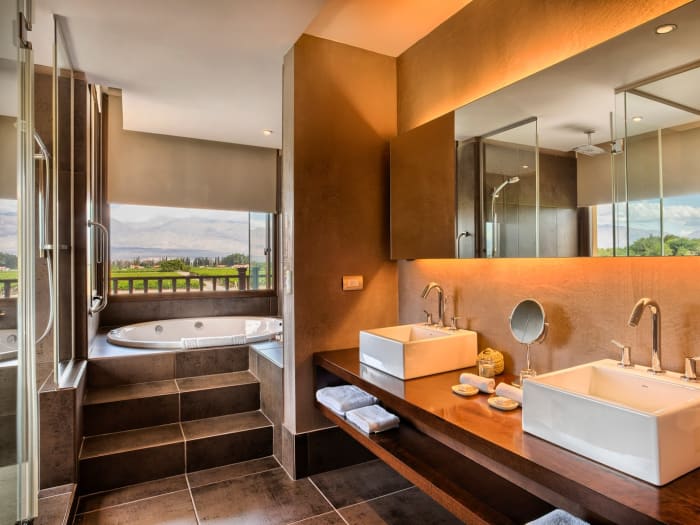
At Grace Cafayate, the rooms and suites blend contemporary comfort with local identity. The spaces retain the charm of the location, with a more subtle balance than mere regional decor.
The materials, hues, and lines extend the hotel's overall architecture. In this mineral and luminous environment, the rooms favour a calming palette and clearly defined volumes.
Luxury here lies in the sense of simplicity. Welcoming bedding, a bathroom designed for a return to tranquillity, fluid circulation, and furniture that allows the space to breathe.
The connection to the outside is among the most valuable aspects of the stay. Views, terraces, patios, and generous light extend the experience of the place.
At Grace Cafayate, private spaces extend the valley rather than isolate from it. This openness provides the accommodation with a genuine continuity with the landscape.
For couples, the room becomes a calm refuge, conducive to leisurely stays and returns from tastings in the late afternoon. For solo travellers, it offers a structuring space for rest.
The warm atmosphere avoids the pitfall of distant luxury. It fosters an immediate sense of welcome.
The daily housekeeping and turn-down service enhance this discreet comfort. In the evening, returning to a prepared, tidy, and serene room is part of the experience.
The rooms and suites at Grace Cafayate thus offer a coherent and restful setting. In a destination focused on vineyards, mountains, and light, this restraint resonates perfectly.
Dining
In Cafayate, dining cannot be separated from wine. Even without detailing a specific culinary offer here, it is clear that a stay at Grace Cafayate belongs to a local culture in which tasting, pairings and proximity to estates shape much of the experience. Simply being in the heart of the wine region gives every meal a particular resonance. One is not merely dining in a hotel; one is eating in a valley where the vine structures the landscape, the economy and an important part of cultural identity.
In that context, the appeal of an address such as Grace Cafayate likely lies in its ability to offer dining in harmony with its surroundings. That implies a cuisine that is legible, attentive to produce, seasonality and the rhythm of the stay. In hotels of this category, the most appropriate table is not necessarily the most demonstrative; it is the one that understands guests have spent the day visiting wineries, tasting characterful wines and travelling scenic roads, and that in the evening they seek something grounded, balanced and genuinely hospitable. A menu that is too heavy or overly conceptual would risk contradicting the spirit of the place; a well-judged kitchen, by contrast, extends the day naturally.
Breakfast deserves particular attention in a destination like Cafayate. It often marks the moment when one takes stock of the light, the weather and the day ahead. In a peaceful setting, it becomes more than a service: an opening note. Fruit, pastries, savoury dishes, hot drinks, juices or local specialities take on another dimension when served in an environment oriented towards the valley or close to the vines. Even without inventing the details, it is reasonable to consider morning pleasure an integral part of the stay.
Wine, of course, remains the guiding thread. The proximity of renowned vineyards invites one to think of the hotel table as a place of transition between outward exploration and a more intimate understanding of terroir. A light lunch before a visit, a glass in the late afternoon, a dinner accompanied by a thoughtfully chosen bottle: these are the moments that often shape travel memories in an address of this kind. The point is not simply to serve local wine, but to help the traveller place what they are tasting within its landscape of origin.
For enthusiasts, Cafayate is as much a destination of curiosity as of pleasure. The hotel table can therefore act as a form of mediation, offering reference points, suggesting simple pairings and accompanying the discovery of the region without heaviness. For less experienced travellers, it provides an accessible entrance into the local wine world. In both cases, the ideal dining experience remains faithful to the place: welcoming, precise and free of unnecessary emphasis.
That is perhaps the best way to think about dining at Grace Cafayate: as a natural extension of the stay, where one comes not only to eat, but to continue reading the valley in another way. Between hospitality, the rhythm of the vineyards and the pleasure of simplicity well executed, gastronomy finds its place not as an autonomous spectacle, but as one of Cafayate’s essential languages.
Wellbeing & the rhythm of the stay
Even when a hotel is not defined primarily by a spectacular spa, wellbeing remains central in a destination such as Cafayate. Altitude, dry climate and days spent between roads, vineyards and cultural discovery naturally call for moments of recovery. At Grace Cafayate, the promise of tranquillity and modern comfort suggests an approach to wellbeing based less on display than on the overall quality of the experience. This is often the most convincing form of luxury: one that does not confine rest to a single facility, but diffuses it throughout the stay.
The first level of wellbeing here is spatial. A hotel designed in harmony with its surroundings produces an immediate calming effect. When architecture respects the lines of the landscape, volumes are allowed to breathe and light is handled intelligently, the body begins to relax even before any specific treatment or ritual. In Cafayate, this relationship between natural setting and physical ease is particularly strong. The mountains, the vines and the dry air impose a different rhythm: slower, more attentive. A hotel that accompanies that movement becomes, in itself, a tool for restoration.
The second level lies in the structure of the day. In this kind of address, wellbeing often comes from the right alternation between activity and retreat. A morning visiting estates, a quiet lunch, a return to the room, a reading pause, a silent moment in a shared space, then dinner without haste: this simple choreography can be enough to create a deep sense of disconnection. Grace Cafayate seems especially suited to this measured art of staying, where the aim is not to fill every hour, but to let the destination work on you.
The hotel’s known services reinforce this underlying comfort. Turndown service, daily housekeeping and the presence of a 24-hour reception and concierge all help reduce the friction of travel. The importance of these details in the perception of rest is often underestimated. Knowing that assistance is always available, returning each day to an ordered room and not having to concern oneself with practicalities all create the conditions for genuine release.
For travellers who associate wellbeing with immersion, Cafayate also offers a singular resource: the wine landscape itself. Walking among the vines, watching the reliefs at the end of the day, taking time to sit facing the valley are simple gestures, yet deeply restorative ones. In such a legible environment, wellbeing does not depend solely on a protocol; it also arises from the quality of one’s presence in the place. A well-located, well-conceived hotel makes that possible.
Wellbeing at Grace Cafayate is therefore best understood as a holistic experience. It resides in the calm, in the attentiveness of service, in the continuous relationship with the landscape and in the ease with which one can slow down. For some travellers, this will matter more than an accumulation of facilities. The true privilege here may simply be the ability to withdraw into a coherent, beautiful and peaceful setting, and then let the valley, the wine and the light do the rest.
Concierge & services
In a destination hotel, the quality of services is measured not only by their number, but by their ability to make a stay smoother, clearer and more serene. Grace Cafayate appears to answer that definition with a service offering centred on discreet efficiency. The presence of a 24-hour concierge and a round-the-clock front desk immediately sets the tone: this is a property attentive to the real rhythms of travel, whether late arrivals, early departures, an unexpected logistical need or simply a request for local guidance.
In Cafayate, this matters particularly. The region lends itself to excursions, winery visits, scenic drives and days that may shift according to season, weather or reservations at the estates. A good concierge service therefore does more than respond; it helps structure the stay. It can guide guests towards vineyards suited to their interests, suggest a coherent rhythm between tastings and downtime, or facilitate the practical details that allow the valley to be enjoyed fully. Even without detailing the exact scope of services here, the presence of continuous concierge support is a genuine marker of comfort.
The known housekeeping services also play an essential role. Daily housekeeping ensures a valuable continuity of comfort in a stay where guests are often coming and going. Turndown service, more subtle in nature, places the experience within the tradition of the fine hotel: one in which attention is paid to the transitions of the day. These are discreet gestures, yet they contribute greatly to the sense of being looked after without intrusion. Luggage storage, meanwhile, eases early arrivals or later departures, always useful in a destination where one may wish to extend a visit before setting off again.
Laundry service and wake-up calls complete the picture with practical intelligence. In a region where one may alternate walks, excursions and more polished moments around dinner or a tasting, the possibility of having garments cared for adds to the lightness of travel. As for wake-up service, it may seem minor; it is not when an early departure, an excursion or a winery booking requires exact timing. Luxury here also lies in reliability.
The multilingual staff mentioned in the facilities excerpt also deserves note. In an international yet more confidential destination than some larger wine regions, the quality of human exchange matters enormously. Being able to ask precise questions, understand recommendations, refine an itinerary or simply feel welcomed without an excessive language barrier directly shapes the quality of the stay.
In sum, Grace Cafayate’s services seem conceived within a logic of intelligent support rather than excess. They accompany the traveller, absorb practical constraints and leave more room for what matters: discovering Cafayate, tasting its wines, enjoying the light and returning each evening to a setting that feels ordered, calm and dependable. It is often this form of service, discreet yet constant, that most enduringly distinguishes a fine address.
The Cafayate way of life
Staying at Grace Cafayate also means entering a very particular way of travelling. Cafayate is not discovered like a major cultural metropolis, nor like a resort entirely shaped by tourism. Its appeal lies in a subtler balance between landscape, viticulture, human scale and a sense of space. The local way of life rests on that combination: days structured by light, wine, short journeys, simple encounters and a very direct relationship with the natural environment.
The first gesture here is often to slow down. In many destinations, travellers arrive with the idea of optimising their time; in Cafayate, they quickly understand that the essential also lies in the intervals. Between winery visits, one must leave room for contemplation, walking, an unplanned detour or a moment spent sitting before the vines. Grace Cafayate, through its peaceful atmosphere and harmonious integration into the landscape, seems particularly suited to this pedagogy of slowing down. The hotel does not distract from the destination; it helps one inhabit it more accurately.
Wine naturally structures this way of life, but it does not exhaust it. Cafayate is also about climate, earth and light. The coloured reliefs, dry air, sharp horizons and almost graphic quality of the scenery give the stay a singular visual intensity. One then understands why architecture inspired by the local landscape makes such sense here: it allows that reading of the territory to continue even indoors. The attentive traveller quickly perceives that everything is connected — the vine, the materiality, the colours, the rhythm of meals, the silence of certain hours.
The town of Cafayate itself adds a more human dimension to the experience. Without trying to rival larger capitals, it offers what many travellers seek today: an accessible scale, a legible identity and a sense of authenticity that does not depend on excessive staging. One comes to explore the surroundings, certainly, but also to feel a local culture still connected to its territory. In that setting, the hotel acts as an elegant anchor point from which it becomes easy to shape each day according to one’s mood.
For couples, the Cafayate way of life often takes the form of a stay built on shared pleasures: tastings, walks, slow late afternoons and dinners without urgency. For solo travellers, it can become a more introspective, almost meditative experience, carried by space and silence. In both cases, the destination rewards those willing not to turn everything into a programme.
That, perhaps, is where Cafayate’s real luxury lies. Not in multiplying events, but in the possibility of living for a few days according to a logic that is at once simpler and denser. In this context, a good hotel is one that supports that quality of presence. Grace Cafayate seems to offer precisely that: a welcoming, well-situated and coherent setting from which the traveller may discover not only a wine region, but a way of seeing, tasting and taking one’s time.
Book through MyConciergeHotel
Booking Grace Cafayate through MyConciergeHotel allows for a well-informed and practical approach to experiencing this destination. Cafayate is not a place to be rushed through. To fully appreciate it, one must consider the pace of the stay, the season, vineyard visits, relaxation time, and the desired level of immersion. A well-prepared reservation significantly enhances the experience, transforming mere accommodation into a destination stay.
The value of an expert intermediary lies in the coherence it brings. Not all travellers seek the same experience in Cafayate. Some are looking for a wine-centric journey with multiple tastings, while others desire a peaceful setting with a few selected discoveries and ample free time. Still, others may wish to combine regional exploration with restful stops as part of a broader itinerary in Argentina. Thoughtful preparation allows for tailoring the stay to these expectations without overwhelming it. Grace Cafayate, with its serene atmosphere and proximity to vineyards, is particularly well-suited for this.
Making discerning reservations is even more crucial as the destination encourages anticipation of certain key moments. It is advisable to book winery tours in advance. In a popular wine region, this foresight helps avoid disappointments and facilitates smoother days. It also aids in balancing experiences; alternating visits, time at the hotel, meals, and moments of contemplation is more rewarding than simply stacking tastings. MyConciergeHotel can serve as this interface, helping to conceptualise the stay as a whole.
The choice of dates also deserves careful consideration. Summer is an ideal season for exploring vineyards and enjoying outdoor activities. Cafayate is a destination of light and landscape as much as it is of wine. Thus, the duration of the stay is nearly as important as the room itself. Two or three nights already allow for a deep immersion in the place, more so if one wishes to explore the region at a leisurely pace.
Booking through MyConciergeHotel also means benefiting from an editorial perspective capable of discerning what makes a location valuable. In the case of Grace Cafayate, this value lies in the harmony between architecture, environment, atmosphere, and access to the vineyard. It is not a hotel to book just to tick off a stop; it is a place to choose if one wishes to experience Cafayate with coherence.
In practice, reserving this property through our intermediary prioritises a more informed, flexible, and qualitative approach to travel. The aim is not merely to confirm a room but to orchestrate a stay that respects the character of the place. In Cafayate, this nuance makes all the difference.