History & heritage
Glenapp Castle belongs to that rare category of addresses where architecture does not merely provide a backdrop, but sets the tone for the entire stay. In Ayrshire, in south-west Scotland, this five-star castle hotel cultivates a clear relationship with the long view of time: that of a historic residence transformed into a house of hospitality without losing the mystery and romance that define great British country houses. Guests do not arrive at a simple rural hotel, but enter a world shaped around a precise idea of the aristocratic retreat: generous proportions, a castle silhouette, landscaped gardens and the atmosphere of an elegant hideaway.
What makes Glenapp Castle compelling is this sense of balance. The property embraces its historic identity, yet it does not feel like a static museum. Its spaces have been adapted for hotel life while preserving what gives a Scottish castle its essence: a strong architectural presence, framed views across the estate, an almost theatrical calm from the moment of arrival, and that distinctly British blend of discreet formality and domestic warmth. Its membership of Relais & Châteaux also places it within a tradition of independent hospitality in which setting, dining and service matter as much as comfort itself.
In a property of this kind, heritage is expressed less through grand narrative than through a sequence of details: wood panelling, staircases, views onto the gardens, drawing rooms suited to reading or lingering over tea, and a dialogue between indoors and outdoors that reinforces the continuity of the estate. The castle evokes a particular idea of travel in Scotland, one that is removed from urban itineraries and more attentive to landscapes, historic houses and the quality of silence. That is precisely what distinguishes Glenapp Castle from a contemporary resort: the experience rests on an intimate relationship between architecture, nature and pace.
The romantic atmosphere often associated with the address is not contrived. It emerges naturally from the combination of the estate’s relative seclusion, the presence of landscaped gardens and the inherent drama of a Scottish castle. For couples, this creates a setting that feels especially well judged: neither ostentatious nor overly ceremonial, yet distinctive enough to turn a simple weekend into a memorable interlude. For other travellers, the appeal lies in the sensation of inhabiting, for a few nights, a residence of character where every room seems to encourage a slower rhythm.
This heritage is finally extended through a style of hospitality that is carefully codified without ever becoming stiff. The promise is not one of showy luxury; it rests instead on the feeling of being received in a grand house, with the level of attention expected from a five-star hotel. Glenapp Castle therefore belongs to a Scottish tradition of welcome in which refinement is measured by service, upkeep and atmosphere. That is what gives the property its depth: a castle that retains its historic personality while meeting the expectations of a contemporary stay.
The property
What strikes guests first at Glenapp Castle is the coherence of the setting. The castle, surrounded by landscaped gardens, forms an ensemble that functions as a world of its own. One does not come here merely to sleep; one comes in search of immersion in a landscape, an architecture and a particular quality of retreat. Ayrshire, with its gentle contours, coastline and countryside, provides an especially fitting backdrop to that idea of a stay. The estate acts as a filter: it removes guests from everyday pace and immediately establishes a slower, almost contemplative rhythm.
The relationship between the building and its grounds is essential. In many character hotels, gardens are an amenity; here, they are fully part of the experience. They extend the elegance of the castle and give the stay a strongly sensory dimension that shifts with the season, the light and the famously changeable Scottish weather. In summer, they invite strolling and lingering; in cooler weather, they become a landscape to observe from drawing rooms or windows, adding to the sense of refuge. This constant dialogue with nature contributes greatly to the property’s distinctiveness.
The hotel is also appealing because of its scale. Despite its five-star status and Relais & Châteaux membership, Glenapp Castle retains the spirit of a house in which one can quickly feel oriented. That clarity matters: it allows guests to enjoy the place without feeling lost in an oversized infrastructure. The public rooms are meant to be lived in, whether for reading, extending a conversation, taking a drink or simply enjoying the quiet. The castle therefore proposes a form of luxury based on the intelligent use of space rather than on an accumulation of effects.
The overall style rests on classic elegance, in keeping with the property’s historic identity. One expects noble materials, decoration attentive to context and a hushed atmosphere closer to a private residence than to a theatrical hotel. This restraint is one of Glenapp Castle’s major strengths: it leaves room for the landscape, the architecture and the quality of the welcome. For travellers seeking strong but understated impressions, it is a particularly persuasive setting.
The destination naturally suits romantic escapes, but not exclusively. The estate may also appeal to travellers wishing to discover a more intimate Scotland, shaped by historic houses, local cuisine and outdoor pursuits. The castle then serves as an anchor point: a place to return to after a day spent exploring the region, walking, observing the gardens or simply enjoying the silence. This ability to combine retreat with openness to the surrounding territory gives the stay much of its value.
Ultimately, Glenapp Castle answers a very contemporary expectation: that of a luxury which does not seek to impress at all costs, but to offer a setting that feels right, coherent and inhabited. Its charm does not come from one isolated detail, but from the whole: arrival through the estate, the presence of the castle, the quality of the gardens, the attentiveness of the service and the sensation of living, however briefly, in a place with a genuine identity. It is this continuity that makes the property a destination in its own right.
Rooms and Suites
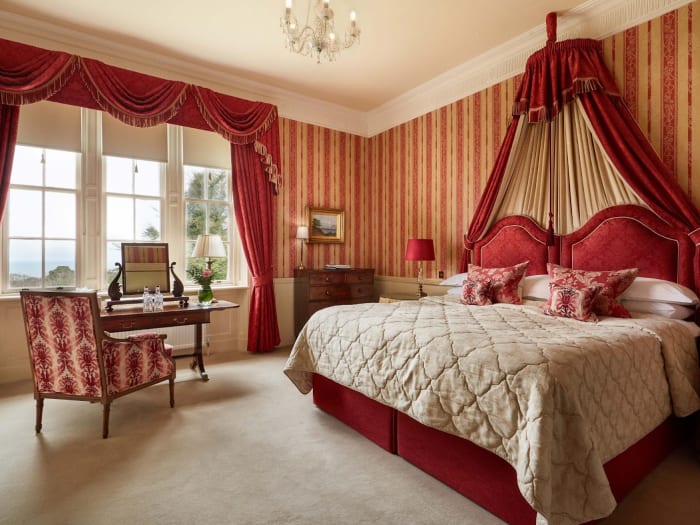
In a castle hotel like Glenapp Castle, the room extends the experience of the place. It combines the comfort of a five-star establishment with the character of a historic residence.
The decor, in dialogue with the castle's architecture, preserves the spirit of the house. It also incorporates the contemporary standards necessary for a serene stay.
Here, the expectation is not of international minimalism, but of residential comfort. The volumes, openings, and period details provide more presence than a typical urban hotel.
At Glenapp Castle, the rooms invite you to slow down. You linger in the morning, read by a window, and observe the gardens.
This quality of pause is particularly significant in a destination where the landscape and atmosphere weigh as heavily as the amenities.
The hotel service complements this impression of controlled comfort. The daily housekeeping and turn-down service enhance the fluidity of your stay.
In a characterful residence, luxury is often reflected in the discreet preparation of the space. A room tidied with precision and a more subdued evening ambiance change the perception of the stay.
The rooms and suites at Glenapp Castle are particularly suited for couples. The castle, gardens, and the relative seclusion of the estate encourage romantic getaways.
However, the appeal is not limited to this aspect. For those who appreciate characterful places, sleeping in a Scottish castle remains an experience in itself.
The relationship with the views also plays an important role. Surrounded by landscaped gardens, the room becomes a privileged observation point.
Depending on the orientation, light, or weather, the landscape changes in tone. It adds an extra depth to the stay.
What distinguishes these accommodations lies in their ability to convey the essence of the castle without sacrificing comfort. The balance between personality and ease of use remains essential here.
Dining
At Glenapp Castle, the gastronomy naturally extends the spirit of the place. The dining experience structures the day, providing a rhythm to your stay. It also contributes to the local anchoring of the establishment. Dining in the castle is akin to reading Ayrshire and Scotland through its products, seasons, and hospitality.
The setting plays a decisive role. In this historic residence surrounded by gardens, each meal takes on a unique tone. Breakfast opens the day on the estate, while dinner aligns with the castle's atmosphere, intimate and conducive to long conversations.
Local cuisine here is understood as a table coherent with its environment. At Glenapp Castle, it is rooted in a careful interpretation of Scottish terroir. It follows the seasons, prioritises the freshness of ingredients, and is accompanied by unobtrusive service. Luxury lies in precision: perfectly cooked dishes, clear presentation, and a controlled pace.
This approach avoids disconnection between the place and the plate. The meal contributes to the understanding of the location, accompanying the experience of the stay with a form of elegant authenticity linked to the region.
The romantic dimension of the establishment also finds a natural expression in the dining experience. A dinner in the castle, after a stroll through the gardens or a day spent outdoors, resonates particularly. The overall experience remains understated, suitable for both special occasions and for travellers who appreciate a well-served meal in a vibrant setting.
Finally, the gastronomy is part of a logic of tailored experiences. The dining can accompany a moment for two, a special attention, or a personalised pace of stay. In this Relais & Châteaux castle, this flexibility is as important as the culinary quality.
Concierge & Services
The luxury of Glenapp Castle is also reflected in the quality of its support. The service enhances the experience with discretion, precision, and availability.
The house offers a 24-hour concierge service, a 24-hour reception, daily housekeeping, turn-down service, luggage storage, laundry service, wake-up calls, and multilingual staff. Together, these create a genuine fluidity, invaluable in a castle hotel designed for relaxation.
The continuously available concierge plays a central role. In Ayrshire, a stay can blend relaxation on the estate, walks, outdoor activities, and regional discoveries. The ability to organise, adjust, and recommend makes all the difference.
The 24-hour reception provides constant comfort, ensuring a smooth arrival or departure, as well as assistance at any hour. In a castle located in a secluded environment, this permanence holds tangible value.
The daily housekeeping and turn-down service reinforce the residential aspect of the stay. An immaculate room prepared for the evening contributes to effortless comfort.
Laundry services and luggage storage are equally useful, simplifying extended stays, broader Scottish itineraries, and early arrivals.
The multilingual staff adds an international accessibility that aligns with the Relais & Châteaux positioning. Being welcomed clearly, in a language you understand, immediately enhances the comfort of your stay.
Ultimately, the services at Glenapp Castle respond to a simple definition of hospitality: to anticipate without imposing, to assist without interrupting, and to personalise without theatricality. The service becomes an invisible architecture, allowing the castle, gardens, and offered experiences to unfold naturally.
The Art of Living in Ayrshire
Staying at Glenapp Castle also means embracing a particular interpretation of Ayrshire. This region in the south-west of Scotland reveals itself in subtle shades. Landscapes, estates, coastlines, and countryside create a serene depth. For the traveller, this makes all the difference. The experience is less about ticking off sights and more about immersing oneself in the local rhythm. Walks, viewpoints, shifting light, and returns to tranquillity weave the fabric of this journey.
The castle serves as a natural starting point for this approach. Its landscaped surroundings invite a slow gaze. Strolling through the gardens, observing the changing weather, and appreciating the silence are enough to set the tone. From there, Ayrshire can be envisaged as an extension of the estate. The region, known for its picturesque landscapes and historic castles, lends itself to itineraries where heritage meets the great outdoors.
The local art of living hinges on this interplay between activity and retreat. A day might begin facing the estate, continue in the countryside or along the coast, and then return to the castle. Relaxing in the drawing room, reading, and enjoying dinner prolong the experience. This sequence aligns with the spirit of Glenapp Castle. Here, luxury resides in the quality of available time.
In a region like Ayrshire, outdoor activities represent a way to connect with the land. Walking, exploring, breathing in the sea air, or simply spending time outdoors allows one to understand the castle's place within the landscape. The scenery is not merely a backdrop; it structures the experience and influences the rhythm of the stay.
This territorial dimension also makes the address appealing to travellers already familiar with Scotland. Glenapp Castle offers a more nuanced, residential, almost literary way to approach the country. It possesses the ability to evoke a sense of place without overstating it. Ayrshire thus becomes less of a destination and more of a setting to inhabit, even if only briefly.
Ultimately, the art of living in Ayrshire, as experienced from Glenapp Castle, rests on a simple idea. A stay here can reconcile comfort, nature, and introspection. For couples, the setting lends itself to a romantic interlude. For solo travellers or enthusiasts of historic homes, it presents an opportunity for a slower, more mindful journey. This proposition retains a rare value.
Book via MyConciergeHotel
Booking Glenapp Castle through MyConciergeHotel means preparing your stay with precision. Choosing a Relais & Châteaux castle in Ayrshire is a decision driven by a specific intention for travel.
Whether it’s a romantic getaway, a retreat into nature, an exploration of a more intimate Scotland, a gastronomic interlude, or a stay focused on gardens and the great outdoors, each project calls for tailored support.
The advantage of a guided reservation lies in its ability to tailor the experience to the traveller's profile. Glenapp Castle has a strong identity, yet one must know how to make the most of it.
Some guests will prioritise the castle's atmosphere and the time spent on the estate, while others may wish to organise bespoke experiences or plan special touches.
In any case, advance preparation avoids a standardised approach and allows for a more coherent stay to be constructed.
The season also plays a significant role. The summer period is particularly pleasant for enjoying the gardens and may influence the choice of dates.
However, the allure of a Scottish castle is not limited to the sunny days. Off-season, the experience becomes more introspective, with a different relationship to light, climate, and indoor spaces.
Booking wisely also means choosing the desired atmosphere rather than simply a window of availability.
MyConciergeHotel enables you to consider the stay as a whole. Beyond the room, it can be relevant to anticipate the highlights of your visit.
Whether it’s organising a customised experience, prioritising dining, managing arrival and departure rhythms, or addressing requests related to a celebration or a romantic trip for two, these details matter.
In a house like Glenapp Castle, it is often these elements prepared in advance that transform the stay. Luxury also lies in the precision of the orchestration.
It is useful to take into account the character sought from the establishment. Booking in advance is particularly pertinent for a venue cherished for its romantic setting, gardens, and castle atmosphere.
Anticipating allows for securing the best options according to your plans, while also providing time to refine special requests.
This is a crucial point for celebratory stays or trips where one wishes to avoid any improvisation.
Booking via MyConciergeHotel means opting for an expert approach to hotel luxury. It involves understanding what distinguishes Glenapp Castle and crafting a stay true to the spirit of the place.
Here, the promise goes beyond mere high-end accommodation. It is one of immersion in a Scottish castle surrounded by gardens, supported by attentive hospitality, cuisine rooted in the territory, and a way of life founded on tranquility.