History & heritage
At Farlam Hall Hotel & Restaurant, the first impression is not of a hotel striving to dazzle at all costs, but of a country house that has retained a sense of proportion. That is precisely where its appeal lies. In this part of northern England, near Brampton and within reach of the landscapes that herald the Scottish border, hospitality belongs to a long tradition: that of rural houses where one comes in search of calm, continuity and a certain idea of British comfort. The traditional-style building belongs to that lineage. Its appearance, its gardens and its setting within green surroundings speak less of spectacle than of a lasting relationship with place.
The identity of the house now rests on a subtle balance between heritage and contemporary use. Its Relais & Châteaux affiliation offers a clear indication of the property's philosophy: attention to character, quality of welcome, the rhythm of a stay and the importance of the table. Here, heritage is not treated as a fixed backdrop. It is felt in the overall atmosphere, in the way the spaces invite guests to slow down, in the constant presence of the landscape and in that rare sensation of being received in an address that values coherence over display.
The charm of Farlam Hall also lies in its relationship with the surrounding countryside. In this kind of English country house, history is not only architectural; it is also landscaped. The tended gardens, views over green spaces, paths and perspectives contribute as much to the experience as the house itself. One quickly understands that a stay unfolds in continuity between indoors and out: a sitting room in which to linger, a window opening onto changing light, a return from a walk that extends the sense of retreat.
Rather than a dramatic narrative, Farlam Hall offers a form of lived heritage. The house feels designed to endure, to welcome without fuss and to give guests an interlude in which time regains a gentler texture. That restraint is a quality in itself. It allows the property to outlast fashions and to preserve a timeless presence, especially appealing to travellers seeking not eventfulness but rightness.
Within the luxury hotel landscape, some properties attract through the scale of their facilities; others through the singularity of their history. Farlam Hall belongs to a quieter, often more affecting category: houses whose elegance comes from remaining true to their original vocation. To stay here is to choose a place that values continuity, tranquillity and the essential art of receiving. That quiet depth, perceptible from the moment of arrival, is perhaps the most convincing expression of its heritage.
The property
Farlam Hall's greatest asset lies in its setting. The hotel stands in peaceful rural surroundings near Brampton, with that immediate sense of measured remove that defines the best country stays: one feels withdrawn without being cut off from the world. This position allows guests to enjoy a serene environment suited to rest while retaining easy access to the region's discoveries. For many travellers, it is the ideal balance between refuge and base.
The house itself sits naturally within the landscape. Its traditional architecture, far from ostentation, is in dialogue with the gardens that surround it and the green spaces that extend the property. This is not a theatrical version of the English countryside, but a more authentic, more liveable one. The eye moves easily between façades, lawns, trees and open views over the surrounding nature. That visual continuity creates an almost immediate sense of calm.
The experience of the place also owes much to its scale. Farlam Hall feels like an address in which one can quickly find one's bearings. The shared spaces, gardens, pathways and views form a coherent whole that encourages an intimate relationship with the house. It offers what seasoned country-house travellers often seek: the possibility of spending a few days in an elegant setting without the impersonal distance that larger properties can sometimes create.
The rhythm of a stay naturally follows that of the setting. In the morning, light across the gardens sets the tone for an unhurried day. Afternoons lend themselves to walks in the surrounding area, reading in a sitting room or a pause before dinner. In the evening, the house regains that enveloping quality unique to well-conceived rural hotels, when the silence outside heightens the feeling of comfort within. This alternation between openness to nature and domestic refuge is one of the property's most constant pleasures.
The proximity of Brampton adds a practical and cultural dimension. Without giving up its secluded character, the hotel allows guests to explore a region shaped by history, landscapes and the traditions of northern England. Walkers, heritage enthusiasts and lovers of back roads will find particularly rewarding ground here. Farlam Hall then becomes an ideal base from which to discover the area at one's own pace before returning to a more hushed atmosphere.
What truly sets the property apart is its ability to offer a luxury of setting rather than a luxury of display. Silence, space, the presence of gardens, the gentleness of the rural environment and the warmth of the welcome combine to create an experience that does not seek attention yet asserts itself through its rightness. For a restorative break, a couple's escape or a few days devoted to the English countryside, Farlam Hall offers a persuasive interpretation of character-led hospitality.
Rooms and suites
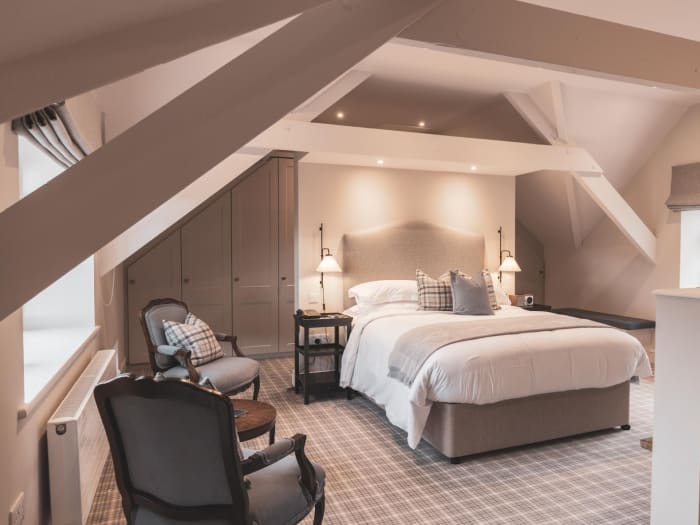
In a house such as Farlam Hall, rooms and suites are not merely places to sleep; they extend the property's overall spirit. What matters here is not a catalogue effect but the feeling of staying in a carefully kept country residence designed for comfort and rest. The decorative register one expects in an address of this kind is that of classical elegance, in keeping with the house's traditional architecture and rural setting. That coherence matters greatly: it gives the stay a tangible unity, from the gardens to the private spaces.
What counts most is the quality of atmosphere. A successful room in a country hotel does not need to overstate itself; above all, it should offer quiet, good light, a sense of privacy and an unhurried relationship with time. At Farlam Hall, everything suggests that the accommodation is conceived in that spirit. One readily imagines views over gardens or green spaces, comfortable materials, a soothing palette and a layout that favours ease of stay. These often discreet elements are what truly determine the quality of a night in the countryside.
Service also plays an essential part in the in-room experience. The available information mentions daily housekeeping and turndown service, two attentions that contribute to the feeling of being looked after without intrusion. In luxury hospitality, comfort depends not only on design but also on the regularity of gestures, on the room being prepared for one's return at the end of the day, on the order restored after a walk or dinner. That continuity of care is especially valuable in a setting devoted to rest.
Travellers who choose Farlam Hall often seek a form of retreat. In that sense, the room becomes central to the stay: a place to read, write a few cards, watch the weather shift over the gardens or simply enjoy a silence that has become rare. For couples, this enveloping quality heightens the intimate character of the escape. For solo travellers, it offers the possibility of a genuinely restorative stay in which one can fully inhabit time without an imposed programme.
In a property of this nature, differences between room and suite categories naturally matter, yet the essential point lies elsewhere: in the consistency of the house feeling. Even when dimensions, views or layouts vary, the promise remains the same, that of accommodation in harmony with the place. This fidelity to the spirit of the residence is often more valuable than an accumulation of effects or spectacular facilities.
Ultimately, the rooms and suites at Farlam Hall belong to a very convincing idea of rural luxury: a luxury of silence, well-considered comfort, attentive service and accord with the landscape. For those who value addresses where one truly sleeps well, wakes with the sense of having changed pace and finds that the room fully contributes to the experience of place, this house answers a precise and increasingly sought-after expectation.
The Table
At Farlam Hall Hotel & Restaurant, gastronomy is an integral part of the establishment's identity. The restaurant is committed to using local and seasonal produce.
In a rural setting like Brampton, this approach roots the culinary experience in the region. The plate accurately reflects the landscape.
Cooking with local and seasonal ingredients adds meaning to the stay. The ingredients evolve with the months, and the textures and flavours follow the rhythm of the harvests.
Dining becomes another way to discover the area, revealing the climate, local produce, and certain local customs.
The atmosphere is just as important as the cuisine. Farlam Hall cultivates a warm spirit, conducive to relaxation. The restaurant embodies this tone.
Here, attentive service, a comfortable dining room, and a pace that allows for conversation are all present. In a rural property, dinner often marks the highlight of the day.
It naturally extends a walk, a heritage visit, or a few hours of tranquillity. Reservations are recommended, especially on weekends.
For both guests and passing visitors, the dining experience serves as a compelling reason to visit. Its reputation thus extends beyond the quality of accommodation alone.
Breakfast also contributes to the establishment's identity. Set amidst gardens, it accompanies a calm and bright start to the day.
The table at Farlam Hall is grounded in local sourcing, a seasonal interpretation of products, and an atmosphere that resonates with the house. Gastronomy here reveals the location without ever overshadowing it.
Concierge & Services
True luxury is often measured by the quality of the most discreet services. At Farlam Hall, this notion takes on a particular significance. The hotel offers a 24-hour concierge service, a 24-hour reception, daily room service, a turndown service, luggage storage, laundry facilities, a wake-up service, and multilingual staff. Gathered within a welcoming country house, these services hold a special value.
The availability of a concierge and reception at all hours brings genuine peace of mind. In a rural destination, where arrivals can sometimes depend on routes or weather conditions, continuous hospitality transforms the experience. The stay becomes more flexible and straightforward.
The daily room service and turndown service contribute to a silent comfort. Returning from a walk to find one’s room impeccably maintained often sets the tone. The space prepared for the night extends this sense of fluidity.
Luggage storage and laundry services cater to very practical needs. They allow for early arrivals, extend a walk before departure, or enable light travel across multiple stages. The wake-up service reflects the attention given to the most fundamental details of comfort.
At Farlam Hall, excellence is not about ostentation, but about precision. Good service anticipates without intruding, informs without overwhelming, and accompanies without rigidity. This relational quality is particularly significant in a property where tranquility is sought.
To organise walks, recommend visits in the vicinity of Brampton, adjust the details of a romantic stay, or facilitate a late arrival, the hotel’s services play a central role. They form the invisible backbone of the experience. At Farlam Hall, this supports a peaceful, elegant, and seamless stay.
The Art of Living in Brampton and the Surrounding Countryside
Staying at Farlam Hall means embracing a different relationship with the territory for a few days. Brampton and its countryside invite an art of living based on slowness and observation.
In this part of the United Kingdom, the landscape shapes the days. People come here to walk, watch the light change over the meadows and trees, and take the back roads.
The region lends itself naturally to cultural excursions. Characterful villages, traces of the past, buildings, and landscapes compose a rich heritage closely tied to its natural environment.
Here, visiting is never entirely separate from strolling. One moves from one point of interest to another, crossing fields, hedgerows, paths, and vistas.
For walking enthusiasts, the location presents an obvious appeal. The rural setting near Brampton encourages outings, from short walks to more structured day hikes.
This type of stay responds to a simple desire: to reconnect with fresh air, silence, and available time. One sets off in the morning and returns with a light fatigue that makes the comfort of homecoming all the more enjoyable.
The local art of living also hinges on seasonality. The English countryside changes with the months, and this variation influences the way one travels.
In fine weather, gardens and green spaces come into their own. When the weather turns cooler, enjoyment shifts to lounges, reading, and seasonal meals.
For couples, the region offers the perfect backdrop for a discreet getaway. For solo travellers, it allows for a peaceful immersion in a restrained landscape.
This restraint paves the way for a more personal experience. Each guest can tailor their stay according to their desires: heritage, nature, gastronomy, or relaxation.
Farlam Hall thus provides access to a certain vision of the British countryside. Discreet comfort, chosen walks, meals rooted in the season, and a slower relationship with time.
Booking via MyConciergeHotel
Choosing Farlam Hall Hotel & Restaurant through MyConciergeHotel means opting for a reservation tailored to the nature of the establishment. Not all fine houses are discovered in the same way. Some require a simple price comparison, while others deserve a more nuanced understanding of the stay, the season, and the desired pace. Farlam Hall falls into the latter category. Its appeal lies in an overall balance: a peaceful rural setting, a traditional house surrounded by gardens, a warm atmosphere, and a restaurant renowned for its local and seasonal approach.
Booking with assistance allows for adjustments to the stay's rhythm. A weekend for two does not call for the same organisation as a solo retreat or a broader itinerary in northern England. Depending on the chosen period, the experience can prioritise walks, heritage discoveries, dinner, or a more stationary retreat. This customisation is useful in a destination where seasonality strongly influences the ambiance.
One of the key aspects concerns dining. Reserving a table, especially on weekends, enhances the quality of the stay. In a place where the dining experience is part of the identity, securing the gastronomic experience at the time of booking allows for a more coherent programme. Arrival times, walks, and rest periods can then naturally revolve around dinner. MyConciergeHotel helps to consider this whole, rather than just a single night.
The assistance also has practical value. Late arrivals, the pace of the stay, romantic getaways, or a few days of solo disconnection are all elements to consider in advance. In a country hotel, the success of the trip often hinges on coordination details. Choosing the right dates, planning the appropriate duration, anticipating meals, and organising exploration of the surroundings contribute to the success of the stay.
Booking via MyConciergeHotel ultimately represents a choice of coherent editorial recommendation. Farlam Hall appeals to travellers sensitive to the character of a place, the quality of hospitality, and the authenticity of an atmosphere. It is not a venue for collecting activities; it is a home for inhabiting a landscape, slowing down, and enjoying fine dining.
To fully enjoy this Relais & Châteaux property near Brampton, the ideal is to view the reservation as the first moment of the stay. By considering the dining experience, the rhythm of the days, and the season, one gives Farlam Hall every chance to reveal its best offerings: an elegant, serene, and coherent interlude.