History & heritage
Ellerman House belongs to a tradition of residential hospitality that sets certain great addresses apart more surely than overt display ever could. Here, the experience is shaped not by scale or spectacle, but by a very precise idea of high-end travel: that of a private home opened to a limited number of guests, with the feeling of being received in a place that is lived-in, cultivated and deeply rooted in its setting. This intimate, almost domestic dimension goes a long way towards explaining the loyalty the hotel inspires among travellers seeking something in Cape Town beyond a well-located luxury stay.
The name Ellerman House evokes the history of a residence more than that of a conventional hotel. The address calls to mind the city’s grand houses, the properties established on residential slopes above the Atlantic, where architecture and position have long mattered as much as the quality of life they promised. In that sense, the hotel extends a certain idea of elegant Cape Town: a discreet art of hosting, shaped by light, ocean views, gardens and the fluid movement between indoors and out. It is not an urban palace cut off from its surroundings, but a house of character that seems to remain in constant dialogue with the coast, the sky and the dramatic topography of the Cape Peninsula.
Another essential aspect of its identity lies in its relationship with contemporary South Africa. Where many luxury hotels claim local roots through a handful of decorative references, Ellerman House approaches the subject in a more substantial way, notably through the place given to South African art. This presence is not merely ornamental; it is part of how the hotel is understood. The works, materials, perspectives and overall atmosphere create a subtle narrative about the country, its visual languages and its cultural imagination. For the traveller, this changes the nature of the stay. One does not simply inhabit a beautiful address with a view; one stays in a place that offers a quiet but genuine conversation with local culture.
Its membership of Relais & Châteaux also helps define its philosophy. The affiliation suggests a particular attention to character, service, cuisine and the overall experience rather than international standardisation. At Ellerman House, this translates into a form of calm precision: nothing needs to be overstated in order to be felt. Luxury is expressed through the rhythm of the stay, the sense of space, the availability of the team and the way each detail appears designed to preserve an atmosphere of ease.
Ultimately, the heritage of Ellerman House is not only architectural or hotel-related. It lies in a way of expressing Cape Town through a refined, residential and cultural lens. It is a place that looks out over the ocean, but also towards the country around it; an address that favours depth over display, turning a stay into an experience of home, landscape and South African sensibility.
The property
Staying at Ellerman House means choosing Cape Town at its most composed. The hotel stands in a peaceful residential area, away from the immediate bustle of the city’s busiest districts, yet close enough to its major landmarks to allow for full and varied days. This position is one of its chief strengths: it creates the feeling of a retreat without imposing isolation. One leaves behind traffic, urban tempo and tourist intensity to arrive at an address where silence, light and the horizon regain their place.
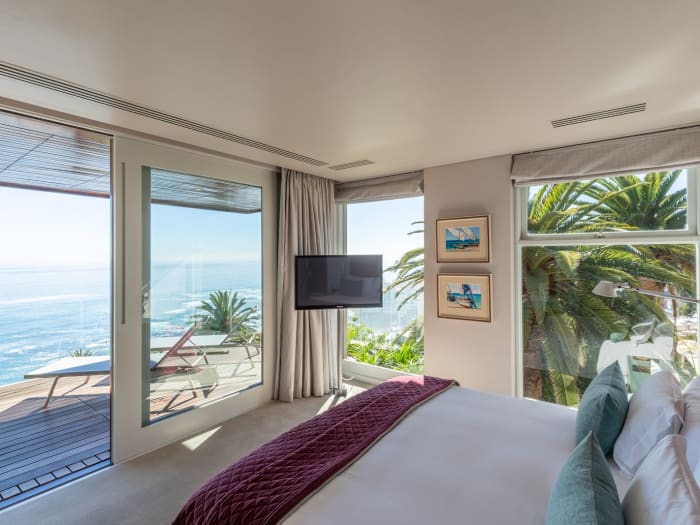
The view over the Atlantic Ocean shapes the experience from the moment of arrival. In Cape Town, panoramas are plentiful, but not all carry the same sense of presence. Here, the relationship with the sea is not simply a distant backdrop. It accompanies the hours of the day, alters the colours of the lounges, enters into the perception of the terraces and gives the shared spaces a particular depth. In the morning, the light is clear and almost graphic; towards late afternoon it softens, becoming more enveloping, a reminder of how deeply the Atlantic coast belongs to the city’s identity. This visual continuity between the house and the open water contributes to the sense of release so many travellers seek after a day spent between Table Mountain, the beaches, cultural districts or the winelands.
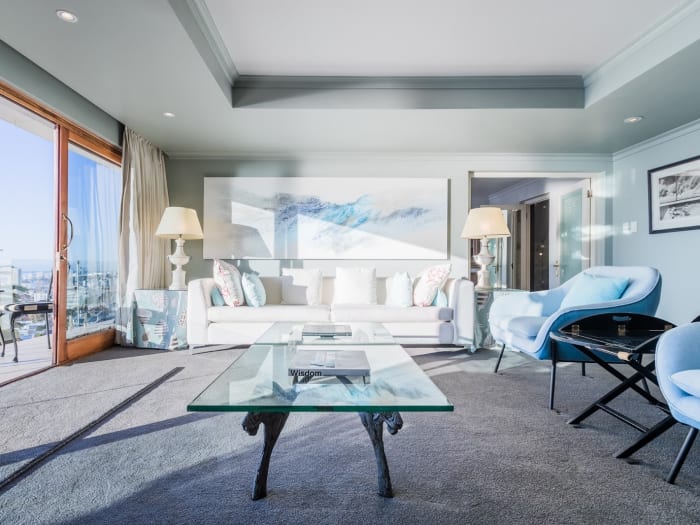
The property cultivates an elegant aesthetic without coldness. Its comfortable lounges, among the hotel’s known highlights, play a central role in that impression. These are spaces where one naturally settles to read, enjoy a drink, watch the changing light or simply pause between outings. The hotel achieves something rare: offering the proportions and poise of a grand address while retaining the warmth of a private home. The design does not rely on fashionable effects; it favours balance, coherence and atmosphere.
That feeling is reinforced by the prominence given to South African art. In circulation areas as well as reception rooms, the works add depth to the stay and prevent the whole from slipping into international neutrality. They root the property in a precise context, that of a country with a particularly rich artistic scene. For the guest, this means that time spent at the hotel is never merely time withdrawn from the world. Even at rest, the address continues to say something about Cape Town and South Africa.
Ellerman House is especially suited to travellers who value intimate hotels where inner life and outside discovery can alternate without a change of tone. Couples will find a setting conducive to slowness and conversation; business travellers, an environment calmer than the larger city-centre hotels; culture-minded guests, an address that does not separate comfort from curiosity. In a city as dramatic as Cape Town, this balance of retreat, view, elegance and local grounding makes for a rare proposition. The hotel does not seek to compete with the energy of the destination; it offers the ideal counterpoint, a calm, cultivated and remarkably well-placed refuge.
Rooms and Suites
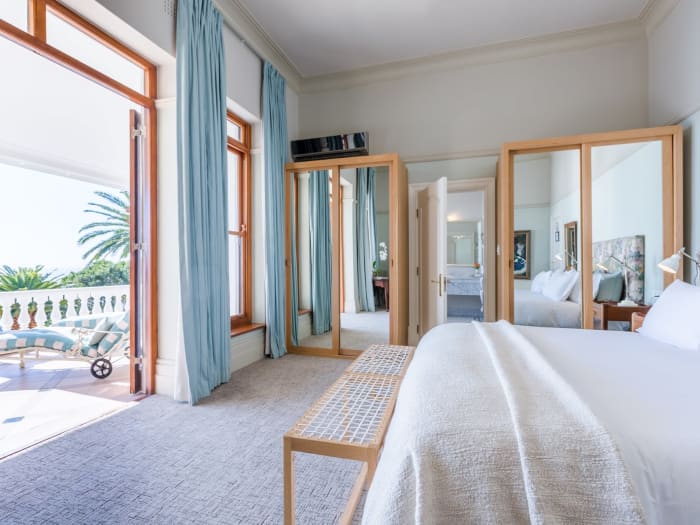
At Ellerman House, the rooms and suites extend the spirit of the home, prioritising genuine quality of living.
The room is not a private space detached from the rest of the hotel; rather, it offers the most personal version of it. Here, it is expressed through space, tranquility, and a seamless connection with the coastal landscape of Cape Town.
The presence of the Atlantic Ocean permeates the experience of the accommodations. Depending on the category and orientation, the light, views, and relationship with the outdoors enhance the feeling of a home open to the sea.
In Cape Town, the climate, winds, and proximity to the ocean shape daily life. A successful room embraces this unique light and provides a refuge after a busy day.
The style remains true to the essence of the establishment, favouring understated elegance, meticulously curated interiors, and carefully selected materials. The composition prioritises genuine comfort over mere visual effect.
This restraint allows for rest, reading, and contemplation. Nothing feels forced; the room becomes a space to prepare for the day or to unwind after dinner.
The service enhances this quality of experience. Daily housekeeping, turn-down service, and round-the-clock reception and concierge ensure a seamless and attentive stay.
Practical needs are addressed discreetly. Rooms are tidied, evening preparations are made, and assistance is provided for schedules, early departures, or special requests.
For couples, the rooms and suites offer an intimate setting. For business travellers or mixed stays, they allow for occasional work without losing the sense of being elsewhere.
For design and art enthusiasts, they extend the cultural identity of the place, expressed in a quieter yet coherent manner.
In summary, the accommodations at Ellerman House evoke a thoughtfully designed seaside residence, where light, decor, comfort, and an understanding of the travel rhythm converge.
Dining
In a house of this nature, dining is not merely a matter of a menu or the reputation of a dining room; it forms part of a broader art of hospitality. At Ellerman House, one may reasonably expect an approach to the table that is consistent with the rest of the experience: attentive, refined, never rigid, and flexible enough to adapt to the rhythm of each stay. Its membership of Relais & Châteaux naturally reinforces that expectation, as the association values addresses where cuisine extends the identity of the place rather than functioning as a separate element.
In Cape Town, dining occupies a particular place. The city is one of the most stimulating gateways into the diversity of South African food culture, with seafood, cosmopolitan influences, local heritage and the proximity of the Cape winelands all playing their part. In that context, a hotel such as Ellerman House benefits from favouring a cuisine of place: one that speaks to the season, the light, the view and the residential spirit of the house. The pleasure of lunch or dinner lies not only in what is served, but in the setting, the tempo of service and the sense that one does not leave the hotel’s atmosphere when sitting down to eat.
Breakfast deserves particular mention in an address of this kind. Facing the Atlantic, it often becomes one of the most memorable moments of the stay, less because of any theatricality than because of the balance it offers between apparent simplicity and real comfort. Beginning the day in a calm house filled with light, with the ocean on the horizon, immediately sets the tone. For travellers planning excursions to the mountain, the beaches, museums, the waterfront or the winelands, this first moment of the day provides an ideal point of departure.
In the evening, the table usually takes on a different register. In a city as rich in restaurants as Cape Town, some guests will choose to dine out frequently; others will value the option of dining in, within a more intimate environment and without further movement. This is where a residential hotel reveals its worth: the ability to return, after the intensity of the city, to cuisine and service that extend the sense of refuge. Dinner is then not merely convenient; it becomes a way of reinhabiting the place, reclaiming calm and allowing the day to settle.
The presence of South African art throughout the hotel adds a subtle dimension to the dining experience. It serves as a reminder that this is an address seeking not to reproduce international luxury, but to offer a singular reading of the country. Even without overtly declaring it, the table may echo that identity through attention to produce, pairings, seasonality or the manner of service.
For discerning travellers, the true success of hotel dining often lies in its sense of rightness. At Ellerman House, everything suggests that this quality comes first: a serene setting, careful execution, a residential atmosphere and the possibility of experiencing each meal as a natural extension of the stay. In a destination with such abundant outside choice, that coherence is precisely what makes the difference.
Spa and wellbeing
Wellbeing at Ellerman House is best understood in a broad sense, true to the spirit of houses where rest is never separated from setting. The advice already suggested in the short description — to book a spa treatment after a day of exploration — says something essential: in Cape Town, days are often intense. Between dramatic landscapes, transfers, visits, beaches, scenic drives and culinary discoveries, one easily accumulates long hours outside. In that context, the possibility of returning to a calm place and finding genuine recovery becomes a decisive part of the stay’s quality.
A spa in an address such as this does not necessarily need to impress through scale or an abundance of facilities. What most guests seek is continuity with the rest of the house: discretion, comfort, personalised attention and an immediate sense of slowing down. A treatment then takes on particular value. It is not simply another activity added to the itinerary, but a way of rebalancing the journey, creating a transition between the city’s energy and the serenity of evening. In a hotel that looks out over the Atlantic and cultivates a residential atmosphere, this wellbeing interlude fits naturally into the rhythm of the stay.
The setting plays a major role here. Cape Town’s light, the proximity of the ocean and the calm of the residential neighbourhood create conditions conducive to a deeper form of rest than one might find in the city centre. Even before the treatment itself, the environment already prepares body and mind to release tension. This is one of the advantages of hotels located in quieter areas: wellbeing is not confined to a single treatment room, it begins in the way one arrives, moves through the spaces and returns to one’s room or a lounge after an active day.
For couples, time at the spa can become one of the stay’s defining moments, particularly when marking an arrival, a final evening or simply a deliberately slower day. For business travellers, it is often an effective way to turn a work trip into a more balanced experience. For seasoned travellers, meanwhile, treatment becomes a matter of rhythm: a way of fully inhabiting the destination without giving in to the fatigue it may generate.
Wellbeing at Ellerman House is not limited to the idea of a spa. It is also expressed through the quality of silence, the availability of the lounges, the possibility of taking one’s time in the morning, sitting with the sea, reading, or doing nothing without guilt. This form of luxury, less visible but often more precious, suits Cape Town particularly well, a city of contrasts where one may move from great visual and social intensity to a very real need for retreat.
In short, the wellbeing experience here seems to rest on a simple and convincing alchemy: a calm setting, a human-scale house, a soothing view, treatments to punctuate the stay, and that rare impression that rest is not an afterthought, but one of the property’s guiding threads.
Concierge & Services
At Ellerman House, the quality of service lies in its ability to make the stay smoother, simpler, and more just. The house offers 24-hour concierge services, 24-hour reception, daily room service, turn-down service, luggage storage, laundry, wake-up calls, and multilingual staff. In a boutique setting, these services take on a special significance, preserving what matters in Cape Town: time, flexibility, and a seamless continuity.
The concierge plays a central role here. In Cape Town, well-organising one’s days profoundly alters the experience. Between urban visits, beaches, restaurant reservations, early departures, vineyard excursions, and the logistical needs of a longer journey in Southern Africa, a continuously available team provides genuine comfort. The concierge alleviates complexity, helping to balance travel times, adapt plans to the weather, find the right rhythm between exploration and relaxation, and maintain a stay that aligns with each guest's expectations.
The 24-hour reception reinforces this freedom. Late arrivals, very early departures, itinerary changes, and last-minute requests are handled naturally. In a city where travellers often alternate between excursions and evenings out, this flexibility is invaluable, allowing guests to fully experience Cape Town with a straightforward return to the hotel.
The more discreet services, such as turn-down, daily maintenance, laundry, and luggage management, also contribute to the overall quality. They keep the room in constant comfort, lighten multi-night stays, and facilitate transitions between travel stages. After a day spent between the sea, wind, city, and travel, returning to a perfectly tidied space truly matters. It is a way to restore balance to the stay.
The multilingual staff adds an important dimension in an international destination like Cape Town. It fosters effortless communication, essential for personalising an itinerary, clarifying preferences, or organising special requests. In the best establishments, this linguistic ease is accompanied by a genuine situational awareness: knowing when to intervene, when to suggest, and when to give space.
At Ellerman House, the service is based on a mature understanding of luxury: being present without being intrusive, anticipating without constraining, and allowing each guest to experience the city at their own pace. In a setting that emphasises calm, views, and a residential atmosphere, this quality of support is essential. It transforms comfort into trust and the logistics of travel into a restful experience.
The Cape Town art of living
Choosing Ellerman House also means choosing a particular way of inhabiting Cape Town. The city is one of the most spectacular on the African continent, yet its beauty does not reveal itself in a single register. It lies in the coexistence of several worlds: an instantly recognisable mountain, a deeply indented coastline, contrasting neighbourhoods, an active cultural scene, a complex history, beaches, gardens, wine routes and a constantly changing light. To grasp its richness, one often needs to alternate tempos. That is precisely where an address such as Ellerman House comes into its own: it offers a calm point of anchorage from which the city may be discovered without saturation.
The peaceful neighbourhood in which the hotel stands invites a more residential reading of Cape Town. One is not in the city of transit, but in the city as lived, observed and breathed. This nuance matters greatly to travellers who prefer to understand a destination rather than merely consume it. From such a refuge, outings take on a different tone. One may leave early for Table Mountain or the beaches, devote a morning to art and design, lunch in town, continue towards the waterfront or surrounding areas, then return to a place that does not add noise to noise. The stay gains depth as a result.
The South African art present throughout the hotel acts as a particularly apt introduction to this creative city. Cape Town has long maintained a strong relationship with the country’s artistic, artisanal and visual scenes. Staying in a house that gives real space to these expressions allows one to enter the destination through more than its landscapes alone. It is a reminder that the city is not merely an exceptional natural setting; it is also a centre of cultural production, debate, memory and aesthetic invention. For the traveller, this dimension considerably enriches the experience.
The local art of living also lies in the relationship between indoors and out. In Cape Town, one readily moves from a lounge to a terrace, from a bright lunch to a walk by the sea, from a moment of rest to an outing at sunset. Ellerman House seems particularly suited to this fluidity. The Atlantic view, the comfort of the shared spaces and the atmosphere of a private home make it possible to enjoy the city without giving up a certain slowness. It is a very contemporary luxury: being able to do everything, without feeling obliged to do everything.
For couples, Cape Town offers a rare blend of romance and energy; for lovers of nature, immediate proximity to powerful landscapes; for curious travellers, dense cultural material; for epicureans, privileged access to the Cape’s restaurants and winelands. The value of Ellerman House is that it does not confine guests to a single version of the destination. The address suits contemplative stays just as well as more active itineraries.
On returning, the house resumes its essential role: filtering the city without denying it. One finds again the evening light, the ocean, the artworks, the calm, and that sense of having experienced Cape Town intensely but without dispersion. This may be the most accurate definition of the art of living the hotel offers: enabling a balanced encounter with a magnificent city, while always preserving, in the background, the possibility of retreat.
Book with MyConciergeHotel
Booking Ellerman House through MyConciergeHotel means approaching the property with the level of preparation it deserves. A hotel of this nature is not chosen solely for a room category or a view; it is booked in relation to a broader travel project. The season, the desired pace, the place given to excursions, the wish to focus on the city or, on the contrary, to preserve genuine periods of retreat — all of this matters. Our role is precisely to turn those variables into a stay that is coherent, fluid and faithful to the spirit of the house.
Cape Town is a destination that often benefits from a degree of orchestration. Travellers readily combine several experiences here: urban discovery, time by the sea, gastronomy, art, the wine route, and sometimes an extension to other parts of southern Africa. In that context, choosing Ellerman House has strategic value. Its peaceful setting, Atlantic views, residential atmosphere and cultural grounding make it a particularly relevant base for those who wish to experience the city fully while preserving a genuine quality of rest. Booking with MyConciergeHotel allows that overall logic to be anticipated rather than treating the hotel as an isolated place to stay.
In practical terms, we can help position the stay at the right time of year, determine the ideal length of time on site, consider the categories best suited to your style of travel and structure the days without overloading them. Couples do not always seek the same thing as business travellers or art-minded guests; a first stay in Cape Town is not built in the same way as a return visit. This is why support before arrival is so valuable. It makes it possible to take decisions that are simple yet well judged: whether to prioritise time at the hotel or exploration, when to book a treatment, how to organise transfers, how to think about flight times and which key reservations to secure.
Our approach remains faithful to the spirit of great houses: personalising without complicating. We know that true luxury often lies in clarity. For Ellerman House, that means helping you make the most of what is most distinctive about the address — calm, views, residential elegance, South African art and quality of service — while placing it within a wider experience of Cape Town. The aim is not to do too much, but to do what is right.
Booking through MyConciergeHotel also means benefiting from an editorial eye and an understanding of the high-end segment that allow the hotel to be positioned accurately. Ellerman House is particularly well suited to travellers who value characterful addresses, intimacy, culture and serenity over constant animation. If that is what you are seeking, we can help build a stay around the house that feels entirely your own.
Ultimately, a successful booking begins well before arrival. It begins at the moment one understands what one truly expects from a destination such as Cape Town — and why an address like Ellerman House may become its finest interpretation. That is exactly the kind of support MyConciergeHotel aims to provide: precise, attentive and designed so that the journey feels as harmonious as the place chosen.